 Write to the booksellers
SENECA.
L. & M. Annaei Senecae atque aliorum Tragoediae. Animadversionibus et notis marginalibus fideliter emendatae atque illustratae. Cum indice locupletissimo. Cura et industria Thomae Farnabii. Cum gratia & privilegio Sacr. Caesar. Majest.
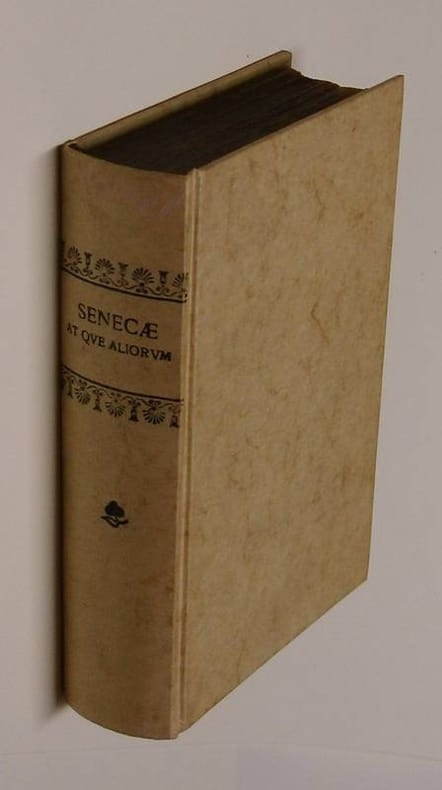
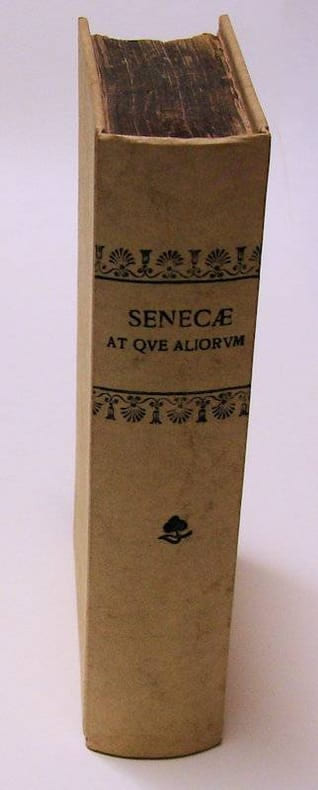
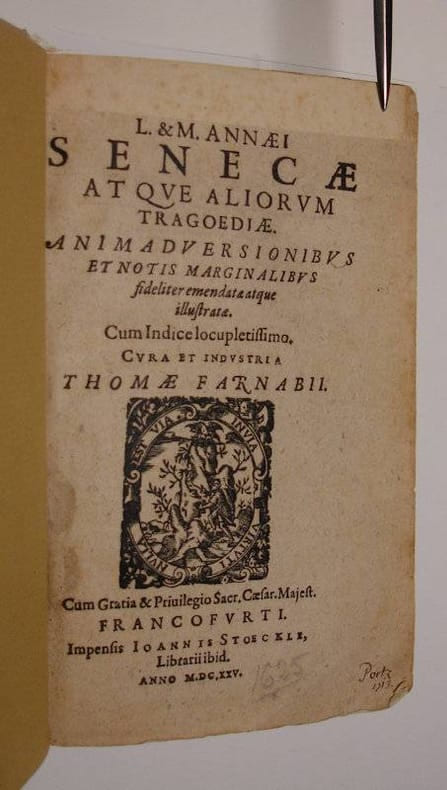
Frankfurt (Francfurti), Impensis Ioannis Stoeckle, Librarii ibid., 1625.
Reference : 120190
8vo. (XVI),481,(3),(58 index) p. Modern hardback 17 cm (Ref: VD17 23:284078M; Schweiger 2, 939/40; Graesse 6/1, 358/59; Ebert 20934; cf. Brunet 5,286) (Details: Second half 20th century binding. Woodcut printer's mark on the title, depicting a man climbing a steep rock, on top of which sits an eagle on a nest; the motto: 'Nulla est via invia virtuti') (Condition: Title slightly soiled. Small name on the title. The blank upper margin of the title has been cut off and repaired with a strip of paper. Paper yellowing) (Note: The English classical scholar Thomas Farnaby, latinized as Thomas Farnabius, ca. 1575-1647, explains in the short preface to this edition that he attributes, following Lipsius, Delrio, J. Scaliger and D. Heinsius, the Medea, Troades and the Phaedra to the Roman author/philosopher Lucius Annaeus Seneca Philosophus, the Hercules Oetaeus to quispiam poetaster, and the Octavia to a nec felicior artifex. The other plays, the Hercules Furens, Phoenissae, Oedipus, Agamemnon and the Thysestes he attributes to one Marcus Seneca Tragicus. Nowadays these plays are attributed to Lucius Annaeus Seneca; the Octavia is certainly spurious, and of the Hercules Oetaeus it is acknowledged that the language and metre resemble Seneca's. There is 'widespread agreement that Seneca's tragedies are important dramas and that the question whether they were composed for recitation or for performance is largely irrelevant. (...) Modern opinion is divided over the extent of Stoic doctrine in them; the majority incline toward judging them solely as dramas. Knowledge of the tragedies was spotty in late antiquity; (...). The earliest complete manuscript is the Codex Etruscus from Italy in the 11th century. It was read by Poliziano and was the basis of the edition of J.F. Gronovius (Amsterdam 1661), the first reliable printed text. (...) Seneca was by far the most important classical model for Renaissance tragedy, at a time when Greek tragedy was hardly known. (...) There is philosophical reflection, especially in the choruses, but that is not their main purpose, and there is psychological subtlety, despite the rhetoric. (...) Julius Caesar Scaliger in his Poetices maintained that Seneca surpassed the Greek tragedians in dignity (maiestas) and had greater polish and brilliance (cultus ac nitor) than Euripides. (The Classical Tradition, Cambridge Mass., 2010, p. 876) The greatest scholarly achievement of Thomas Farnaby were his editions of classical Roman poets and playwrights, accompanied by thorough Latin notes, such as Juvenal (1612), the tragedies of Seneca (1613), Martialis (1615), Lucanus (1618), Vergil (1634), Ovid's Metamorphoses (1636), Terentius (1651) 'As a school teacher, a rhetorical theorist and an editor of classical texts, Farnaby was one of the most influential scholars of the early seventeenth century. His schoolbooks on rhetoric were highly popular in the schoolroom, he collaborated and corresponded with some of the most distinguished continental scholars of his day, and his editions contributed greatly to the development of early modern textual criticism'. (DBC 1,308/9) Farnaby's edition of Seneca's tragedies, which was first published in London in 1613, was reissued several times, in Amsterdam in 1633, 1656 and 1678) (Provenance: On the title the name: 'Portz, 1713'. On the front flyleaf the name of 'Lennart Hakanson', 1939-1987, professor of Latin at the university of Uppsala) (Collation: ):(8, A-2L8 (minus blank leaf 2L8) (Photographs on request)
Bookseller's contact details
Antiquariaat Fragmenta Selecta
+31 20 418 55 65
Payment mode

Sale conditions
Terms of Sale All items offered are subject to prior sale. Your order will be final after you have received our confirmation, with a specification of the availability of the items and the shipping costs. All books are complete and in good antiquarian condition, unless otherwise described. Prices are in EURO. Postage and insurance are not included. Postage will be calculated at cost (no extra charges). Returns Books may be returned within 14 days of receipt, if returned in the same condition as sent, and packed, shipped and insured as received (please always notify us). We will refund the shipping costs of a return shipment only if our descriptions were not correct. How to pay Pre-payment is necessary for new customers. Our order confirmation will provide detailed information and a specification of the shipping costs. Customers who are known to us and libraries will be invoiced as usual. We accept Visa and Mastercard. You can submit your card information through our SECURE PAYMENT FORM. PayPal: we will send you a personal link to the PayPal website. Banktransfers: payment can be made into our bank account in The Netherlands.

