 Write to the booksellers
182 books for « seneca »Edit
-
Type
Book (181)
Music sheets (1)
-
Language
English (1)
French (173)
Latin (2)
Russian (6)
-
Century
16th (1)
17th (12)
18th (4)
19th (3)
20th (29)
21st (3)
-
Countries
Belgium (14)
Canada (1)
Denmark (4)
France (69)
Germany (1)
Netherlands (68)
Switzerland (19)
United States of America (6)
-
Syndicate
CLAM (1)
ILAB (39)
NVVA (3)
SLACES (2)
SLAM (29)
Topics
- Adultery (1)
- Anonymous (1)
- Architecture/ urban planning/ memorials (1)
- Brittany (1)
- Clock-making (2)
- Comedy (1)
- Denmark (2)
- Drawings (1)
- Early printed books (1)
- Economics (1)
- Education (1)
- Engraving (books about) (2)
- Erasmus (2)
- Ethic (1)
- Ethics (1)
- Fine arts (1)
- Games toys (3)
- Georgia (1)
- Germanic languages (4)
- Greek (60)
- History (3)
- Hugo victor (1)
- Humanism (1)
- Illustrated books (2)
- Industrial arts & crafts - fine arts (2)
- Italy (1)
- Latin (69)
- Law (1)
- Literature (10)
- Magazine (1)
- Newspapers press (1)
- Noel bernard (1)
- Philology (1)
- Philosophy (8)
- Reviews (1)
- Rhetoric (1)
- Scandinavian literature (1)
- Scores (2)
- Social sciences (2)
- Songs (1)
- Theatre (2)
- Theology (1)
- Tragedy (1)
- Translation (1)
- United states (1)
- Woods & woods’ price lists (1)
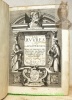
L. Annaei Senecae Opera quae extant omnia, a Iusto Lipsio emendata et scholiis illustrata. Editio quarta, atque ab ultima Lipsi manu. Aucta Liberti Fromondi scholiis ad Quaestiones Naturales, & Ludum de morte Claudii Caesaris, quibus in hac editione accedunt eiusdem Liberti Fromondi ad Quaestiones Naturales excursus novi.
Antwerp (Antverpiae), Ex officina Plantiniana Balthasaris Moreti, 1652.
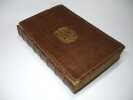
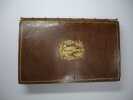
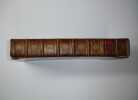
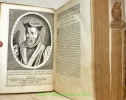
Folio. (XVI),XXXVI,911,(1 blank) p.; portrait of Lipsius; engraved title; a bust of Seneca, and a plate of Seneca standing in a tub, both plates by C. Galle after Rubens. Calf 41 cm. (Ref: STCV: 6608951; Schweiger 2,902: 'Gesuchteste Ausgabe des Lipsius, aber nicht weiter als Wiederholung der von 1632'; Brunet 5,276/77: 'Édition estimée. Les 3 premières éditions, Antverpiae, ex off. Plantiniana, 1605, 1615 et 1632 sont moins complètes.'; Dibdin 2,397: 'excellent notes of Lipsius'; Moss 2,578: 'it is certainly a very elegant publication'; Fabricius-Ernesti 2,115; Ebert 20860: 'Beste und gesuchteste der von Lipsius besorgten Ausg.'; Graesse 6/1, 348/49: 'très recherchée'; Spoelder 642, Middelburg 4) (Details: Prize copy, but lacking the prize. Gilt back with 7 raised bands, red morocco shield in the second compartment. Borders of both boards gilt, and with the coat of arms of Middelburg in the center. Portait of Lipsius engraved by Cornelius Galle. Engraved architectural title, the text of it is flanked by the statues of Greek philosopher Zeno, the founder of the Stoic school, whose doctrine of suicide as a 'reasonable exit' from life in response to incurable disease or inexorable pain Seneca accepted, and Zeno's pupil Cleanthes; in the upper frieze reside pictures of Hercules, Pallas and Ulysses, at the feet of Cleanthes and Zeno are the portraits of Seneca and Epictetus. The full page 'Seneca standing in his bath', is engraved by Cornelius Galle, and made after the famous painting of Rubens, 'the death of Seneca'. The full page portrait of Seneca was engraved after a drawing of Rubens. A smaller engraved portrait of Seneca, 11.5x13.5 cm, on page XXIV after the Italian scholar and antiquarian Fulvius Orsinus (imago quae a Fulvio quidem Ursino prodita est). Woodcut initials. The 'Officina Plantiniana' issued 2 'Opera' editions of Seneca in 1652. This is the second issue, probably printed by Petrus III Bellerus for Balthasar Moretus. Bellerus printer's device is found on f. X6 verso and f. Y4 recto) (Condition: Binding somewhat scuffed and scratched. Front joint beginning to split. Head and tail of the spine chafed. Corners slightly bumped. The school prize has been removed. Edges of both flyleaves browning. Some leaves yellowing, a few are browning. Faint waterstain in the right margin of the last 6 gatherings) (Note: The Roman philosopher and politician Lucius Annaeus Seneca, ca. 4 BC - 65 AD, has ever since antiquity been controversial. He was 'attacked for his Latin style, his political compromises, and his wealth. (...) Seneca (...) devoted himself to philosophy, finally being charged with complicity in the conspiracy of Piso in 65. His suicide (ordered by Nero) is described by Tacitus (...). The death scene, 'imago vitae suae', 'the image of his life', has been a significant element in Seneca's influence on posterity. (...) His style was urgent, colourful and pointed, appropriate for the fragmented ethical and political ambiguities of his time, and it ultimately proved to be an effective vehicle for the Latin Church Fathers'. ('The classical tradition', Cambridige Mass., 2010, p. 873) By the 4th century Seneca's reputation, as an author and as a philosopher, had recovered. He is praised by Boethius (d. ca. 524), and has through the works of Cassiodorus (d. ca. 585) and Martin of Braga (d. ca. 579) influenced medieval and Renaissance philosophy. From the 13th century onward he was widely read, especially after the invention of printing. A Senecan Renaissance was advanced with the editions of Erasmus, who did much to improve the text. Seneca's reputation was further enhanced by the magnificent edition of his 'Opera', produced by the Flemish scholar Justus Lipsius, and published in 1605 by the Flemish 'Officina Plantiniana', lead by Balthasar Moretus. This edition and the later ones of 1615, 1632 and 1652 were adorned with elaborate title pages and portraits engraved by T. Galle and C. Galle. The worth of Lipsius' editions lies in the preface and commentary. 'His commentary, while economical by modern standards, was fuller than that by Erasmus. Lipsius died before he could finish his commentary on 'Quaestiones Naturales'. The first edition of Lipsius' Seneca (1605) included a commentary by M.A. Muretus (d. 1585), replaced by that of Libertus Fromond in later editions. The introductory paragraphs to each section of Seneca's prose were lucid, concise, and often enthusiastic. 'Legite iuvenes senesque!' is a frequent exhortation, typical of Lipsius' primary goal, which was to teach'. (Idem, p. 875) 'Moretus had been Lipsius' student, and he was a friend of Peter Paul Rubens whom he commissioned to design, for the 1615 edition and its successors, a portrait of Lipsius and two full-page engravings of Seneca, one of an ancient bust believed to be of Seneca, and owned by the artist, and the other of Seneca entering the bath in which he died. The latter engraving was related to Rubens's 1608 painting of Seneca's death, which further spread the fame of Seneca as a martyr to tyranny who died true to his philosophical principles'. (Idem, ibidem) Justus Lipsius, the greatest Latin scholar of his time, came in 1579 to the recently founded University of Leyden (1575) to teach Latin. He resided there with great distinction as honorary Professor of History from 1579 till 1591. According to J.E. Sandys his greatest strength lies in textual criticism and exegesis. (J.E. Sandys, History of Classical Scholarship, N.Y., 1964, vol. 2, p. 303). Lipsius edited only Latin prose writers. He was not attracted to Latin verse. The 'Opera omnia' of this edition do not include Seneca's tragedies) (Collation: (*)-2*4, A-C6, A-4G6 (leaf 4G6 verso blank); leaf *1 portr. Lipsius, *2 engraved title, 2*3 Seneca in bath, 2*4 bust of Seneca) (Photographs on request) (Heavy book, may require extra shipping costs)
L. & M. Annaei Senecae atque aliorum Tragoediae. Animadversionibus et notis marginalibus fideliter emendatae atque illustratae. Cum indice locupletissimo. Cura et industria Thomae Farnabii. Cum gratia & privilegio Sacr. Caesar. Majest.
Frankfurt (Francfurti), Impensis Ioannis Stoeckle, Librarii ibid., 1625.
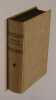
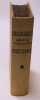
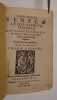
8vo. (XVI),481,(3),(58 index) p. Modern hardback 17 cm (Ref: VD17 23:284078M; Schweiger 2, 939/40; Graesse 6/1, 358/59; Ebert 20934; cf. Brunet 5,286) (Details: Second half 20th century binding. Woodcut printer's mark on the title, depicting a man climbing a steep rock, on top of which sits an eagle on a nest; the motto: 'Nulla est via invia virtuti') (Condition: Title slightly soiled. Small name on the title. The blank upper margin of the title has been cut off and repaired with a strip of paper. Paper yellowing) (Note: The English classical scholar Thomas Farnaby, latinized as Thomas Farnabius, ca. 1575-1647, explains in the short preface to this edition that he attributes, following Lipsius, Delrio, J. Scaliger and D. Heinsius, the Medea, Troades and the Phaedra to the Roman author/philosopher Lucius Annaeus Seneca Philosophus, the Hercules Oetaeus to quispiam poetaster, and the Octavia to a nec felicior artifex. The other plays, the Hercules Furens, Phoenissae, Oedipus, Agamemnon and the Thysestes he attributes to one Marcus Seneca Tragicus. Nowadays these plays are attributed to Lucius Annaeus Seneca; the Octavia is certainly spurious, and of the Hercules Oetaeus it is acknowledged that the language and metre resemble Seneca's. There is 'widespread agreement that Seneca's tragedies are important dramas and that the question whether they were composed for recitation or for performance is largely irrelevant. (...) Modern opinion is divided over the extent of Stoic doctrine in them; the majority incline toward judging them solely as dramas. Knowledge of the tragedies was spotty in late antiquity; (...). The earliest complete manuscript is the Codex Etruscus from Italy in the 11th century. It was read by Poliziano and was the basis of the edition of J.F. Gronovius (Amsterdam 1661), the first reliable printed text. (...) Seneca was by far the most important classical model for Renaissance tragedy, at a time when Greek tragedy was hardly known. (...) There is philosophical reflection, especially in the choruses, but that is not their main purpose, and there is psychological subtlety, despite the rhetoric. (...) Julius Caesar Scaliger in his Poetices maintained that Seneca surpassed the Greek tragedians in dignity (maiestas) and had greater polish and brilliance (cultus ac nitor) than Euripides. (The Classical Tradition, Cambridge Mass., 2010, p. 876) The greatest scholarly achievement of Thomas Farnaby were his editions of classical Roman poets and playwrights, accompanied by thorough Latin notes, such as Juvenal (1612), the tragedies of Seneca (1613), Martialis (1615), Lucanus (1618), Vergil (1634), Ovid's Metamorphoses (1636), Terentius (1651) 'As a school teacher, a rhetorical theorist and an editor of classical texts, Farnaby was one of the most influential scholars of the early seventeenth century. His schoolbooks on rhetoric were highly popular in the schoolroom, he collaborated and corresponded with some of the most distinguished continental scholars of his day, and his editions contributed greatly to the development of early modern textual criticism'. (DBC 1,308/9) Farnaby's edition of Seneca's tragedies, which was first published in London in 1613, was reissued several times, in Amsterdam in 1633, 1656 and 1678) (Provenance: On the title the name: 'Portz, 1713'. On the front flyleaf the name of 'Lennart Hakanson', 1939-1987, professor of Latin at the university of Uppsala) (Collation: ):(8, A-2L8 (minus blank leaf 2L8) (Photographs on request)
Den Vitberømte oc Nafnkundige Philosophi eller Viszdoms-Elskeris Skrifter...Nu paa voris danske Maal oversat...(af Birgitte Thott). - [THE FIRST PRINTED PIECE OF FEMINISM IN DENMARK]
Sorøe, Georg Hantsch, 1658. Folio. In a bit later half calf binding. Binding partly defective, inner hinges split, bookblock detached. Previous owner's names to front free end-paper. Light occassional marginal brownspotting and dampstaining, but internally generally nice and clean. (41), 183, (2), 324, (1), 374 pp. Wanting the engraved portrait of Birgitte Thott.
First edition of the groundbreaking first translation of Seneca into Danish - being the first complete translation of a classical author in Danish, the first proper translation of a classical work into Danish, and the first printed piece of feminism in Denmark. This magnificent work was done by the great Birgitte (also known as Bridge Thott (1610-1662), who is famous world-wide, not only for being arguably the most important translator of classical works into Danish, but also for being the first female translator in Danmark, the first Danish feminist and one of the first defenders of women's rights in Scandinavia. This, her magnum opus, her enormous 1.000-page translation of the Latin moral philosopher Seneca was the very first of its kind. Up until Thott's great work, the Danish population had nothing but small pieces of clumsy translations of a few classical authors available in their mother tongue, and Thott's translations opened up a new era - it introduced a new cultural and religious conversation to the Danish audience and actually altered the language significantly, introducing many new words to Danish and greatly enriching the language. Together with Christian Pedersen's translation of the Bible and Anders Sørensen Vedel's translation of Saxo, Birgitte Thott's translation of Seneca came to define the Danish language from the 17th century and onwards. The work is magnificently printed and is also considered of monumental value from a book printing perspective. It is not only monumental in size and beautiful in type-setting, it is also equipped with wonderful woodcut initials, an engraved portrait of Birgitte Thott and a wonderful engraved frontispiece. Birgitte Thott's name is actually not mentioned on the title-page, but she is shown as Minerva wearing a helmet at the top of the frontispiece. There are 12 laudatory poems in Latin, German, and Danish, clearly exposing Thott's importance among her contemporaries. The work is dedicated to ""the praiseworthy woman"" - being the woman in general - to all women, who appreciate virtue, sense, and learning.Thott had a clear ambition with the work, namely to give women specifically, only very few of which had the opportunity to learn Latin, access to the thoughts of the great stoic author of the 1st century. Even if women are not exposed to learning other languages, they should have access to literary works from other cultures via translation. She protested unambiguously against the dominating tendency of considering learning harmful for women and she demonstrated how ignorance led to moral depravity. Thus, the present work is without doubt the most important work in the history of Danish feminism and constitutes the first printed piece of feminism in the country. Being one of the first defenders of Women's rights in Scandinavia, she was part of a rather small European network of learned women, including Christina Queen of Sweden, the French Marie le Jars du Gournay, the English Bathsua Makin, the Irish Dorothea Moore (in Ireland), and the Dutch Anna Maria van Schurman (who wrote one of the laudatory letters for the Seneca-translation). With her present magnum opus, her monumental translation of Seneca, ""Thott combined her classical erudition and translation with a role as an active champion of women's rights"" (Rosie Wyles et. Al. edt.: Women Classical Scholars..., pp. 75-76) and completely altered both classical scholarship in Denmark, the view of women in Danish society, and the Danish language. .Bibl. Dan. IV,132. - Thesaurus II,679.
L. Annaei Senecae Tragoediae, cum notis integris Johannis Frederici Gronovii, et selectis Justi Lipsii, M. Antonii Delrii, Jani Gruteri, H. Commelini, Josephi Scaligeri, Danielis et Nicolai Heinsiorum, Thomae Farnabii aliorumque, itemque observationibus nonnullis Hugonis Grotii. Omnia recensuit, notas, animadversiones, atque indicem novum locupletissimumque adjecit; ipsum vero auctoris syntagma cum MS. codice contulit Joannes Casparus Schröderus.
Delft (Delphis), Apud Adrianum Beman, 1728.
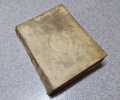
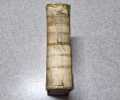
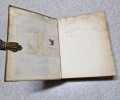
4to. (XXIV including frontispiece),(98),802,(214 index) p. Vellum 27 cm (Ref: STCN ppn 14155522X; Schweiger 2,941; Dibdin 2,399: 'a very elaborate and celebrated edition'; Fabricius/Ernesti 2,136/37; Brunet 5,286; Moss 579/80: 'its merits are highly and justly appreciated'; Graesse 6/1,359; Ebert 20942; Ter Meulen/Diermanse 540) (Details: Back with 6 raised bands. Boards with blind double fillet borders, and a blind stamped oval ornament in the center. Frontispiece designed by L.F. Dudourg and executed by F. Ottens and B. Bernarts, depicting some scenes from the tragedies. Title printed in red & black. Upper part of the page has the Latin text, the lower part the commentary) (Condition: Vellum soiled. Back cracked and damaged, partly discoloured; its head repaired with chemical glue. Both joints are split, but strong. Paper partly foxed, yellowing and browning. Bookplate on the front pastedown) (Note: There is 'widespread agreement that Seneca's tragedies are important dramas and that the question whether they were composed for recitation or for performance is largely irrelevant. (...) Modern opinion is divided over the extent of Stoic doctrine in them; the majority incline toward judging them solely as dramas. Knowledge of the tragedies was spotty in late antiquity; (...). The earliest complete manuscript is the Codex Etruscus from Italy in the 11th century. It was read by Poliziano and was the basis of the edition of J.F. Gronovius (Amsterdam 1661), the first reliable printed text. The 'editio princeps' was printed at Ferrara in 1484; the first edition with a critical text and commentary of any value was that of Jodocus Badius (Paris 1514), which included the conjectures of Erasmus. (...) Seneca was by far the most important classical model for Renaissance tragedy, at a time when Greek tragedy was hardly known. (...) There is philosophical reflection, especially in the choruses, but that is not their main purpose, and there is psychological subtlety, despite the rhetoric. (...) Julius Caesar Scaliger in his 'Poetices' maintained that Seneca surpassed the Greek tragedians in dignity ('maiestas') and had greater polish and brilliance ('cultus ac nitor') than Euripides. (The Classical Tradition, Cambridge Mass., 2010, p. 876) This 1728 edition of the tragedies of Seneca is based on the Amsterdam edition of Gronovius of 1682. It offers the entire notes of the Dutch scholar of German origin Johannes Friedrich Gronovius, 1611-1671, who was professor of Greek at the University of Leiden, and the selected notes of Lipsius and of many other scholars, among whom Hugo Grotius. Seneca owes more to Gronovius than to all the preceding editors. His edition marked the beginning of a new age in Senecan scholarship. His commentary is superb, and he greatly amended the text. This so-called 'Variorum' edition of 1728 was produced by the Dutch schoolmaster Johannes Caspar(us) Schröder(us), who was Rector of the 'Schola Latina' at Delft. He added also notes of his own, which are according to Dibdin 'frequent and judicious', but according to Schweiger 'weder zahlreich, noch besonders werthvol'. A 'Variorum' edition offers a 'textus receptus' which is widely accepted, accompanied with the commentary and the annotations of various specialists, taken, or excerpted from earlier useful, normative or renewing editions. Editions like these, 'cum notis Variorum', were useful, but never broke new ground. The production was the specialty of Dutch scholars of the 17th and 18th century.) (Provenance: Engraved bookplate on the front pastdown of 'R.N. Cresswell', above the name a squirrel cracking a nut. This might well be the member of the landed gentry and member of the English bar R.N. Cresswell, Esq. Barrister-at-Law, once, in 1844, working at the Insolvent Court, London. The squirrel figures in the coat of arms of that family. On the front flyleaf in pencil 'L.H. Cooley, from Rev. C. Dea....') (Collation: pi1, *-3*4; a-m4, n1; A-6M) (Photographs on request) (Heavy book, may require extra shipping costs)
Ontologie du jouir.
<p>La jouissance orgastique est le sujet de ce livre, cette sensation que l'enfant découvre par hasard. ébranlé des pieds à la tête il n'aura de cesse de comprendre cet éblouissement à nul autre pareil, comme un idiot qui essaierait de rejoindre la ligne d'horizon. De l'attachement de Roland Sénéca au “désir de corps”, Claude Louis-Combet dit ceci: “Sénéca s'applique à la dénition du corps humain… Les signes qui individualisent sont éliminés… Il ne reste de l'homme qu'un archétype debout dans l'irrévocable et dont les caractères se déchiffrent à partir de la géologie plutôt qu de l'histoire”. A la manière d'une carte de géographie, aussi représentative qu'abstraite, les dessins de Roland Sénéca nous proposent de rentrer dans le corps, minéral et fantasque, d'en jouir l'instant d'un verbe.</p> Saint-Clément-de-Rivière, 2017 Fata Morgana 80 p., broché. 17 x 24
Neuf
Lucius Anneus Seneca Van de Weldaden. Leerende den rechten aert van broederlijcke liefe, getrouwe vrientschap en beleeftheyt. Voor allen staten seer nut om te lesen Uyt 't Latijn vertaelt Door Dirck Volckertsz Koornhart.
't Amsterdam, By Jan Fredericksz Stam, 1644. Title within nice engraved ornamental border. 153 unnumbered pages + 3 blanks. 12mo. Contemporary overlapping vellum, handwritten title to spine. Muller 344 ("Fraai drukje van Matthys Perfect"); Scheepers ii, 365; De Vries 343. Second edition of this Dutch translation of Seneca's De Beneficiis. Important work by Seneca the Younger, born in Cordoba (Spain). De Beneficiis deals with themes of an ethical nature, within a context pertaining to concerns with regards to political leadership. As such, the work is concerned with the lives of aristocrats, and the nature of their relationships. This concern is of the form of and etiquette of bond-formation between persons by the giving and exchanging of gifts or services (favors), and is prescriptive of the way in which the aristocrats might behave, for the good of ancient Roman society. The translator, Dirck Volckertszoon Coornhert (1522 - 29 October 1590), also known as Theodore Cornhert, was a Dutch writer, philosopher, translator, politician, theologian and artist. Coornhert is often considered the Father of Dutch Renaissance scholarship. - On the last leaf, colophon: Ter Goude, By Matthijs Perfect, 1644.


(NVVA, )
Phone number : 31 20 698 13 75
Les Grandes routes du massacre, bois gravés. Texte de Jean Roudaut.
Bédée Editions Folle Avoine 1996 in-folio en feuilles Bédée, Editions Folle Avoine, 1996. 47 x 33 cm, in-folio, 22 ff. n. ch., 11 bois gravés en noir dont 3 à double page et 8 à pleine page, en feuilles sous couverture blanche à petits rabats imprimée.
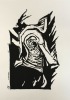

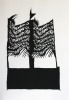
Tirage unique à 80 exemplaires sur vélin Lana gravure (n° 12), signé par l'auteur et l'artiste à la justification. "Ces onze bois gravés par Roland Sénéca forment une suite dans une série en comportant quarante et portant le même titre. La totalité des bois, reproduits dans un format réduit accompagné du texte complet de Jean Roudaut, est publiée aux mêmes éditions ; l'ensemble constituant l'édition originale." (notice de l'éditeur). Bel exemplaire (menus accrocs au dernier plat de couverture). Très bon
Le Championnat du Monde des Echecs
M. KNOPS Editeur 1948 103 pages in8. 1948. broché. 103 pages. Camil Seneca chroniqueur d'échecs a publié en 1948 'Le championnat du monde des échecs 1948' chez l'éditeur Knops. L'ouvrage analyse le championnat du monde de 1948 et propose des parties exemplaires pour enseigner la stratégie échiquéenne des bases aux principes avancés
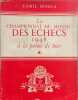
Bon état couverture légèrement usagée intérieur propre
Seneca L.A. Tragedy. In Russian /Seneka L. A. Tragedii.
Seneca L.A. Tragedy. In Russian /Seneka L. A. Tragedii. The Young Guard 1983. We have thousands of titles and often several copies of each title may be available. Please feel free to contact us for a detailed description of the copies available. The delivery of this book might be delayed beyond the usual timeframe due to extended processing and preparation before shipment, and faster shipping options are not offered. Please inform us if you need the order by a certain date or have a deadline. SKUalbcf930782fa3e5e66
Les Oeuvres de L. Annaeus Seneca mises en François par Matthieu de Chalvet. Relié avec: Les Controverses et suasoires de M. Annaeus Seneca Rhetur de la traduction de M. Mathieuv de Chalvet.
Roven, Chez Estien Nevereul 1618 - 1618, 250x185mm, titre gravé - 10 ff. - portrair gravé - 1108 pages (numérotés 1 - 554) - 1 ff. - 13 ff. (Table des Matieres) + titre gravé - 326 pages, bandeaux, lettrines. Reliure plein dain de l’époque avec dos à cinq nerfs. Petites taches sur la reliure, autrement bon état, intérieur propre.
Pour un paiement via PayPal, veuillez nous en faire la demande et nous vous enverrons une facture PayPal
Seneca L.A. Moral Letters to Lucilia. With comments and illustrations. In Russi
Seneca L.A. Moral Letters to Lucilia. With comments and illustrations. In Russian /Seneka L. A. Nravstvennye pisma k Lutsiliyu. S kommentariyami i illyustratsiyami. Series: Popular Philosophy with Illustrations Translation from Latin. Moscow, ACT, 2022, 352 We have thousands of titles and often several copies of each title may be available. Please feel free to contact us for a detailed description of the copies available. The delivery of this book might be delayed beyond the usual timeframe due to extended processing and preparation before shipment, and faster shipping options are not offered. Please inform us if you need the order by a certain date or have a deadline. SKUalbaf7af1bb92bcdbc8

Calvijn en Seneca. Een inleidende studie van Calvijns Commentaar op Seneca, De clementia, anno 1532.
Groningen, Djakarta, J.B. Wolters, 1957.
XVI,243 p. Stiff wrappers. 23 cm (Dissertation, University Utrecht)
Seneca L. Moral Letters to Lucilia. In Russian /Seneka L. Nravstvennye pisma k
Seneca L. Moral Letters to Lucilia. In Russian /Seneka L. Nravstvennye pisma k Lutsiliyu. Kemerovo book published in 1986. We have thousands of titles and often several copies of each title may be available. Please feel free to contact us for a detailed description of the copies available. SKUalb9e3c52d26fd5df5d.
Seneca L.A. Letters on Life and Death. In Russian /Seneka L.A. Pisma o zhizni
Seneca L.A. Letters on Life and Death. In Russian /Seneka L.A. Pisma o zhizni i smerti. Series: Classics in Illustrations. M. Olma Media Group 2012. 304 p. We have thousands of titles and often several copies of each title may be available. Please feel free to contact us for a detailed description of the copies available. SKUalb8b1c7d7b870a5c01.
Seneca L.A. Moral Letters to Lucilia. Tragedy. In Russian /Seneka L. A. Nravstv
Seneca L.A. Moral Letters to Lucilia. Tragedy. In Russian /Seneka L. A. Nravstvennye pisma k Lutsiliyu. Tragedii. The Latin pen, introduced by S. Osherov. Series Library of Ancient Literature. Rome. Art Literature. 1986. 543 p. We have thousands of titles and often several copies of each title may be available. Please feel free to contact us for a detailed description of the copies available. SKUalbc43790f27344b4e6.
Seneca en Erasmus - Brieven over den vrede en den vrede des harten
Bussum, Paul Brand 1947 64pp.+ enkele buitentekstills., in de reeks "De Guirlande" nr.6, 19cm.
Au pied de la lettre.
Face à cet abécédaire organique, où les caractères sont vivants et désormais indomptables, Bernard Noël interroge :<br data-mce-fragment="1"><br data-mce-fragment="1"><em data-mce-fragment="1">N’est-il pas bouleversant de penser que si, depuis son origine, le monde fut pour l’homme visible, il lui fallut des millénaires pour le rendre dicible, et bien des siècles encore pour rendre la parole lisible et donc visuelle par l’écriture. Et le plus simplement par l’invention de l’alphabet qui ne remonte guère qu’à trois mille ans. L’alphabet qui réussit avec si peu de lettres – le nôtre vingt-six – à représenter tous les sons de notre langue.</em><em data-mce-fragment="1"><br data-mce-fragment="1"></em><br data-mce-fragment="1"> Les dessins de Roland Sénéca – exposés en France comme à l’étranger depuis 1973 – sont des corps aux contours oniriques, proches de l’indescriptible. Dans des enchevêtrements fantasques, les matières déchirent le sens et transcendent l’énigme de la lettre : ces mystérieux spécimens n’attendent que le regard pour s’exprimer. Roland Sénéca et Bernard Noël ont entretenu une correspondance nourrie. Fascinés tous deux par les rapports entre la langue et le visible (<em>Une machine à voir</em>) ce livre, tentative de représentation de la lettre, apparaît comme un glissement de la forme vers le sens. Saint Clément de rivière, 2022 Fata Morgana 40 p., illustrations noir et blanc, broché avec rabats. 12 x 17
Neuf
Dessins d’à côté.
<p>Lorsque Bernard Noël s’interroge sur la nature de l’œuvre de Roland Sénéca, il y voit «des forces nouées à l’intérieur de formes simples - des formes qui sont à la fois débordantes et assiégées tant elles implosent ou explosent sous l’effet d'une fureur qu'indiquent stries et fêlures. A moins qu’il ne s'agisse là de gestes soudain statufiés comme le fut selon la légende biblique Celle qui se retourna vers l’image qu’il ne fallait pas regarder. On perçoit des autopsies, des projections, des jaillissements de feu cru... » Mais le plus souvent, les dessins de Sénéca restent des énigmes, auxquelles l’artiste répond cependant ici par de courts poèmes en regard de ses œuvres.</p> Saint-Clément-de-Rivière, 2013 Fata Morgana 80 p., broché. 17 x 24
Neuf
Quae extant opera. Ad veterum exemplarium fidem nunc recens castigata: Graecis lacunis, quibus superiores Editiones scatebant, expletis: Ac illustrata Commentariis selectoribus, quorum Auctores citantur pagina sequenti. Accessere Loci Communis ex utro...
Paris, P. Chevalier, 1607. Folio. Newer full leather binding with five raised bands and gilt leather title-label to spine. First title-page a bit ""dusty"" and the first few quires with a damp stain to upper right corner. Some leaves with light underlinings. Internally mostly very nice and clean. First title-page in red and black and with large engraved portrait"" second title-page with woodcut vignette. Woodcut initials and vignettes. 8, (4), 974, (46, -Indices), 116 pp + (12), 284, 98, (32, -indices), (2, - colophon) pp.
The 1607-edition (with the additional notes of Lipsius) of this highly important edition of the works of Seneca the Younger (the philosopher) and Seneca the Elder (the rhetorian), having the excellent and important notes by some of the most noted scholars, e.g. Muretus and Erasmus. The work first appeared in 1602, but that did not contain the notes of Lipsius, which first appeared in the 1607-edition (i.e. the present). The work was very popular and new editions kept appearing - 1613, 1619, 1627. ""This is called a very excellent edition by Ernesti... The 1607 edition contains, besides the preceeding materials, some notes of Lipsius..."" (Dibdin).
SENECA , Roland - Texte de Charles Madezo - Avant regard de Roger Judrin
Reference : 12199
La Horde.
Sans lieu, Calligrammes, Guillemot, 1984. Grand in-4 - Pleine toile noire, titre incrusté dans le plat - 48 dessins hors-texte de Roland Sénéca - Texte de Charles Madezo. Avant regard de Roger Judrin - Tirage limité à 99 exemplaires numérotés et 24 exemplaires hors commerce - sans les 3 eaux-fortes - Non paginé. - bon exemplaire, Propre
Roland Sénéca, peintre et graveur, vit et travaille à Douarnenez. Cnformément à nos conditions générales de vente :Les frais de port sont affichés à titre indicatif. Il se peut que nous devions vous contacter pour vous informer du coût de laffranchissement supplémentaire en fonction du poids et du nombre de livres, surtout pour les envois internationaux Cependant vu l'augmentation des tarifs postaux à l'internationale, nous pouvons expédier les ouvrages en point relais MONDIAL RELAY pour les pays suivants : Allemagne, Autriche, Belgique, Espagne, Italie, Luxembourg, Pays-Bas, Pologne, et Portugal. Merci de nous indiquer en retour le point relais choisi ainsi que votre numéro de téléphone mobile & adresse Courriel pour assurer le suivi du colis.N'hésitez pas à nous interroger.In accordance with our general terms and conditions of sale:Shipping costs are displayed for informational purposes only. We may need to contact you to inform you of the additional postage costs depending on the weight and number of books, especially for international shipments.However, given the increase in international postal rates, we can ship books via Mondial Relay to the following countries: Germany, Austria, Belgium, Spain, Italy, Luxembourg, Netherlands, Poland, and Portugal. Please provide us with your chosen Mondial Relay point, as well as your mobile phone number and email address to ensure package tracking.Please feel free to contact us with any questions
Seneca L.A. Moral Letters to Lucilia. In Russian /Seneka L.A. Nravstvennye pism
Seneca L.A. Moral Letters to Lucilia. In Russian /Seneka L.A. Nravstvennye pisma k Lutsiliyu. Series: PHILOSOPHY. Moscow, ACT. 2012 year.Contact us for details or to request photos of available books. Delivery of this book could take longer than normal due to additional handling time before shipping, and no rush delivery options are available. Please let us know if you have a specific date by which you need to receive your order.SKUalb29c56dfbba16e190
De beneficiis libri VII. De clementia libri II. Iterum edidit Carolus Hosius.
Leipzig, B.G. Teubner, 1914.
XXXIV,259 p. Cloth. 17 cm (BT, Bibliotheca Teubneriana, Seneca Opera I,2) (Occasional red and black pencil underlinings)
Dialogorum libros XII edidit E. HERMES.
Lpz., Tbn., 1905.
XX,383 p. Cl. 17 cm (BT, Seneca Opera I,1)(Back sl. worn at head & foot; some faint pencil)
Seneca sapiens. Negen Epistulae morales in filosofische en cultuurhistorische context. (Door) C. FISSER, E. VESTER (et alii).
Den Bosch, Malmberg, n.d.
2 vols: 164;80 p.; ills. Pb. 24 (Eindexamen 1991; Epistula 7, 28, 41, 47, 95, 51, 54, 116, 123)

