 Write to the booksellers
SALLUSTIUS.
C. Sallustius Crispus, cum veterum Historicorum fragmentis. (Bound with:) Colloques d'Érasme, fort curieusement. Traduits de Latin en François, pour l'usage des amateurs de la langue .
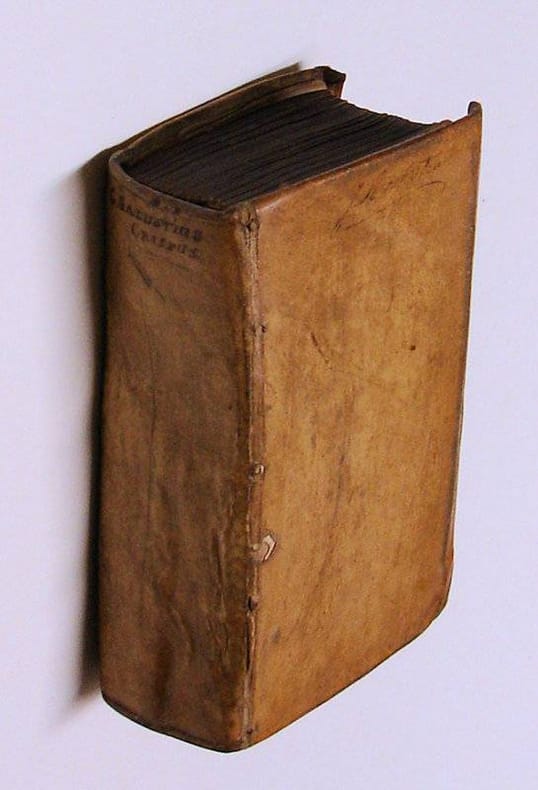
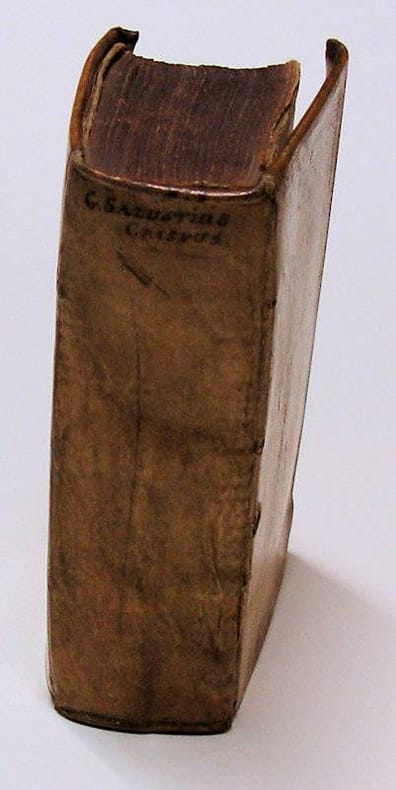
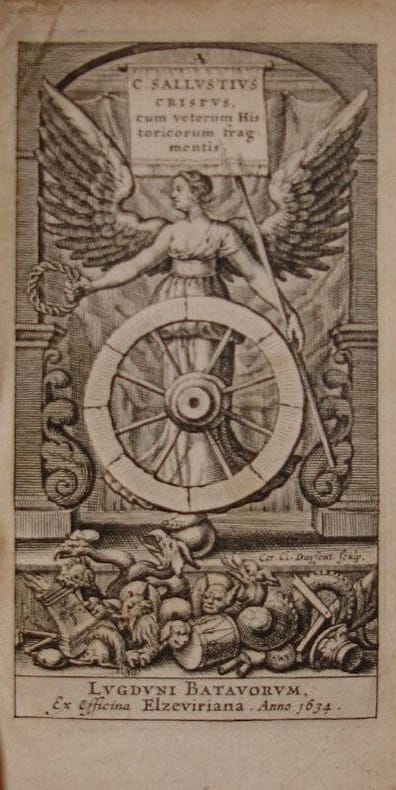
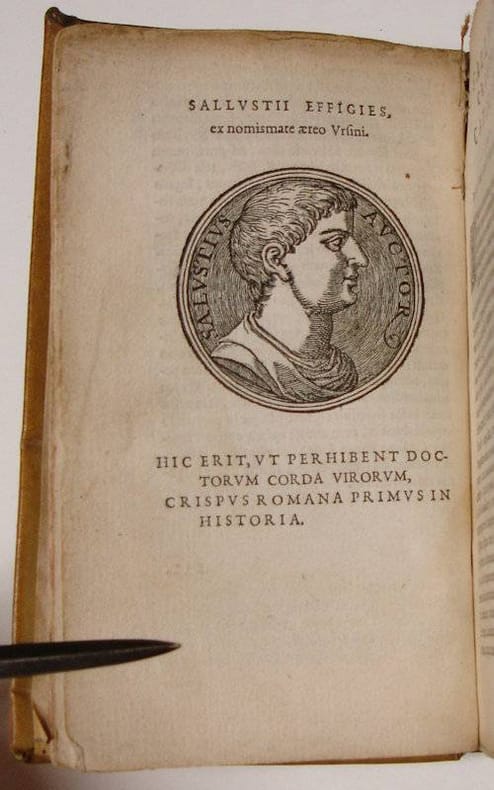
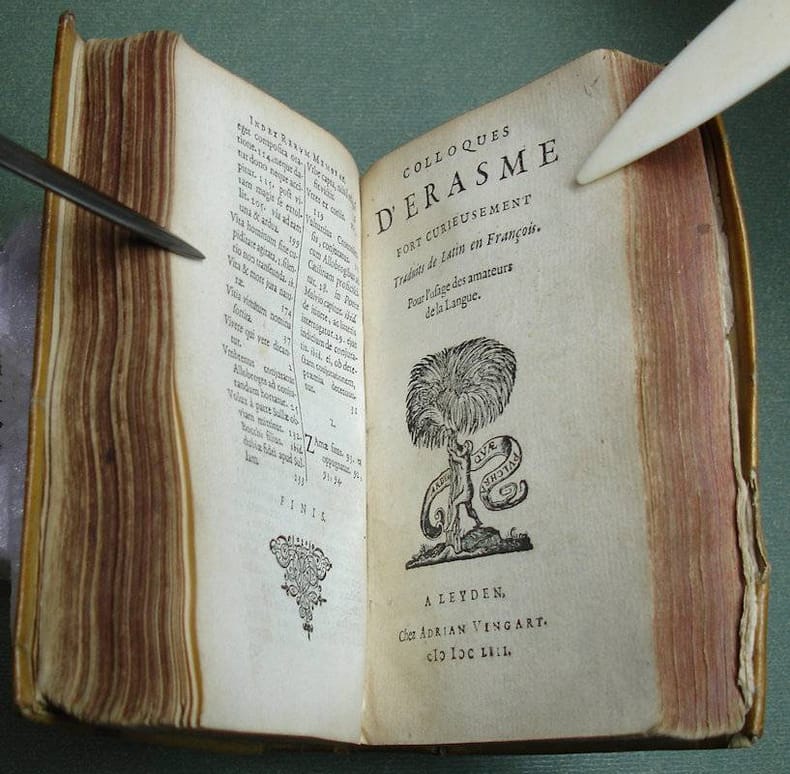
Ad 1: Leiden (Lugduni Batavorum), Ex officina Elzeviriana, 1634. Ad 2: Leiden (A Leyden), Chez Adrian Vingart, 1653.
Reference : 120162
12mo. 2 volumes in 1: vol. 1: (XVI),310,(34 index); vol. 2: (XII),360,(12 table) p. Overlapping vellum 13 cm (Ref: Ad 1: Willems 412, note: this is the second of the 3 reissues of this text in that year; Bergman 2115; Rahir 399; Schweiger 2,877: 'Sehr saubere u. gesuchte Ausg.'; Dibdin 2,384. Ad 2: Willems 1675, 'Annexes de la collection Elzevirienne': 'assez jolie édition. La traduction est de Samuel Chappuzeau'; Bergman 1357: 'édition fort jolie et d'une insigne rareté') (Details: Ad 1: Title engraved by Cor.Cl. Duysent. Woodcut portrait of Sallustius at the end of the preface. Ad 2: Woodcut printer's mark on the title, depicting a man climbing a palmtree, the motto is 'Ardua quae pulchra', already mentioned in the Adagia of Erasmus) (Condition: Binding worn & soiled. Front hinge loosening, but still hanging on 2 ropes. The hinge in the rear hangs on 1 rope. Tiny part of the vellum on the front joint gone. Edges of the first & last gathering thumbed. Caput numbers in the margins of the Bellum Catilinum & the Bellum Iugurthinum, alternately written in ink & red pencil) (Note: Ad 1: 'One of the most widely read and influential of Roman historians, along with Caesar, Livy, and Tacitus, Sallust (86-34 BC) has been studied, quoted, and imitated not only as a historian but also as a moral philosopher, political thinker, and stylist.' Until 1600 more than 200 editions of his work appeared. Sallust was used in the 16th and 17th century to support absolute theories of government. But, 'on the other hand, it was the republican Sallust, 'ennemy of tyrants,' whom John Milton admired and who bolstered the cause of liberty in the Lowlands during the war with Spain and, later, in France and on the American continent'. (The Classical tradition, Cambr. Mass., 2010 p. 856) Sallustius furnished indeed weapons to the supporters and opponents during the rebellion of the Netherlands against the Spaniards, a war of independence that lasted 80 years, from 1568 till 1648. Numberless pamphlets appeared during this war, and many are full of reminiscences and quotations of classical authors. Sallust also was widely used, everyone chose his favourite argument. This was possible because Sallustius preached party politics under a cloak of grave and philosophic impartiality. This 1634 edition was edited, while the Eighty Years' War was raging on, by the wellknown Dutch scholar, Neolatin poet, and editor of Latin classics, Marcus Zuerius Boxhornius, 1602-1653. A year before, in 1633 he was appointed professor of Rhetoric at Leiden, and later he filled the chair of Daniel Heinsius. Ad 2: 'The Colloquia, like the Adagia, were written over a period of years and constantly enlarged as edition succeeded edition. From their earliest form of short models of Latin conversation and formulae of etiquette (composed at Paris in 1497 for the use of some pupils and first printed in 1518) they grew into 'a rich and motley collection of dialogues, each a master piece of literary form, well-knit, spontaneous, convincing, unsurpassed in lightness, vivacity and fluent Latin, each one a finished one-act play' (Huizinga). The Colloquia, full of witty and penetrating observations on ordinary day-to-day happenings as well as on the basic weakness of Church and society, are an invaluable mine of information about 16th century customs, institutions and social problems. Besides, their success as a schoolbook was unrivaled and the stream of editions and translations flowed almost uninterruptedly down to modern times'. (Gilhofer & Ranschburg GmbH, Catalogue 50, Erasmus, published on the 500th anniversary of his birth', Luzern, ca. 1967, p. 34) This translation of 1653 contains only 10 colloquia: 1, La Caresme; 2, Le point du jour; 3, Les Hotelleries; 4, Le mensonge et la Vérité; 5, L'Épithalame; 6, L'Épicurien; 7, Le Maquignon; 8, Du nom & de la chose; 9, Le Secret des sciences; 10, Le Banquet des sobres. And: Apologie d'Érasme, aux théologiens de Louvain. This choice from the colloquia was translated by the French scholar, author, poet and playwright Samuel Chappuzeau, 1625-1701, whose best-known work today is 'Le Théâtre François', a description of French Theatre in the 17th century. (See for him Wikipedia 'Samuel Chappuzeau') (Provenance: In pencil on the front pastedown: 'J. v. Dijck') (Collation: *8, A-O12, P6 (minus the blank leaves P5 & P6); *4, 2*2, A-P12, Q6) (Photographs on request)
Bookseller's contact details
Antiquariaat Fragmenta Selecta
+31 20 418 55 65
Payment mode

Sale conditions
Terms of Sale All items offered are subject to prior sale. Your order will be final after you have received our confirmation, with a specification of the availability of the items and the shipping costs. All books are complete and in good antiquarian condition, unless otherwise described. Prices are in EURO. Postage and insurance are not included. Postage will be calculated at cost (no extra charges). Returns Books may be returned within 14 days of receipt, if returned in the same condition as sent, and packed, shipped and insured as received (please always notify us). We will refund the shipping costs of a return shipment only if our descriptions were not correct. How to pay Pre-payment is necessary for new customers. Our order confirmation will provide detailed information and a specification of the shipping costs. Customers who are known to us and libraries will be invoiced as usual. We accept Visa and Mastercard. You can submit your card information through our SECURE PAYMENT FORM. PayPal: we will send you a personal link to the PayPal website. Banktransfers: payment can be made into our bank account in The Netherlands.

