 Write to the booksellers
109 books for « sallustius »Edit
-
Language
French (108)
Latin (1)
-
Century
16th (2)
17th (2)
18th (3)
19th (8)
20th (3)
-
Topics
Early printed books (1)
English (1)
First edition (5)
Foreign literature (1)
Greek (73)
History (8)
Latin (80)
Literature (5)
Philosophy (1)
Roman history (1)
Roman literature (1)
Rome (1)
Sciences (1)
Theology (1)
War (1)
-
Countries
Belgium (5)
Denmark (2)
France (20)
Germany (1)
Netherlands (79)
Switzerland (2)
-
Syndicate
ILAB (15)
SLAM (12)
C. Sallustii Crispi quae extant. Ex recensione J.F. Gronovii, cum Variorum observationibus, ab Ant. Thysio collectis.
Leiden & Rotterdam (Lugd. Batav. et Roterod.), Ex Officina Hackiana, 1665.
8vo. (XXII),534;(45, index),(1 blank) p. Overlapping vellum 20.5 cm (Ref: STCN ppn 061326216; Schweiger 2,879; Dibdin 2,385; Ebert 20023; cf. Fabricius/Ernesti, 1,243; Graesse 6/1,240) (Details: Title page removed) (Condition: Vellum soiled. Title page removed. Some paper damage at the front pastedown. Tip of the right upper corner torn off. Paper slightly yellowing) (Note: 'One of the most widely read and influential of Roman historians, (...), Sallust (86-34 BC) has been studied, quoted, and imitated not only as a historian but also as a moral philosopher, political thinker, and stylist.' Until 1600 more than 200 editions of his work appeared. Sallust was used in the 16th and 17th century to support absolute theories of government. But, 'on the other hand, it was the republican Sallust, 'ennemy of tyrants,' whom John Milton admired and who bolstered the cause of liberty in the Lowlands during the war with Spain and, later, in France and on the American continent'. (The Classical tradition, Cambr. Mass., 2010 p. 856) Sallustius furnished indeed weapons to the supporters and opponents during the rebellion of the Netherlands against the Spaniards, a war of independence that lasted 80 years, from 1568 till 1648. Numberless pamphlets appeared during this war, and many are full of reminiscences and quotations of classical authors. Sallust also was widely used, everyone chose his favourite passage and argument. This was possible because Sallustius preached party politics under a cloak of grave and philosophic impartiality. The editor of this Sallustius edition, Antonius Thysius, emphasizes another aspect of the author's worldview, the corrupting power of wealth. Sallustius is disgusted by the corruption he sees around him, decay which was caused by the power and wealth Rome had acquired. The Dutch jurist and classical scholar Anthony Thys, or in Latin Antonius Thysius, 1603-1665, was from 1637 professor of 'poêsis' of the University at Leiden, where he also lectured on public law, after 1663 as professor. He delivered several speeches on patriotic topics at the end of the Eighty Years' War. In 1655 he succeeded Daniel Heinsius as librarian of the University. His Sallustius edition, first printed in 1649, was a success. It was repeated several times. (NNBW 5, 924/26) Thysius was not a great scholar. He produced 'Variorum' editions, in which he skillfully compared and contrasted the excerpted material of brighter minds. Such editions were very popular and contained everthing a student required. It offered the 'textus receptus' which was widely accepted, accompanied with the commentary and the annotations of specialists, taken from earlier useful, normative or renewing editions. Editions like these, 'cum notis Variorum', were useful, but never broke new ground. The production of this kind of editions was the specialty of Dutch scholars of the 17th and 18th century.) (Collation: *8 (minus leaf *1), 2*4, A-2N8, 2O2 (leaf 2O2 verso blank)) (Photographs on request)
C. Salustius Crispus. Roomsche historie. Van de t'Zamenzweeringe van Catilina, en den oorlog met Jugurtha. Vertaelt door F.v.H.
Rotterdam (Tot Rotterdam), By Fransois van Hoogstraeten, 1683.
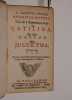
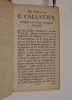
12mo. (XVI),98,(2),196 p. Vellum 13 cm (Ref: Geerebaert 132,3; OiN 331; Schweiger 598; In NCC 5 copies) (Details: 5 thongs laced through the joints. Title printed in red and black) (Condition: Vellum slightly soiled) (Note: 'One of the most widely read and influential of Roman historians, along with Caesar, Livy, and Tacitus, Sallust (86-34 BC) has been studied, quoted, and imitated not only as a historian but also as a moral philosopher, political thinker, and stylist.' Until 1600 more than 200 editions of his work appeared. Sallust was used in the 16th and 17th century to support absolute theories of government. But, 'on the other hand, it was the republican Sallust, 'ennemy of tyrants,' whom John Milton admired and who bolstered the cause of liberty in the Lowlands during the war with Spain and, later, in France and on the American continent'. (The Classical tradition, Cambr. Mass., 2010 p. 856) Sallustius furnished indeed weapons to the supporters and opponents during the rebellion of the Netherlands against the Spaniards, a war of independence that lasted 80 years, from 1568 till 1648. Numberless pamphlets appeared during this war, and many are full of reminiscences and quotations of classical authors. Sallust also was widely used. William of Orange e.g. was once called 'desen seditieuse Catalina' (P.A.M. Geurts, 'Sallustius' Catilinae Coniuratio in politieke pamfletten'. In Hermeneus, 32, 1961. p. 113/7) The translator of both works is the publisher François van Hoogstraten, 1632-1696. He was a literary minded publisher, who wrote some poetry and translated Boethius, Thomas Morus, and the 'Laus Stultitiae' of Erasmus. (NNBW 8,833/34) (Collation: *8, A-M12 N4) (Photographs on request)
C. Crispi Sallustii Opera omnia quae exstant, cum commentariis integris Joh. Rivii, Aldi Manutii, Petri Ciacconii, Fulvii Ursini & Heliae Putschii, et selectis Jani Gruteri, H. Glareani, Cypr. à Popma, Ludov. Carrionis, Jani Douzae & aliorum. Accedunt huic editioni Jani Melleri Palmerii Spicilegia in eundem auctorem. Cum indice rerum & verborum locupletissimo. Editio novissima.
Amsterdam (Amstelodami), Ex officina Henrici & Viduae Theodori Boom, 1690.
8vo. (XXVIII)(including frontispiece), 596, (38) p. Vellum 20 cm Prize copy (Ref: STCN ppn 851959466; Schweiger 2,879; Dibdin 2,385: 'this is the best Variorum edition' and 'a valuable book'; Moss 2,560; Graesse 6/1,240; Ebert 20026: 'Eine der seltenste Ausgg. cum notis varior., und sehr gesucht'; Spoelder p. 490, Amst. 9) (Details: Prize copy, without the prize. Binding gilt. 7 thongs laced through the joints. Gilt coat of arms of Amsterdam on both boards; Frontispiece by Wingendorp, depicting the 'triumphus' of the Roman general Marius; in front of the cart walks the defeated king Jugurtha, in chains. The frontispiece is dated 1689) (Condition: Vellum soiled and somewhat worn. Prize removed. All 4 ties gone) (Note: 'One of the most widely read and influential of Roman historians, along with Caesar, Livy, and Tacitus, Sallust (86-34 BC) has been studied, quoted, and imitated not only as a historian but also as a moral philosopher, political thinker and stylist.' Until 1600 more than 200 editions of his work appeared. Sallust was used in the 16th and 17th century to support absolute theories of government. But, 'on the other hand, it was the republican Sallust, 'ennemy of tyrants,' whom John Milton admired and who bolstered the cause of liberty in the Lowlands during the war with Spain and, later, in France and on the American continent'. (The Classical tradition, Cambr. Mass., 2010 p. 856). Sallustius furnished indeed weapons to the supporters and opponents during the rebellion of the Netherlands against the Spaniards, a war of independence that lasted 80 years, from 1568 till 1648. This edition is a socalled 'Variorum edition'. It offers a 'textus receptus' which is widely accepted, accompanied with the commentary and the annotations of various specialists, taken or excerpted from earlier useful, normative or renewing editions. Editions like these, 'cum notis Variorum', were useful, but never broke new ground. The production of these sometimes overloaded editions was the specialty of Dutch scholars of the 17th and 18th century. The compilers seldom were great scholars, but often hard working schoolmasters. Their involvement in publishing a new edition was limited to the necessary. The text of Sallustius is preceded by the chapter which J. Vossius had written on him in his 'De historicis latinis'. Then follow 'Judicia et Testimonia'. At the end of the text we find the 'Spicilegium in Sallustium' of Janus Mellerus Palmerius. This is a collection of notes on the 'Catilina' and 'Bellum Jugurthinum', which was first published in 1580. It consists of explanations and observations, but most of all proposed emendations. Next to nothing is known about this scholar. Palmerius or Palmier was a Neolatin poet and scholar from Bruges. (Van der Aa, 15 p. 68)) (Collation: *8, 2*6; A-2Q8, 2R4, 2S1) (Photographs on request)
Quae exstant opera.
Paris (Parisiis), Typis J. Barbou. 1761.
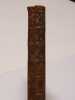
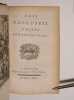
12mo. (XXXVI),348 p., 3 plates (one of which is the frontispiece). Mottled calf 16 cm (Ref: Schweiger 2,882; Graesse 6/1,241; Ebert 20036; Brunet 5,87) (Details: Back gilt, boards with triple fillet gilt borders. Endpapers marbled. Edges of the bookblock gilt. The plates, including the frontispiece, are designed by N. Cochin filius and executed by E. Fessard. The frontispiece depicts the elevation to the Pantheon of the author, the historian Sallustius. Woodcut printer's mark of the Barbou brothers on the title, it depicts in a central round medallion two flying pelicans (or storks), with one feeding the other; it symbolizes mutual help and brotherly love) (Condition: Binding shabby and scuffed, corners bumped. Inside good) (Note: 'One of the most widely read and influential of Roman historians, along with Caesar, Livy, and Tacitus, Sallust (86-34 BC) has been studied, quoted, and imitated not only as a historian but also as a moral philosopher, political thinker, and stylist.' Until 1600 more than 200 editions of his work appeared. Sallust was used in France during the 16th and 17th century to support absolute theories of government. But, 'on the other hand, it was the republican Sallust, ennemy of tyrants, whom John Milton admired and who bolstered the cause of liberty in the Lowlands during the war with Spain and, later, in France and on the American continent'. (The Classical tradition, Cambr. Mass., 2010 p. 856) Sallust's condemnation of corruption made a deep impression on the Founding Fathers of the American Republic at the end of the 18th century. One of them, John Adams, urged his son John Quincy to read Sallust, whom he called 'one of the most polished and perfect of the Roman historians'. The Barbou's previously published this same Sallust edition in 1754. This first Barbou is according to Schweiger and Ebert a reissue of the Sallust edition of Paris 1744, which was edited by the French historian and geographer St. Andr. Philippe, or rather Étienne André Philippe de Prétot, 1710-1787. He produced in the beginning of his career quite a number of editions of Latin classics. Between 1747 and 1755 he edited for the Parisian publisher Antoine-Urbain Coustelier Catullus, Tibullus, Propertius, Sallustius, Vergilius, Horatius, Juvenalis, Persius, Phaedrus, Lucretius, Velleius Paterculus, Eutropius and Terentius. (See Wikipedia 'Philippe de Prétot') (Collation: a12, b6; A-O12, P6) (Photographs on request)
[Librairie Poussielgue Frères] - SALLUSTIUS ; PLANCHE, J. ; ( SALLUSTE )
Reference : 37358
(1825)
Caius Crispus Sallustius, ex Burnouf, Pottier et aliorum editionibus recensitus, cum selectis variorum interpretum notis, ac novis etiam additis, item Julius Exsuperantius, curante J. Planche (2 Tomes - Complet)
2 vol. in-12 reliure demi-percaline marron, Apud C. Gosselin et L. Mame-Delaunay, Parisiis [ Paris ], 1825, xxxvi-347 ; 237-178 pp.

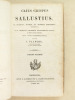
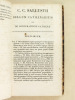
Complet. Bon état (petite mouill. angulaire aux premiers ff. du tome 2), Graesse, VI, 243
Sallustius. With an English translation by J.C. ROLFE.
Ldn., Cambr. Mass., 1980.
Cl. 17 cm (Loeb, including a frayed dustjacket)
Caii Crispi Sallustii Quae exstant, item epistolae de republica ordinanda, declamatio in Ciceronem et Pseudo-Ciceronis in Sallustium, necnon Jul. Exsuperantius de bellis civilibus, ac Porcius Latro in Catilinam. Recensuit diligentissime et adnotationibus illustravit Gottlieb Cortius. Accedunt fragmenta veterum historicorum, Constantius Felicius Durantinus de Conjuratione Catilinae, et index necessarius.
Venice (Venetiis), Excudit Jo. Baptista Paschalius, 1737.
4to. XVI,948,150 p. Vellum 27 cm. An admirable edition (Ref: Leeman 235; Schweiger 2,881: 'schöner Nachdr. von Corte's Ausgabe'; Brunet 5,86; Dibdin 385/86; Moss 2,560; Fabricius/Ernesti 1,244/45: 'textus sine dubio optimus'; Graesse 6/1,241; Ebert 20030) (Details: Back with 6 raised bands. Short title in the second compartment. Blind tooled boards. Title in red and black, on it a baroque printer's mark engraved by 'Ant. Visentini j.', it depicts Apollo standing in glory as he leans on his shield, and holding an open book in his right hand; the scene is placed in cartouche; above Apollo Pasquali's motto 'Litterarum Felicitas'. 2 engraved headpieces) (Condition: A not very objectionable tear of 3 cm on the joint at the head of the spine. Bound somewhat too tightly) (Note: This Venetian edition of Sallust of 1737 is a reissue of the Leipzig edition of the German classical scholar Gottlieb Cortius, or Corte or Kort(t)e, which was published in Leipzig in 1724. Cortius, born in 1698, made his name producing editions of Latin authors, so-called 'Variorum editions'. These productions provided very extensive commentaries, in the manner of the Dutch scholar Petrus Burmannus. From 1726 till his death in 1731, Cortius was professor of law at the University of Leipzig. His most important contribution to classical scholarship is his edition of Sallust of 1724. It is an elaborate and critical edition, meant for those who wish to enter minutely into all the niceties of grammatical construction and historical illustration. For the text Cortius consulted 30 manuscripts and a lot of important earlier editions 'with an accuracy and precision that reflects distinguished credit on the editor'. (Dibdin) Cortius was furthermore the first editor to bring the fragments in a more or less chronological order. After the works of Sallust Cortius added 'De bellis Civilibus' of the late antique historian Julius Exsuperantius, a treatise that was found at the end of Sallust in an old manuscript 'ex bibliotheca Pithoeana'. (p. 913) It is in fact a rhetorical 'breviarium' of Sallust's 'Historiae'. This 'breviarium' is followed by a 'Declamatio contra Lucium Sergium Catilinam', which we now ascribe to the Roman rhetorician Marcus Porcius Latro (died 4 B.C.). Some assume that Porcius Latro is also the author of the Orations of Sallust against Cicero, and of Cicero against Sallust. 'One of the most widely read and influential of Roman historians, along with Caesar, Livy, and Tacitus, Sallust (86-34 BC) has been studied, quoted, and imitated not only as a historian but also as a moral philosopher, political thinker, and stylist'. Sallust was used in the 16th and 17th century to support absolute theories of government. But, on the other hand, Sallust was also portrayed as a republican and ennemy of tyrants. Yet, Sallustius preached party politics under a cloak of grave and philosophic impartiality. This edition of 1737 contains an influential monograph of the Italian humanist Constanzo Felice of Castel Durante, first published in Rome in 1518, which questioned this impartiality. In his 'Historia conjurationis Catilinariae non pauca a Sallustio praetermissa continens' (part 2, p. 73/106 in this edition) he stands up against Catilina and Caesar, in defence of Cicero. Despite his appeals to principles of historical objectivity however, Constantius Felicius, who was a product of the Renaissance Ciceronian movement, was chiefly concerned with enhancing Cicero's role in the events during the 'Coniuratio Catilinae', promoting his superior rhetoric. This monograph influenced in the 19th century German historians like Theodor Mommsen and Eduard Schwartz, who launched an attack on Sallust's credibility as an historian. Felicius' monograph on the 'Coniuratio Catilinae' was long time seen as an apology for Caesar, and the work of a political pamphleteer, written in support of a conservative ideology. (See for this monograph: Patricia J. Osmond and Robert W. Ulery Jr., 'Constantius Felicius Durantinus and the Renaissance Origins of Anti-Sallustian Criticism', in International Journal of the Classical Tradition, Vol. 1, No. 3 (Winter, 1995), p. 29-56)) (Collation: pi2; +-2+4, *-2*4; A-5G4, chi1, 5H-6C4, 2chi2, a-t4 (leaf t4 blank)) (Photographs on request) (Heavy book, may require extra shipping costs)
HISTORIAE ROMANAE RES MEMORABILES EX SCRIPTORIBUS ILLUSTRIBUS COLLECTAE LIVIO SCILICET, FLORO, SALLUSTIO & PATERCULO AB URBE CONDITA AB OBITUM USQUE CAESARIS AUGUSTI. (Approx: Evénements mémorables de l’histoire romaine d’après des écrivains célèbres comme LIVIUS, FLORUS, SALLUSTE, PALERCULUS depuis la fondation de Rome jusqu’à César- Auguste).
Apud Colas, Parisiis, 1786
Un volume in-12°, reliure cuir de l’époque, dos lisse avec ornements dorés. Mors partiellement fendus sur le 1er plat, coiffes émoussées, (VI + 400 pages dont un Index des extraits des différents auteurs avec les numéros des pages correspondantes. In fine on trouvera le catalogue des livres que l’on peut trouver chez COLAS (5 pages). Troisième édition, texte intégralement en latin. ETAT ACCEPTABLE


TROIS DEVOTS PAIENS, 3 TOMES
La Colombe. 1944. In-12. Broché. Bon état, Couv. convenable, Dos satisfaisant, Intérieur frais. 33 pages pour le tome I, 43 pages pour le tome II, et 49 pages pour le tome III. Texte en français. Etiquettes de code sur les dos. Tampons et annotations de bibliothèque sur les 1ers plats et en pages de titre.. . . . Classification Dewey : 870-Littératures des langues italiques. Littérature latine
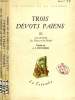
'Les textes de la Colombe'. Trad. par A.J. Festugière. Tome I: Firmicus Maternus, Prières et Conseils de Vie. Tome II: Porphyre, Lettre à Marcella. Tome III: Sallustius, Des Dieux et du Monde. Ouvrage tiré à 750 exemplaires num. sur vélin de Rives. Ex. n° 174. Classification Dewey : 870-Littératures des langues italiques. Littérature latine
CAIUS CRISPUS SALLUSTIUS, 2 TOMES
Librairie de Charles Gosselin, Paris. 1825. In-12. Broché. Etat d'usage, Plats abîmés, Dos fané, Mouillures. 347 pages pour le tome I et 237 + 178 pages pour le tome II. Texte en latin et Notes en français (sur 2 colonnes). Papiers muets encollés sur les dos, les consolidant. Etiquettes de code sur les couvertures. Quelques tampons de bibliothèque. Traces de colle sur la couverture. Manques importants sur les bords des plats.. . . . Classification Dewey : 470-Langues italiques. Latin
Auteurs classiques latins avec des Commentaires. Salluste par J. Planche. Classification Dewey : 470-Langues italiques. Latin
C. Sallustius Crispius cum veterum Historiarum fragmentis.
Leyde, ex officina Elzeviriana [Bonaventure et Abraham fils Elzevier], 1634. 1 vol. petit in-12, vélin ivoire à rabats, titre écrit à la plume au dos. Reliure de l'époque. Bel exemplaire. Titre-frontispice h.-t. gravé à l'eau-forte par Duysent, 1 médaillon gravé sur bois dans le texte avec l'effigie de Salluste, (12) ff. (front. compris), 310 pp., (19) ff. Plusieurs passages soulignés à l'encre et qq. annotations marginales. Haut. : 122 mm.
La première, la plus rare et la plus recherchée des quatre éditions publiées à cette date par les Elzevier. Le texte ayant été établi avec soin par Marcus Zuerius Boxhorn, les Elzévier, par reconnaissance, le lui ont dédié. Bel exemplaire. Willems, 412; Rahir, 399.
C. Sallustius Crispus cum veterum Historicorum fragmentis
Lugduni Batavorum (Leiden), Elzevir, 1634, petit in 12 de, 1 titre gravé par Cl. Duysent d'une jolie composition allégorique, (14)-310-(34) pp., 1 portrait de salluste gravé d'après une médaille antique, reliure d'époque XVIIIe de plein veau brun, dos lisse orné de fers dorés, pièce de titre de maroquin vetrt, encadrements de triple-filets dorés sur les plats, tranches dorées, bel ex.
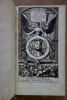

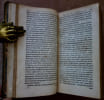
Jolie édition Elzévirienne peu commune. (Willems, 412).
CAII SALLUSTII CRISPI QUAE EXSTANT OPERA
Parisiis Typis, J. Barbou 1801, nova editio expurgata, texte en latin. in/12, XLp, 352 pages, 4ff, 3 planches dont le frontispice, d'après Charles-Nicolas Cochin fils, gravées par Fessard. Bandeaux, culs-de-lampe, plein veau marbré, dos lisse orné, pièces de titre rouge, triple filet doré sur les plats, roulette dorée sur les coupes et les chasses, toutes tranches dorées, coins légèrement émoussés. Intérieur frais.
Ad codices parisinos recensitus cum varietate lectionum et novis commentariis item Julius Escuperantius e codice nondum explorato emendatus.
Parisiis, Colligebat N.E. Lemaire, 1821. Fort in-8, rel. post. demi-chagrin chocolat, dos à 5 nerfs réhaussés de filets dorés, titre doré, tête mouchetée, LXIV-688 pp., front, texte en latin, index. Ex-libris armorié de Monsieur le Duc et Madame la Duchesse de Doudeauville.
De la Collection Bibliotheca Classica Latina. Qq. rousseurs, bel ex. relié au demaurant. - Frais de port : -France 8,4 € -U.E. 10 € -Monde (z B : 15 €) (z C : 33 €)
Coniuratio Catilinae. Recensuit Axel W. Ahlberg. (Bound with) Bellum Iugurthinum. Recensuit Axel W. Ahlberg.
Göteborg, Leipzig, Eranos' Förlag, Otto Harrassowitz, 1911 - 1915.
2 volumes in 1: VIII,86; IV,152 p. Half cloth. 21 cm (Cover worn at the extremes)
Catilina, Iugurtha, orationes et epistulae, excerptae de historiis. Recognovit A.W. AHLBERG. Editio maior.
Lpz./Bln., Tbn., 1919.
VIII,170 p. Cl. (BT) (Leeman 188; In the 'Verzeichnis der wichtigsten benützten Ausgaben' of the comm. of the BC by Vretska) (Pencil underl. throughout, occ. sm. ink ann.; cover worn; back damaged)
Catilina, Iugurtha, orationes et epistulae, excerptae de historiis. Recognovit A.W. AHLBERG. Editio minor.
Lpz./Bln., Tbn., 1923.
140 p. Wrs. (BT)
Libri de Catilinae coniuratione et de bello Iugurthino. Accedunt orationes et epistulae ex historiis excerptae. Edidit R. DIETSCH. Editio quarta emendatior.
Lpz., Tbn., 1879.
XIV,128 p. Cl. 18 cm (BT, with index nominum) (Leeman 180; Herescu p. 60) (Cover shabby; backstrip loosening; paper yellowing)
Catilina, Jugurtha, fragments des histoires. Texte établi & trad. par A. ERNOUT.
Paris, Les Belles Lettres, 1960.
Cl. 20 cm (Budé)(Rebound)
Catilina, Jugurtha, fragments des histoires. Texte établi & traduit par Alfred Ernout.
Paris, Les Belles Lettres, 1962.
Wrappers. 20 cm (Budé)
Catilina, Jugurtha, fragments des histoires. Texte établi & traduit par Alfred Ernout.
Paris, Les Belles Lettres, 1962.
Wrappers. 20 cm (Budé) (Cover plasticized)
Catilina, Iugurtha, ex Historiis orationes et epistulae. Edidit A. EUSSNER.
Lpz., Tbn., 1912.
XXII,146 p. Cl. (BT) (Some pencil)

