 Write to the booksellers
SALMASIUS,C.
Funus Linguae Hellenisticae, sive Confutatio exercitationis de Hellenistis et Lingua Hellenistica. Cui libet exequias ire Hellenisticae, i, licet. Ecce illa iam effertur. (And from page 281: 'Ossilegium Hellenisticae, sive Appendix ad confutationem Exercitationis De Hellenistica')
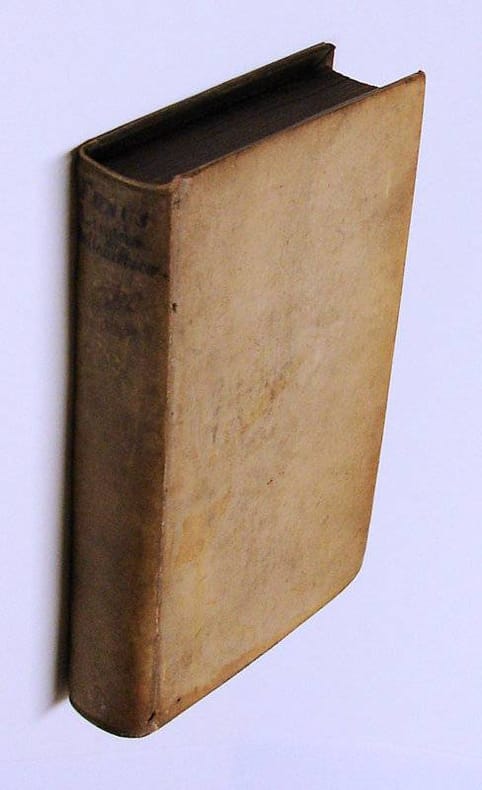
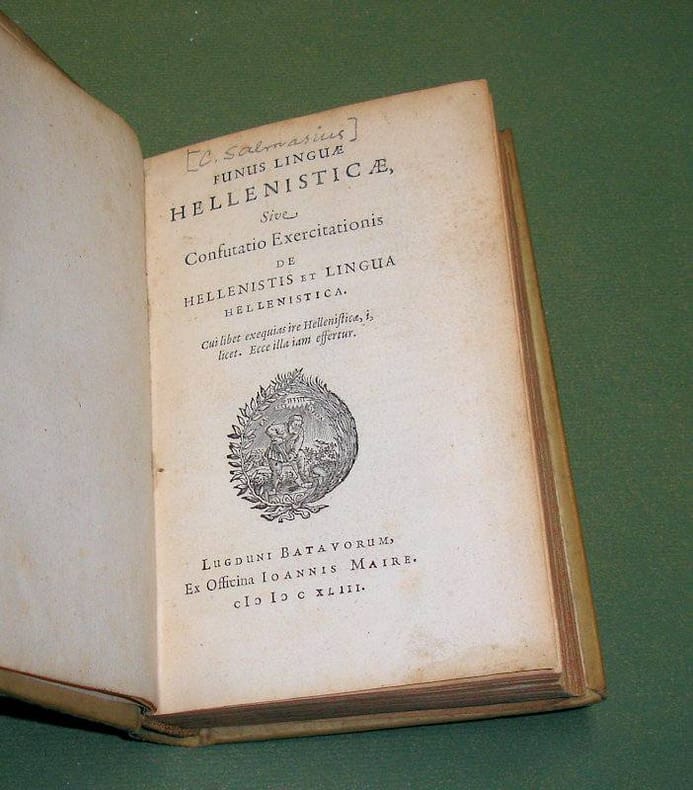
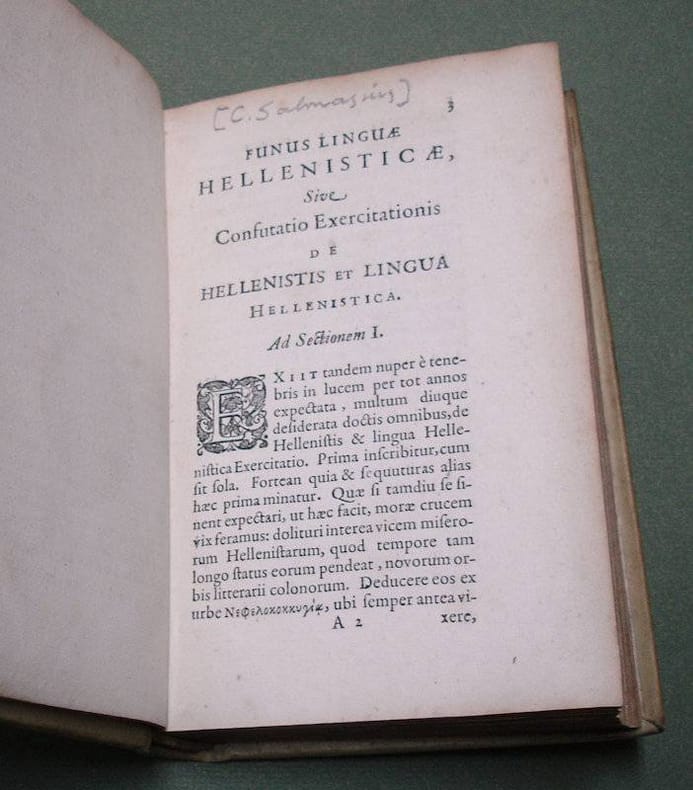
Leiden (Lugduni Batavorum), Ex officina Ioannis Maire, 1643.
Reference : 120157
8vo. 390,(1 corrigenda),(1 blank) p. Vellum. 8vo. 16.5 cm. (Ref: Breugelmans 1643:10; Graesse 6,249; Berghman 704; Rahir 1920; Ebert 20118; Brunet 6, no. 10665; cf. Willems 558) (Details: 5 thongs laced through the joints. Woodcut printer's mark of Maire on the title, depicting a farmer who stamps a shovel into the ground; above his head the motto 'fac et spera'. Page 1-280: Funus Linguae Hellenisticae, page 281-390: Ossilegium Hellenisticae) (Condition: Vellum age-toned. One gathering foxed) (Note: The French scholar Claude de Saumaise, latinized Claudius Salmasius, 1588-1653, was a prolific author, and he distinguished himself in his editions as a textual critic and erudite commentator. He was easy to get along with, but haughty and murderous on paper. In 1623 he was appointed as the successor of Scaliger at the University of Leiden, a city he was going to hate. This Funus linguae Hellenisticae of 1643 is a stage in the ongoing quarrel between the Leyden professors Daniel Heinsius, once the favourite of Scaliger, and Salmasius. When Heinsius published his Sacrae Exercitationes ad Novum Testamentum in 1639 Salmasius saw an opportunity to take 'revenge on the man he viewed as the leader of the coterie opposing him at Leiden'. (P.R. Sellin, 'Daniel Heinsius and Stuart England', Leiden/Oxford 1968, p. 43) In the preface of his De Modo Usurarum of 1639 he ridiculed Heinsius' description of the koinê as 'lingua Hellenistica'. A flurry of polemics followed. In this quarrel the printer Maire sided with Salmasius in his attempts to destroy Heinsius' integrity. (Sellin p. 47) With his De lingua Hellenistica et origine ac dialectis graecae linguae of 1643 Salmasius mounted a full-scale assault on Heinsius position on the koinê, followed in the same year by a still fiercer attack, De Hellenistica commentarius, controversiam de linguae hellenistica decidens and this anonymously published attack on his colleague, the Funus Linguae Hellenisticae. In it Salmasius contended that the language of the Greek Scriptures was not a separate dialect, but the ordinary Greek of his time. (Sandys, A History of Classical Scholarhip, N.Y., 1964, volume 2, 284/86) Concerning the De Hellenistica commentarius, which was published by Elzevier, and the Funus Linguae Latinae, both written by Salmasius, we quote part of an excellent note of Willems, p. 138, no. 558: 'On appelait Hellénistes les Juifs dispersés parmi les Grecs, surtout ceux qui habitaient Alexandrie et parlaient habituellement le grec. Partant de là, certains savants, à l'exemple de Daniel Heinsius, dans son Aristarchus sacer s'étaient crus autorisés désigner sous le nom d'hellénistique le langage, mêlé d'expressions et de tours de phrases hébraïques, qui était usité parmi ces mêmes Juifs, et dans lequel sont écrits la version des Septante et le Nouveau Testament. Saumaise, qui trouvait l'expression impropre, composa ce gros volume (De Hellenistica commentarius) contre ceux qu'il appelle les Hellénisticaires, et notamment contre Daniel Heinsius, quoique celui-ci ne soit pas nominativement désigné. Il n'en resta pas là; car dès la même année il donna encore le Funus linguae hellenisticae, suivi de l'Ossilegium hellenisticae, Lugd. Bat., J. Maire, 1643. L'auteur a beau jeu pour démontrer que le terme d'hellénistique est inconnu à toute l'antiquité, que cette langue ne constitue pas à proprement parler un dialecte spécial, qu'il n'y a en grec que quatre dialectes, ou cinq si l'on y comprend la langue commune , &c. A cet égard son livre est plein de vues nouvelles et ingénieuses, dont les grammairiens ont fait leur profit. Mais le fait que les livres saints sont écrits en un idiome dont les mots sont grecs et la phrase hébraïque, n'en subsiste pas moins, et Saumaise en convient. (...) Quoi qu'il en soit, le mot qui échauffait si fort la bile de Saumaise a fait fortune, car les récents linguistes Matthiae, Kühner &c n'ont pas fait difficulté de l'admettre') (Provenance: On the front pastedown in pencil: 'J. v. Dijck') (Collation: A-2A8, 2B4 (leaf 2B4 verso blank)) (Photographs on request)
Bookseller's contact details
Antiquariaat Fragmenta Selecta
+31 20 418 55 65
Payment mode

Sale conditions
Terms of Sale All items offered are subject to prior sale. Your order will be final after you have received our confirmation, with a specification of the availability of the items and the shipping costs. All books are complete and in good antiquarian condition, unless otherwise described. Prices are in EURO. Postage and insurance are not included. Postage will be calculated at cost (no extra charges). Returns Books may be returned within 14 days of receipt, if returned in the same condition as sent, and packed, shipped and insured as received (please always notify us). We will refund the shipping costs of a return shipment only if our descriptions were not correct. How to pay Pre-payment is necessary for new customers. Our order confirmation will provide detailed information and a specification of the shipping costs. Customers who are known to us and libraries will be invoiced as usual. We accept Visa and Mastercard. You can submit your card information through our SECURE PAYMENT FORM. PayPal: we will send you a personal link to the PayPal website. Banktransfers: payment can be made into our bank account in The Netherlands.

