 Write to the booksellers
MAXIMUS TYRIUS.
V.C. Maximi Tyri Philosophi Platonici Dissertationes XLI. Graece. Cum interpretatione, notis, & emendationibus Danielis Heinsii. Accessit Alcinoi In doctrinam Platonis introductio ab eodem emendata: & alia ejusdem generis.
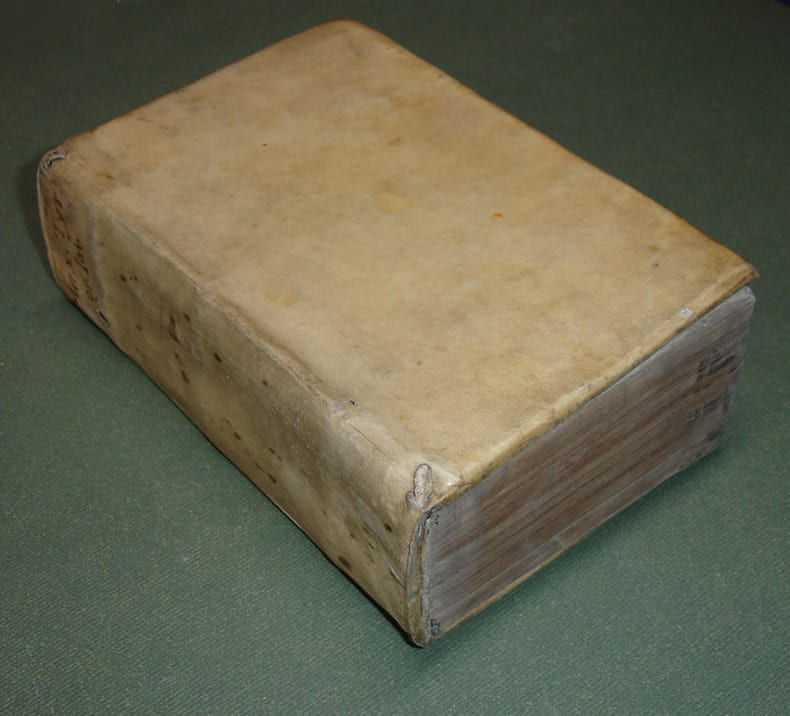
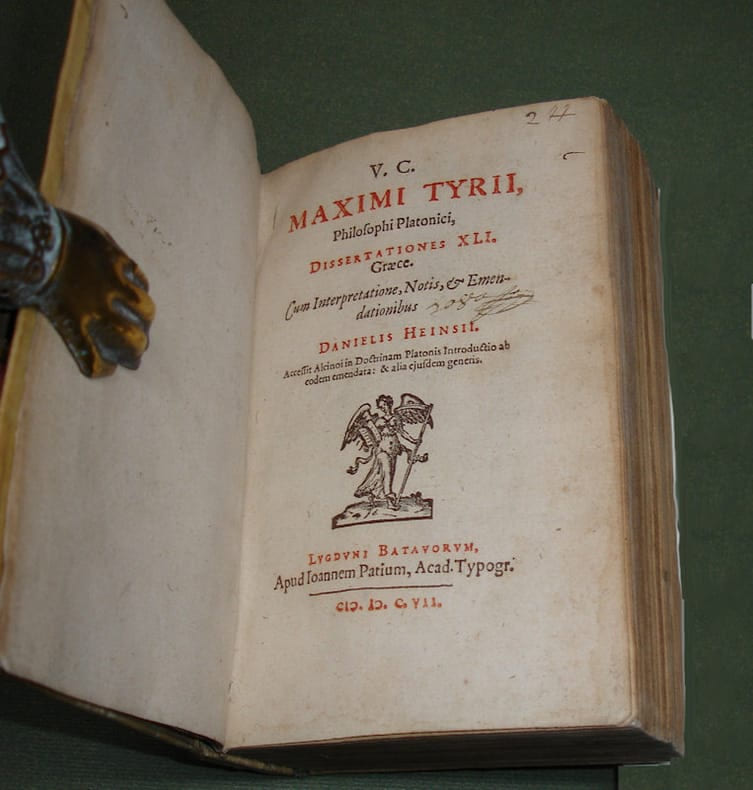
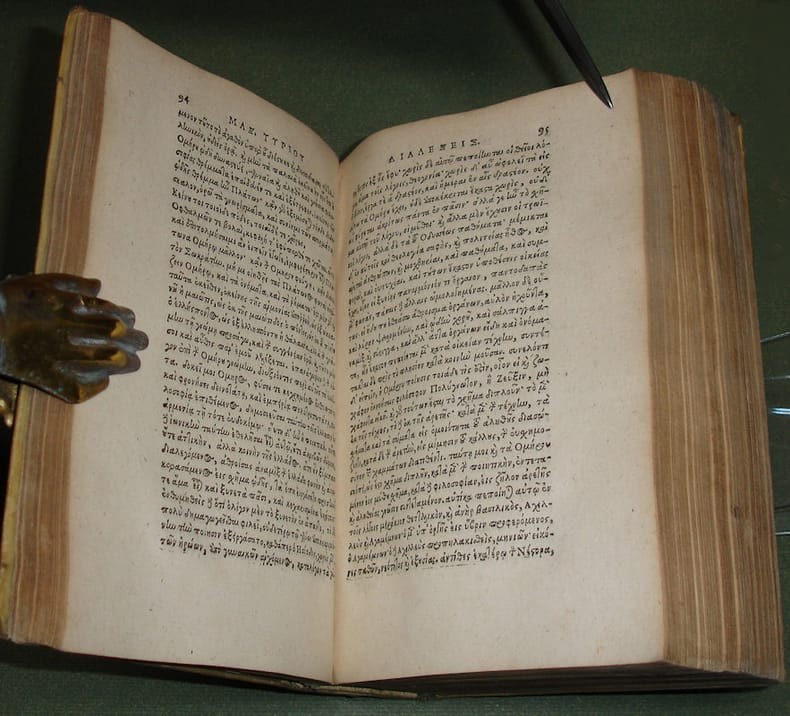
Leiden, (Lugduni Batavorum), Apud Joannem Patium, Acad. Typogr., 1607.
Reference : 120123
8vo. 3 parts in 1: (XXIII),(1 blank),408; (12),411,(4),(1 blank); (159 unnumbered pages),(1 blank) p. Vellum 17.5 cm (Ref: Hoffmann 2,585; Schweiger 1,204; Dibdin 2,232; Graesse 4,453; Ebert 13450; Brunet 3,1552) (Details: Greek texts and Latin translations. Each part has its own title, the first is in red & black. Woodcut printer's mark of Paets on the titles, depicting a winged young woman who holds a scythe in her left hand and an opened book in her right arm) (Condition: Vellum age-toned and spotted. Tiny hole in the vellum of the lower board. Both pastedowns detached. Bookplate pasted on inside of the upper board. First title finger soiled. Almost invisible pinpoint wormhole at the tip of the right upper corner of ca. 250 p. Paper yellowing) (Note: The Greek Platonist Maximus Tyrus, ca. 125-185 AD, was an itinerant philosopher, who left us 41 dissertations (dalexeis) on theological, ethical and philosophical subjects. These lectures are not great literature, nor specimina of great learning. Philosophical originality is not be be looked for in these lectures.The author offers a pleasant prensentation of a theme, and his lectures 'are simply eloquent exhortations to virtue decked out in quotations, chiefly from Plato, and Homer'. (OCD 2nd ed. 658) The themes are for example: 'die Lust (hêdonê, 29-33), sokratische Liebe (18-22), platonische Theologie (11), 'daimones' (8-9), Gebet (5), Weissagung und freier Wille (13), das Böse (41) und Wiedererinnerung (10)'. (Neue Pauly, 7,1074/75) Maximus Tyrius was widely read by humanists like Ficino, Bessarion and Poliziano. The 'editio princeps' was published in 1557 by the French scholar/publisher Henricus Stephanus. The next important and authorative edition was published in 1607 by the Dutch scholar Daniel Heinsius, 1580-1655, who was in 1607 librarian of the University of Leiden. In 1609 he succeeded as professor of Greek his praeceptor Josephus Justus Scaliger. The first 300 pages of the first part of this book contain the Greek text of the 'Dissertationes', followed by a number of Pythagorean fragments, and by 27 pages 'castigationes' on Maximus Tyrius by Henricus Stephanus. The pages 329-386 contain the Greek text of Alcinous' handbook of Platonism 'Introductio in Platonicam philosophiam'; the pages 387-408 contain Diogenes Laertius on Plato. The second part contains Heinsius's Latin translation of Maximus Tyrius and Alcinous; added are 33 pages with a Latin translation of the earlier mentioned Pythagorean fragments, made by the Dutch scholar Willem Canter. At the end 27 pages filled with Apuleius's 'De Deo Socratis liber, qui Maximi Dissertat. de eodem respondet'. Part 3 contains the notes of Heinsius. Heinsius based his edition of Maximus Tyrius on that of Stephanus, but 'quae corrupta erant emendavimus, quae obscuriora, leviter illustravimus'. (Part 1, leaf *6 recto) But he was a conservative and reserved text critic, 'Nobis', he explains 'temeritas nunquam placuit, et si quid in autoribus peccandum est, timidus videri malo quam audax'. (Part 3, leaf a4 recto/verso) Heinsius also produced the Latin translation and notes. In a 'Lectori' to the third part Heinsius tells that the French scholar Isaac Casaubon sent him a manuscript of Maximus Tyrius's 'Dissertationes'. It arrived too late for amending the Greek text and Latin translation, but Heinsius used it for and in his notes. Heinsius received also some excerpts (excerpta quaedam) of Sixtus Arcerius, and the Heidelberg professor Marquard Freher, 1565-1614, sent him a manuscript from the Palatine Library) (Provenance: Armorial bookplate of the barony 'Sinclair', a shield divided into 4 fields, flanked by 2 griffons, a baron's coronet on top, above which a peer's helmet with mantlings, and a crest, consisting of a swam on its nest. Each of the four fields is filled with what seems a ship under sail. Old manuscript shelfmark on and under the bookplate. The motto reads: 'Fide sed pugna', 'with faith, but with fist') (Collation: *8, 2*4 (leaf 2*4 verso blank); a-u8, x4, y-cc8; pi2, b-dd8, cc4, a-k8) (Photographs on request)
Bookseller's contact details
Antiquariaat Fragmenta Selecta
+31 20 418 55 65
Payment mode

Sale conditions
Terms of Sale All items offered are subject to prior sale. Your order will be final after you have received our confirmation, with a specification of the availability of the items and the shipping costs. All books are complete and in good antiquarian condition, unless otherwise described. Prices are in EURO. Postage and insurance are not included. Postage will be calculated at cost (no extra charges). Returns Books may be returned within 14 days of receipt, if returned in the same condition as sent, and packed, shipped and insured as received (please always notify us). We will refund the shipping costs of a return shipment only if our descriptions were not correct. How to pay Pre-payment is necessary for new customers. Our order confirmation will provide detailed information and a specification of the shipping costs. Customers who are known to us and libraries will be invoiced as usual. We accept Visa and Mastercard. You can submit your card information through our SECURE PAYMENT FORM. PayPal: we will send you a personal link to the PayPal website. Banktransfers: payment can be made into our bank account in The Netherlands.

