 Write to the booksellers
4 books for « maximus tyrius »Edit
-
Topics
Italian (1)
Philosophy (1)
Tyre (1)
-
Countries
Belgium (1)
Netherlands (2)
Switzerland (1)
V.C. Maximi Tyri Philosophi Platonici Dissertationes XLI. Graece. Cum interpretatione, notis, & emendationibus Danielis Heinsii. Accessit Alcinoi In doctrinam Platonis introductio ab eodem emendata: & alia ejusdem generis.
Leiden, (Lugduni Batavorum), Apud Joannem Patium, Acad. Typogr., 1607.
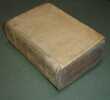
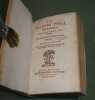
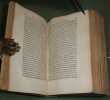
8vo. 3 parts in 1: (XXIII),(1 blank),408; (12),411,(4),(1 blank); (159 unnumbered pages),(1 blank) p. Vellum 17.5 cm (Ref: Hoffmann 2,585; Schweiger 1,204; Dibdin 2,232; Graesse 4,453; Ebert 13450; Brunet 3,1552) (Details: Greek texts and Latin translations. Each part has its own title, the first is in red & black. Woodcut printer's mark of Paets on the titles, depicting a winged young woman who holds a scythe in her left hand and an opened book in her right arm) (Condition: Vellum age-toned and spotted. Tiny hole in the vellum of the lower board. Both pastedowns detached. Bookplate pasted on inside of the upper board. First title finger soiled. Almost invisible pinpoint wormhole at the tip of the right upper corner of ca. 250 p. Paper yellowing) (Note: The Greek Platonist Maximus Tyrus, ca. 125-185 AD, was an itinerant philosopher, who left us 41 dissertations (dalexeis) on theological, ethical and philosophical subjects. These lectures are not great literature, nor specimina of great learning. Philosophical originality is not be be looked for in these lectures.The author offers a pleasant prensentation of a theme, and his lectures 'are simply eloquent exhortations to virtue decked out in quotations, chiefly from Plato, and Homer'. (OCD 2nd ed. 658) The themes are for example: 'die Lust (hêdonê, 29-33), sokratische Liebe (18-22), platonische Theologie (11), 'daimones' (8-9), Gebet (5), Weissagung und freier Wille (13), das Böse (41) und Wiedererinnerung (10)'. (Neue Pauly, 7,1074/75) Maximus Tyrius was widely read by humanists like Ficino, Bessarion and Poliziano. The 'editio princeps' was published in 1557 by the French scholar/publisher Henricus Stephanus. The next important and authorative edition was published in 1607 by the Dutch scholar Daniel Heinsius, 1580-1655, who was in 1607 librarian of the University of Leiden. In 1609 he succeeded as professor of Greek his praeceptor Josephus Justus Scaliger. The first 300 pages of the first part of this book contain the Greek text of the 'Dissertationes', followed by a number of Pythagorean fragments, and by 27 pages 'castigationes' on Maximus Tyrius by Henricus Stephanus. The pages 329-386 contain the Greek text of Alcinous' handbook of Platonism 'Introductio in Platonicam philosophiam'; the pages 387-408 contain Diogenes Laertius on Plato. The second part contains Heinsius's Latin translation of Maximus Tyrius and Alcinous; added are 33 pages with a Latin translation of the earlier mentioned Pythagorean fragments, made by the Dutch scholar Willem Canter. At the end 27 pages filled with Apuleius's 'De Deo Socratis liber, qui Maximi Dissertat. de eodem respondet'. Part 3 contains the notes of Heinsius. Heinsius based his edition of Maximus Tyrius on that of Stephanus, but 'quae corrupta erant emendavimus, quae obscuriora, leviter illustravimus'. (Part 1, leaf *6 recto) But he was a conservative and reserved text critic, 'Nobis', he explains 'temeritas nunquam placuit, et si quid in autoribus peccandum est, timidus videri malo quam audax'. (Part 3, leaf a4 recto/verso) Heinsius also produced the Latin translation and notes. In a 'Lectori' to the third part Heinsius tells that the French scholar Isaac Casaubon sent him a manuscript of Maximus Tyrius's 'Dissertationes'. It arrived too late for amending the Greek text and Latin translation, but Heinsius used it for and in his notes. Heinsius received also some excerpts (excerpta quaedam) of Sixtus Arcerius, and the Heidelberg professor Marquard Freher, 1565-1614, sent him a manuscript from the Palatine Library) (Provenance: Armorial bookplate of the barony 'Sinclair', a shield divided into 4 fields, flanked by 2 griffons, a baron's coronet on top, above which a peer's helmet with mantlings, and a crest, consisting of a swam on its nest. Each of the four fields is filled with what seems a ship under sail. Old manuscript shelfmark on and under the bookplate. The motto reads: 'Fide sed pugna', 'with faith, but with fist') (Collation: *8, 2*4 (leaf 2*4 verso blank); a-u8, x4, y-cc8; pi2, b-dd8, cc4, a-k8) (Photographs on request)
MAXIMOU TURIOU LOGOI. Maximi Tyrii Dissertationes. Ex interpretatione Danielis Heinsii. Recensuit & notulis illustravit Joannes Davisius, Coll. Regin. apud Cantabr. Socius.
Cambridge (Cantabrigiae), Ex Officina Joann. Hayes, celeberrimae Academiae Typographi, 1703.
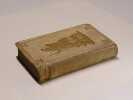
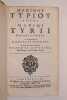
8vo. (XVI),435,(1 blank);(10 index),(2 blank) p. Vellum 20 cm (Ref: ESTC Citation No. T98323; Hoffmann 2,586: 'Diese Ausgabe übertrifft die früheren'; Dibdin p. 2,233: 'Foreign critics seem to consider Davies the best editor of Maximus Tyrius. (...) but it is to be regretted that Heinsius's notes are not given entire. At the bottom of each page some short critical and historical observations are given; and there are two very useful indexes'; Brunet 3,1552; Graesse 4,453; Ebert 13454: 'Die Anmerkungen sind theils kritisch, theils die Geschichte der Philosophie betreffend'; Spoelder p. 578, 's-Gravenhage 3) (Details: Prize copy, without the prize. 6 thongs laced through the joints. Boards with double fillet gilt borders and the coat of arms of The Hague in the center. Woodcut printers' mark on title, with the University's motto: 'Hinc lucem et pocula sacra', 'From this place, we gain enlightenment and precious knowledge'. At the end is bound a manuscript 'actio gratiarum' of 16 lines, i.e. a note of thanks. (See Provenance below)) (Condition: Vellum slightly scratched and soiled. Lower margin of the first 30 p. very slightly waterstained. Prize gone) (Note: The Greek Platonist Maximus Tyrius, ca. 125-185 AD, was an itinerant philosopher/lecturer, who lived during the Second Sophistic, and left us 41 dissertations (dialexeis) on theological, ethical and philosophical subjects. The lectures were delivered in Rome, apparently during the reign of Commodus (180-92). They deal with ethics, physics, theology and epistemology, but are not great literature, nor specimina of great learning. Themes are for example: 'die Lust (hêdonê, 29-33), sokratische Liebe (18-22), platonische Theologie (11), 'daimones' (8-9), Gebet (5), Weissagung und freier Wille (13), das Böse (41) und Wiedererinnerung (10)'. (Neue Pauly, 7,1074/75) Maximus Tyrius 'was well read in Greek literature, but apparently not in Greek philosophy except in Plato, of whom he claimed to be a follower. His lectures show no philosophical originality, and are simple eloquent exhortations to virtue decked out with quotations, chiefly from Plato and Homer'. (OCD 2nd ed. p. 658) As a philosophic orator he is comparable with contemporaries like Dio Chrysostomus and Apuleius. He was widely read by the humanists of the 15th century, e.g. Poliziano, Bessarion, Lascaris, Reuchlin. The 'editio princeps' was published in 1557 by the French scholar/publisher Henricus Stephanus. The next important and authorative edition was published in 1607 by the Dutch classicist Daniel Heinsius, 1580-1655. The English scholar John Davies, Fellow of Queens' College at Cambridge based the Greek text of his edition on that of Stephanus, he tells us in the 'praefatio', and adopted the Latin translation of Heinsius with corrections, and with notes and 2 useful indexes of his own. (p. *4 verso) John Davies, or Joannes Davisius, 1679-1732, studied at Queens College, of which he was elected fellow, and subsequently became Rector, or Praeses, in 1717. He chiefly devoted his attention to the philosophical works of Cicero. His editions show great learning and knowledge of the history of and the systems of ancient philosophy. Davies also produced editions of Caesar, Minucius Felix and Lactantius. He was a friend and ally of the greatest classical scholar of his age Richard Bentley) (Provenance: At the end has been added a leaf with the text of the 'Actio gratiarum' of the schoolboy who received this book: 'Celeberissime Princeps. Nobilissimi atque Amplissimi Scholae curatores. Doctissime Rector. Quanto diligentius vestram in me munificentiam mente agito, tanto amplior beneficii vestri magnitudo mihi videtur, Viri Nobilissimi, quod praemio hoc magnifico iterum decoratus laudibusque et victoria clarus in altiorem militiae scholasticae gradum promoveor. Quocirca nolite dubitare, Curatores nobilissimi, sinceram benignitatis vestrae memoriam nullo apud me tempore esse intermorituram. Credite vero nihil unquam quidquam deincpes mihi dulcius fore, quam si meum in Vos animum gratissimum meamque observantiam Vobis probare queam'. See for this kind of speeches Spoelder, Prijsboeken op de Latijnse School. Amsterdam 2000, p. 176/184) (Collation: *8, A-2E8 (leaf 2E8 blank)) (Photographs on request)
CASSIUS MAXIMUS TYRIUS (Maxime de Tyr); BARDI Pietro (traducteur):
Reference : 16045
(1642)
Discorsi di Massimo Tirio filosofo platonico, tradotti dal signor Piero de Bardi conte di Vernio, academico fiorentino.
in Venetia, Apresso I Giunti, 1642. In-8 de [8]-207-[3] pages, plein vélin ivoire, dos à nerfs, tranches jaunes. Auréole sur le premier plat. Rousseurs.
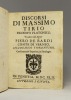
Edition originale de cette traduction en italien des dissertations du philosophe et rhéteur grec Maxime de Tyr (125 - 185). Il fut l'adversaire des épicuriens contemporains, il répandit ses thèses platoniciennes et prépara ainsi le néoplatonisme. Le texte fut traduit du grec au latin par Cosimo de' Pazzi, (édité à Bâle, chez J. Froben en 1519), puis du latin à l'italien par Pietro Bardi, qui fut membre de diverses académies: l'Accademia degli Alterati, mais surtout fut un des premiers membres de la prestigieuse Accademia della Crusca ou il fut le zélé défenseur de la langue italienne.
ISOCRATES- Johannes LONICER ( secondary author ) - Maximus TYRIUS - Johann Froben ( secondary author ) :
Reference : 44165
Contemporary collection of two titles bound in one volume. [1] Isocratis Atheniensis, oratoris & philosophi clarissimi, orationes. Eiusdem vita, ex Plutarcho, philostrato , & dionysio halicarnaseo. Joanne Ionicero interprete. [2] Sermones e Graeca in Latinum linguam versi cosmo paccio interprete.
[1] Basel, Andreas Cratander, 1529, in-folio, 305 x 199 mm, (24)nn pp + 117 leaves (= 118, error twice leaf number 116) + (20)nn pp (index) (complete, contains a last leaf not mentionned in the USTC collation). With contemporary finely executed rubrication in red, green , yellow and some blue. Title within woodcut historiated architectural border (signed HF), another historiated border on a1-recto by Hans Holbein. [2] Basel, Johann Froben, 1519, in-folio, pp 170 (= 174, a4-verso, b1, b2-recto , wrongly numbered or uncounted) + (2)nn pp (operis novissima) (complete). Title within woodcut historiated architectural border (signed AH = Ambrosius Holbein), 2 further woodcut historiated architectural borders, pp. a3-recto , pp b1-recto and several large initial letters ( 45 x 45 mm), of which three coloured. This copy also with contemporary finely executed rubrication and underlinings. Bound in somewhat later mottled calf, raised spine with gilt decorations and title label. Spine with restorations, joints cracked again but binding technically sound and with not many obtrusive signs of wear . Both works were rubricated by the same, first (?) owner, most probably J.Boerii, Archdyacon Z Contsen[ ] (?). His name on both title pages in the same (most probably his own) handwriting. In the second book also some marginal notes in the same hand. A John Boerius, archdeacon, is mentionned in connection with Durham cathedral around 1515. But we cannot interpret the addition Z Contsen[ ]. There are no other provenance indications apart from a small thumnail printed ex-libris of ''MN'' with the devise '' cy est mon amy le moins fol'', tipped-in on the first paste down. Nicely preserved collection of two Basle postincunables pertaining to ancient Greek philosophy and literature. Both works are extensively rubricated and colored. USTC N° 667214 and USTC N° 673353..

