2 books for « scaliger j j heinsiu... »Edit

Sort by

‎SCALIGER,J.J.- HEINSIUS,D. ‎

Reference : 120076

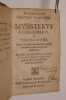
‎Satirae duae, Hercules tuam fidem sive Munsterus Hypobolimaeus, et Virgula divina. Cum brevioribus annotatiunculis, quibus nonnulla in rudiorum gratiam illustrantur. Accessit his accurata Burdonum Fabulae confutatio, quibus alia nonnula hac editione accedunt. ‎

‎Leiden (Lugduni Batavorum), Apud Ludovicum Elzevirium, 1617. (Colophon at the end: 'Lugduni Batavorum, Typis Isaaci Elsevirii, anno 1617') ‎
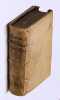

‎12mo. (XXIV),619 (recte 529),(20),(3 blank) p. Overlapping vellum 13 cm (Ref: STCN ppn 832983446; USTC 1028202; Willems 123; Rahir 99; Berghman 1329 Graesse 6/1, 273/274; Not in Smitskamp's 'The Scaliger Collection', but it does figure in its list of Scaliger editions, p. 120) (Details: 5 thongs laced through the joints. Manuscript title on the back. The first Elzevier edition in small format) (Condition: Vellum age-toned and soiled. Front hinge cracking. Front flyleaf worn and inscribed. Title dustsoiled, and with 2 small ownership entries. Some old marginal notes, occasional ink underlinings) (Note: The French protestant classical scholar J.J. Scaliger, 1540-1609, was a genius, but was also vain and sharp tongued. Consequently he had many enemies. His greatest enemies were among members of the catholic Jesuit order. Scaliger had turned his back on France, and had come in 1592 to Leiden at the request of the authorities of that city and the local University, who desired nothing more than his inspiring presence. There he gathered around him a group of brilliant young man, among whom H. Grotius. In 1599 young Daniel Heinsius, 1580-1655, entered the group, and became 'because of his reputedly attractive personality and remarkable gifts' Scaliger's favorite student. (P.R. Sellin, Daniel Heinsius and Stuart England', Leiden etc., 1968, p. 14) Heinsius rapidly made a name as classical scholar and neolatin poet. In 1609 Scaliger died in his arms. One of Scaliger's foulest adversaries was a former friend, Gaspar Schoppe, or in Latin Scioppius, 1576-1649, who converted to catholicism. He distinguished himself by the virulence of his writings against the Protestants, and he even wanted to incite a war against these heretics. In 1607 this man published a vicious attack upon Scaliger with his 'Scaliger hypololymaeus', in English 'Suppositious Scaliger', or rather 'Basterd Scaliger'. 'Dem tobensten Schimpfen wird hier freier Lauf gelassen; Gifte jeder Art von Verunglimpfung und Verdächtigung werden zusammen gebraut'. (J. Bernays, 'Joseph Justus Scaliger', Berlin, 1855, p. 85) Scioppius wanted to throw discredit on Scaliger, and weaken his authority, so he attacked him at his weakest spot, his supposed noble birth. Scaliger had been raised in the belief that he was a descendent of the royal family Della Scala of Verona, and he let no opportunity pass to mention the splendour of his ancestry. The validity of his pretentions were however dubious. The challenge of Scioppius was accepted by the favourite pupil of Scaliger, Daniel Heinsius, who published one year later, in 1608, anonymously in defence of his master the 'Satirae duae, Hercules tuam fidem, sive Munsterus Hypobolimaeus, et Virgula divina', two mordant Menippean satires that covered Scioppius, who occasionally signed his letters off as 'G.S. a Munster' (hence Munsterus), with much abuse. As Scioppius himself had done with Scaliger, Heinsius smears with the mud of satire his scholarship, his name, the respectability of his parents, and his conversion to catholicism. In the following mockery 'Virgula Divina, sive Lucretii Vespillonis apotheosis', inspired by Seneca's Apocolocyntosis, Heinsius focusses on the humble origins of Scioppius, himself, he tells, a supposititious child. His 'father', called by Heinsius Vespillo, or corpse-bearer/gravedigger (See Martial I,47,1), is sentenced to become assistant of Charon. Scaliger has often admitted in his letters that Heinsius was the author of the satires, and the editor of the book, which opens with a preface dedicated to Scaliger, and a section of Scioppius praise of Scaliger from the time when he was still a friend and a protestant, then a support letter of the French scholar and friend of Scaliger, Isaac Casaubon. Next follow both satires of Heinsius, followed by an attack on Scioppius and his ancestry in a mock-biography: 'Vita et parentes Gasp. Schoppii, a Germano quodam contubernali eius conscripta', composed by Scaliger himself or by Ianus Rutgerus, a friend of Heinsius, and a student of Scaliger. The great man himself contributed, using the initials of his student Rutgerus (auctore I.R. Batavo, Iuris studioso) also to this own defence, a 'accurata Burdonum Fabulae confutatio', 'a precise refutation of the Burdonese story', with the help of charters and documents which should prove his noble origin. Nevertheless, the defence of Heinsius and Scaliger made 'einen sehr kühlen Eindruck auch auf die nähreren Freunde Scaligers'. (Bernays, p. 85). Few wanted to side with him on this matter; the answer of Scaliger was deemed not satisfactory. Scioppius' reputation was damaged too. Heinsius had portrayed him as a parasite and as 'Monster of Münster', labels which he never got rid of. A revised second edition of the 'Satirae duae' was published in the same year in Leiden by Johannes Patius, who had also published the first edition. 1609 he already produced his 4th edition. An eludicating survey of the hard to fathom content of both satires can be found in chapter 5 of 'Menippean Satire and the Republic of Letters, 1581-1655', of A. R. de Smet, Geneva, 1996. 'Hercules tuam fidem' is the title of Varro's 39th Menippean satire) (Provenance: On the title: 'Bern. à Mallinckroth', and also 'Sum J. Niefert'. On the front pastedown a Swedish name 'Henrik Kröijer', and probably one 'R. Berghes') (Collation: *12, A-Z12 (leaf Z11 verso and Z12 blank. Page numbers 513-529 misnumbered 603-619)) (Photographs on request) ‎

Phone number : +31 20 418 55 65

EUR650.00 (€650.00 )

‎SCALIGER,J.J.- HEINSIUS,D. ‎

Reference : 155429

‎Danielis Heinsii in obitum V. Illustr. Josephi Scaligeri Iul. Caes. a Burden F. eruditorum Principis orationes duae. Accedunt Epicedia eiusdem & aliorum: effigies item ac monumentum Scaligeri, & Principum Veronensium aeri incisa. (And:) Oratio funebris dicta honori & memoriae maximi virorum Josephi Justi Scaligeri. Auctore D. Baudio I.C. et Historiarum in Illustri Academia Lugdun. Batavo. Professore. ‎

‎Ad 1: N.pl. (Leiden), Ex Officina Plantiniana Raphelengii, 1609. Lugd. Bat. prostant apud Lud. Elzevirium & Andream Cloucquium. (Ad 2:) Leiden (Lugduni Batavorum), Prostant apud Ludov. Elzevirium, & Andream Cloucquium, 1609. ‎


‎4to. Ad 1: (VIII),100 p. Ad 2: 23,(1 blank) p. Contemporary vellum. 25 cm. (Ref: Not in Smitskamp's 'The Scaliger Collection', though mentioned in the bibliography. Ad 1: STCN ppn 840343604; Willems 54; Rahir 36; Berghman 795. Ad 2: STCN ppn 832983063; Willems 53; Rahir 34; Berghman 779) (Details: 3 thongs laced through the joints. Woodcut initials. Ad 1: Engraved printer's mark on the title, depicting an eagle in the clouds (aietos en nephelêsi). A full page engraved portrait of J.J. Scaliger, and of his father J.C. Scaliger. A full page engraving of the funerary monument erected by the University and the City Council of Leiden for Scaliger in the 'Vrouwekerk', the local Walloon church, where he used to attend divine service; it is a work of the famous Dutch architect Hendrik de Keyser. On the monument, now in the Pieterskerk, is an honorary inscription, probably by Daniel Heisius, in which Scaliger is proudly remembered as 'Principum Veronensium nepotis', offspring of the princes of Verona. After this follow 3 plates concerning the princely claims of Scaliger; one of them is folding. They depict 3 tombs of Veronese Scaligers, the 'Tomb of Cangrande I', the founder of the Scaliger dynasty, who died 1329, the 'Tomb of Cansignorio della Scala', and the 'Tomb of Mastino II'. Ad 2: Elsevier's first printer's mark, depicting an eagle that holds a bundle of 7 arrows in its beak, the bird is surrounded by the motto: 'A. 1595, Concordia Res Parvae Crescunt'; the seven arrows represent the union of the Seven Provinces of the Dutch Republic; since its foundation in 1588 the motto of the Seven United Provinces was 'Concordia Res Parvae Crescunt', in Dutch 'Eendracht maakt macht'. The saying was coined by the Roman historian Sallust. ('Bellum Jugurthinum', caput 10)) (Condition: Vellum age-tanned, slightly soiled and spotted. Short title in ink on the back. Name on the first title. Small stamp on the 2nd title. Paper yellowing) (Note: The place of Josephus Justus Scaliger, 1549-1609, in the history of classical scholarship is royal. His preeminence is summarized masterly in the text of the dustjacket of the intellectual biography of Anthony Grafton 'Joseph Scaliger, A study in the history of classical scholarship', Oxford, 1983/93. 'In an age of great classical scholars, Joseph Scaliger was the greatest. His early work as an editor of Latin texts won the attention of the learned throughout Europe and contained technical innovations that remain of interest. His later work as the founder of the discipline of historical chronology involved him in the superhuman task of trying to reconstruct every sophisticated calender and to date every significant event in human history. Along the way he emended hundreds of corrupt passages in classical texts, collated scores of manuscripts, quarrelled with dozens of his rivals, failed humiliatingly (...) to prove that he was descended from the della Scala of Verona - and dashed off in his spare time works that would remain standard for centuries, like Gruter's Corpus of inscriptions, the publication of which Scaliger oversaw. His work was perhaps most important in that it showed that the Bible and the events it recorded could not be understood except in the light of the writings of the pagans and the methods of classical scholarship'. In 1593 Scaliger filled the vacant place left by Justus Lipsius at the young the University of Leiden. 'His disinclination to lecture was duly respected; all that the authorities at Leyden desired was his living and inspiring presence in that seat of Protestant learning'. (Sandys 2/202) On this honorary post he produced works that made him immortal, and lend lustre to Leyden and its University. Scaliger spent the last 16 years of his life in Leiden as the jewel of the University. There he enjoyed also the friendship of a great number of pupils and admirers. To his circle belonged H. Grotius, D. Heinsius, his successor the Dousae, and in France Du Thou and Casaubon. Scaliger died in the arms of his favourite pupil and closest friend Daniel Heinsius, who wrote a funerary oration for him. Scaliger had inherited from his father Julius Caesar Scaliger a profound belief in his descent from the noble Veronese family Della Scala. Scaliger tried to prove his princely descent, but clearly failed according to his biographer Anthony Grafton. This title of 1609 contains the funerary oration of Heinsius, and secondly the speech he held on the occasion of the inauguration in the 'Vrouwekerk' of the funerary monument of Scaliger. At the beginning of the second speech we find the plate with the 'editio princeps' of the text of the epitaph. After the speech of the inauguration of the monument, follow 'Manes Scaligeri', a series of poems and epitaphs, some of them in ancient Greek. The first one is called 'Aphotheosis'. At the end we find 'Epicedia diversorum', poetic epitaphs by H. Grotius and other leading Dutch scholars. (p. 73-91). At the end there are 'Iudicia de Iosepho Scaligero ex infinitis pauca', the 'legatum' of Scaliger's books to the University library of Leiden, and a portrait of J.C. Scaliger. (p. 92-100) The added funerary oration of 24 pages is the work of the erudite Flemish humanist and cosmopolitan scholar Dominicus Baudius, colleague and friend of Scaliger, and one of the best Neolatin epistolary talents of his time. In 1603 he was appointed 'Professor Eloquentiae' (of Latin) at the University of Leiden) (Provenance: On the front flyleaf the name of 'M. Tijdeman'. Mr. Meindert Tydeman, 1741-1825, was from 1811 librarian of the University Library of Leyden, and in 1814 he was appointed professor of philosophy. Inscription on the title: 'Sum J. Didaci Nieuhoff'. We found only one Didacus Nieuhoff. His name occurs on a baptismal certificate, 's-Hertogenbosch, 1695) The name on the title page of Baudius' speech is illegible. He was 'Pfarrer in B, Freiburg i. Br.' and lived in the 'Joh. von Weerthstr. 4') (Collation: Ad 1: *4 (including full page portrait of J.J. Scaliger), A-L4, M6 (Full page portrait of J.C. Scaliger on p. 99). 1 engraved plate after page 32, 3 after p. 40, of which one is folding. Ad 2: A-C4 (leaf C4 verso blank)) ‎

Phone number : +31 20 418 55 65

EUR1,750.00 (€1,750.00 )
Get it on Google Play Get it on AppStore
Search - scaliger j j heinsiu...
The item was added to your cart
You have just added :

-

There are/is 0 item(s) in your cart.
Total : €0.00
(without shipping fees)
What can I do with a user account ?

What can I do with a user account ?

  • All your searches are memorised in your history which allows you to find and redo anterior searches.
  • You may manage a list of your favourite, regular searches.
  • Your preferences (language, search parameters, etc.) are memorised.
  • You may send your search results on your e-mail address without having to fill in each time you need it.
  • Get in touch with booksellers, order books and see previous orders.
  • Publish Events related to books.

And much more that you will discover browsing Livre Rare Book !