 Write to the booksellers
PINDARE
Pindari Olympia, Nemea, Pythia, Isthmia
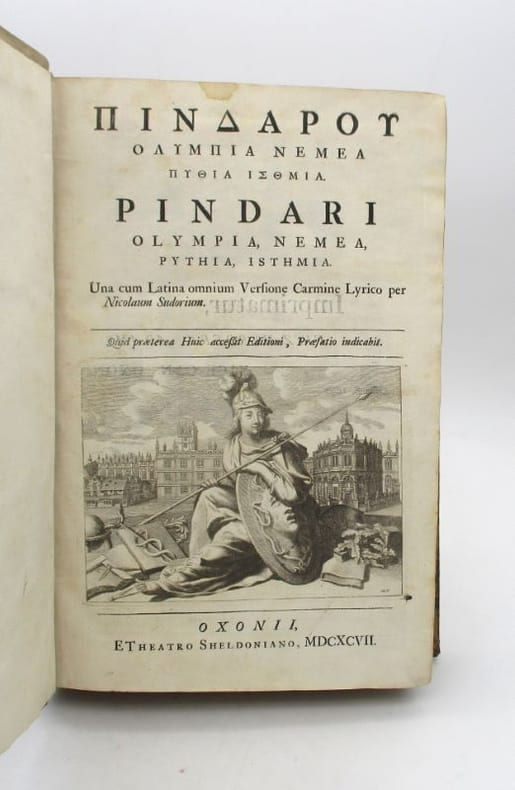
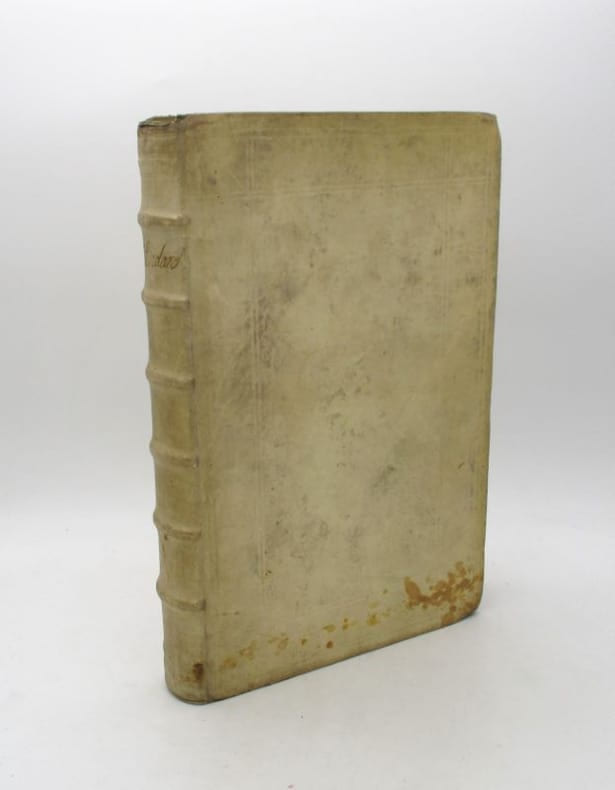
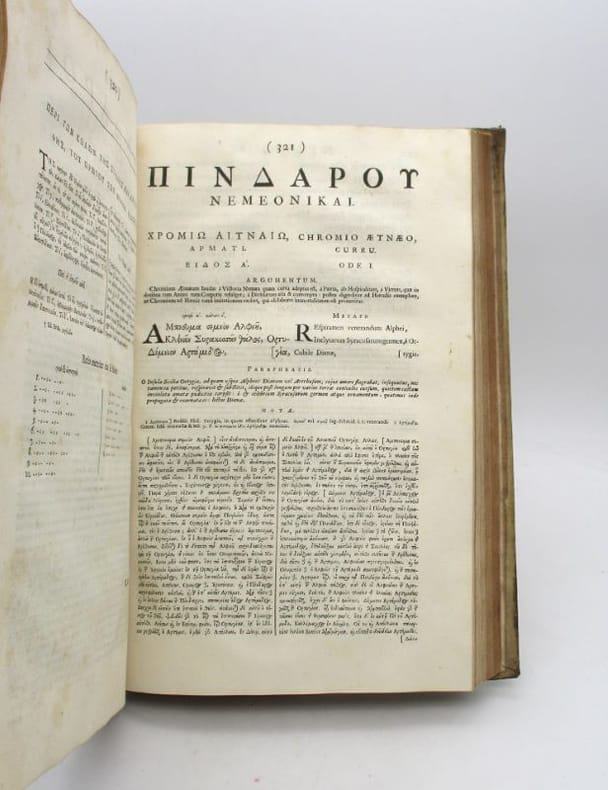
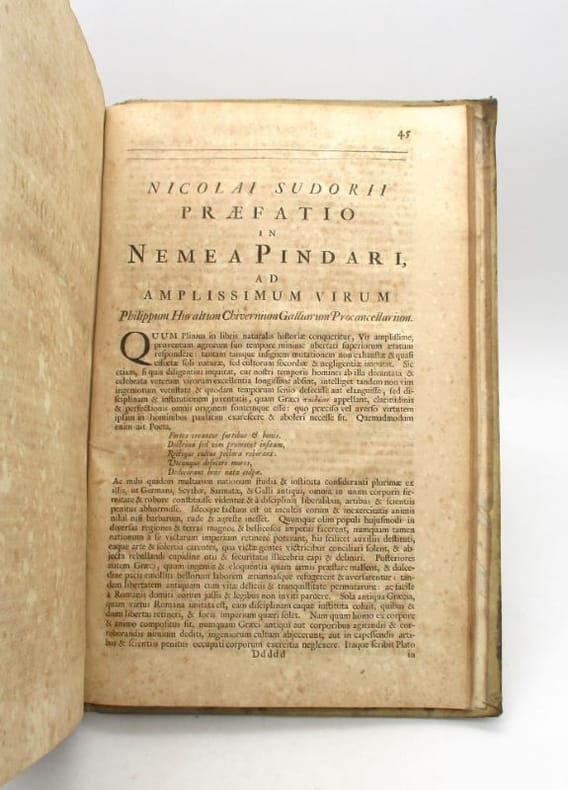
Oxford, Sheldonian Theatre, 1697. In-4, [36]-497-[95]-77-[3] pp., vélin rigide ivoire, plats estampés à froid, dos à nerfs, titre manuscrit au dos, tranches mouchetées de bleu (coiffe supérieure arasée, coins frottés, quelques taches, des ff. roussis, petit manque angulaire à la 1ère garde)
Reference : 20064
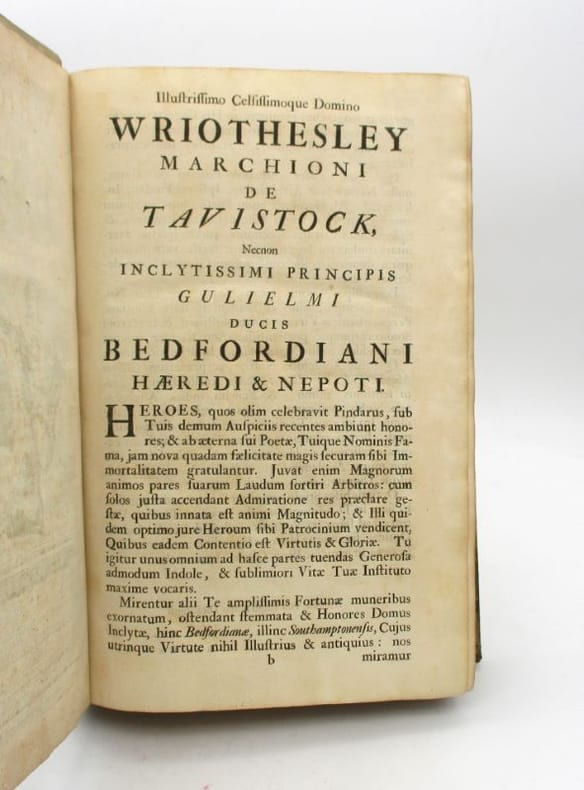
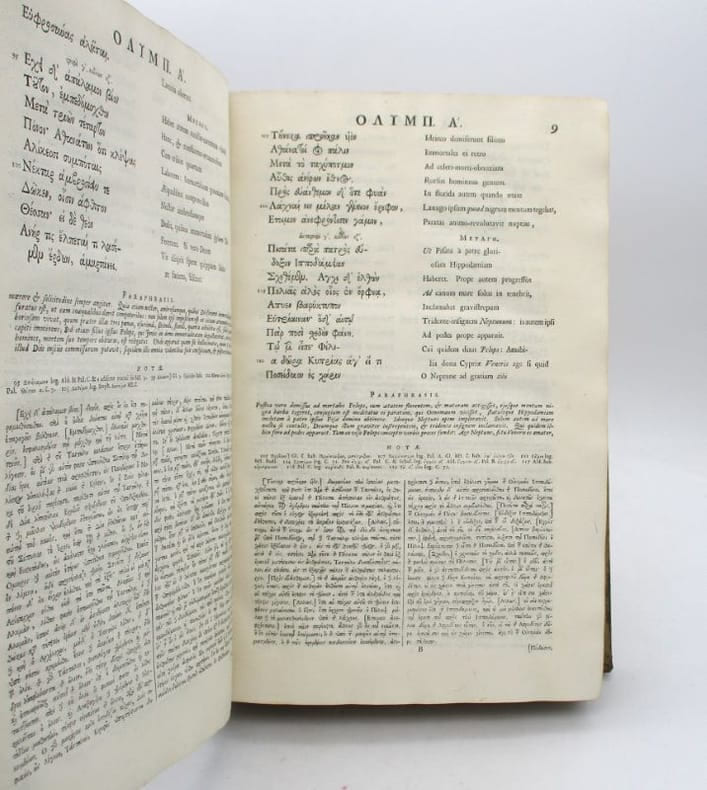
Première édition anglaise, imprimée à Oxford, du texte en grec des 4 livres des Odes triomphales ou épinicies de Pindare en l'honneur des jeux d'Olympie, de Delphes, de Corinthe et de Némée. Elle est illustrée d'une belle vignette au titre représentant Athéna et dans le fond de laquelle on peut apercevoir le fameux Sheldonien Theatre de Christopher Wren où fut publié l'ouvrage, ainsi qu'un portrait de Pindare, tous deux gravés par M. Burghers. L'ouvrage comprend d'une notice biographique sur Pindare. Chaque Ode est imprimée sur deux colonnes en caractère grec avec sa traduction latine en regard, elle est précédée d'un résumé en latin, suivie d'une paraphrase (ou reformulation) et de notes en latin, puis d'une scholie en grec. Après un index exhaustif, se trouve la traduction des mêmes odes uniquement en latin par Nicolas Le Sueur. Cet ouvrage a été édité par Richard West et Robert Welsted en se fondant sur les manuscrits conservés à la Bodleian library et la biblioteca Palatina. Brunet, IV, 659; Graesse, IV, 295. Voir photographie(s) / See picture(s) * Membre du SLAM et de la LILA / ILAB Member. La librairie est ouverte du lundi au vendredi de 14h à 19h. Merci de nous prévenir avant de passer,certains de nos livres étant entreposés dans une réserve.
Bookseller's contact details
L'Ancienne Librairie
M. Alban Caussé
3 Rue Pierre l'Ermite
75018 Paris
France
librairie.ancienne.paris@gmail.com
09 78 81 38 22
Payment mode


Sale conditions
conforme aux règles du SLAM
5 book(s) with the same title
PINDAROU OLUMPIA, PUTHIA, NEMEA, ISTHMIA. Pindari Olympia, Pythia, Nemea, Isthmia.
Leiden (Lugduni Batavorum), Ex officina Plantiniana, Apud Franciscum Raphalengium, 1590.
8vo. (XVI),246,(4 blank) p. Vellum. 16 cm (Ref: Hoffmann 3,98; Graesse 5,294; Ebert 16858) (Details: Woodcut printer's mark on the title, it depicts a hand that comes out of a cloud, and draws a circle with a pair of compasses, the motto is: 'Labore et constantia'. Short biography of Pindar by Gyraldus in Latin precedes the Greek text of the epinicia. Greek text only) (Condition: Vellum age-tanned. Some small wormholes in the blank upper corner of the first gathering, smaller pinpoint ones in next six gatherings, nowhere affecting the text. The edges of the lower corner of the first gathering eaten away by some insect) (Note: A quarter of the works of the Greek poet Pindar, ca. 518-438 BC, his four books of 'epinicia', named after the Great Games, the Olympian, Pythian, Nemean and Isthmian, survive. Pindar wrote eulogistic hymns to celebrate a victory in athletics, boxing and horse racing. Praised in a magnificent way are the victor, his family, the native city. 'Each ode draws from a variety of historical, cultural, and mythological sources. The highly allusive manner by which this material is presented is complemented by an equally rich repertoire of metrical patterns from epic, Doric, and Aeolic systems'. (The Classical tradition, Cambridge Mass., 2010, p. 729) 'Extended similes and difficult metaphors, intricate syntax and rapid narration, far-reaching digressions and bold disruptions' result in grandiose, but also obscure, enigmatic and sometimes seemingly awkward poetry. Already in antiquity the comic playwright Aristophanes presented in the 'Aves' Pindaric poetry as foolish, pretentious and embarrassing. The Hellenistic poets Callimachus and Theocritus wrote poetry under his influence. The Roman poet Horace thought him grandiose and sublime. Pindar's influence on European literature is great. The great number of editions in Greek, and Latin translations of Pindar's odes that were printed in the 16th century are an indication of a continuous and widespread humanist interest. Many of Pindar's gnomic maximes and punctuated statements, containing elements of traditional wisdom, were collected in Renaissance anthologies of 'sententiae', for example in Erasmus's Adagia. Already the first full Latin translation of Pindar (1528) indexed all the gnomes according to moral lessons. 'The sententious Pindar (...) provided the Humanists of the Reformation with pithy statements of moral instruction and wordly advice, which ensured the poet's place in pedagogical circles'. 'The sheer variety of Pindarically influenced traditions -the political ode and the personal, the religious hymn and the song of genius, the freely aimless and the rigorously concise- all serve as a testament not only to Pindar's versatility, but also to his rich potential to inspire'. (Op. cit. p. 730) For Filelfo, Pontano, Cowley, Dryden Pindar was a model for political encomium, and there are quite a number of imitators of Pindar in European literature. Giangiorgio Trissino wrote a tragedy and three canzoni in a form approximating Pindar's practice, Luigi Alamanni modelled his hymns on the Pindaric ode, Ronsard wanted to be the French Pindar, introducing the Pindaric ode into the vernacular literature of France. The French author Voltaire made the witty remark that Pindar wrote verses that no one understood, and everyone had to admire. For Thomas Gray, Goethe and Hölderlin he was a genius. This Pindar edition of 1590 is based, according to Hoffmann, Graesse & Ebert, on the Greek text of the edition of 1560 produced by the French scholar/printer Henri Estienne (Henricus Stephanus). Stephanus published a second (1566) and third edition (1586), all three containing in addition to the Greek text a Latin translation of the odes, but the 1560 edition is to be preferred, because the Greek text is, according to Dibdin the most correct. Plantin published a reissue of the Greek text of this 1560 edition earlier in 1567. Greek text only) (Provenance: On the front pastedown in pencil: '18 april 1961', written by the Flemish linguist Walter Couvreur, 1914-1996, who was an Orientalist, and professor of Indoeuropean linguistics at the University of Gent. It indicates the date of aquisition. The place of acquisition he wrote on the flyleaf at the end: 'Utrecht, Beijers, veiling Wille'. On the front flyleaf an illegible name, and 'J. Wille, 10 febr. 1928'. J. Wille, 1881-1964, was professor of Dutch literature and linguistics and at the same time librarian of the protestant Free University at Amsterdam. His specialty was 18th century Dutch literature, and an excessive buyer of books. His books were auctioned by Beijers at Utrecht on the 23rd, 26-27th april 1961. It was the largest private library ever auctioned by Beijers. (P.J. Buijsters, 'Geschiedenis van de Nederlandse bibliofilie, boek- en prentverzamelaars 1750-2010', Nijmegen, 2010, p.110/11; including a picture of Wille) (Collation: *8, A-P8, Q6 (leaves Q5 & Q6 blank) (Photographs on request)
PINDAROU PERIODOS. Pindari Olympia, Pythia, Nemea, Isthmia. Johannes Benedictus, medicinae doctor, & in Salmuriensi Academia Regia linguae Graecae Professor, ad metri rationem, variorum exemplarium fidem, scholiastae ad verisimiles coniecturas directionem, totum authorem innumeris mendis repurgavit. Metaphrasi recognita, latina paraphrasi addita, poeticis & obscuris phrasibus graeca prosa declaratis; denique adiectis rerum & verborum brevibus & sufficientibus commentariis, arduum eiusdem sensum explanavit. Editio purissma, cum indice locupletissimo.
Saumur, (Salmurii), Ex typis Petri Piededii, 1620.
4to. (XVI),756,(recte 750),(56 index) p. Calf 24 cm (Ref: Gerber p. 5; Rico p. 13; Hoffmann 3,99; Schweiger 1,235; Dibdin 2,288; Moss 2,410: 'a very good and critical edition'; Brunet 4,659; Graesse 5,294; Ebert 16864) (Details: The Greek text is accompanied by a Latin paraphrasis on the left and a Latin translation on the right. Back with 5 raised bands, elaborately gilt & expertly rebacked in antique style (in the 19th century?). Boards with gilt fillet borders, having also 2 double fillet gilt rectangles, and a gilt coat of arms in the center. 19th century marbled endpapers. Woodcut ornament on the title. Edges dyed red) (Condition: Binding worn at the extremes. Edges of the boards chafed. Corners bumped. Leather on the boards crackled. Strip of 1 cm cut from upper margin of the title, and repaired with a new strip. A few old ink marginalia) (Note: A quarter of the works of the Greek poet Pindar, ca. 518-438 B.C., survives, his four books of 'epinicia', named after the Great Games, the Olympian, Pythian, Nemean and Isthmian. Pindar wrote eulogistic hymns to celebrate a victory in athletics, boxing and horse racing. Praised in a magnificent way are the victor, his family, the native city. 'Each ode draws from a variety of historical, cultural, and mythological sources. The highly allusive manner by which this material is presented is complemented by an equally rich repertoire of metrical patterns from epic, Doric, and Aeolic systems'. (The Classical tradition, Cambridge Mass., 2010, p. 729) 'Extended similes and difficult metaphors, intricate syntax and rapid narration, far-reaching digressions and bold disruptions' result in grandiose, but also obscure, enigmatic and sometimes seemingly awkward poetry. Already in antiquity the comic playwright Aristophanes presented in the 'Aves' Pindaric poetry as foolish, pretentious and embarrassing. The Hellenistic poets Callimachus and Theocritus wrote poetry under his influence. The Roman poet Horace thought him grandiose and sublime. Pindar's influence on European literature is great. The great number of editions in Greek, and Latin translations of Pindar's odes that were printed in the 16th century are an indication of a continuous and widespread humanist interest. Pindar was, with the Roman poet Horace, the chief classical model for modern formal lyric poetry. The lyric poets of the Renaissance borrowed first of all thematic material from Pindar. It brought a nobler and graver spirit. 'They enriched their language on the model of Pindar's and Horace's odes, taking it father away from plain prose and from conventional folk-song phraseology. And in their eagerness to rival the classics, they made their own lyrics more dignified, less colloquial and song-like (...) more ceremonial and hymn-like'. (G. Highet, 'The classical tradition', Oxford 1978, p. 230) The 'loudest and boldest answer to the challenge of Pindar's style and reputation came from France', beginning with Pierre de Ronsard, born 1524. Ronsard wanted to be the French Pindar, introducing the Pindaric ode into the vernacular literature of France. He, together with his poetic friends 'were the energy and the material, of the group of poets who rebelled against the traditional standards of French poetry and proclaimed revolution in ideals and techniques. They called themselves the Pléiade, after the group of seven stars which join their light into a single glow'. (Op. cit. (Highet) p. 231) Their work amounted to a closer synthesis between French and Greco-Latin literature, and was the annunciation of a new trend in French, and European literature. Many of Pindar's gnomic maximes and punctuated statements, containing elements of traditional wisdom, were collected in Renaissance anthologies of 'sententiae', for example in Erasmus's Adagia. Already the first full Latin translation of Pindar (1528) indexed all the gnomes according to moral lessons. 'The sententious Pindar (...) provided the Humanists of the Reformation with pithy statements of moral instruction and wordly advice, which ensured the poet's place in pedagogical circles. Moreover, as a source of proverbial wisdom, Pindar was elevated nearly to the status of biblical Salomon. (...) The sheer variety of Pindarically influenced traditions -the political ode and the personal, the religious hymn and the song of genius, the freely aimless and the rigorously concise- all serve as a testament not only to Pindar's versatility, but also to his rich potential to inspire'. (The Classical tradition, Cambridge Mass., 2010, p. 729/30) For Filelfo, Pontano, Cowley, Dryden Pindar was a model for political encomium, and there are quite a number of imitators of Pindar in European literature. The French author Voltaire made the witty remark that Pindar wrote verses that no one understood, and everyone had to admire. This Pindar edition of 1620, produced by the scholar Jean Benoist, or Johannes Benedictus, (died 1664) is based on the edition of Wittenberg of 1616 by the German scholar Erasmus Schmi(e)d(t), or Schmidius, 1570-1637, who was the first truly important Pindaric scholar, and according to Dibdin the 'eruditorum Pindari facile princeps'. Benoist was a doctor of medecin, and, it is said, of German origin. He was appointed on the recommandation of the great Greek scholar Isaac Casaubon the King's professor of Greek at the protestant Academy of Saumur. A year before Benoist had published in Saumur an edition of Lucian, also with his Latin translation. His Latin translations leaves however, according to Hutton, much to be desired. (J. Hutton, 'The Greek Anthology in France', Ithaca, N.Y., 1946, p.176/77) The commentary of Benoist on the other hand is excellent, for many philological, historical and mythological problems are explained in a sagacious manner. The text also contains many valuable readings from other earlier works, and there are excerpts of scholia. 'Benedictus contributed 23 emendations, 4 of which are printed and 2 mentioned in the Snell-Maehler Teubner edition on 1980'. (Gerber,D.E., 'Emendations in the Odes of Pindar', in 'Pindar', Entretien sur l'Antiquité Classique XXXI', p. 9) (Provenance: On the boards the gilt coat of arms of John Henry Gurney. This might be John Henry Gurney Sr., 1819-1890, who was an English banker, amateur ornithologist, and Liberal Party politician, or his son John Henry Gurney Jr., 1848-1922, who was an ornithologist. (See for them Wikipedia)) (Collation: a4, e4, A-5I4, 5K2 (minus the blank leaves 2H2 (p. 243/44), minus leaf 3P3 (p. 485/86), and minus leaf 4N3 (p. 653/54); the pagination seems irregular, owing to the removal of these 3 blank leaves)) (Photographs on request)
Pindarou periodos. Pindari Olympia, Pythia, Nemea, Isthmia. Iohannes Benedictus (...) ad metri rationem, variorum exemplarium fidem, scholiastae ad verisimiles conjecturas directionem, totum authorem innumeris mendis repurgavit.
Saumur, Pierre Pié-de-Dieu, 1620. 1 vol. in-4°, veau fauve, dos à nerfs orné de petits fleurons dorés encadrés d'un double filet doré, encadrement d'un double filet doré sur les plats, écoinçons dorés, armes dorées au centre, roulette dorée sur les coupes, tranches dorées. Reliure du temps, mors fendillés, traces de lacets, qq. éraflures estompées sur les plats. Agréable exemplaire. Ex-libris ms. et étiquette du Séminaire de Caen sur le titre. (8) ff., 651 pp., (1) f. blanc, pp. 655 à 756, (1) f. d'errata, (27) ff. d'index.
L'une des plus belles productions savantes de l'Académie de Saumur. Edition grecque et latine établie par Jean Benoist, médecin et professeur de grec à l'Académie protestante de Saumur. Elle est fondée sur l'édition qu'avait donné Schmidt à Wittenberg en 1616 mais Jean Benoist y a ajouté "de très bonnes observations et une paraphrase latine" (Schoell). Cette édition "estimée des savants" (De Bure) est par ailleurs d'une remarquable exécution typographique et est "non moins célèbre que celle des oeuvres de Lucien" (Pasquier & Dauphin) également imprimée par Pierre Pié-de-Dieu. Plaisant exemplaire dans une jolie reliure d'époque, aux armes de Thomas de Morant du Mesnil Garnier, conseiller du roi en ses conseils d'Etat et trésorier de son épargne en 1633, agonothète du collège des jésuites de Caen. Ce livre a sans doute été offert en prix de ce collège. Graesse V, 294; De Bure, 2582; Pasquier & Dauphin, 287; Schoell I, 285; Labarre,(BBA LXXXV), n°166; Guigard III, 134.


Pindari Olympia, Pythia, Nemea, Isthmia, caeterorum octo lyricorum carmina : Alcaei, Sapphus, Stesichori, Ibyci, Anacreontis, Bacchylidis, Simonidis, Alcmanis, nonnulla etiam aliorum. Editio II, graecolatina, .... Editio IIII. Græcolatina H. Stapha. Recognitione quorundam interpretationis loco- rum, & accessione lyricorum carminum locupleta.
Lugduni, Lugduni, Apud Joan Pillehotte 1598 In-24 demi-chagrin brun, dos lisse, filets à froid reliure du XIXe s., 684-1 pp. Texte grec en regard du texte latin. Feuillet de titre restauré, en partie délié. Seconde charnière int. fendillée.
Quatrième édition des textes de Pindare et autres poètes mineurs grecs données par Henri Estienne en 1560. Etat correct d’occasion
Pindarou periodos. Pindari Olympia, Pythia, Nemea, Isthmia. Iohannes Benedictus (...) ad metri rationem, variorum exemplarium fidem, scholiastae ad verisimiles conjecturas directionem, totum authorem innumeris mendis repurgavit.
Saumur, Pierre Pié-de-Dieu, 1620. 1 vol. in-4°, veau fauve jaspé, dos à nerfs orné de caissons dorés, pièce de titre en maroquin rouge, encadrement d'un triple filet doré sur les plats, roulette dorée sur les coupes, tranches rouges. Reliure du début du XVIIIe siècle, coiffes élimées, coins émoussés, petit manque de cuir en pied, mors sup. fendu en tête sur qq. cm. aux angles des plats. Bon exemplaire dans l'ensemble. (8) ff., 756 pp., (1) p., (27) ff. d'index. Quelques rousseurs.
L'une des plus belles productions savantes de l'Académie de Saumur. Edition grecque et latine établie par Jean Benoist, médecin et professeur de grec à l'Académie protestante de Saumur. Elle est fondée sur l'édition qu'avait donné Schmidt à Wittenberg en 1616 mais Jean Benoist y a ajouté "de très bonnes observations et une paraphrase latine" (Schoell). Cette édition "estimée des savants" (De Bure) est par ailleurs d'une remarquable exécution typographique et est "non moins célèbre que celle des oeuvres de Lucien" (Pasquier & Dauphin) également imprimée par Pierre Pié-de-Dieu. Graesse V, 294; De Bure, 2582; Pasquier & Dauphin, 287; Schoell I, 285; Labarre,(BBA LXXXV), n°166.

