 Write to the booksellers
PINDARUS.
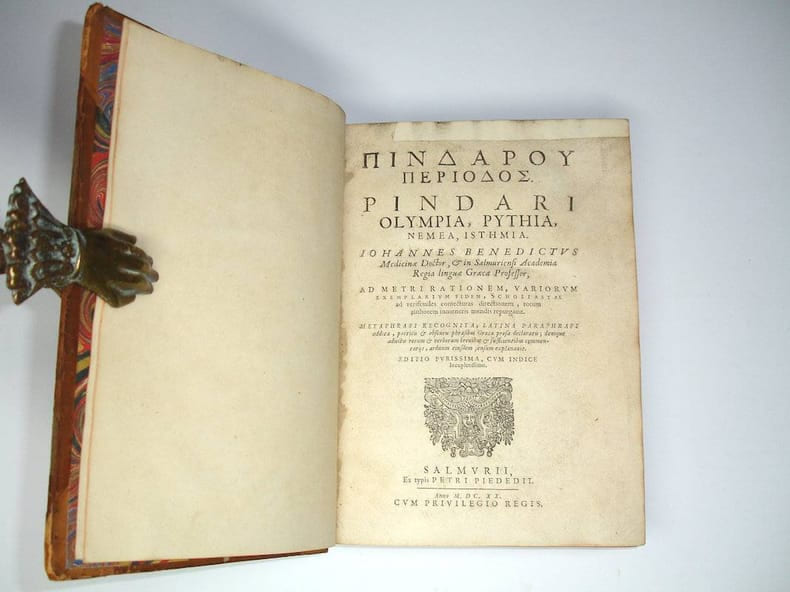
PINDAROU PERIODOS. Pindari Olympia, Pythia, Nemea, Isthmia. Johannes Benedictus, medicinae doctor, & in Salmuriensi Academia Regia linguae Graecae Professor, ad metri rationem, variorum exemplarium fidem, scholiastae ad verisimiles coniecturas directionem, totum authorem innumeris mendis repurgavit. Metaphrasi recognita, latina paraphrasi addita, poeticis & obscuris phrasibus graeca prosa declaratis; denique adiectis rerum & verborum brevibus & sufficientibus commentariis, arduum eiusdem sensum explanavit. Editio purissma, cum indice locupletissimo.
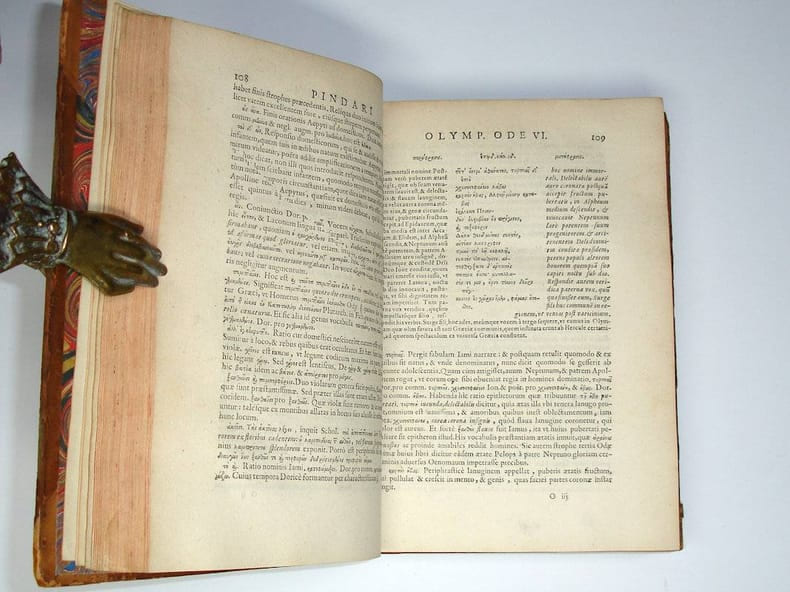
Saumur, (Salmurii), Ex typis Petri Piededii, 1620.
Reference : 140034
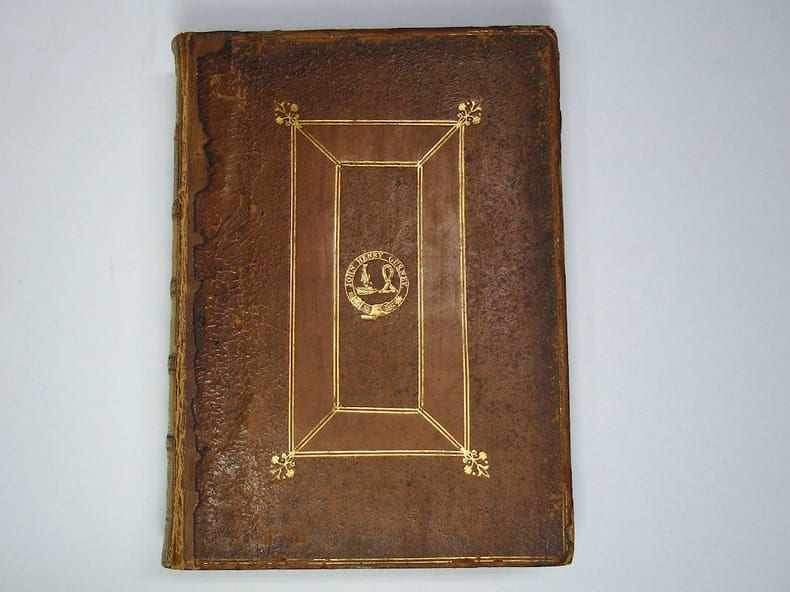
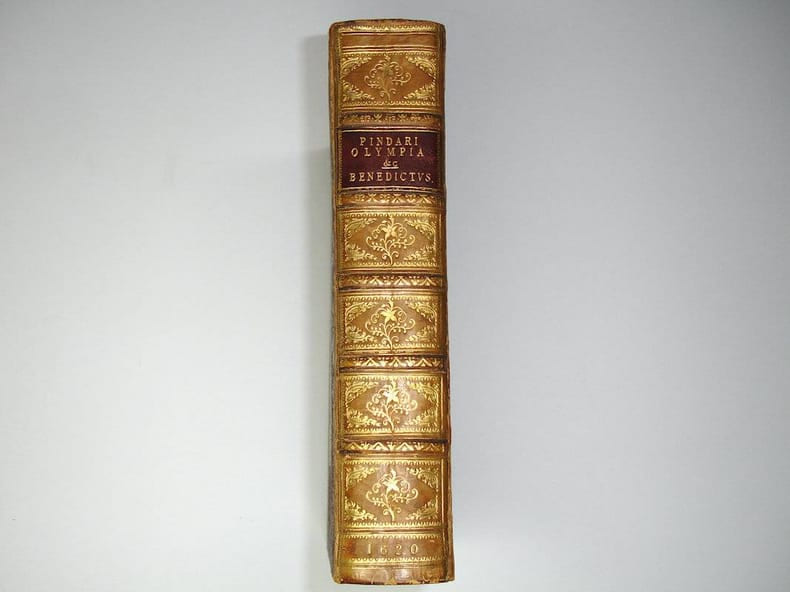
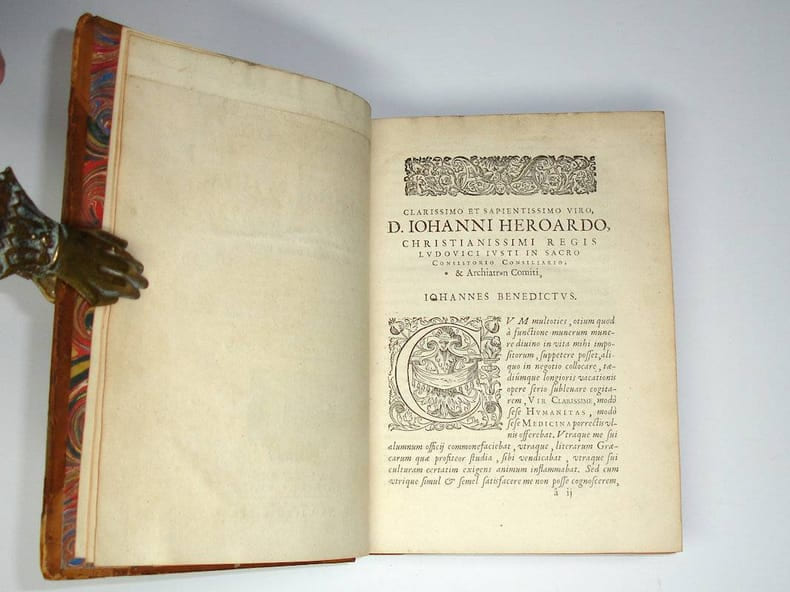
4to. (XVI),756,(recte 750),(56 index) p. Calf 24 cm (Ref: Gerber p. 5; Rico p. 13; Hoffmann 3,99; Schweiger 1,235; Dibdin 2,288; Moss 2,410: 'a very good and critical edition'; Brunet 4,659; Graesse 5,294; Ebert 16864) (Details: The Greek text is accompanied by a Latin paraphrasis on the left and a Latin translation on the right. Back with 5 raised bands, elaborately gilt & expertly rebacked in antique style (in the 19th century?). Boards with gilt fillet borders, having also 2 double fillet gilt rectangles, and a gilt coat of arms in the center. 19th century marbled endpapers. Woodcut ornament on the title. Edges dyed red) (Condition: Binding worn at the extremes. Edges of the boards chafed. Corners bumped. Leather on the boards crackled. Strip of 1 cm cut from upper margin of the title, and repaired with a new strip. A few old ink marginalia) (Note: A quarter of the works of the Greek poet Pindar, ca. 518-438 B.C., survives, his four books of 'epinicia', named after the Great Games, the Olympian, Pythian, Nemean and Isthmian. Pindar wrote eulogistic hymns to celebrate a victory in athletics, boxing and horse racing. Praised in a magnificent way are the victor, his family, the native city. 'Each ode draws from a variety of historical, cultural, and mythological sources. The highly allusive manner by which this material is presented is complemented by an equally rich repertoire of metrical patterns from epic, Doric, and Aeolic systems'. (The Classical tradition, Cambridge Mass., 2010, p. 729) 'Extended similes and difficult metaphors, intricate syntax and rapid narration, far-reaching digressions and bold disruptions' result in grandiose, but also obscure, enigmatic and sometimes seemingly awkward poetry. Already in antiquity the comic playwright Aristophanes presented in the 'Aves' Pindaric poetry as foolish, pretentious and embarrassing. The Hellenistic poets Callimachus and Theocritus wrote poetry under his influence. The Roman poet Horace thought him grandiose and sublime. Pindar's influence on European literature is great. The great number of editions in Greek, and Latin translations of Pindar's odes that were printed in the 16th century are an indication of a continuous and widespread humanist interest. Pindar was, with the Roman poet Horace, the chief classical model for modern formal lyric poetry. The lyric poets of the Renaissance borrowed first of all thematic material from Pindar. It brought a nobler and graver spirit. 'They enriched their language on the model of Pindar's and Horace's odes, taking it father away from plain prose and from conventional folk-song phraseology. And in their eagerness to rival the classics, they made their own lyrics more dignified, less colloquial and song-like (...) more ceremonial and hymn-like'. (G. Highet, 'The classical tradition', Oxford 1978, p. 230) The 'loudest and boldest answer to the challenge of Pindar's style and reputation came from France', beginning with Pierre de Ronsard, born 1524. Ronsard wanted to be the French Pindar, introducing the Pindaric ode into the vernacular literature of France. He, together with his poetic friends 'were the energy and the material, of the group of poets who rebelled against the traditional standards of French poetry and proclaimed revolution in ideals and techniques. They called themselves the Pléiade, after the group of seven stars which join their light into a single glow'. (Op. cit. (Highet) p. 231) Their work amounted to a closer synthesis between French and Greco-Latin literature, and was the annunciation of a new trend in French, and European literature. Many of Pindar's gnomic maximes and punctuated statements, containing elements of traditional wisdom, were collected in Renaissance anthologies of 'sententiae', for example in Erasmus's Adagia. Already the first full Latin translation of Pindar (1528) indexed all the gnomes according to moral lessons. 'The sententious Pindar (...) provided the Humanists of the Reformation with pithy statements of moral instruction and wordly advice, which ensured the poet's place in pedagogical circles. Moreover, as a source of proverbial wisdom, Pindar was elevated nearly to the status of biblical Salomon. (...) The sheer variety of Pindarically influenced traditions -the political ode and the personal, the religious hymn and the song of genius, the freely aimless and the rigorously concise- all serve as a testament not only to Pindar's versatility, but also to his rich potential to inspire'. (The Classical tradition, Cambridge Mass., 2010, p. 729/30) For Filelfo, Pontano, Cowley, Dryden Pindar was a model for political encomium, and there are quite a number of imitators of Pindar in European literature. The French author Voltaire made the witty remark that Pindar wrote verses that no one understood, and everyone had to admire. This Pindar edition of 1620, produced by the scholar Jean Benoist, or Johannes Benedictus, (died 1664) is based on the edition of Wittenberg of 1616 by the German scholar Erasmus Schmi(e)d(t), or Schmidius, 1570-1637, who was the first truly important Pindaric scholar, and according to Dibdin the 'eruditorum Pindari facile princeps'. Benoist was a doctor of medecin, and, it is said, of German origin. He was appointed on the recommandation of the great Greek scholar Isaac Casaubon the King's professor of Greek at the protestant Academy of Saumur. A year before Benoist had published in Saumur an edition of Lucian, also with his Latin translation. His Latin translations leaves however, according to Hutton, much to be desired. (J. Hutton, 'The Greek Anthology in France', Ithaca, N.Y., 1946, p.176/77) The commentary of Benoist on the other hand is excellent, for many philological, historical and mythological problems are explained in a sagacious manner. The text also contains many valuable readings from other earlier works, and there are excerpts of scholia. 'Benedictus contributed 23 emendations, 4 of which are printed and 2 mentioned in the Snell-Maehler Teubner edition on 1980'. (Gerber,D.E., 'Emendations in the Odes of Pindar', in 'Pindar', Entretien sur l'Antiquité Classique XXXI', p. 9) (Provenance: On the boards the gilt coat of arms of John Henry Gurney. This might be John Henry Gurney Sr., 1819-1890, who was an English banker, amateur ornithologist, and Liberal Party politician, or his son John Henry Gurney Jr., 1848-1922, who was an ornithologist. (See for them Wikipedia)) (Collation: a4, e4, A-5I4, 5K2 (minus the blank leaves 2H2 (p. 243/44), minus leaf 3P3 (p. 485/86), and minus leaf 4N3 (p. 653/54); the pagination seems irregular, owing to the removal of these 3 blank leaves)) (Photographs on request)
Bookseller's contact details
Antiquariaat Fragmenta Selecta
+31 20 418 55 65
Payment mode

Sale conditions
Terms of Sale All items offered are subject to prior sale. Your order will be final after you have received our confirmation, with a specification of the availability of the items and the shipping costs. All books are complete and in good antiquarian condition, unless otherwise described. Prices are in EURO. Postage and insurance are not included. Postage will be calculated at cost (no extra charges). Returns Books may be returned within 14 days of receipt, if returned in the same condition as sent, and packed, shipped and insured as received (please always notify us). We will refund the shipping costs of a return shipment only if our descriptions were not correct. How to pay Pre-payment is necessary for new customers. Our order confirmation will provide detailed information and a specification of the shipping costs. Customers who are known to us and libraries will be invoiced as usual. We accept Visa and Mastercard. You can submit your card information through our SECURE PAYMENT FORM. PayPal: we will send you a personal link to the PayPal website. Banktransfers: payment can be made into our bank account in The Netherlands.

