 Write to the booksellers
"CHYTRAEUS, DAVID. - P,F. SUHMS COPY.
Chronicon Saxoniae & vicinarum aliquot Gentium: Ab Anno Christi 1500. usque ad M.D. XCIII. Appendix Scriptorum certis Chronici Locis inserandorum. Additus est Index Personarum & Rerum maximè insignium copiosiss.
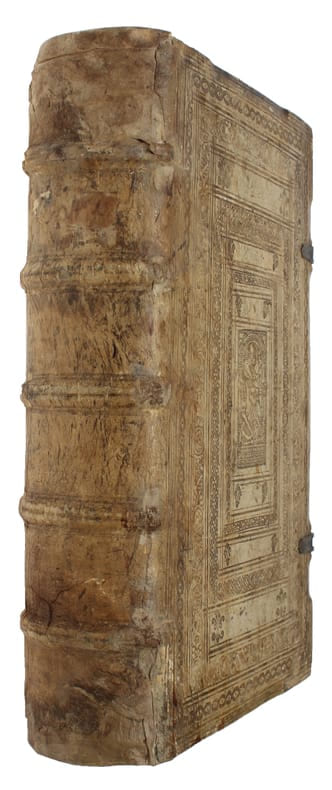
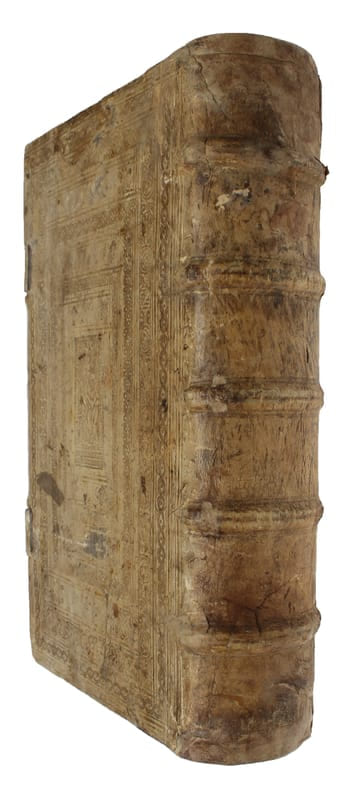
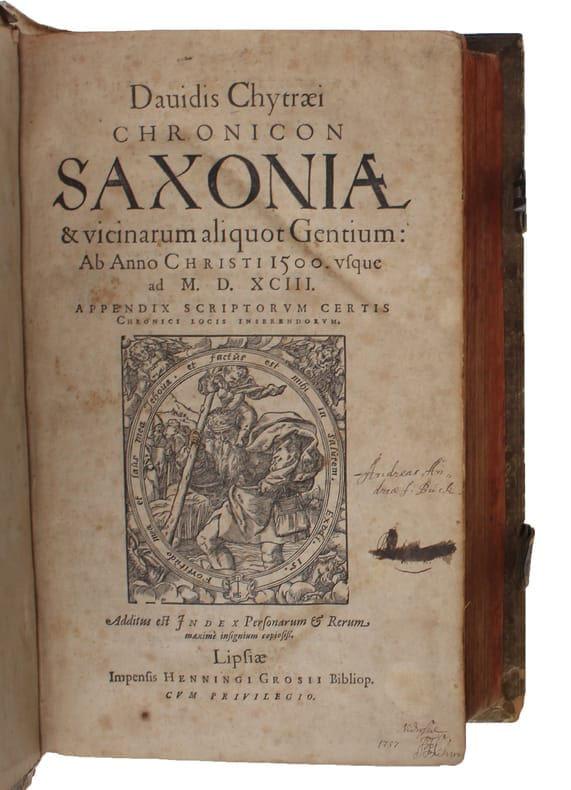
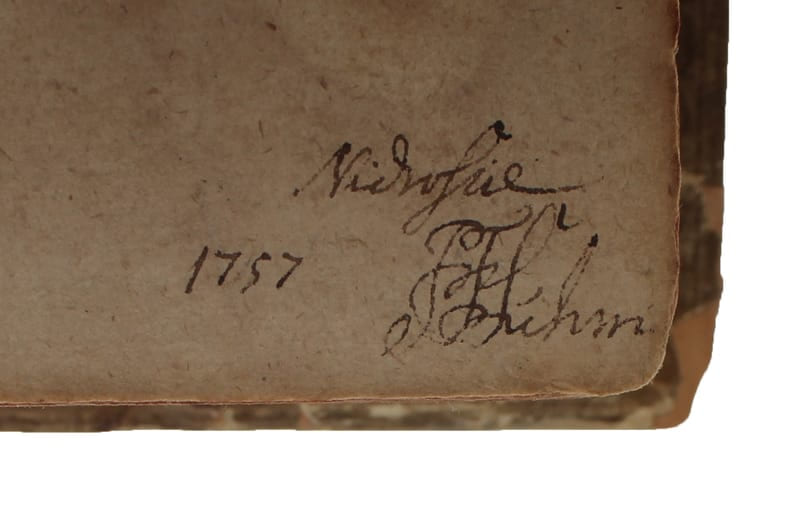
Leipzig, (Michael Lanzenberger)/ Henning Grosius, (1593). Folio. Contemp. full richly blindtooled pigskin over wood. 5 raised bands. Neath repairs to upper and lower compartments of spine. With 2 catches and 1 of 2 clasps.Title-page with large printers wood-cut device. XVIII,969,(24) pp. Printers wood-cut device repeated on last leaf. Various browning of sheets. A few ink-and brownspots. On lower right corner in Suhm's hand ""Nidrosie/ 1757/ P.F. Suhm"" (see notes below).
Reference : 52557
First edition of Chytraeus' ""Chronicle of Saxony and its Neighbouring Tribes: From 1500 up to 1593"", which constitutes the continuation of and commentary on Albert Krantz’s (1448–1517) historiographical works Vandalia and Saxonia. David Chytraeus (1530-1600) was a Lutheran professor of theology at Rostock. He had been a disciple of Philip Melancthon, a German Lutheran reformer and collaborator with Martin Luther. Chytraeus attended the lectures of Martin Luther on Genesis.He mediated between the warring Lutherans, organized a Lutheran church in Austria, and gained great influence through a catechism, Bible interpretations, and not least his historical work Chronicon Saxoniæ (The Saxon Chronicle). ""The Chronicon Saxoniæ, written in the manner of annals from a religious point of view, was appreciated in all Europe. In his very carefully prepared geanological labours Chytræeus was encouraged by Duke Ulrich, and in general his historical writings bear, so to speak, the official stamp of the duchy of Mecklenburg, as, following the custom of his time, he preferred to give the result of his researches in academical lectures."" (Loesche, pp. 116-117). The work is compiled from archival records, diplomatic correspondence, and regional eyewitness testimonies, focusing on verifiable sequences of political, military, and ecclesiastical developments.Peter Frederik Suhm (P.F. Suhm"" 1728-1798) was a Danish historian, writer and bibliophile. He lived in Trondheim (""Nidarosie"" in Old Norse), Norway, between 1751 and 1765. In 1752, he married Karen Angell (1732-88), daugher of a wealthy Norwegian merchant. While in Norway, he collected sources for a large, critical history of Denmark up to 1448. He continued these preparations after his return to Copenhagen. He also wrote numerous books on mythological and historical matters in the 1770s, as well as dramas and poetry inspired by them – as a young student he had written and translated comedies while studying at The University of Copenhagen, where Ludvig Holberg (1684-1754) had been his teacher. His monumental Historie af Danmark (History of Denmark), 1-14 (1782-1828) is characterized by extensive source references, as Suhm emphasized that authenticity takes precedence over the historian's own interpretations. In 1775, he opened his library for the public use – a dozen years before the Royal Library became publicly accessible in 1793. In 1796 he sold his approximately 90,000 books to the Royal Library.See:Loesche, G. (2020). Chytræus. In Jackson, Samuel Macauley (Ed.). New Schaff-Herzog Encyclopedia of Religious Knowledge (Vol. III: Chamier-Draendorf, pp. 116-117). Adams, C 1575. - Graesse II, 154.
Bookseller's contact details
Herman H. J. Lynge & Son
William Schneider
Silkegade 11
1113 Copenhagen
Denmark
+45 33 155 335
Payment mode
Sale conditions
All items may be returned for a full refund for any reason within 14 days of receipt.
1 book(s) with the same title
Chronicon Saxoniae & vicinarum aliquot Gentium: Ab Anno Christi 1500. usque ad M.D. XCIII. Appendix Scriptorum certis Chronici Locis inserandorum. Additus est Index Personarum & Rerum maximè insignium copiosiss. - [THE SAXON CHRONICLE]
Leipzig, (Michael Lanzenberger)/ Henning Grosius, (1593). Folio. Contemporary full vellum binding with visible spine bands at hinges. Small holes to boards, where the ties were attached. Handwritten name of the author on spine. Binding a little soiled and stained and with a small hole to middle of spine. Solid and sturdy. Old owner's names to title-page, all but one (J.B. Höserich) attempted erased (one of them leaving a small hole, not affecting printer's device or text) and a crowned ex library stamp. Last leaves with a small, marginal worm-hole. A mostly marginal damp stain throughout. Occasional marginal notes. Pasted-down end-papers with handwritten notes in brown ink, back end-paper with very extensive notes, including genealogical ones. Title-page with large woodcut printer's device. (2), XVIII, 969 pp., (11 - being 1 blank leaf + 10 leaves Index) ff.
First edition of Chytraeus' ""Chronicle of Saxony and its Neighbouring Tribes: From 1500 up to 1593"", which constitutes the continuation of and commentary on Albert Krantz’s (1448–1517) historiographical works Vandalia and Saxonia. David Chytraeus (1530-1600) was a Lutheran professor of theology at Rostock. He had been a disciple of Philip Melancthon, a German Lutheran reformer and collaborator with Martin Luther. Chytraeus attended the lectures of Martin Luther on Genesis.He mediated between the warring Lutherans, organized a Lutheran church in Austria, and gained great influence through a catechism, Bible interpretations, and not least his historical work Chronicon Saxoniæ (The Saxon Chronicle). ""The Chronicon Saxoniæ, written in the manner of annals from a religious point of view, was appreciated in all Europe. In his very carefully prepared geanological labours Chytræeus was encouraged by Duke Ulrich, and in general his historical writings bear, so to speak, the official stamp of the duchy of Mecklenburg, as, following the custom of his time, he preferred to give the result of his researches in academical lectures."" (Loesche, pp. 116-117). The work is compiled from archival records, diplomatic correspondence, and regional eyewitness testimonies, focusing on verifiable sequences of political, military, and ecclesiastical developments.See:Loesche, G. (2020). Chytræus. In Jackson, Samuel Macauley (Ed.). New Schaff-Herzog Encyclopedia of Religious Knowledge (Vol. III: Chamier-Draendorf, pp. 116-117). Adams, C 1575. - Graesse II, 154.


