Write to the booksellers
Ricardo, David
On the Principles of Political Economy, and Taxation.
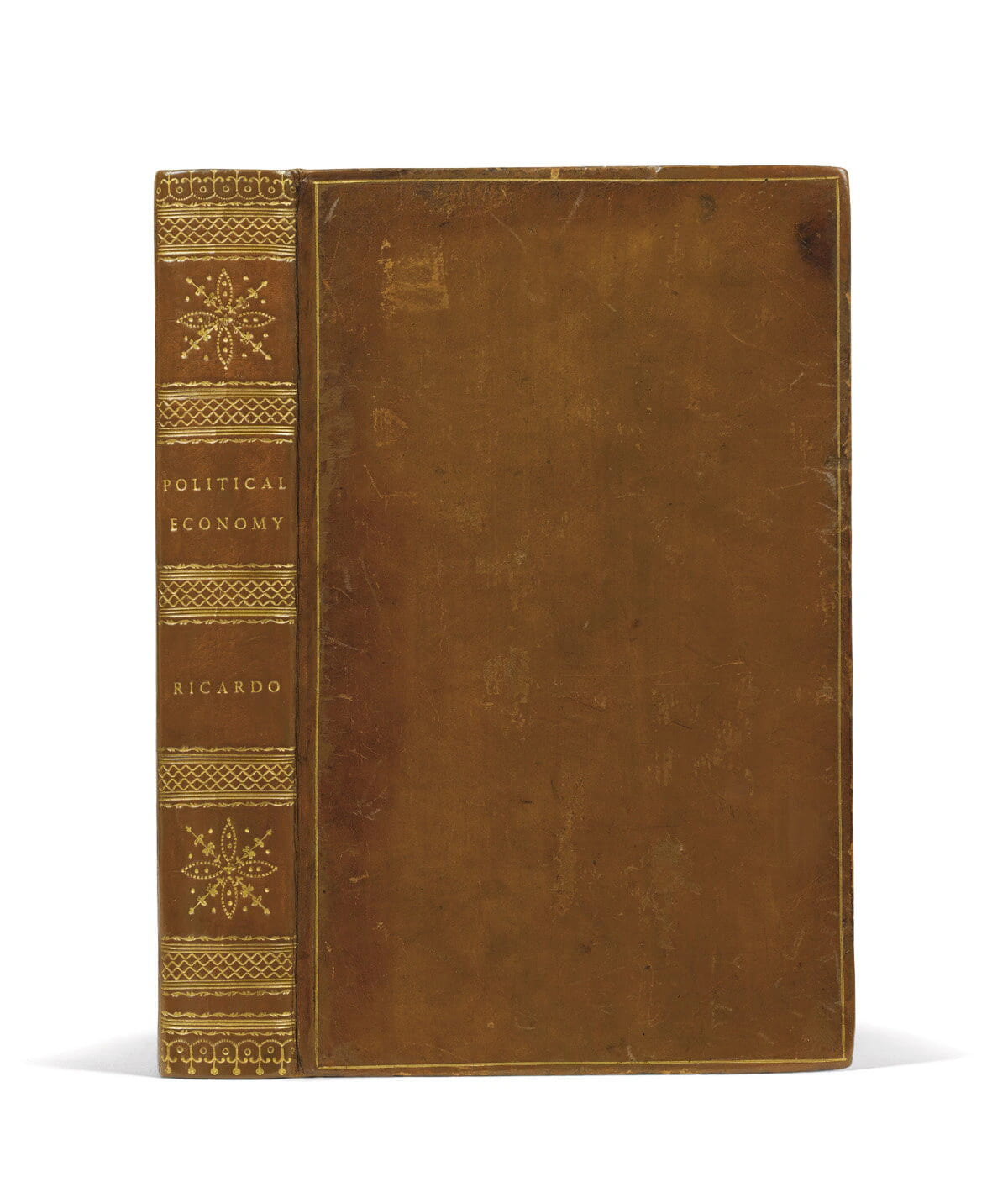
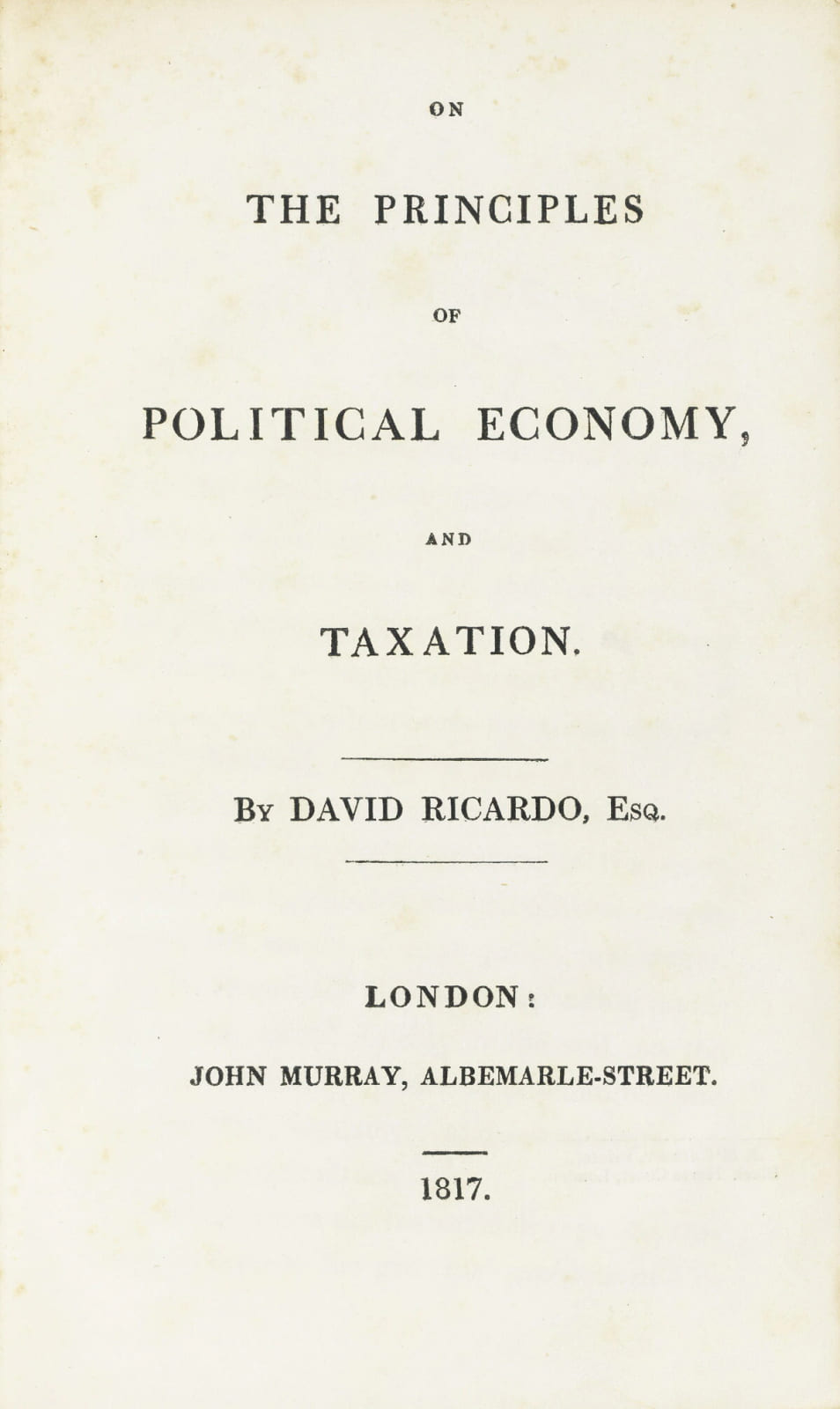
"A towering contribution to the development of political economy. The book that overcame 18th century doctrines, forever” (Books that made Europe). First edition, first printing of David Ricardo’s “On the Principles of Political Economy”. A nice copy kept in its contemporary binding. In-8 de VIII et 589 pp., (1) p. d’errata, (14) pp. Veau fauve, filet or encadrant les plats, dos lisse richement orné, coupes décorées, tranches jaspées. Reliure de l’époque. 211 X 130 mm. Ricardo, David. On the Principles of Political Economy, and Taxation. London, John Murray, 1817. First edition, first printing of David Ricardo’s most important contribution to the science of political economy. Goldsmiths, 21734 ; Kress, B7029 ; Mattioli, 3015 ; Einaudi, 4740 ; Books that made Europe, p.198 ; PMM, 277. "A towering contribution to the development of political economy. The book that overcame 18th century doctrines, forever” (Books that made Europe). "David Ricardo is without doubt the greatest representative of classical political economy. He carried the work begun by Adam Smith to the farthest point possible. In the opinion of his own contemporaries at home and abroad, Ricardo was acknowledged the leader of the science. His most important work is On the Principles of Political Economy and Taxation, first published in 1817" (Roll, History of Economic Thought, 155-6). "The fundamental ground-work of the Principles is based on the theory that, given free competition in trade, the exchange value of commodities will be determined by the amount of labour expended in production: not a wholly original thesis, nor one capable of absolute expression, but one which was given new force by the theory of distribution with which Ricardo reinforced it. This has been summarized thus: 'the demand for food determines the margin of cultivation; this margin determines rent; the amount necessary to maintain the labourer determines wages; the difference between the amount produced by a given quantity of labour determines profit'" (PMM) « Ricardo coordonna toutes ses idées économiques et financières dans ses « Principes de l’Economie Politique et de l’impôt ». La doctrine de la rente entrevue par Adam Smith, traitée en partie par James Anderson en 1777 puis par Malthus en 1815 est ici traitée de manière complète par Ricardo. L’ouvrage s’attache aux thèmes de l’impôt, de la rente foncière des profits et des salaires » (Ch. Coquelin, p.739). Ricardo considère que son enquête essentielle doit porter sur la détermination des rapports qui règlent la distribution des produits entre les différentes catégories sociales, détermination qu’il obtient en liant le problème de la distribution à celui de la valeur d’échange des biens, estimée d’après le travail nécessaire pour les produire. Les bases d’un système étaient posées, système dont, ensuite devaient se réclamer Marx pour édifier sa théorie du plus-value et les théoriciens de l’utilité. « David Ricardo est un de ces hommes qui prennent au sérieux les crises des sociétés et ses écrits nous le présentent comme un homme bien décidé à s’appuyer sur des réalités et à ne pas s’élancer dans les régions de l’idéal. Si sa phrase marche c’est pour arriver et non pour faire voir en marchant sa grâce et sa souplesse. En un mot et jusque dans ses Principes, Ricardo écrit sous la dictée des évènements et en vue d’un progrès réel, palpable » (A. Fonteyraud) Exemplaire conservé dans sa reliure de l’époque.
Reference : 19338
Bookseller's contact details
Librairie Amélie Sourget
Madame Amélie Sourget
29 rue de Condé
75006 Paris
France
01 42 22 48 09
Payment mode


Sale conditions
Chèque Carte Bancaire Nous assurons une garantie totale quant aux ouvrages que nous vendons : tous les livres proposés à la vente ont été préalablement collationnés, et leurs éventuels défauts sont toujours signalés. Conditions de vente conformes au règlement du SLAM et aux usages de la LILA (ILAB).
3 book(s) with the same title
Om Nationaloeconomiens og Beskatningens Grundsætninger. Oversat efter Originalens tredie Udgave af Sophus Fallesen. (On The Principles of Political Economy and Taxation. Translated from the third edition of the original by Sophus Fallesen). - [THE DISTRIBUTION OF WEALTH - A DEFENCE OF FREE TRADE]
Kjøbenhavn, Bianco Luno, 1839. 8vo. Nice comtemporary half calf with gilt lettering and ornamentation to spine. Minor wear to capitals and corners bumped. Light brownspotting to first and last leaves. A very fine and clean copy. (8), 470 pp.
Rare first Danish edition of the monumental main work by one of the absolutely most influential classical economists, David Ricardo, the systematizer of economics. The Danish translation is translated from the third edition, which appeared in 1821.David Ricardo (1772-1823) was born in London as the son of a Dutch Jew. Initially Ricardo was primarily interested in science and mathematics, but after having read Adam Smith's ""Wealth of Nations"" in 1799, he devoted himself entirely to political economy, and in 1817 he could publish his seminal work ""The Principles of Political Economy and Taxation"" (see PMM 277). Two years later, in 1819, Ricardo was elected to the Parliament, and became the House's acknowledged expert on economic affairs, -also as such he considerably influenced the opinion towards free trade.There are three classical economists, who must be said to have fundamentally changed political economy, and they are Adam Smith, Thomas Robert Malthus, and David Ricardo, -the three main founders of ""modern economic analysis"". On the basis of ""The Wealth of Nations"", classical political economy could be founded by Malthus and Ricardo, -in his ""Principles"". Ricardo was in doubt as to whether he should publish his later so exceedingly famous work, but was persuaded to do so by his friend James Mill, chief Apostle of the Utalitarians, and so he did in 1817, when the work presented the population of Great Britain with some very unexpected conclusions. Enlarging on the Physiocrats, Ricardo places the interest of the landlord and that of the community in the most violent opposition, -he states: ""the interest of the landlord is necessarily opposed to the interest of every other class in the community."" On the grounds of this theory, he gathered quite a number of opponents, who considered this the embodiment of injustice and strongly opposed of his theories. ""Ricardo, in his paradox to arrest attention, outlined the case for class war. It is one of the issues which John Stuart Mill will be forced to confront, and upon which Marx built his theory and makes his observations."" (Catlin, A History of the Political Philosophers, Ldn., 1950, p. 374). In opposition to Smith, Ricardo was not interested in the value as the principle for the equal exchange between differentiated individuals, but in it as the means of building up theories of the relation between wages, profits and rents and their distribution to landlords, capitalists and labourers, -thus developing the famous theory of ""labour as measure"". Against Malthus he opposes the interest of the agriculturalist as against that of the free-trading manufacturer, -one of his distinctive contributions to economics lies in expounding the monopoly theory of rent. ""Ricardo was, in a sense, the first ""scientific"" economist. Lacking Smith's warmth and sympathy for humanity and for the labourer in particular, Ricardo saw the study of economics as a pure science whose abstractions were capable of quasi-mathematical proof. Although his theorems remain hypothetical, his deductive methods have proved a great use in the elementary analysis of economic problems, currency and banking, it has proved a lasting value."" (Printing and the Mind of Man 277).The work is groundbreaking in numerous respects, one of them being that Ricardo here also sets out to establish paper-money, -he actualized this as well as the theory that the banks should convert its stock of gold into standardized gold bars, -this is the reason why the very first gold bars, as we know them, were called ""Ricardos""" the first was issued in 1820.The work has been immensely influential throughout Europe, and has had a strong effect on Danish liberal thought and politics.
On the Principles of political Economy, and Taxation.
London, John Murray, 1819. 8°. VIII, 550, (2) pp. (advertisement) Contemporary half calf with gilt back spane label (front cover loosen, rubbed and bumped).
Second edition. First published in 1817 in an edition of 750, this second edition has been published in 1000 copies. Mayor classic in the history of political economy. - Partly severly browned. Flying endpaper loosen.

Phone number : 41 (0)44 261 57 50
The principles of political economy and taxation
J.M. Dent & sons/E.P. Dutton. 1937. In-12. Relié. Etat d'usage, Couv. défraîchie, Dos satisfaisant, Papier jauni. xvi+300 pages. Nombreuses annotations en marges du texte et en pages de garde, à l'encre. Texte en anglais. Nombreuses rousseurs. Jaquette défraîchie. Coins frottés.. Avec Jaquette. . . Classification Dewey : 420-Langue anglaise. Anglo-saxon
Classification Dewey : 420-Langue anglaise. Anglo-saxon