 Write to the booksellers
SÉNÈQUE.
Opera quae extant omnia.
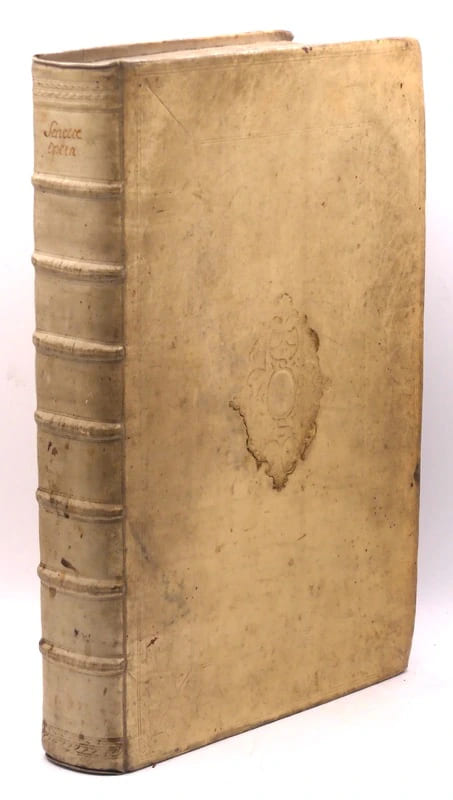
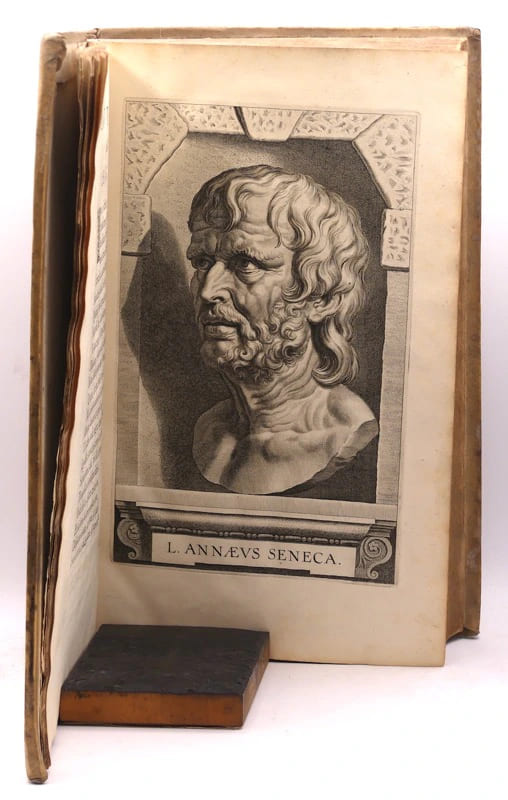
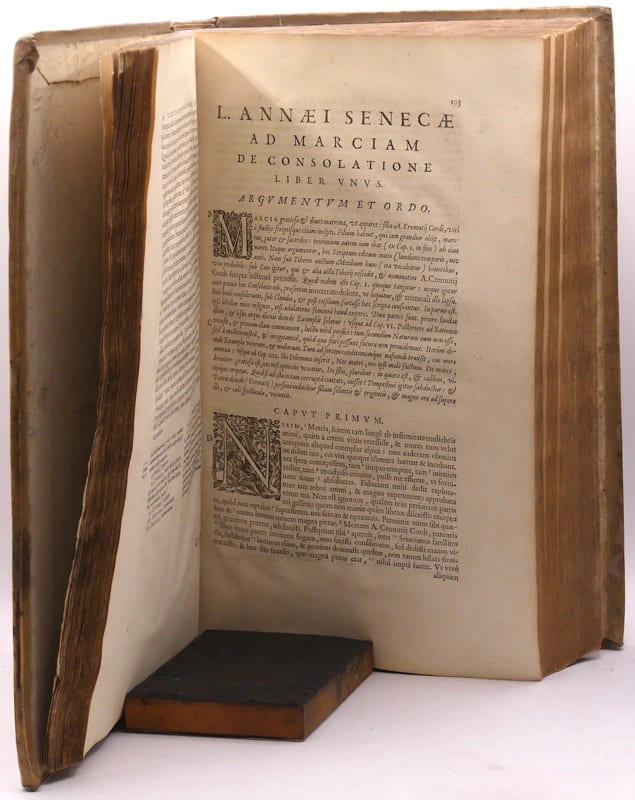
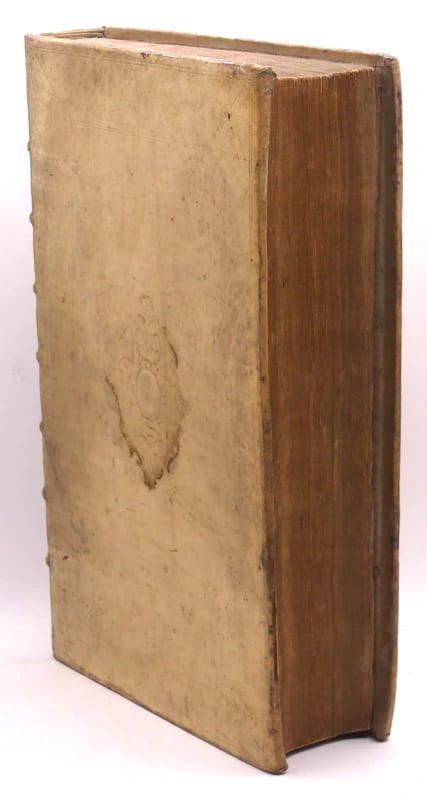
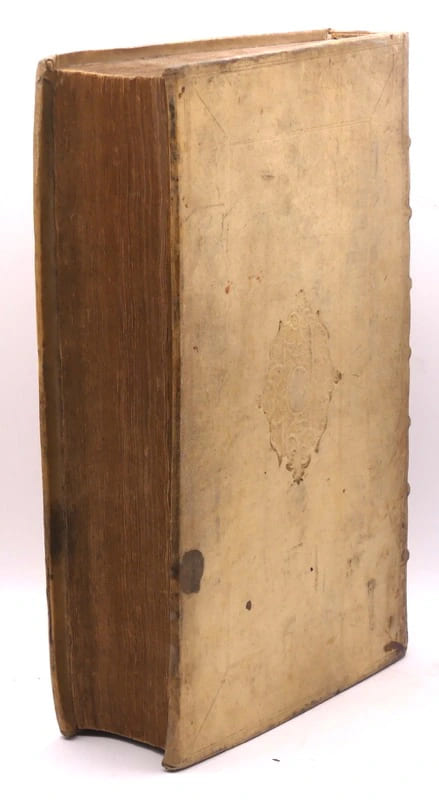
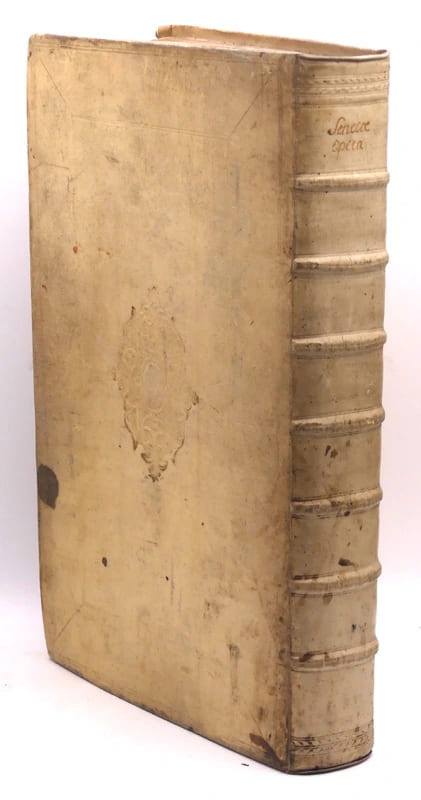
Anvers, Plantin-Balthasar Moretus, 1652. In-folio (242 x 450 mm), 10 ff. n. ch., XXXVI pp., 911 pp. Vélin rigide, double encadrement de double filet à froid et large fer estampé au centre des plats, dos à nerfs avec titre ancien à l’encre, petite mouillure marginale sur les premiers feuillets et mouillure angulaire sur les derniers feuillets, petite tache au plat inférieur (reliure de l’époque).
Reference : 7229
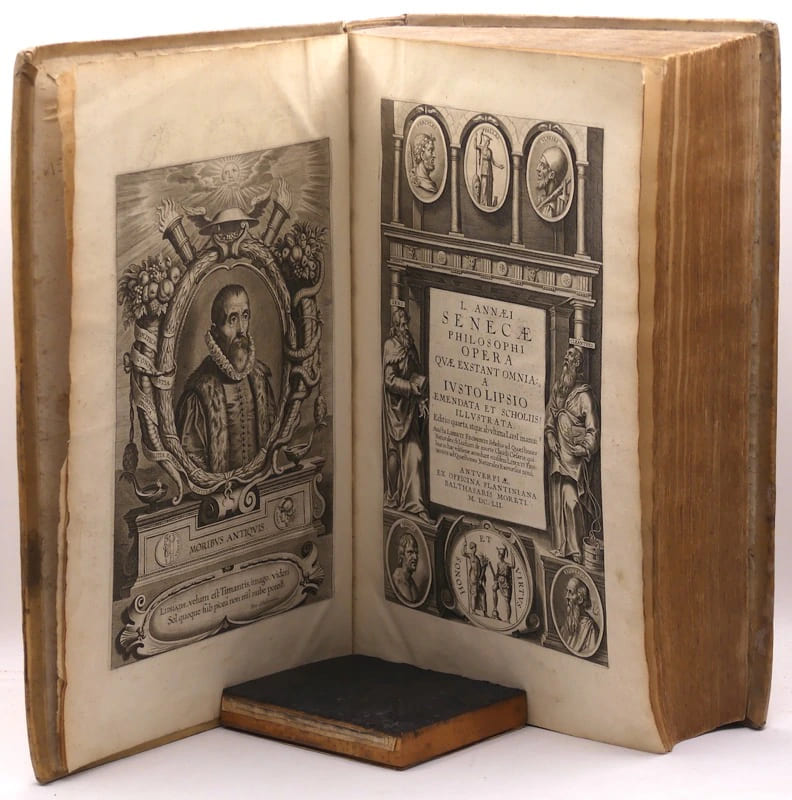
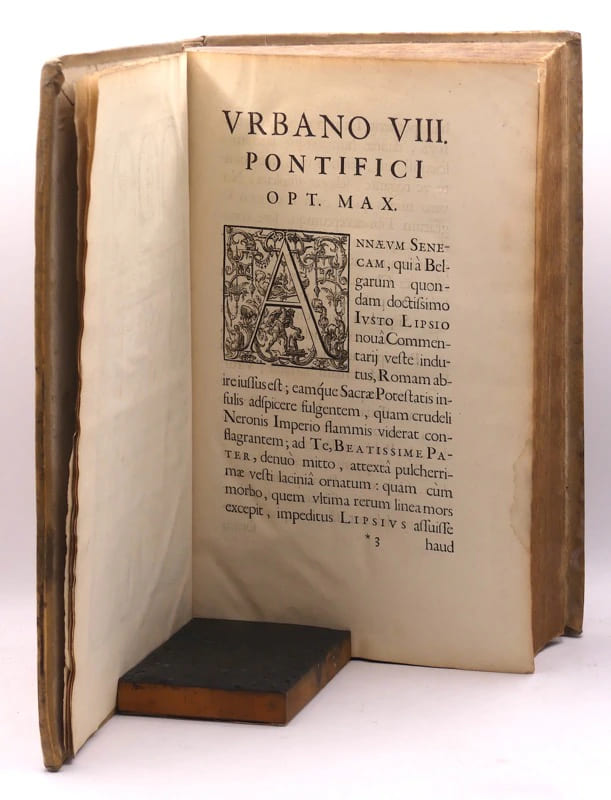
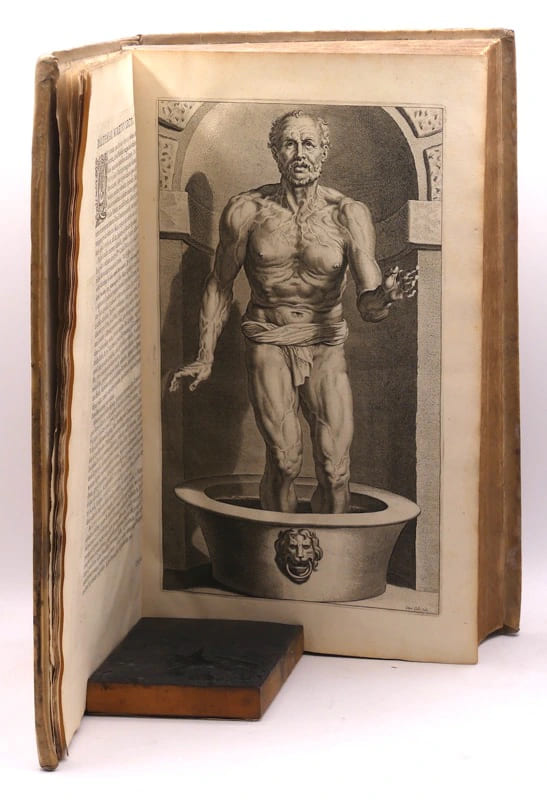
Belle édition plantinienne définitive de Sénèque par Juste Lipse. Edition illustrée d’un beau frontispice de Lipse par Cornelius Galle d’après Rubens, d’un titre-frontispice gravé baroque, d’un portrait frappant de Sénèque se donnant la mort sur ordre de Néron et d’un buste du même. Elle est encore agrémentée de bandeaux, culs-de-lampe et lettrines. C’est la quatrième édition plantinienne, contenant les oeuvres morales et philosophiques de Sénèque, revue et complétée par Libert Froidmont (1587-1653), théologien et scientifique liégeois, professeur à l’Université de Louvain. Au rapport de Brunet, “édition estimée. Les trois précédentes sont moins complètes”. Froidmont complète la grande œuvre de Lipse mort en mars 1606 avant d’avoir pu achever son grand oeuvre. Selon Jeannine De Landtsheer, “à Rome déjà, (Lipse) avait manifesté un intérêt grandissant pour Sénèque, auteur qu’il avait d’ailleurs régulièrement inscrit au programme de ses cours. Durant les années passées à Leyde, il rédigea deux traités philosophiques originaux, le De constantia (1584) et les Politica (1589), qui connurent tous deux un nombre considérable de rééditions et de traductions. Il essayait d’y concilier l’ancienne pensée stoïcienne avec les idées chrétiennes”. L’illustration et les commentaires de Lipse en font un parfait manuel de néo-stoïcisme. Notre exemplaire comporte bien l’état avec la dédicace au pape Urbain VIII où on appelle à considérer Sénèque l’auteur le plus sage de l’Antiquité et l’auteur profane le plus chrétien. Notes marginales anciennes p.113. Brunet, Manuel de l’amateur, IV, pp. 276-277. Dibdin, Introduction to the Knowledge… of Greek and Latin Classics, II, 397 (“Harwood speeks highly magnificence and beauty of the volume”). De Landtsheer, “Juste Lipse et son De bibliothecis syntagma”, Littératures classiques, 2008, pp. 81-91.
Bookseller's contact details
Librairie Pierre-Adrien Yvinec
M. Pierre-Adrien Yvinec
53, avenue de La Bourdonnais
75007 Paris
France
(0033) 143 674 644
Payment mode
Sale conditions
conformes à celles du Syndicat nationale de la Librairie Ancienne et Moderne
5 book(s) with the same title
PETRI ANDREAE MATTHIOLI MEDICI CAESAREI ET FERDINANDI ARCHIDUCIS AUSTRAIE OPERA QUAE EXTANT OMNIA : HOC EST COMMENTARII IN VI.LIBROS PEDACII DIOSCORIDIS ANAZARBEI DE MEDICA MATERIA
"SUMPTIBUS JOANISS KONIG. 1674. In-Folio. Relié plein cuir. Etat d'usage, Coins frottés, Coiffe en pied abîmée, Mouillures. Environ 100 pages + 1027 pages + 236 pages ""De ratione distillandia aquas ex omnibus plantis : et quomodo genuini odores in ipfisaquis conservarii pofsint"" - OUVRAGE EN LATIN - nombreuses gravures en noir et blanc dans le texte - traces de mouillures en début d'ouvrage sans conséquence sur la lecture - quelques rousseurs sans conséquence sur la lecture dû à l'année de l'ouvrage - dos à 5 nerfs - titre et caissons dorés sur le dos - coiffe en tête légèrement abîmée - mors légèrement abîmés - griffures et quelques épidermures sur les plats - OUVRAGE EN LATIN - 13 photos disponibles.. . . . Classification Dewey : 840.04-XVII ème siècle"
NOTA : Pietro Andrea Matthioli (ou Mattioli, Matthiole, Matthiolus) est un médecin et un botaniste italien, né le 23 mars 1501 à Sienne et mort vers 1578 à Trente de la peste - PETRI ANDREAE MATTHIOLI MEDICI CAESAREI ET FERDINANDI ARCHIDUCIS AUSTRAIE OPERA QUAE EXTANT OMNIA : HOC EST COMMENTARII IN VI.LIBROS PEDACII DIOSCORIDIS ANAZARBEI DE MEDICA MATERIA : ADJECTIS IN MARGINE VARIIS GRAECI TEXTUS LECTIONIBUS EX ANTIQUISSIMIS CODICIBUS DESUMPTIS QUI DIOSCORIDIS DEPRAVATAM LECTIONEM RESTITUUNT : A CASPARO BAUHINO BASILIENSI MEDICINAE PROFESSORE CLARISS POST DIVERSARUM EDITIONUM COLLATIONEM INFINITIS LOCU AUCTI : SYNONYMIIS QUOQ PLANTARUM ET NOTIS ILLUSTRATI ADJECTIS PLANTARUM ICONIBUS SUPRA PRIORES EDITIONES PLUS QUAM TRECENTIS AD VIVIUM DELINEATIS DE RATIONE DISTILLANDI AQUAS EX OMNIBUS APOLOGIA IN AMATUM LUSITANUM CUM CENSURA IN EJUSDEM ENARRATIONES EPISTOLARUM MEDICINALIUM LIBRI QUINQUE DIALOGUS DE MORBO GALLICO - EDITIO ALTERA. Classification Dewey : 840.04-XVII ème siècle


L. Annaei Senecae Opera quae extant omnia, a Iusto Lipsio emendata et scholiis illustrata. Editio quarta, atque ab ultima Lipsi manu. Aucta Liberti Fromondi scholiis ad Quaestiones Naturales, & Ludum de morte Claudii Caesaris, quibus in hac editione accedunt eiusdem Liberti Fromondi ad Quaestiones Naturales excursus novi.
Antwerp (Antverpiae), Ex officina Plantiniana Balthasaris Moreti, 1652.
Folio. (XVI),XXXVI,911,(1 blank) p.; portrait of Lipsius; engraved title; a bust of Seneca, and a plate of Seneca standing in a tub, both plates by C. Galle after Rubens. Calf 41 cm. (Ref: STCV: 6608951; Schweiger 2,902: 'Gesuchteste Ausgabe des Lipsius, aber nicht weiter als Wiederholung der von 1632'; Brunet 5,276/77: 'Édition estimée. Les 3 premières éditions, Antverpiae, ex off. Plantiniana, 1605, 1615 et 1632 sont moins complètes.'; Dibdin 2,397: 'excellent notes of Lipsius'; Moss 2,578: 'it is certainly a very elegant publication'; Fabricius-Ernesti 2,115; Ebert 20860: 'Beste und gesuchteste der von Lipsius besorgten Ausg.'; Graesse 6/1, 348/49: 'très recherchée'; Spoelder 642, Middelburg 4) (Details: Prize copy, but lacking the prize. Gilt back with 7 raised bands, red morocco shield in the second compartment. Borders of both boards gilt, and with the coat of arms of Middelburg in the center. Portait of Lipsius engraved by Cornelius Galle. Engraved architectural title, the text of it is flanked by the statues of Greek philosopher Zeno, the founder of the Stoic school, whose doctrine of suicide as a 'reasonable exit' from life in response to incurable disease or inexorable pain Seneca accepted, and Zeno's pupil Cleanthes; in the upper frieze reside pictures of Hercules, Pallas and Ulysses, at the feet of Cleanthes and Zeno are the portraits of Seneca and Epictetus. The full page 'Seneca standing in his bath', is engraved by Cornelius Galle, and made after the famous painting of Rubens, 'the death of Seneca'. The full page portrait of Seneca was engraved after a drawing of Rubens. A smaller engraved portrait of Seneca, 11.5x13.5 cm, on page XXIV after the Italian scholar and antiquarian Fulvius Orsinus (imago quae a Fulvio quidem Ursino prodita est). Woodcut initials. The 'Officina Plantiniana' issued 2 'Opera' editions of Seneca in 1652. This is the second issue, probably printed by Petrus III Bellerus for Balthasar Moretus. Bellerus printer's device is found on f. X6 verso and f. Y4 recto) (Condition: Binding somewhat scuffed and scratched. Front joint beginning to split. Head and tail of the spine chafed. Corners slightly bumped. The school prize has been removed. Edges of both flyleaves browning. Some leaves yellowing, a few are browning. Faint waterstain in the right margin of the last 6 gatherings) (Note: The Roman philosopher and politician Lucius Annaeus Seneca, ca. 4 BC - 65 AD, has ever since antiquity been controversial. He was 'attacked for his Latin style, his political compromises, and his wealth. (...) Seneca (...) devoted himself to philosophy, finally being charged with complicity in the conspiracy of Piso in 65. His suicide (ordered by Nero) is described by Tacitus (...). The death scene, 'imago vitae suae', 'the image of his life', has been a significant element in Seneca's influence on posterity. (...) His style was urgent, colourful and pointed, appropriate for the fragmented ethical and political ambiguities of his time, and it ultimately proved to be an effective vehicle for the Latin Church Fathers'. ('The classical tradition', Cambridige Mass., 2010, p. 873) By the 4th century Seneca's reputation, as an author and as a philosopher, had recovered. He is praised by Boethius (d. ca. 524), and has through the works of Cassiodorus (d. ca. 585) and Martin of Braga (d. ca. 579) influenced medieval and Renaissance philosophy. From the 13th century onward he was widely read, especially after the invention of printing. A Senecan Renaissance was advanced with the editions of Erasmus, who did much to improve the text. Seneca's reputation was further enhanced by the magnificent edition of his 'Opera', produced by the Flemish scholar Justus Lipsius, and published in 1605 by the Flemish 'Officina Plantiniana', lead by Balthasar Moretus. This edition and the later ones of 1615, 1632 and 1652 were adorned with elaborate title pages and portraits engraved by T. Galle and C. Galle. The worth of Lipsius' editions lies in the preface and commentary. 'His commentary, while economical by modern standards, was fuller than that by Erasmus. Lipsius died before he could finish his commentary on 'Quaestiones Naturales'. The first edition of Lipsius' Seneca (1605) included a commentary by M.A. Muretus (d. 1585), replaced by that of Libertus Fromond in later editions. The introductory paragraphs to each section of Seneca's prose were lucid, concise, and often enthusiastic. 'Legite iuvenes senesque!' is a frequent exhortation, typical of Lipsius' primary goal, which was to teach'. (Idem, p. 875) 'Moretus had been Lipsius' student, and he was a friend of Peter Paul Rubens whom he commissioned to design, for the 1615 edition and its successors, a portrait of Lipsius and two full-page engravings of Seneca, one of an ancient bust believed to be of Seneca, and owned by the artist, and the other of Seneca entering the bath in which he died. The latter engraving was related to Rubens's 1608 painting of Seneca's death, which further spread the fame of Seneca as a martyr to tyranny who died true to his philosophical principles'. (Idem, ibidem) Justus Lipsius, the greatest Latin scholar of his time, came in 1579 to the recently founded University of Leyden (1575) to teach Latin. He resided there with great distinction as honorary Professor of History from 1579 till 1591. According to J.E. Sandys his greatest strength lies in textual criticism and exegesis. (J.E. Sandys, History of Classical Scholarship, N.Y., 1964, vol. 2, p. 303). Lipsius edited only Latin prose writers. He was not attracted to Latin verse. The 'Opera omnia' of this edition do not include Seneca's tragedies) (Collation: (*)-2*4, A-C6, A-4G6 (leaf 4G6 verso blank); leaf *1 portr. Lipsius, *2 engraved title, 2*3 Seneca in bath, 2*4 bust of Seneca) (Photographs on request) (Heavy book, may require extra shipping costs)
C. Sallustii Crispi Opera, quae extant, omnia : cum selectissimis Variorum Observationibus, et Accurata Recensione Antonii Thysii ICti.
Lugd. Batavorum, Apud Franciscum Hackium, 1654. In-8, rel. postérieure (XIXe), pleine-basane fauve, dos lisse orné, pièce de titre de maroquin rouge, tranches mouchetées ; titre gravé-[13]ff.-546pp.-[25]ff.
Texte et notes en latin. Dos et coupes frottés, qq. ff. brunis, bon ex. - Frais de port : -France 5,7 € -U.E. 8 € -Monde (z B : 12 €) (z C : 22 €)
Ailianou ta heuriskomena hapanta. Claudii Aeliani praenestini pontificis et sophistae, qui Romae sub imperatore Antonio Pio vixit aut Meliphtongus ab orationis suauitate dognominatus, opera, quae extant, omnia
Apud Gesneros fratres ( Gessner) | Tiguri (Zurich) 1556 | 20 x 31.50 cm | relié
Première édition chez cet éditeur. Marque de l'imprimeur Andréas Gesner en page de titre et sur le verso du dernier feuillet ; cette marque étant également présente au verso du feuillet précédant l'index. Edition bilingue avec impression à double colonne, le grec d'un côté, la traduction latine de l'autre ; les deux colonnes en grecs forment le milieu du livre. Edition réalisée par Conrad Gesner, naturaliste suisse célèbre, imprimée par Andréas Gesner et mis dans le commerce de la librairie par Hans Jakob Gesner. Au colophon : Tiguri per Andream Gesnerum f. et Iacobum Gesnerum fratres.Les traductions du grec sont de Theodore Gaza (1400-1475),de Sebastian Guldenbeck (mort en 1565) et Pierre Gilles (1490-1555). Le texte De militaribus est illustré de plusieurs figures in-texte, d'une grande planche à double page (camp militaire). On remarquera également les belles lettrines historiées. Exemplaire aux armes estampés de l'université de Paris, sur le plat supérieur : trois fleurs de lys, sur le plat inférieur deux plumes se croisant. Reliure en pleine basane brune du XVIIe. Dos à nerfs richement orné (ors en partie estompés). Une pièce de titre en maroquin rouge, une seconde en maroquin brun. Mors fendus avec divers manques. Coiffes arasées. Coins émoussés. Page de titre consolidé au verso en marge. Une bande de papier ancienne au milieu sur les premiers feuillets. Feuillet 605 restauré en marge. Edition qui rassemble les oeuvres de Claude Elien, orateur et historien romain écrivant en langue grecque, mort en 235. Il ne nous reste que deux des oeuvres d'Elien, De la nature des animaux (De natura animalium) en 17 livres, et qui est un livre d'histoire naturelle, l'auteur y citant70 espèces de mammifères, 109 espèces d'oiseaux, une cinquantaine de reptiles et environ 130 poissons (Pierre Gilles et Conrad Gesner en sont les commentateurs). La seconde oeuvre d'Elien s'intitule Histoire variées (Variae historiae), c'est un recueil d'anecdotes sur des sujets fort variés (Commentateur : Justus Vultejus). L'édition donne également un troisième texte d'Elien, De Militaribus, mais Claude Elien n'en est en fait pas l'auteur, il s'agit d'Elien le tacticien, écrivain grec qui vivait un siècle auparavant, mais qui n'a été identifié qu'au XIXe siècle ; son traité de tactique est fort précieux, c'est un exposé sur l'armée macédonienne à l'époque hellénistique. ce traité sera promu à un bel avenir durant la Renaissance, et depuis sa première traduction latine en 1487 par Thedore Gaza, que reprend l'édition de Gesner dans une présentation par Robortello qui date de 1552. Les ouvrages de Claude Elien sont en fait des compilations d'anecdotes curieuses extraites d'auteurs anciens, mais qui ont le mérite de nous renseigner sur nombre d'auteurs rares ayant disparu. Ce type d'ouvrage sera par ailleurs abondamment copié et plagié durant la Renaissance, notamment par Polydore Vergil, Le livre des inventeurs des choses qui rassemble également des connaissances dans tous les domaines dans le style anecdotique. In fine, l'ouvrage, désireux d'être absolument exhaustif sur l'auteur romain rassemble également une correspondance d'Elien qui nous est parvenue : Epistolæ rusticæ, dans une traduction de Guldenbeck. - Photographies et détails sur www.Edition-Originale.com -
L. Annaei Senecae philosophi stoicorum omnium acutissimi Opera quae extant omnia, Coelii Secundi Curionis uigilantissima cura castigata & in nouam prorsus faciem, nimirum propriam & suam, mutata: quorum lectio non modò ad bene dicendum, uerumetiam ad bene beatéque uiuendum prodesse plurimùm potest. Index rerum & uerborum copiosus.
Basilea, Per Ioannem Hervagium, et Bernardum Brandum, anno 1557, Mense Augusto. In-folio de [16]-759 (chiffrées 761)-[16] pages ( collation: ��8; a-z6; A-Z6;Aa-Ss6-Tt4 ). Plein vélin souple du temps, dos lisse orné de filets et fleurons dorés, large fleuron doré au centre des plats, attaches.
Belle édition avec des commentaires et des notes de Erasmus, Celio Secondo Curione, Fernando Vázquez Menchaca, Rodolphus Agricola, Hadrianus Junius, et Beatus Rhenanus. Jolies lettrines historiées gravées sur bois. Petite galerie d'insecte au premier cahier; mouillures claires, charnières faible. Inscriptions sur la page de titre. Graesse VI, 347; VD16 S 5763.

