 Write to the booksellers
BOUZY Alain
La loi de la guillotine
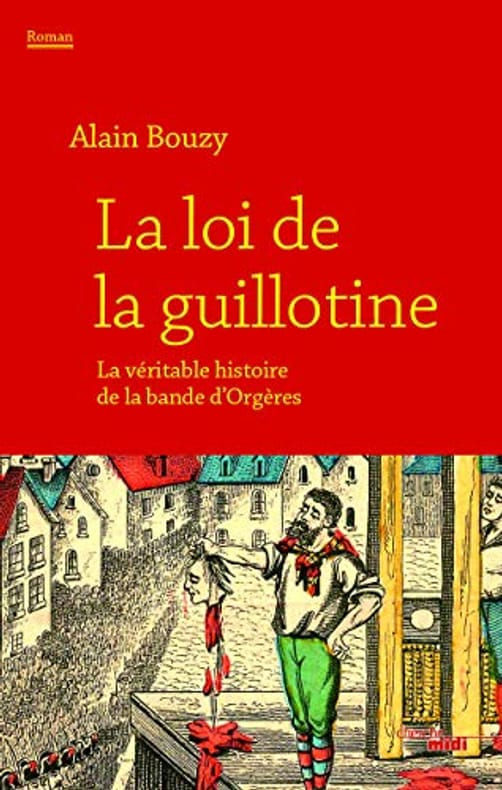
Cherche midi 2016 528 pages 22x14x4cm. 2016. Broché. 528 pages.
Reference : 61204
ISBN : 9782749140773
MERCI DE LIRE L'ANNONCE JUSQU'A LA FIN !! Le livre présente des traces de stockage et d'usure mais reste en état correct d'ensemble. Expedié soigneusement depuis la France
Bookseller's contact details
Démons et Merveilles
M. Christophe Ravignot
contact@demons-et-merveilles.com
07 54 32 44 40
Payment mode

Sale conditions
Rapidité d'envoi Tous nos articles sont expédiés le jour même de la confirmation de la commande Soin de l'emballage Un soin particulier est apporté à l'emballage, vos objets voyagent en toute sécurité. A votre écoute Si toutefois un incident devait survenir lors de l'acheminement de votre paquet, n'hésitez pas à nous contacter, nous mettrons tout en oeuvre pour vous satisfaire, en vous proposant un retour, un remboursement ou toute autre soluton à votre convenance. Professionnalisme Les livres que nous vendons sont pour la plupart des livres anciens, nous tâchons d'être le plus objectif possible quant à leur état.
5 book(s) with the same title
La loi de la guillotine La véritable histoire de la bande d'Orgères.
Le Cherche Midi France 2016 In-8 ( 220 X 145 mm ) de 535 pages, broché sous couverture illustrée. Très bel exemplaire.
La loi de la guillotine - la véritable histoire de la bande d'Orgères
2016, Cherche Midi, in-8 broché, récit | Etat : bon état (Ref.: ref97803)
Cherche Midi
La loi de la guillotine - la véritable histoire de la bande d'Orgères
2016, Cherche Midi, in-8 broché, récit | Etat : bon état (Ref.: ref99412)
Cherche Midi
LOI 1791 LOUIS XVI - PEINE DE MORT & GUILLOTINE - ABOLITION DE LA MARQUE - RARE
LOI 1791 LOUIS XVI - PEINE DE MORT & GUILLOTINE - ABOLITION DE LA MARQUE - RARE Loi révolutionnaire imprimée, relative à la peine de mort, à celle de la marque et aux délais accordés à l'accusé, donnée à Paris le 30 décembre 1791. Texte promulgué au nom de Louis XVI, par la grâce de Dieu et par la Loi constitutionnelle de l'État, Roi des Français , sur décret de l'Assemblée nationale des 26 et 27 septembre 1791. Le document ouvre sur un bandeau gravé de style révolutionnaire, surmontant le titre LOI, suivi de l'article premier énonçant que dès à présent la peine de mort ne sera plus que la simple privation de la vie , disposition qui s'inscrit dans la réforme humanisante du droit pénal à la veille de l'an II. La loi abolit également la peine de la marque et fixe les délais de recours en cassation, avec sursis à exécution durant ces délais. Impression réalisée à Chartres, chez Fr. Labalte, libraire-imprimeur de l'Évêché et du département d'Eure-et-Loir. Le texte est complet sur un double feuillet de papier vergé filigrané, avec mentions de certification administrative et signatures imprimées (Foreau, président ; Barré, secrétaire). Datation d'exécution et de certification début 1792. Il s'agit d'un texte juridique majeur de la Révolution française, directement lié à l'évolution de la peine capitale et au nouveau droit pénal révolutionnaire, antérieur à la mise en application généralisée de la guillotine. Ce type de loi imprimée, destinée à l'affichage et à l'enregistrement dans les districts, constitue un témoignage direct du fonctionnement législatif et administratif de la France révolutionnaire. * Dimensions : 27,5 x 21,8 cm* État : Bel état général, plis marqués, salissures anciennes, taches, usures et petites fragilités en bordures, sans manque de texte. Voir photos et description pour plus de détails.* Nombre de pages : 3 pages
Loi relative à la peine de mort, et au mode d’exécution qui sera suivi à l’avenir. Donnée à paris, le 25 mars 1792. - [AUTHORIZING THE GUILLOTINE AS FRANCE'S STANDARD METHOD OF EXECUTION]
(Paris, L'Imprimerie Royale, 1792). 4to. Stitched in later marbled wrappers, with printed book label ""Collection Quarré-Reyboyrbon, Lille"" to inside of front wrapper. Contemporary handwritten inscription above head-piece ""Bon pour imprimeur chez M. Descamps Douay le 12 avril 1792."" (presumably in the hand of Quarré-Reybourbon). A bit of brownspotting and soiling, but overall very nice. 4pp.
Scarce first printing of the legal document that led to the guillotine becoming France's standard method of judicial execution. This groundbreaking decree of the National Assembly, given 20 March 1792, suspended all pendig death punishments and authorized the use of necessary expenses to achieve a more humane method of execution throughout the kingdom. The methods for achieving this humane form of execution is explained in the the annexed text signed by Antoine Louis (see below), the permanent secretary of the Academy of Surgery. The decree is as follows: “The National Assembly, considering that the uncertainty regarding the method of execution of Article III of Title 1 of the Penal Code, suspends the punishment of several criminals who are sentenced to death" that it is urgent to put an end to inconveniences which could have unfortunate consequences" that humanity requires that the death penalty be as painless as possible in its execution, decrees that there is an emergency.” The Penal Code of 1791, title 1, article 3 (Tout condamné aura la tête tranchée, “Every condemned person will have their head cut off”) should be executed “according to the manner indicated and the method adopted by the consultation signed by the Permanent Secretary of the Academy of Surgery, which remains annexed to this decree” and the National Assembly “consequently authorizes the Executive Power to incur the necessary expenses to achieve this method of execution, so that it may be uniform throughout the Kingdom.” (p. 1) Prior to 1791, under the Ancien Régime, there existed a variety of means of capital punishment in France, depending on the crime and the status of the condemned person. In 1791, there was a campaign towards the abolition of the death penalty, but later that year, The National Assembly refused to pass such a law. However, torture was abolished and a single method of execution was declared, that of beheading, which had previously only been applied to nobles. In 1791-92, the development of a mechanical beheading device was set in force by a committee in order to make the death penalty ""as painless as possible in its execution"" and ""uniform throughout the kingdom”. Note that before the use of a mechanical beheading device, manual beheading and a variety of other methods of execution had been in force in France. Ironically, what is now known as the guillotine was developed with the help from Louis XVI – who was a skilled amateur locksmith – with regards to the shape of the blade. This change towards a more painless method was ignited by physician Joseph-Ignace Guillotin in October 1789 at the National Assembly. Later, a committee was formed under Antoine Louis, the inventor of the guillotine, and physician to the King and Secretary to the Academy of Surgery. This committee included Guillotin, and although he did not invent the guillotine and opposed the death penalty, his name became an eponym for it. After its adoption, the device remained France's standard method of judicial execution until the abolition of capital punishment in 1981. The last execution with a guillotine in France took place in 1977.


