 Write to the booksellers
Pascal
Les Provinciales
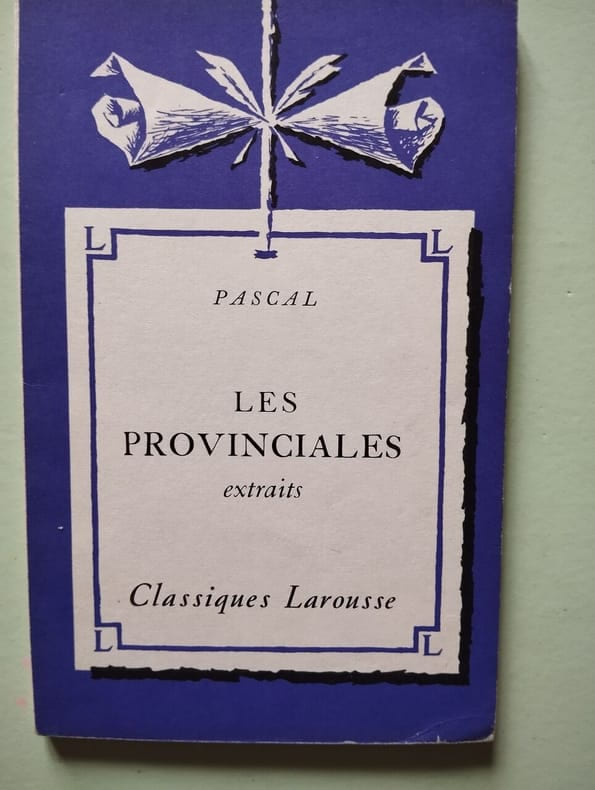
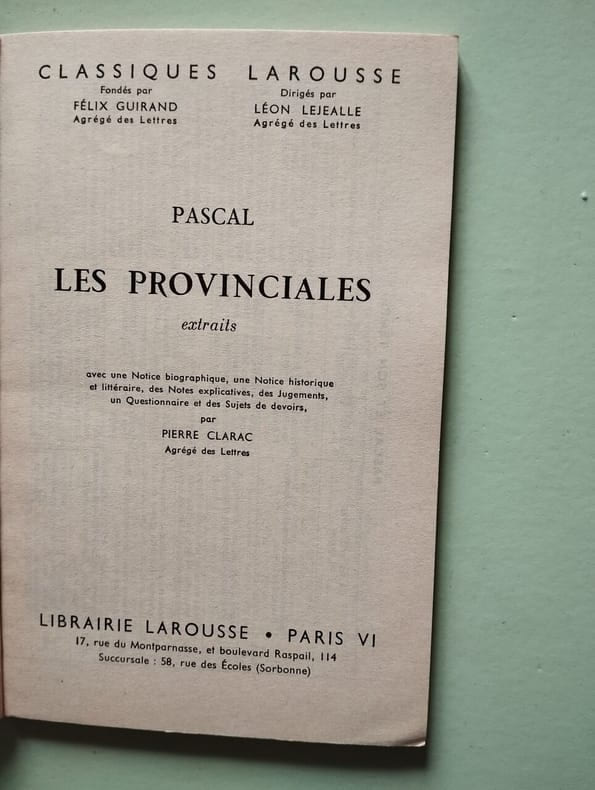
Larousse 1940 1940.
Reference : 500336302
Bom estado
Bookseller's contact details
Démons et Merveilles
M. Christophe Ravignot
contact@demons-et-merveilles.com
07 54 32 44 40
Payment mode

Sale conditions
Rapidité d'envoi Tous nos articles sont expédiés le jour même de la confirmation de la commande Soin de l'emballage Un soin particulier est apporté à l'emballage, vos objets voyagent en toute sécurité. A votre écoute Si toutefois un incident devait survenir lors de l'acheminement de votre paquet, n'hésitez pas à nous contacter, nous mettrons tout en oeuvre pour vous satisfaire, en vous proposant un retour, un remboursement ou toute autre soluton à votre convenance. Professionnalisme Les livres que nous vendons sont pour la plupart des livres anciens, nous tâchons d'être le plus objectif possible quant à leur état.
5 book(s) with the same title
Provinciales
Editions Le Livre De Poche 1970 190 pages 1970. 190 pages. Provinciales est le premier roman de Jean Giraudoux publié en 1909. Il s'agit d'un livre de jeunesse composé de chapitres ou de nouvelles reliés par l'unité de lieu de la province française. L'œuvre introduit un style impressionniste dans le roman explorant l'enfance et la vie provinciale
Bom estado
Provinciales.
aldes 1926 Aux Aldes, Paris, 1926, 1 volume in-4 de 255x 325 mm environ, 121 pages, (1) f. (Justification du tirage). Un des 122 exemplaires numérotés sur Vergé de Rives, complet des 9 aquarelles à pleine page (tirage des ateliers d'art Nevet) de la peintre Geneviève GALLIBERT. Demi maroquin à coins, grain long, couleur havane (reliure signée mais marque en partie effacée), plats en suédine brune, dos lisse portant titres bruns à froid, tranche de tête dorée, gardes marbrées, couvertures conservées. Un petit manque de cuir au dos, coiffes et coins légèrement frottés, discrètes griffures sur les plats, intérieur en très frais, bel exemplaire malgré les défauts signalés.
Premier roman de Jean Giraudoux, paru en 1909. Merci de nous contacter à l'avance si vous souhaitez consulter une référence au sein de notre librairie.
Apologie des Lettres Provinciales de Louis de Montalte ; contre la dernière réponse des Jésuites, intitulées Entretiens de Cleandre et d'Eudoxe.
A Delft, chez Henry van Rhin, Marchand-Libraire et Imprimeur, 1698, 2 volumes (en 2 partie chacun), reliés en 1 tome in-12 de 160x95 mm environ, xxiv-334 pages, 2 ff. de table, 2 ff. blancs, vii-(titre avertissement)-336 pages (avec 4 ff. de titre et avertissement entre les pages 192 et 193, qui annoncent la quatrième partie), 2ff. de table, 3ff. blancs, pleine basane granitée brune, dos à nerfs portant titres dorés, orné de caissons à fleurons et motifs dorés, coupes dorées, tranches mouchetées. Des rousseurs et pages brunies, des erreurs de pagination sans manque, début de fente et petits trous de ver sur un mors et au bas du dos, une coiffe ébréchée, frottements d'usage sur le cuir, sinon bon état.
Matthieu Petit-Didier (18 décembre 1659, Saint-Nicolas-de-Port , Lorraine , 17 juin 1728, Senones ) était un théologien bénédictin français et historien ecclésiastique. Le père Mathieu Petit Didier, après avoir été éduqué chez les Jésuites rejoignit les bénédictins, fut chancelier de l'université de Pont à Mousson et enfin directeur de conscience de Christine de Suède. Merci de nous contacter à l'avance si vous souhaitez consulter une référence au sein de notre librairie.
Ludovici Montaltii Litteræ Provinciales, de Morali & Politica Jesuitarum disciplina. A Willelmo Wendrockio Salisburgensi theologo, e gallicâ in latinam linguam translatæ, et theologicis notis illustratæ, quibus tum jesuitarum adversus Montaltium criminationes repelluntur: tum præcipua theologiæ moralis capita à novorum casuistarum corruptelis vindicantur.
Coloniæ, Apud Nicolaum Schouten (Leiden, Jean Elzevier), 1658. (32), 608 pp. 8vo. Contemporary overlapping vellum, handwritten title to spine. Willems 829; Brunet, iv, 396; Tchemerzine-Scheler, v, p. 69; Peignot, Livres Condamnés, ii, 27; En Français dans le Texte 96; PMM 140 (both for the original edition). First Latin edition of the famous Lettres Provinciales, translated by Pierre Nicole (and with additions (p. 510-608) by Pierre Nicole (as "Willem Wendrockius" and as "Paulus Irenaeus")), published under the pseudonym Wilhelm Wendrock, a few months after the original French edition and just as that edition forbidden (by the Conseil d'État on September 23, 1660) and burnt. The book was printed by Jean Elzevier "pour le compte de ses parents d'Amsterdam" who had very good relations with the jansenists and were about to publish the first collective edition of the Provinciales (see Willems). Born in 1623, Pascal came under Jansenist influence in 1646. 'In 1654, after a period of discouragement and repeated meditations, he underwent a mystical experience which effected his definite conversion to a religious life ..... He now, in 1655, took up his residence in Port Royal ..... Attacks by the Jesuits on the Jansenist cause and on Antoine Arnauld led to the publication in 1656-7 of eighteen Lettres de Louis de Montalte à un Provincial de ses amis et aux RR. PP. Jesuites sur la morale et la politique de ces peres; they were composed by Pascal and are known as his Lettres provinciales. They deal with two subjects: divine grace, and the ethical code of the Jesuits ... Against the relaxed morality which the Jesuits were said to teach, he makes a vigorous appeal to public opinion by means of quotations from Jesuit works and by dialogues in which Jesuits are made, by their admissions, to cast discredit on themselves. The Lettres provinciales, written with polite irony and the utmost simplicity, lucidity, and objectivity, were an enormous success and dealt the Jesuits a blow from which they never recovered. The work was placed on the Index and was ordered by the Royal Council to be burnt (1660)' (Oxford Companion to French Literature, p. 541).After his mystical experience Pascal brought into this new existence "the gift of concrete precision which was the mark of his genius. The Lettres Provinciales are masterpieces of both the esprit de géométrie and the esprit de finesse. The first carried to the extreme the demands of a morality that was sincerely Christian and did not permit of serving two masters at the same time; the second unmasked one by one the abstract formulae, seemingly framed for juridical and secular purposes, behind which lay hidden the complaisance of the casuists. He forced the faithful Christian to scrutinize his own conscience, laying bare the depths of desire and the libido which testifies to the persistence of the original sin. (.....) If the influence of Pascal, which has been decisive in the history of positive science, in the history of French literature and in the history of Christian thought, continues to be felt in our own days, the reason is that no work invites us more to pass byond discursive abstractions and to uncover by direct contact with the realities of nature and of the soul the springs of vivifying intuition (Léon Brunschvicg in ESS, vol 12, pp. 7-8).'L'ouvrage le plus lu à son epoque, Les Provinciales ont contribué à imposer un art d'écrire classique' (En Français dans le Texte).'The Lettres Provinciales, as they are called, are the first example of French prose as we know it today, perfectly finished in form, varied in style, and on a subject of universal importance ... Pascal's weapon was irony, and the freshness with which the gravity of the subject contrasts with the lightness of the manner is an enduring triumph. The vividness of and distinction of his style recalls the prose of Milton at its best' (Printing and the Mind of Man). - Provenances: Guillaume Hoffman with engraved ex-libris "G.H.", manuscript ex-libris C. Stahl and a small stamp in blank portion of the title "Bibl. Familiæ Pajacsich."


(NVVA, )
Phone number : 31 20 698 13 75

