 Write to the booksellers
LUCAIN (Marcus Annaeus Lucanus) / AMAR DU RIVIER (Jean-Auguste, corr.)
Pharsalia
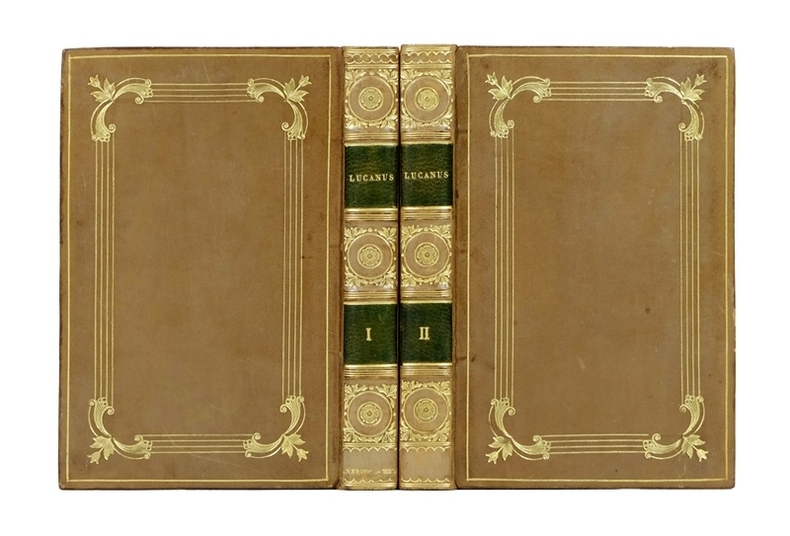


Parisiis Lefèvre 1822 2 vol. grand in-32° (121 x 82 mm), veau crème, dos à 4 nerfs orné, encadrement d'un filet sur les plats avec large décor aux fers, filet sur les coupes, triple-filet intérieur avec fer en écoinçons, tranches dorées (HERING. & MUL[LER], reliure de l'époque).
Reference : 123
Édition imprimée sur grand raisin vélin satiné dans une fine reliure des relieurs Hering & Muller Belle édition imprimée sur grand raisin vélin satiné dans une fine reliure des relieurs associés parisiens Hering & Muller. Cette édition fait partie de la collection intitulée « scriptores latini principes » dont elle forme les tomes XVI et XVII. Cette collection fut imprimée par Pierre Didot l'Ainé dans le souci d'en faire la remplaçante et l'égale par sa perfection typographique des éditions de petits formats exécutées par les Elzévirs au XVIIème siècle. Elle donne aussi l'un des textes les plus corrects, confié au bon soin de Jean-Augustin Amar du Rivier (1765 - 1837), homme de lettres, professeur émérite et traducteur, il enseigna les belles-lettres dans plusieurs collèges, notamment au lycée Henri IV, et fut nommé en 1803 conservateur de la bibliothèque Mazarine. La collection se compose de 45 volumes publiés de 1821 à 1826 regroupant les principaux auteurs latins : Tacitus, Sallustius, Nepos, Florus, Plinius secundus, Cicero pour les prosateurs et Terentius, Lucresius, Virgilius, Prospertius, Horatius, Ovidius, Phaedrus, Lucanus pour les poètes. Lucain (en latin Marcus Annaeus Lucanus, 39 - 65 ap. J.-C.) est un poète latin fécond, neveu du philosophe Sénèque, dont seule une oeuvre nous est parvenue : le Bellum civile (La Guerre civile), que la tradition a pérennisé sous le titre de Pharsale, une épopée en 10 chants, demeurée inachevée, sur la guerre civile ayant opposé César à Pompée au Ier siècle avant notre ère. Pharsale fut la ville où César vainquit Pompée. Dos légérement passé, rousseurs à la fin du tome Ier et au tout début du tome II ; Ramsden -103 - Fléty - 91.
Bookseller's contact details
Librairie-Galerie Emmanuel Fradois
M. Emmanuel Fradois
5 rue du Cambodge
75020 Paris
France
contact@livresetmanuscrits.com
+336 72 05 01 03
Payment mode
Sale conditions
Our conditions of sale are in accordance with the customs of the profession. All books or works are guaranteed to conform to the description. Any claim, to be valid, must be made within fourteen days of receipt. Payment can be made by check, bank transfer or credit card. Prices are net, in euros, plus postage if applicable. Free packaging. All orders placed by telephone must be confirmed by e-mail or mail.
5 book(s) with the same title
M. Annaei Lucani Cordubensis Pharsalia, sive belli civilis libri decem. Cum scholiaste, hucusque inedito, et notis integris Henrici Glareani, Jacobi Micylli, Joachimi Camerarii, Hugonis Grotii &c. Et excerptis (...) aliorumque observationibus. Curante Francisco Oudendorpio, qui suas etiam adnotationes, & copiosos indices adjecit.
Leiden (Lugduni Batavorum), Apud Samuelem Luchtmans, 1728.
4to. 2 volumes: (LXXIV),966 (recte 968);(CIVC, indices) p.; folding map. Vellum 26 cm 'A valuable edition, containing the ancient scholia, select notes of ancient and modern editors' (Ref: STCN ppn 238571637; Schweiger 2,564; Dibdin 2,186; Moss 2,242; Fabricius/Ernesti 2,146/47; Brunet 3,1200; Graesse 4,273; Ebert 12349) (Details: Backs with 5 raised bands. Boards blind tooled. Title in red and black. Luchtman's woodcut printer's mark on the title, it depicts Pallas Athena leaning on her shield, the aegis; the motto: 'Tuta sub Aegide Pallas'. Folding map of the ancient world. 3 engraved text illustrations) (Condition: Vellum somewhat soiled. The front joint of volume 1 has a crack of 4 cm. Ownership's inscription on the title. Bookplate removed from the front pastedown. Some slight foxing. Frontispiece removed) (Note: When the first three books of the only surving work of the Roman poet Marcus Annaeus Lucanus, 39-65 A.D., the epic 'Bellum Civile' or 'Pharsalia', were published in 62 or 63, the emperor Nero was not amused, because it was great poetry, and because it contained eloquent denunciations of tyranny. The epic was on the civil war between Caesar and Pompeius, a war that ended the Roman republic. Lucan soon joined the conspiracy of Piso against the emperor Nero, and was forced to commit suicide on its disclosure, spring 65. The remaining books of the 'Pharsalia', the last, book 7 being unfinished, were published posthumously after the death of Nero. 'Beginning with the causes of the war between Caesar and Pompey, it carries the story beyond the death of Pompey until it breaks off with Caesar's occupation of Pharos in Egypt. The battle of Pharsalos is related in book 7. (...) All the resources of rhetoric are enlisted to impress the reader; vehement declamation and brilliant epigrammatic utterances (sententiae) are everywhere in evidence. There are numerous digressions, many of them making a display of curious learning'. (OCD 2nd ed. p. 620) Lucan made Pompey a tragic hero and evoked sympathy for him and his lost republican cause. The climax of the story is the battle at Pharsalos. According to Rose, the 'Pharsalia' contains 'some of the finest rhetoric ever written in verse'. (H.J. Rose, A handbook of Latin literature, London 1967, p. 380) The philosophy of the Pharsalia is Stoic. Lucan was during the Middle Ages a popular school-author, he survives in ca. 300 manuscripts. His afterlife is interesting. At the beginning of the Renaissance he was placed by Dante alongside Homer, Horace and Ovid. 'For the Renaissance, Lucan provided an important precedent for composing epics about comparatively recent historical events, and more remarkably (...) for epics whose sympathies favor the losing side'. Lucan's republicanism made him in the 17th century unsuitable for incorporation in the series 'editions for the Dauphin', the crown prince of France, while on the other hand the poet was admired by Voltaire for his libertas. This edition of 1728 was produced by the Dutch classical scholar Franciscus Oudendorp, 1696-1761, who was, according to Sandys, the last of the great latinists of his age. For the last 20 years of his life he was professor of Eloquence and History at the University of Leiden. He consulted for his edition 17 manuscripts and also old editions, adding his own remarks and annotations, and he published the very useful old scholiasts of Lucanus, the 'Adnotationes super Lucanum', a series of short notes on Lucan's Pharsalia dating from the Middle Ages, here for the first time. Oudendorp restored many places with the help of the 'Adnotationes', often offering them as his own ideas and conjectures, 'mori aetatis suae indulgens'. (Adnotationes super Lucanum, edidit I. Weber, Leipzig, 1909, p. V) Nevertheless, the English scholar A.E Housman observed in the introduction to his Lucan edition of 1926 that Oudendorp's edition is the most solid and valuable, though not in all respects the most important. He was, according to Housman, 'in common sense, sobriety of judgment, and fairness of temper, (...) the best of Lucan's annotators') (Provenance: On the title in ink: 'Bibliothecae FF Min. Hib. Conventus Pontanensis, 1895'. This book once belonged to the library of the monastery of the Fratres Minores (Friars Minor) in the Irish city of Drogheda. See for the long and turbulent history of this monastery highlanes.ie/Content.aspx?PageID=71. There we read that a new friary (residence) was opened on St. Laurence Street in 1840. At that time the Franciscan community consisted of four priests assisted by two tertiaries. The conventus of the friars became in 1860 a Noviciate, that is, a training school or university for members of religious orders, and remained so until 1877. The scholarly interest of the friars did not wane, as is shown by the entry of this book in 1895) (Collation: Volume 1: +6 (minus leaf +6), 2-3+4; *-6*4, folding map, A-3R4, 3S4 (after leaf 3S1 leaf chi1, the half title of the second volume), 3T-6E4, 6F4 (minus blank leaf 6F4); a-2a4, 2b2 (minus blank leaf 2b2)) (Photographs on request) (Heavy book, may require extra shipping costs)
Marci Annaei Lucani Pharsalia, eiusdem ad Calpurnium Pisonem poemation. Praemittitur notitia literaria studiis Societatis Bipontinae. Editio secunda auctior et emendatior. (Bound with:) T. Petronii Arbitri Equitis Romani Satiricon, cum supplementis Nodotianis. Accedunt veterum poetarum catalecta. Praemittitur notitia literaria studiis Societatis Bipontiae. Editio accurata.
Ad 1: Zweibrücken (Biponti), Ex typographia Societatis, 1807. Ad 2: Zweibrücken (Biponti), Ex typographia Societatis, 1790.
8vo. 2 volumes in 1: XLVIII,277,(1 blank); XXXVI,252 p. Half calf 21 cm (Ref: Ad 1: Burkard p. 91/93; Schweiger 2,566; Dibdin 2,188: 'elegantly executed book'; Moss 2,243: 'a very neat and correct edition'; Ebert 12355; Graesse 4,274; Ad 2: VD18 11361557; Burkard 125/27; Schweiger 2,725; Dibdin 2,278: 'neat edition, and useful for presenting us with a valuable Notitia literaria'; Ebert 16527; Graesse 5,240) (Details: Back ruled gilt, and with a red morocco shield. Ad 1: The preliminary pages contain a 2 short biographies of Lucanus (p. I-IX), and a 'notitia literaria, including a long and up to date critical bibliography of editions, and translations, the 'index editionum' (p. X-XLVIII); the Pharsalia take up p. 1-265, followed by the 1st century A.D. Latin verse panegyric in praise of a member of the Piso family, 'Laus Pisonis' (p. 267-277). This panegyric has been attributed to Lucan, but also to Ovid, Bassus and Statius. Ad 2: The preliminaries contain a 'Live' of Petronius (p. III-VIII), followed by a 'Notitia Literaria', or a critical bibliography of important editions (p. X-XXXVI). The Satiricon fills the p. 1-214, the 'Petronii fragmenta' p. 215-225. At the end a collection of fragments of ancient Latin poets, the 'Veterum poetarum catalecta' (p. 227/52). An engraved vignette adorns the title, depicting a man and woman on a 'chaise longue', and a girl and boy standing beside them) (Condition: Binding slightly scuffed)(Photographs on request)
The Pharsalia. Translated and published by Edward Ridley. 2 vols.
London, Humpreys, 1919, in-4to, XXVIII + 277 p. / VII + 315 p., title pages in red and black type, with early owners name on endpapers, orig. half-cloth, spine bit stained with paper labels. - Generally a good copy.
New version of this latin-english parallel edition. -The Pharsalia, "an epic in 10 books, which was left unfinished at Lucan's death, carries the story of the civil war between Caesar and Pompey down to the arrival of Caesar in Egypt after Pompey's death". Lucan, a great Latin poet, nephew of Seneca, died aged 26 after being implicated in Piso's conspiracy against Nero. Encycl. Brit. XIV/455

(SLACES, NVVA)
Phone number : 41 (0)26 3223808
LA PHARSALE [La guerre civile].[Pharsalia] Civilis Belli.
Venetiis apud Aldum Mense Aprili M.DII, (Venise, publiée par Alde l'Ancien) Edition de 1502, in-12 de 165x100x20 mm environ, 140 ff. n. ch. (signatures a-r8, s4 y compris le colophon), caractères italiques, reliure postérieure, pleine basane acajou, titres dorés sur dos lisse, orné de petites frises dorés avec date et nom de l'imprimeur en queue, encadrement des plats d'une frise dorée. Une ancienne étiquette de librairie des signatures et des notes manuscrites sur les pages de gardes, traces d'encre sur la tranche supérieure, des feuillets un peu salis, reliure restaurée sur le dernier plat, début de fente sur les mors, quelques trous de ver sur le cuir et dans l'ouvrage (sans atteinte au texte).
Lucain (en latin Marcus Annaeus Lucanus), né le 3 novembre 39 à Cordoue, en Hispanie ultérieure, et mort le 30 avril 65, est un poète latin dont la seule uvre conservée, La Pharsale, est une épopée sur la guerre civile ayant opposé Jules César à Pompée entre 49 et 48 av. J.-C. Il se suicide à 25 ans, sur l'ordre de Néron. Merci de nous contacter à l'avance si vous souhaitez consulter une référence au sein de notre librairie.

