 Write to the booksellers
Lawrence Durrell
NUNQUAM
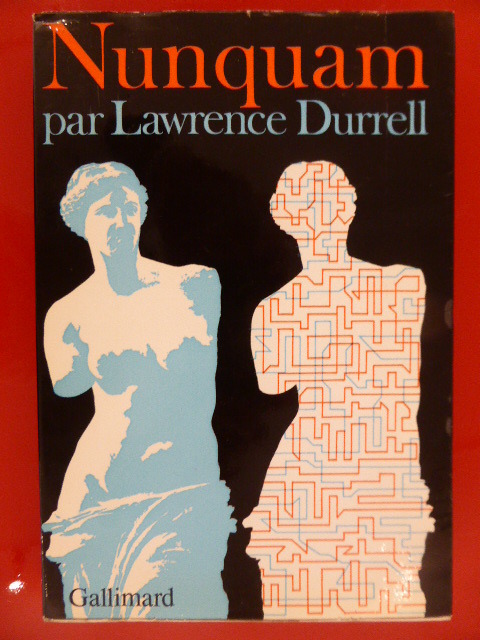
IN8 broché, 329p, 1970
Reference : LIT049C21
TBE
Bookseller's contact details
Librairie du Levant
M. Yannick RENAUD
15 rue Marengo
64100 Bayonne
France
+33 5 59 03 69 40
Payment mode


Sale conditions
We accept payments in € by bank transfers, remote Credit Card, Paypal or checks. Checks made payable to and addressed to: Librairie du Levant 15 rue Marengo 64100 Bayonne France Bank transfers to: Banque Courtois, 1 pl du Réduit 64100 Bayonne / RIB / 10268 02696 62711600200 13 / IBAN / FR76 1026 8026 9662 7116 0020 013 / SWIFT BIC / COURFR2T PAYPAL via the address: librairiedulevant@orange.fr For any remote payment by Credit Card, informations communicated are automatically deleted as soon as payment is made and validated. Shipping upon receipt of payment. Member of the Syndicat des Libraires Anciens et Modernes (SLAM) and of the International League of Antiquarian Booksellers (ILAB), our sales are made according to the customs of the profession. All our books and objetcs are guaranteed to conform to the description which appears in each sheet; if, as a result of an error or an oversight, this was not the case, order will be taken back (within fifteen days) and reimbursed (including the costs of redirection), provided that it is returned in the same condition as the purchase. For obvious technical reasons (format, colors, cropping, viewing angle, etc.), the photographs presented on this site are not contractual. Our prices are in Euros, packaging included. Shipments, made under the responsibility of the buyers, are made by Colissimo Post, registered with insured value from € 50 and up to € 5,000 (delivery against signature, package tracking and insured value); for works less than 50 €, shipments are made by registered letter; works whose value exceeds € 5,000 must be sent by special carrier with insured value and delivery against signature. For any shipment outside mainland France, shipping and insurance costs remain the responsibility of the customer. Shipments are made under the same conditions set out above. Possibility to collect the orders on site. Do not hesitate to keep up to date with our news, finds, curiosities, catalogs and various thematic lists by leaving your contact details by email at librairiedulevant@orange.fr
5 book(s) with the same title
Nunquam
Gallimard 1970 329 pages in8. 1970. broché avec jaquette. 329 pages. Nunquam raconte l'histoire de la résurrection de Iolanthe une prostituée d'Athènes devenue star d'Hollywood dont on fabrique une réplique parfaite sous forme de robot doué de mémoire et de libre arbitre plus 'réel' peut-être que l'original
Bon état
nunquam
Folio 1980 1980. Lawrence Durrell: Nunquam/ Folio 1980 . Lawrence Durrell: Nunquam/ Folio 1980
Etat correct
Omnium fere Gentium nostrae aetatis habitus, nunquam ante hac aediti. Illustration de la mode de la Renaissance, reliée en maroquin brun de Chambolle-Duru.
Bel exemplaire à grandes marges. Ferdinando Bertelli, Aeneis Typis Excudebat Venetiis, Anno 1563. In-4 comportant 1 titre gravé et 60 planches gravées sur cuivre. Maroquin brun janséniste, dos à nerfs, double filet or sur les coupes, roulette intérieure dorée, tranches dorées sur marbrure. Chambolle-Duru. 210 x 163 mm.
Première édition de ce « Recueil rare composé de 60 planches chiffrées ». Brunet, I, 815. Vinet 2085 ; Rahir 229 ; Cicognara 1588; Lipperheide 2. «Volume d’une grande rareté» (Vinet, Bibliographie méthodique et raisonnée des Beaux-arts). « Recueil de costumes gravés sur cuivre par Ferdinand Bertellius. Le volume comprend un titre gravé ornementé et 60 pl. numérotées de costumes d’hommes et de femmes.» «Première édition de cet ouvrage célèbre, presque inconnue. Les planches sont plus larges que celles des éditions suivantes, elles mesurent 104 x 154 mm, 118 x 156 mm, 98 x 152 mm, tandis que les planches postérieures de mesurent qu’à peu près la moitié». « Recueil précieux, composé de 60 planches. Les exemplaires qu’on rencontre ordinairement sont à la date de 1569, et les planches sont chiffrées». Colas mentionne 1 titre gravé et 64 planches gravées sur cuivre, chiffrées 1 à 60. Le recueil contient en fait 1 titre et 60 planches, certains exemplaires contenant des planches « sans numéro qui n'appartiennent peut-être pas à cette suite. » Brunet. Ces planches, d'environ 155 x 105 mm, représentent chacune un personnage masculin ou féminin dans un encadrement. Un panneau de bois suspendu à la branche d'un arbrisseau porte la légende. Les gravures illustrent la mode « Renaissance » de la péninsule italienne, de l'Espagne, des pays allemands et slaves, de la France mais aussi de la Turquie, de l'Éthiopie et des pays riverains de la méditerranée. Bel exemplaire à grandes marges.

Scholia medica ad totidem & antè nunquam vulgatas consultationes et responsiones. Quas partim author, partim alii, praecipue in Bavaria celeberrimi archiatri privatim & diversis temporibus exararunt.
2 Teile in 1 Band. München, Johann Jäcklin, 1673. Folio. 13 n.n. Bl., 196 S., 4 n.n. Bl., 200 S., 7 n.n. Bl. Index., 1 Bl. Druckermarke. Mit gestochenem Frontispiz und einem gestochenen Textkupfer. Pergamentband der Zeit mit goldgeprägter Deckelfiletierung und handschriftlichem Rückentitel.
Hirsch-H. V, 555. - Lesky 652. - VD 17, 12, 165656M. - "Sein Hauptwerk bildet eine Sammlung eigener Erfahrungen, mit denen anderer berühmter, meist alter Aerzte über die am häufigsten vorkommenden Krankheiten und zeugt von dem Bestreben, die Ergebnisse der anatomischen und physiologischen Forschungen der 1. Hälfte des 17. Jahrhunderts für die Behandlung derselben zu verwerthen". (Hirsch). Thiermair war der führende Mediziner Bayerns im 17. Jahrhundert, Leibarzt des Kurfürsten, Organisator des akademischen Unterrichts und Spitalgründer. Das Kupfer am Ende des ersten Abschnitts zeigt die 1673 in München geborenen siamesischen Zwillinge. Mit einem hübschen allegorischen Frontispiz. - Vereinzelte schwache Stockflecken. Der Einbandrücken fachgerecht wohl schon im 19. Jahrhundert erneuert. - Sehr gutes Exemplar.

Phone number : 41 (0)44 261 57 50
Scholia medica ad totidem & antè nunquam vulgatas consultationes et responsiones. Quas partim author, partim alii, praecipue in Bavaria celeberrimi archiatri privatim & diversis temporibus exararunt.
2 Teile in 1 Band. München, Johann Jäcklin, 1673. Folio. (14) Bl., 196 S., (4) Bl., 200 S., (7) Bl. (Index), 1 Bl. Druckermarke. Mit gestochenem Frontisp. und einem gestochenen Textkupfer. Pergamentband aus der Zeit.
Hirsch-H. V, 555. – Lesky 652. – VD 17, 12, 165656M. – Krivatsy 11789. – Erste Ausgabe mit handschriftlichem Schenkungsvermerk des Verfassers, datiert 1673 auf dem Vorsatz sowie handschriftlichem Besitzervermerk des Kapuzinerordens München auf dem gestochenen Titel. «Sein Hauptwerk bildet eine Sammlung eigener Erfahrungen, mit denen anderer berühmter, meist alter Aerzte über die am häufigsten vorkommenden Krankheiten und zeugt von dem Bestreben, die Ergebnisse der anatomischen und physiologischen Forschungen der 1. Hälfte des 17. Jahrhunderts für die Behandlung derselben zu verwerthen» (Hirsch-H.). Thiermair war der führende Mediziner Bayerns im 17. Jahrhundert, Leibarzt des Kurfürsten, Organisator des akademischen Unterrichts und Spitalgründer. Das Kupfer am Ende des ersten Abschnitts zeigt die 1673 in München geborenen siamesischen Zwillinge. Mit einem hübschen allegorischen Frontispiz. – Vereinzelt etwas fleckig. Mit wiederholter Wurmspur, meist am Rand. Einband fleckig. Schliessbänder ausgerissen.
Phone number : 41 (0)44 261 57 50

