 Write to the booksellers
-
Type
Book (11836)
Magazine (105)
Maps (1)
-
Latest
Last 24h (2)
Last 3 days (4)
Last month (57)
Last week (20)
-
Language
Dutch (1)
English (5)
French (11926)
German (2)
Italian (4)
Portuguese (1)
Spanish (3)
-
Century
16th (5)
17th (8)
18th (35)
19th (406)
20th (5182)
21st (1111)
-
Countries
Belgium (1212)
Canada (1)
China (1)
Côte d'Ivoire (69)
Denmark (15)
France (9837)
Germany (1)
Switzerland (806)
-
Syndicate
ALAC (1)
CLAM (2)
ILAB (6007)
NVVA (351)
SLACES (351)
SLAM (5636)
SNCAO (2)
Le Suicide.
PUF (Presses Universitaires de France). 2ème édition. 1967. In-12. Broché. Etat d'usage, Couv. légèrement passée, Dos satisfaisant, Intérieur frais. 461 pages. Quelques cartes en noir et blanc dans le texte. Charnière fendue en coiffe de pied. Tampons.. . . . Classification Dewey : 301-Sociologie
Bibliothèque de Philosophie Contemporaine. Etude de sociologie. Classification Dewey : 301-Sociologie
"Le suicide (Collection ""Quadrige"", n°19)"
Presses universitaires de France. 1995. In-8. Broché. Etat d'usage, Couv. convenable, Dos satisfaisant, Intérieur frais. 463 pages. Quelques annotations au crayon dans le texte. Un ex-libris au crayon sur la page de garde.. . . . Classification Dewey : 301-Sociologie
"Collection ""Quadrige"", n°19. Classification Dewey : 301-Sociologie"
Le suicide. Etude de Sociologie.
QUADRIGE / PUF. 1991. In-12. Broché. Très bon état, Couv. fraîche, Dos satisfaisant, Intérieur frais. 463 pages.. . . . Classification Dewey : 301-Sociologie
"Collection ""Quadrige"". Classification Dewey : 301-Sociologie"
Le suicide - Etude de sociologie
Presses Universitaires de France, 1986, in-8 br., 463 p., coll. "Quadrige", quelques passages soulignés, sinon bon état.
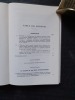
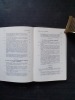
Voir le sommaire sur photos jointes.
LE SUICIDE. Etude de sociologie
Paris Presses Universitaires de France P.U.F. 1969 in 8 (21,5x13,5) 1 volume broché, 463 pages, avec des figures dans le texte. Collection '' Bibliothèque de Philosophie Contemporaine '. Emile Durkheim, 1858-1917. Huitième édition. Bon exemplaire
Bon Broché
Le suicide - Etude de sociologie.
Quadrige / PUF. 2007. In-8. Broché. Etat d'usage, Couv. légèrement pliée, Coiffe en tête abîmée, Papier jauni. 463 pages - coins frottés.. . . . Classification Dewey : 301-Sociologie
Classification Dewey : 301-Sociologie
Le suicide. Etude de sociologie.
Paris : Presses Universitaires de France, 1973. Un volume in-8°, broché.
[25186]
Le Suicide. Etude de sociologie.
PUF, 1967, in-8°, 462 pp, broché, bon état (Bibl. de Philosophie Contemporaine)
On se suicide généralement parce que les liens d'appartenance à un couple, une famille, une profession, une religion, une société, se sont défaits. Le suicide dépend moins des facteurs individuels que des facteurs sociaux. Telle est la thèse de cet ouvrage paru en 1897, devenu un classique et une référence en sociologie, et qui est probablement le plus connu d'Emile Durkheim. Sur cette base, l'auteur des “Règles de la méthode sociologique” élabore une typologie du suicide et indique une voie thérapeutique qui consiste à proposer des groupes d'appartenance substitutifs. Désormais les frais d'envoi sont de 6 € seulement pour les livres jusqu'à 1 kg (colissimo suivi), pour la France métropolitaine.
Le suicide. Etude de sociologie
Puf Paris, Puf 1995. In-12 broché de 463 pages. Collection Quadrige. Quelques passages oulignés au crayon de papier sinon Bon état
Toutes les expéditions sont faites en suivi au-dessus de 25 euros. Expédition quotidienne pour les envois simples, suivis, recommandés ou Colissimo.
"Le suicide - Etude de sociologie (Collection ""Bibliothèque de Philosophie Contemporaine"")"
Presses Universitaires de France. 1973. In-8. Broché. Etat d'usage, Coins frottés, Dos plié, Intérieur frais. 463 pages.. . . . Classification Dewey : 301-Sociologie
"Collection ""Bibliothèque de Philosophie Contemporaine"" dirigée par Félix Alcan Classification Dewey : 301-Sociologie"
Le Suicide Etude sociologie
Presses universitaires de France. Non daté. In-12. Broché. Bon état, Couv. convenable, Dos satisfaisant, Intérieur frais. 463 pages.. . . . Classification Dewey : 301-Sociologie
Classification Dewey : 301-Sociologie
Le Suicide. Etude Sociologique.
Paris, P.U.F., Bibliothèque de Philosophie Contemporaine, 1960. In-8, broché, 461 pp.
Photos sur demande.
L'EVOLUTION PEDAGOGIQUE EN FRANCE
Paris Presses Universitaires de France P.U.F. 1969 in 8 (21,5x13,5) 1 volume broché, 403 pages, avec des figures dans le texte. Introduction de Maurice Halbwachs. Collection '' Bibliothèque scientifique internationale '. Emile Durkheim, 1858-1917. Deuxième édition. Bel exemplaire
Très bon Broché
Leçons de sociologie. Physique des moeurs et du droit. Avant propos de Hüseyin Nail Kubali. Introduction de Georges Davy.
PUF, 1950, gr. in-8°, xlvii-259 pp, un fac-similé d'une page du manuscrit et un portrait de Durkheim hors texte, bibliographie des écrits de Durkheim, broché, qqs rares annotations crayon, bon état (Coll. Bibliothèque de philosophie contemporaine)
Edition originale posthume des cours donnés en 1890-1900 à Bordeaux puis repris en Sorbonne en 1904 et 1912. Cet ouvrage a été édité et imprimé en Turquie sur l'initiative et par les soins de la Faculté de Droit d'Istambul. Exemplaire à grandes marges sur beau papier filigrané turc. Désormais les frais d'envoi sont de 6 € seulement pour les livres jusqu'à 1 kg (colissimo suivi), pour la France métropolitaine.
Leçons de sociologie. Physique des moeurs et du droit
Puf Paris, Puf, 1950. In-8 carré broché de 259 pages non coupées. Très bon état
Toutes les expéditions sont faites en suivi au-dessus de 25 euros. Expédition quotidienne pour les envois simples, suivis, recommandés ou Colissimo.
L'éducation morale. Avertissement de Paul Fauconnet. Collection: Travaux de l'année sociologique publiés sous la direction de Marcel Mauss.
Paris, Librairie Felix Alcan, 1925, in-8vo, III + 326 p., cartonnage original illust.

(SLACES, NVVA)
Phone number : 41 (0)26 3223808
L'évolution pédagogique en France,
Presses Universitaires de France, Bibliothèque scientifique internationale, 1969, 403 pp., broché, légères traces d'usage, un nom en troisième page, manque sur le bas de la pemière de couverture, état général correct
Sociologie et philosophie,
Presses Universitaires de France, Quadrige, 2017, 115 pp., poche, passages soulignés au crayon, état correct.
"Sociologie et philosophie - Nouvelle édition - ""Bibliothèque de Philosophie contemporaine"""
PUF. 1963. In-12. Broché. Etat d'usage, Couv. légèrement passée, Dos plié, Intérieur frais. XV + 141 pages. Quelques annotations au crayon de papier dans le texte.. . . . Classification Dewey : 301-Sociologie
Préface de C. Bouglé. Classification Dewey : 301-Sociologie
Sociologie et philosophie
Paris, P.U.F. 1951 xv + 144pp., dans la série "Bibliothèque de philosophie contemporaine", br., bon état
Les formes élémentaires de la vie religieuse. Le système totémique en Australie. Avec une carte hors texte. - [THE SOCIAL ORIGIN OF RELIGION]
Paris, Félix Alcan, 1912. 8vo. Completely uncut and unopened, in the fragile original printed green wrappers. Remains of a paper label to front wrapper, otherwise an exceptionally fine, clean, and fresh copy. Light minor brownspotting due to the quality of the paper. Housed in a custom-made green cloth box with gilt red laetaher title-label to spine. (4), 647 pp + folded map + publisher's catalogue (38, (2) pp).
![Les formes élémentaires de la vie religieuse. Le système totémique en Australie. Avec une carte hors texte. - [THE SOCIAL ORIGIN OF RELIGION]. ...](https://static.livre-rare-book.com/pictures/LLX/48897_1_thumb.jpg)
![Les formes élémentaires de la vie religieuse. Le système totémique en Australie. Avec une carte hors texte. - [THE SOCIAL ORIGIN OF RELIGION]. ...](https://static.livre-rare-book.com/pictures/LLX/48897_2_thumb.jpg)
Scarce first edition - especially in this condition - of what is generally regarded as Durkheim's magnum opus, his groundbreaking study of totemism among the Australian aborigines, which led him to the foundational conclusion that religion is social, that the primary purpose of religion is to bind people together. Showing that society is the soul of religion, that society is the foundation of all religious belief, and that religion is what allows for a society to express its social unity ""The Elementary forms of religious Life"" furthermore explains the enduring relevance of religion throughout history. In this milestone work of sociology, Durkheim sets out to discover the enduring source of human social identity. To that aim, he investigates totemism among the Australian Aborigines, acknowledging that all religion has its origin in totemism. Totems are collective symbols that represent both a god and society. The collective thought, of which totemism is an early expression, is the basis of all religious thought and as such also of philosophy and modern science.The work came to have a profound effect on not only sociology and religion, but also on philosophy, psychology, and history of science, documenting how collective thought, through totemism and religious expression, enabled mankind to enter into a world of concepts and correspondence and to identity causes and relations. All philosophy and science ultimately rests on this collective thought, which allowed mankind to enter into a conceptual realm. ""The Elementary Forms has been applauded and debated by sociologists, anthropologists, ethnographers, philosophers, and theologians, and continues to speak to new generations about the intriguing origin and nature of religion and society."" (from the English langiuage translation).""The general conclusion of the book which the reader has before him is that religion is something eminently social. Religious representations are collective representations which express collective realities" the rites are a manner of acting which take rise in the midst of assembled groups and which are destined to excite, maintain, or recreate certain mental states in these groups. So if the categories are of religious origin, they ought to participate in this nature common to all religious facts" they should be social affairs and the product of collective thought. At least -- for in the actual condition of our knowledge of these matters, one should be careful to avoid all radical and exclusive statements -- it is allowable to suppose that they are rich in social elements."" (From ""The Elementary forms of religious Life"").
Quid secundatus Politicae Scientiae Instituendae Contulerit. Hanc Thesim Parisiensi Litterarum facultati proponebat ad Doctoris Gradum Promovendus. - [FOUNDING SOCIOLOGY AS A SCIENCE]
Burdigalae, Ex Typis Gounouilhou, 1892. 8vo. Bound with the scarce original printed wrappers in mathcing recent light greenish-grey boards with title to spine.- A few markings and spotting to wrappers and tiny paper-restorations to corners, A part from light pencil-annotations, a very fine and clean copy. 74, (2) pp.

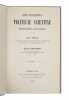
The scarce first edition of Durkheim's earliest published work, his subsidiary Latin thesis on Montesquieu, which anticipates many of his most important theories and contains important observations that are formative for his later work. As such, the present work constitutes his earliest exposition of sociology as a science.Emile Durkheim (1858-1917), the father of sociology, is credited with making sociology a science and established sociology as a recognized academic discipline. Together with Karl Marx and Max Weber he is considered the principal architect of modern social science. The present work, which serves as the companion to his ""The Division of Labour in Society"", printed the year after, in 1893, analyses Montesquieu's ""Spirit of Laws"" as a foundational work of modern sociology, explains how Montesquieu's distinctions define the conditions and boundaries of sociology and how the work is the first to establish the main principles of political science. One of Durkheim's major contributions lies in his insistence on taking the total society as his theoretical frame of reference, which is quite explicitly observed in the present analysis and explanation of Montesquieu.
Le Suicide. Étude de Sociologie.
Paris, Baillière et Cie Félix Alcan, 1897. 8vo. Contemp. hcloth. Gilt spine with gilt lettering. XII,462 pp. Small stamps on halftitle and title-page. Internally clean and fine.
First edition of this classical study of suicide by ""the father of modern sociology"".
La mode.
P., Imprimerie Nationale (Collection "Notre Siècle"), 1980, grand in 8° broché, 362 pages.
Très importante iconographie en noir et en couleurs. L'auteur est président d'honneur de l'Union Française des Arts du Costume. PHOTOS sur DEMANDE. Fermeture du 1er au 23 Août

Phone number : 04 77 32 63 69

