 Write to the booksellers
-
Type
Book (5292)
Magazine (45)
Maps (17)
Old papers (1)
-
Latest
Last 24h (9)
Last month (21)
Last week (2)
-
Language
Dutch (1)
English (19)
French (5326)
German (1)
Hungarian (1)
Italian (3)
Portuguese (2)
Spanish (2)
-
Century
16th (1)
17th (5)
18th (47)
19th (667)
20th (2287)
21st (74)
-
Countries
Belgium (282)
Canada (1)
China (14)
Côte d'Ivoire (15)
Denmark (241)
France (3649)
Greece (1)
Switzerland (1152)
-
Syndicate
ALAC (1)
CLAM (3)
ILAB (2891)
NVVA (727)
SLACES (727)
SLAM (1822)
SNCAO (2)
Première note sur la formation infra-liasique dans le midi de la Provence
1866 Paris : Imprimerie de E. Martinet, 1866? ,Extrait du "Bulletin de la société géologique de France", 2e série, t. XXIII, p. 309, séance du 5 février 1866.1 vol. (p. 309-321) : ill. ; 22 cm.,broché,couvertures factices ,ENVOI autographe AUTEUR ,rare

Remise de 20% pour toutes commandes supérieures à 200 €
Étude pétrographique des minerais de fer oolithiques du Dogger des Alpes suisses
Berne : en commission chez Kümmerly & Frey A.G., 1945. IV, VIII, 116, [20] p. : ill. ; 29x21 cm (Beiträge zur Geologie der Schweiz. Geotechnische Serie - Matériaux pour la géologie de la Suisse. Série géotechnique ; 13,2) (Die Eisen- und Manganerze der Schweiz ; 2) (Les minerais de fer et de manganèse de la Suisse ; 2). Avec 5 figures et 20 pl. de photographies.
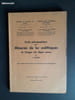
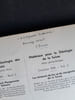
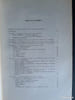
Exemplaire en bon état, dédicacé et signé par l'auteur en page de titre.
Contribution a l'etude du quaternaire recent de la grande Limagne marno-calcaire: morphogenèse et pédogenèse.
INRA,Annales Agronomiques;1963,Saint-Amand, impr. Bussière, 1963.IN8 broche,200p.,ill.HT
bon etat Remise de 20% pour toutes commandes supérieures à 200 €
Allgemeine Geomorphologie.
1968 (3rd ed.) xxvi, 522 p., 124 figs, 140 photographs in separate booklet, 1 folded map, cloth (dust jacket).
Le Commissariat à l'Energie Atomique.
GALLIMARD. 1995. In-12. Broché. Bon état, Couv. convenable, Dos satisfaisant, Intérieur frais. 144 pages. Nombreuses photos et illustrations en noir et blanc et en couleurs dans le texte et hors-texte.. . . . Classification Dewey : 553-Géologie économique
Classification Dewey : 553-Géologie économique

Étude géologique de la Tunisie centrale
F. R. de Rudeval Editeur 1903 in4. 1903. Broché. Ouvrage scientifique de Léon Pervinquière publié en 1903 dédié à l'étude géologique de la Tunisie centrale. Il décrit les formations géologiques notamment les argiles bariolées gypsifères et s'inscrit dans une politique de conservation patrimoniale avec la BNF
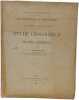
Bon état pages non coupées pages jaunies intérieur propre
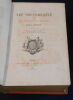
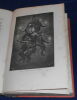
La Vie Souterraine ou les Mines et les Mineurs
Paris. 18 cm x 27 cm. 1867. Relié. III+ 604 pages pages. Paris Librairie Hachette & Cie 1867 - Cartonné dos à nerfs titre et filets dorés 18 cm x 27 cm III+ 604 pages 10 planches hors-texte en chromo lithographie 30 cartes hors-texte en couleur 163 figures in et hors-texte. Texte de L. Simonin envoi de l'inspecteur général des mines. Grosses épidermures sur le dos rousseurs bon état Grosses épidermures sur le dos rousseurs bon état
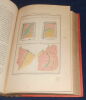
Cours abrégé d'histoire naturelle. Minéralogie.
Couverture rigide. Cartonnage défraîchi. 144 pages. Annotations sur une page.

Livre. Valence, 1874.
Le bellezze della Svizzera. Descrizione del paesaggio e sue cause geologiche. Versione italiana sulla 3. ed. inglese con aggiunte dell'autore illustrata con 154 incisioni e una carta della Svizzera del Luigi Scotti, Prefazione Torquato Taramelli.
Milano, Ulrico Hoepli, 1900, in-8°, XXXIX + 434 p., 154 illustr., pt. tache noire dans la marge supérieure jusqu'à la p. 30 + 1 carte dépl. de la Suisse en couleur, ‘Omaggio dell' Editore’ ms. sur page du titre, reliure en toile originale.
It was Sir John Lubbock who coined the terms ‘Neolitic’ and ‘Paleolithic’ to distinguish the later and earlier Stone Age periods. Complete with the folded map. Dict. of scientific Biography VIII/527-529.

(SLACES, NVVA)
Phone number : 41 (0)26 3223808
Charles Darwin. Eine Apologie und eine Kritik. ‘Klassiker der Naturwissenschaften. Bd. 2.
Leipzig, Theod. Thomas, o.J. (1905), in-8°, 2 Bl. + Frontispiz (Porträt von Charles Darwin) + 116 S., illustr. Original-Leinenband. Schönes Ex.
(SLACES, NVVA)
Phone number : 41 (0)26 3223808
Lucas Flandrin Visse Dalloni Bolfa Hilly Roubault Gourinard Repal Sadran
Reference : 100124152
(1952)
Monographies régionales 1re série: Algérie: n°18-19-20-21-22-23-24-27 / XIXe congrès géologique internationale
Alger 1952 in8. 1952. Agrafé. 8 volume(s).
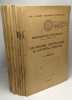
tampons sur les pages titres et les premiers plats tranhes et couvertures tachées intérieurs propres documents dépliant in-fine
Description géologique et pétrographique des Monts de Ghar Rouban et du Sidi el Abed. Bulletin du Service de la Carte géologique de l'Algérie. 2e série Stratigraphie - Descriptions régionales n° 16. En 2 volumes: Volume I: texte; Volume II: Atlas.
Laval, Barnéoud, 1942, in-4°, VIII + 539 p., non coupé / 34 planches (cartes et photographies) dépliantes, brochures originales. (Ouvrage scientifique sur la géologie de la région frontalière séparant le Maroc de l'Algérie).
(SLACES, NVVA)
Phone number : 41 (0)26 3223808
Breiz - Karregadoù ha maenadoù kaer
LE RELECQ KERHUON (29), An Here - 2001 - In-4 - Cartonnage éditeur avec jacquette couleur illustrée sur 1er et 4ème plat - Nombreuses photographies en couleurs de B.Y. Leglatin - 127 pages - Etat neuf
Cnformément à nos conditions générales de vente :Les frais de port sont affichés à titre indicatif. Il se peut que nous devions vous contacter pour vous informer du coût de laffranchissement supplémentaire en fonction du poids et du nombre de livres, surtout pour les envois internationaux Cependant vu l'augmentation des tarifs postaux à l'internationale, nous pouvons expédier les ouvrages en point relais MONDIAL RELAY pour les pays suivants : Allemagne, Autriche, Belgique, Espagne, Italie, Luxembourg, Pays-Bas, Pologne, et Portugal. Merci de nous indiquer en retour le point relais choisi ainsi que votre numéro de téléphone mobile & adresse Courriel pour assurer le suivi du colis.N'hésitez pas à nous interroger.In accordance with our general terms and conditions of sale:Shipping costs are displayed for informational purposes only. We may need to contact you to inform you of the additional postage costs depending on the weight and number of books, especially for international shipments.However, given the increase in international postal rates, we can ship books via Mondial Relay to the following countries: Germany, Austria, Belgium, Spain, Italy, Luxembourg, Netherlands, Poland, and Portugal. Please provide us with your chosen Mondial Relay point, as well as your mobile phone number and email address to ensure package tracking.Please feel free to contact us with any questions
Die Geologie Luxemburgs in ihren Beziehungen zu den benachbarten Gebieten
Luxemburg, P. Worré-Mertens 1937 176pp. with many illustrations (plans, maps, tables) in text and out of text (of which some folding), text in German, published by the "Grand-Duché de Luxembourg, Ministère des travaux publics. Publications du Service de la Carte géologique de Luxembourg" volume 1, 24cm., softcover, 2 stamps, good condition, W100500
Die Geologie Luxemburgs in ihren Beziehungen zu den benachbarten Gebieten.
Luxemburg, 1937. 176 pp., tables and many folded plates.
Physisch-moralische Briefe über die Berge, und die Geschichte der Erde und des Menschen. Aus dem Französischen übersetzt von J. M. Marcard. (= Lettres physiques et morales sur les montagnes et sur l’histoire de la terre et de l’homme).
Leipzig, bey Weidmanns Erben und Reich, 1778, in-8vo, XXVIII + 258 S., Original H.-Lederband, Rückenvergoldung, Titeletikette. Schönes Exemplar.
Deutsche Erstausgabe dieses erstmals 1778 in Den Haag (La Haye) im französischen Original erschienenen Werkes. In Briefform abgefasster Reisebericht von Lausanne nach Sitten im Walliserlande. Von Lausanne über Murten und Bern zu den Gletschern des Grindelwalds, ins Berner Oberland, mit Beschreibung der Gletscher, der Bevölkerung, der ländlichen Gastfreundschaft und der guten Luft. Der Schweizer Geologe und Meteorologe Deluc stammte aus Genf, wurde 1770 Vorleser der Königin von England und später Professor der Philosophie und Geologie in Göttingen, lebte aber meist in London. Als genauer Beobachter der Natur begründete er seinen Ruf mit Experimenten zur Atmosphäre und Barometermessungen in den Alpen und im Jura. Die Funktionsweise und Verbesserung eines tragbaren Barometers mit verschliessbarem Quecksilberreservoir sowie ein nach seinen Plänen gebautes Thermometer sind heute noch in Museen erhalten. Perret 1269; Poggendorff I, 545; Dict. of scientific biography 4, 27; Reichler & Ruffieux, Le voyage en Suisse p. 285, 290-292; de Beer p. 59. Image disp.
(SLACES, NVVA)
Phone number : 41 (0)26 3223808
La région de la Brèche du Chablais (Haute-Savoie). Diss. de l'Univ. de Lausanne. .
Paris, Baudry et Cie., 1896, gr. in-8vo, 108 p., reliure en toile originale.
(SLACES, NVVA)
Phone number : 41 (0)26 3223808
Sedimentation in the Mississippi River. Between Davenport, Iowa, and Cairo, Illinois.Augusta Library Publication Nr. 11.
Rock Island Illinois, 1927, 270x195mm, 104pages, paperback. Book in very good condition.
illustrated, Pour un paiement via PayPal, veuillez nous en faire la demande et nous vous enverrons une facture PayPal
De secretis naturae sive Quinta essentia libri duo. His accesserunt Alberti Magni Summi philosophi, De mineralibus & rebus metallicis Libri quninque. Quae omnia solerti cura repurgata rerum naturae studiosis recens publicata sunt per M. Gualtherum H. ... - [THE CULMINATION OF LULLISM]
(Argentorati (Strassbourg) apud Balthassarum Beck), 1541. Small 8vo. Contemporary full calf binding with brass clasps. Professionally and neatly re-backed. Title-page a bit soiled and three very small holes to first leaf of text, otherwise internally very nice, clean and fresh. Early 20th century book-plate to front free end-paper (depicting Aristotle and Plato and with Greek writing). One full-page and 7 half-page woodcut illustrations in the text. (4), 183, (4 - Index) ff.
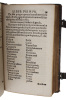
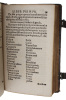
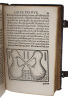
The very rare first edition edition thus, being the first edition edited by the celebrated Strasbourg physician Walter Hermann Ryff (reprinted in Venice in 1542). The book contains two works: Lull's ""De secretis naturae"" and Albert the Great's ""De mineralibus & rebus metallicus"", which is among the authentic writings of the author"" both works are of the utmost importance and greatly influenced Renaissance philosophy and science: Lull invented an ""art of finding truth"" (often in Lullism referred to as ""The Art""), which centuries later stimulated Leibnitz' dream of a universal algebra. Lull applied this to basically all subjects studied at the Medieval Universities. ""Lull's metaphysics worked a revolution in the history of philosophy"" (The Cambridge History of Renaissance Philosophy, p. 548). ""The production of pseudo-Lullian alchemical texts culminated at the end of the fourteenth century with an important work, the ""Liber de secretis naturæ sive de quinta essential"". At that time the formation of this corpus of texts entered a second stage. In the ""Liber de secretis naturæ"" the alchemical practice of the Testamentum becomes linked to the fifth essence of wine, a distillation technique popularized in by Jean de Roquetaillade in 1350. Moreover, its author said on several occasions that he relied on the Testamentum and other alchemical texts, thus recognizing Lull as an alchemist. If the ""Liber de secretis naturæ sive de quinta essential"" seems to be a medical book guided by the thought and the style of Lull, it is also notable for its author's interest in turning matter into gold, unlike John Roquetaillade who for religious reasons was not mainly interested in such transmutation. It begins with a prologue consisting of a conversation between Lull and a monk, then come the two books paraphrasing Roquetaillade's De quinta essentia. It ends with a Tertia distinctio devoted to an alchemical application of the Lullian method (alphabets and trees). Even if the ""Liber de secretis naturæ sive de quinta essential"" suffered, like a number of alchemical works, from a very unreliable textual tradition in both manuscript and printed form, it enjoyed great success in the sixteenth century.""His works on occult philosophy were essential to Renaissance magic. ""As the inventor of a method which was to have an immense influence throughout Europe for centuries, Lull is an extremely important figure. Lullism is a precursor of scientific method. Lullian astral medicine developed into Pseudo-Lullian alchemy. The great figures of Renaissance Neoplatonism include Lulliiam in their interests, and naturally so since Lullism was the precursor of their ways of thinking. And from the point of history of religion and of religious toleration, surely we admire Lull's vision in taking advantage of the unique concentration of Christian, Moslem, and Jewish traditions."" (Yates, The Occult Philosophy in the Elizabethan Age).The present work also contributed greatly to what later was to become known as Christian Kabbalah. Living in a region where the Catholic Church was dominant, where a large part of the land was still under heavy influence from Moslem Arabs, and where the Jews made important contributions to the culture, Lull sought to unify all three religions by developing a (natural) philosophy incorporating elements common to all. These rather unorthodox, and to some extent heretical, thoughts were later taken up by the Italian Renaissance philosopher Pico della Mirandola (1463-94). He and many of his contemporaries believed to have discovered in Kabbalah a lost divine revelation that could give the key to understanding both the teachings of Pythagoras, Plato, and the Orphics, as well as the inner secrets of Catholic Christianity. Pico della Mirandola had a considerable amount of Kabbalistic literature translated into Latin by the convert Samuel ben Nissim Abulfaraj.Raymond Lull (ab. 1232 - 1315), Majorcan writer, philosopher, memorycian (he was later to become a great source of inspiration for Giordano Bruno), logician, and a Franciscan tertiary. He wrote the first major work of Catalan literature. Recently-surfaced manuscripts show him to have anticipated by several centuries prominent work on elections theory. He is sometimes considered a pioneer of computation theory, especially given his influence on Gottfried Leibniz. He is also well known also as a glossator of Roman Law. Lull taught himself Arabic with the help from a slave. As a result, he wrote his ""Ars Magna"", which was intended to show the necessary reasons for the Christian faith. To promote his theory and test its effectiveness, he went to Algiers and Tunis. At the age of 82, in 1314, Lull traveled again to North Africa, where an angry crowd of Muslims stoned him in the city of Bougie. Genoese merchants took him back to Mallorca, where he died at home in Palma the following year.Despite the fact that a large corpus of the printed works by Lull are erroneously ascribed to him:"" On the whole, we get the impression that the ""Testament"", ""De secretis naturae seu de quinta essential"", and ""Lapidarius"" are probably the oldest members of the Lullian alchemical collections"" (Thorndyke)The present Ryff-edition became very popular and later appeared numerous times. It was reprinted already the following year in Venice, 1542, and editions followed in Nürnberg, 1546, Basel, 1561, Köln, 1567, etc. etc.Freilich: 372Adams: L, 1703Honeyman: v, 2064AWellcome: 3897
Studier öfver faunan i den Stenkolsförande Formationen i Nordvästra Skane.
lund, Fr. Berlings Boktryckeri Och Stilgjuteri, 1878, gr. in-8vo, 57 p., + 2 pl. et 1 carte, reliure en d.-toile. / H-cloth.
(SLACES, NVVA)
Phone number : 41 (0)26 3223808
Beskrivning till Kartbladen Visby och Lummelunda.
Stockh., 1940. 167 pp., 1 tvl., 1 kort. (Sv.geol.Unders.).
La terre.
Couverture rigide. Cartonnage de l'éditeur. 245 pages. 23, 5 x 29, 5 cm.
Livre. Editions Larousse (Collection : L'univers en couleurs), 1978.
La terre.
Couverture rigide. Cartonnage de l'éditeur. 245 pages. 23, 5 x 29, 5 cm.
Livre. Editions Larousse (Collection : L'univers en couleurs), 1978.
Inventaire Papiers Jules Cornet géologue (1865-1929)
Tervuren, Musée royal de l'Afrique centrale 1961 100pp.+ 1 planche, br.orig., bel état, 27x18cm., dans "Inventaire des archives historiques" vol.I
L'Ancienneté de l'homme prouvée par la géologie et remarques sur les théories relatives à l'origine des espèce par variation ; traduit avec le consentement et le concours de l'auteur par Mr M. Chaper. Deuxième édition. revue, annotée et augmentée (avec page de titre séparée) d'un Précis de paléontologie humaine par E.-T. Hamy. Illustré de 182 figures.
P., J.-B. Baillière, 1870, fort in-8°, xvi-592 pp, un frontispice, une planche hors texte et 68 figures gravées sur bois dans le texte ; + 4 ff.-372 pp, illustré de 114 figures gravées sur bois in-t. ; + 40 pp de catalogue de l'éditeur, reliure pleine percaline verte de l'éditeur, dos lisse avec titres dorés, encadrements à froid sur les plats, une charnière recollée, 2e plat lég. défraîchi, bon état. Peu courant. Edition la plus complète, les 2 volumes reliés ensemble par l'éditeur
Sir Charles Lyell, géologue anglais, est l'un des premiers défenseurs, sinon le créateur de la théorie des causes actuelles, il s'efforça dans ses écrits, principalement dans ses célèbres Principles of Geology, qui soulevèrent bien des polémiques, d'expliquer tous les phénomènes géologiques du passé par ceux qui se produisent actuellement sous nos yeux ; il s'attacha plus particulièrement à décrire minutieusement les causes des oscillations du sol et il émit sur les volcans et les tremblements de terre une foule d'idées nouvelles qui rencontrèrent du reste beaucoup de contradicteurs. C'est lui également qui, le premier, vers 1828, classa les dépots tertiaires d'après la proportion des coquilles d'espèces encore existantes trouvées dans chacun d'eux ; il arriva ainsi à une division tripartite, pour laquelle il imagina les noms, généralement adoptés, d'éocène, de miocène et de pliocène. Il étudia enfin avec le plus grand soin la migration des espèces et l'origine de l'espèce et il aboutit à des conclusions qui concordent sur beaucoup de points avec les opinions de Darwin. C'est ainsi qu'après de longues recherches dans les principales cavernes de l'Europe, il assigna à la race humaine une très grande antiquité. (La Grande Encyclopédie XXII, 837) — L'édition originale de 'The Geological Evidences of the Antiquity of Man' remonte à 1863. Lyell, éminent géologue (le premier, déjà, à avoir apporté sa caution à Boucher de Perthes), est avec cet essai le premier grand savant à apporter explicitement son appui aux théories évolutionnistes de Darwin et Wallace. Son retentissement est tel qu'il est traduit immédiatement en français (1864), et que Büchner s'en empare pour le traduire en allemand. Désormais les frais d'envoi sont de 6 € seulement pour les livres jusqu'à 1 kg (colissimo suivi), pour la France métropolitaine.

