 Write to the booksellers
-
Type
Art print (2)
Autograph (4)
Book (33986)
Magazine (201)
Manuscript (3)
Maps (1)
Photographs (8)
-
Latest
Last 24h (7)
Last 3 days (14)
Last month (243)
Last week (107)
-
Language
Chinese (1)
Dutch (3)
English (108)
French (33953)
German (9)
Greek (1)
Italian (112)
Japanese (1)
Latin (5)
Polish (1)
Portuguese (4)
Russian (3)
Spanish (3)
Swedish (1)
-
Century
16th (32)
17th (77)
18th (573)
19th (4316)
20th (11314)
21st (1713)
-
Countries
Belgium (7839)
Brazil (14)
Canada (11)
Côte d'Ivoire (35)
Denmark (146)
France (24894)
Germany (9)
Greece (3)
Netherlands (1)
Switzerland (1253)
-
Syndicate
ALAC (11)
CLAM (15)
CLAQ (3)
CNE (19)
ILAB (13900)
NVVA (532)
SLACES (531)
SLAM (13117)
SNCAO (64)
BIBLIOTHEQUES ET EVALUATION.
EDITIONS DU CERCLE DE LA LIBRAIRIE / COLLECTION BIBLIOTHEQUES. 1994. In-8. Broché. Etat d'usage, Couv. convenable, Dos fané, Intérieur frais. 197 pages.. . . . Classification Dewey : 20-Bibliothéconomie et sciences de l'information
Classification Dewey : 20-Bibliothéconomie et sciences de l'information


Anne Legeay - Fabrice Besse (Photographies)
Reference : 46339
(2003)
ISBN : 2047200733
Calligraphies médiévales d'Anne Legeay
2003 PARIS, Dessain & Tolra - 2003 - In-4, 29,9 x 21,1 x 0,7 cm - Illustrations en texte - 80 pages - Comme neuf
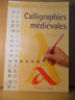
Une initiation méthodique à l'écriture des lettres médiévales. Sept styles d'écriture vous sont présentés par ordre de difficulté croissante : onciale, caroline, gothique primitive, textura, fraktur, rustica et gothique. Pour vous exercer, écrivez à même le cahier : les tracés en gris, les lignes de conduite et le papier ont été spécialement conçus pour vous permettre de vous entraîner directement dans le livre, jour après jour. Pour chaque style d'écriture, retrouvez : une brève introduction historique et esthétique ; une présentation des lettres avec le tracé de chacune d'elles ; de nombreux exercices d'entraînement ; des idées de mise en pratique Cnformément à nos conditions générales de vente :Les frais de port sont affichés à titre indicatif. Il se peut que nous devions vous contacter pour vous informer du coût de laffranchissement supplémentaire en fonction du poids et du nombre de livres, surtout pour les envois internationaux Cependant vu l'augmentation des tarifs postaux à l'internationale, nous pouvons expédier les ouvrages en point relais MONDIAL RELAY pour les pays suivants : Allemagne, Autriche, Belgique, Espagne, Italie, Luxembourg, Pays-Bas, Pologne, et Portugal. Merci de nous indiquer en retour le point relais choisi ainsi que votre numéro de téléphone mobile & adresse Courriel pour assurer le suivi du colis.N'hésitez pas à nous interroger.In accordance with our general terms and conditions of sale:Shipping costs are displayed for informational purposes only. We may need to contact you to inform you of the additional postage costs depending on the weight and number of books, especially for international shipments.However, given the increase in international postal rates, we can ship books via Mondial Relay to the following countries: Germany, Austria, Belgium, Spain, Italy, Luxembourg, Netherlands, Poland, and Portugal. Please provide us with your chosen Mondial Relay point, as well as your mobile phone number and email address to ensure package tracking.Please feel free to contact us with any questions
Closer to Vermeer
, , 2025 hardcover, 432 pages, 26,5 x 21,5 cm, Quadrichromie, Illustrated, text English, ISBN . ISBN 9789464941999.
The successor to the international bestseller Vermeer, featuring groundbreaking research on the Dutch master Closer to Vermeer explores the world of Johannes Vermeer, a painter whose work continues to fascinate more than 350 years after his death. Taking the landmark 2023 Rijksmuseum exhibition as a point of departure, this volume brings together new art-historical and technical research by leading international experts. How did Vermeer translate his creative ideas into paint? Did the seventeenth-century Dutch master truly rely on optical devices? What do the carefully rendered objects in his interiors reveal about the artist himself? And how has the perception of his small but extraordinary oeuvre evolved over time? Using the latest imaging techniques, researchers scrutinize Vermeer?s masterpieces, yielding compelling new insights into his artistic process, material choices, and technical virtuosity. These investigations contribute to a deeper understanding of Vermeer?s painting technique throughout his career. Other specialists revisit seventeenth-century sources, uncover new archival documents, and explore Vermeer?s patrons and the material world he portrayed. The objects depicted in his interiors ? maps, pearls, porcelain, kitchenware ? are examined not merely as visual motifs, but as clues to his worldview and working methods. At once scholarly and accessible, Closer to Vermeer offers a fresh, intimate perspective on one of the most enigmatic and beloved painters ? a vital resource and enduring reference for specialists and art lovers alike. With contributions by Christina L. An, Dina Anchin, Piet Bakker, Rachel Billinge, Quentin Buvelot, Frederico Car , Silvia A. Centeno, Gareth R. Davies, John K. Delaney, Alexandra van Dongen, Kathryn A. Dooley, Esther van Duijn, Francesca Gabrieli, E. Melanie Gifford, Lisha D. Glinsman, Catherine Higgit, Helen Howard, Paolo D'Imporzano, Jonathan Janson, Koen Janssens, Anna Krekeler, Paul van Laar, Rozemarijn J.W. Landsman, Alexandra Libby, Annelies van Loon, Dorothy Mahon, Daphne Martens, Marta Melchiorre Di Crescenzo, Sabrina Meloni, Steven De Meyer, Aimee Ng, Judith Noorman, Elke Oberthaler, David Peggie, Carol Pottasch, Justine Rinnooy Kan, Pieter Roelofs, Marika Spring, Maartje Stols-Witlox, David G. Stork, Ariane van Suchtelen, Paul Taylor, Katharina Uhlir, Abbie Vandivere, Frederik Vanmeert, Evelyne Verheggen, Ige Verslype, Marjorie E. Wieseman
Cambridge II
, Brepols - Harvey Miller, 2022 Paperback, 328 pages, Size:210 x 270 mm, Illustrations:47 b/w, Language: English. ISBN 9781912554270.
Summary This is the ninth volume in a continuing series of publications listing and identifying all illustrations contained in English manuscripts from the time of Chaucer to Henry VIII. Because representations of all types are included?from miniatures to marginalia? the series provides unparalleled reference to imagery in the long fifteenth century. The present fascicle, the second of two devoted to the collections in Cambridge, catalogues 553 manuscripts for eleven colleges and can be used as a search tool for manuscripts available on line. The manuscript entries in the catalogue note the subject of every illustration, all of which are fully indexed in the index of pictorial subjects. Entries for alchemy and medicine are particularly rich in this fascicle; the largest entry is for costume. The broad range of pictorial information makes the Cambridge fascicles useful supplements to the fifth volume of A Catalogue of Western Illumination in the Fitzwilliam Museum and Cambridge Colleges. Like the other fascicles in the series, Cambridge II includes a manual for users, an extensive glossary of subjects and terms, indexes of authors, texts and incipits, as well as a list of manuscripts with coats of arms. There are forty-seven black and white illustrations.
Noble Magnificence. Culture of the Performing Arts in Rome 1644-1740
, Brepols, 2024 Paperback, 619 pages, Size:230 x 280 mm, Illustrations:16 b/w, 154 col., 6 maps color, 5 musical examples, Language: English. ISBN 9782503613123.
Summary The thirty chapters in this book are based on the work of an international, multidisciplinary team of researchers and archivists brought together for the PerformArt project, funded by the European Research Council from 2016 to 2022. This project investigated the artistic patronage of the great Roman aristocratic families of the seventeenth and eighteenth centuries through research in the extant archives. After the accession to the papal throne of Innocent X in 1644, and more so after the Peace of the Pyrenees in 1659 - which led to a greater loss of power for the pope in his relations with other European states - the Roman families stepped up their efforts to assert their social preeminence not only through architecture and the fine arts, but also through the ephemeral performing arts: music, theatre, and dance, which were omnipresent throughout the year and especially during the intense period of artistic production that was the Roman Carnival. The search for traces of these spectacles in the archives of these families reveals that their desire to display their magnificence - an ideal well documented in the literature of the period - gave rise to lavish expenditure on a scale that could only be justified by the benefits (if not tangible, then at least symbolic) they hoped to gain. The essays in this book, which draw on social economic history, the history of ideas, and the evolving artistic practices of the time, make a major contribution to our knowledge of courtly societies in Ancien R gime Europe by integrating the performing arts into their analyses in innovative ways. TABLE OF CONTENTS Overture Anne-Madeleine GOULET, Introduction - Prologue: The Roman Context Isabella CECCHINI and Anne-Madeleine GOULET, Some Thoughts about the Roman Context Irene FOSI, Magnificence and the Roman Nobility between the Papacy and Europe I. The Economy of Magnificence Beno t MAR CHAUX, Patrons, Aristocratic Patrimonies and Finance: Reconsidering the Economic Foundations of Private Magnificence in Rome (c. 1650-1700) Isabella CECCHINI, Instruments of Magnificence. Finance and Credit in Early Modern Rome Maurizio PEGRARI, The Costs of Magnificence, the Magnificence of Costs: Nobility, Economics, and Status in Seventeenth and Eighteenth-Century Rome Isabella CECCHINI and Anne-Madeleine GOULET, Celebrating a Wedding in the Lante della Rovere Family: An Exercise in Magnificence (1682-83) Cristina FERNANDES, Portuguese Patronage in Rome and the Economics of Magnificence: La Virt negl'amori by Alessandro Scarlatti at the Teatro Capranica (1721) - Intermezzo I. Into the Family Archives Marco CAVIETTI, Portraying the Family in Household Archives in the Seventeenth and Eighteenth Centuries Orsetta BARONCELLI, The Computista and the Archivista: Two Key Figures in the Management of Roman Family Archives in the Seventeenth and Eighteenth Centuries Letizia LELI, Reordering a Family Archive in the Seventeenth Century: The Case of the Lante della Rovere Archive II. Social Values and Moral Principles Aldo ROMA, Education to Magnificence: Aristocratic Schooling and College Academies in Seventeenth- and Eighteenth-Century Rome Sarah MALFATTI, Patronage and Pastoral Simplicity in Arcadia: Patronus nullus esto - the Case of Francesco Maria Ruspoli (1707-21) Diana BLICHMANN, Sumptuousness versus Sobriety: Magnificence in the Musical Productions at Cardinal Pietro Ottoboni's Teatro della Cancelleria (1710-12) Valeria DE LUCCA, Ars moriendi in Seventeenth-Century Rome: Staging Lorenzo Onofrio Colonna's Death - Intermezzo II. Some Thoughts on Method Manuela GRILLO and Michela BERTI, Magnificenza as a Paradigm in the Development of a Thesaurus: From Scientific Research to a Difficult Definition, and Back Again III. Conquering and Asserting Magnificence Sara Elisa STANGALINO, Lorenzo Onofrio Colonna 'L'Africano': Military and Artistic 'Campaigns' in Rome and Spain Barbara NESTOLA, 'Donna regale in auree scene t'apre il mondo in teatro': Maria Camilla Pallavicini Rospigliosi and Opera in Rome at the End of the Seventeenth Century Michela BERTI, The Conquest of Magnificence: The Performing Arts and the Social Ascent of the Vaini Family Huub VAN DER LINDEN, Boxes at the Teatro Capranica in 1732: Occupants, Financial Dealings, and Social Visibility - Intermezzo III. Brokers of Magnificence in the Noble Household Natalia GOZZANO, Maestri di casa: Masters of Roman Magnificence in the Old Regime Alexandra NIGITO, The Christmas Cantata in Rome: Papal Munificence and Self-promotion by the Majordomo (1676-1740) milie CORSWAREM, The Art of Appropriation: Girolamo Colonna and the Festivities Held at Rome for the Coronation of Ferdinand IV as King of the Romans (1653) IV. Magnificence on Stage Gloria GIORDANO, 'Si fatto di nuovo ma impiegandovi molte cose del vecchio': The Artifice of Magnificence in the Choreographic Episodes at the Seminario Romano Valentina PANZANARO, Monumentality and Magnificence: Dance and Dramaturgy in Seventeenth century Roman Visual and Musical Sources Jos Mar a DOM NGUEZ, Gloria GIORDANO, Chiara PELLICCIA, Beyond Magnificence: The Caduta and its Imagery in the Performing Arts in Seventeenth-Century Rome Teresa CHIRICO, Magnificence in Miniature: The Puppet Theatre of Cardinal Pietro Ottoboni in the Palazzo della Cancelleria (1694-c. 1712) - Intermezzo IV. The City as a Stage. The Roman Scene in the Early Eighteenth Century Antonella FABRIANI ROJAS, Nobility, Spectacle, and Competition: Reflections on Francesco Valesio's Diario (1700-42) V. The Glories of Fame: Reputation, Circulation, Market Chiara PELLICCIA, The Colonna Family and the Performing Arts in Villeggiatura at Marino lodie ORIOL, From the Reputation of the Artist to the Magnificence of the Prince: The Borghese Family and its Musicians in the Eighteenth Century Giulia VENEZIANO and Margaret MURATA, Rome, Naples, Opera and the 1720s in Rome Glossary Maps General Bibliography Sources and Archival Documents Names of Individuals and Communities Titles of Works Place Names
Anne-Madeleine Goulet, R my Campos, Mathieu da Vinha, Jean Duron (eds)
Reference : 65900
foyers artistiques la fin du r gne de Louis XIV (1682-1715). Musique et spectacles
, Brepols, 2019 Paperback, 446 pages, Size:178 x 254 mm, Illustrations:24 b/w, 7 col., Languages: French, English. ISBN 9782503586199.
Summary Les demeures aristocratiques de Paris et d' le-de-France ont g n ralement t per ues comme des lieux p riph riques, p les reflets de la cour de Versailles. En r alit ,?les h tels particuliers du Marais, o dominaient les sociabilit s f minines, la r sidence de Philippe d'Orl ans au Palais-Royal, celle de la princesse de Conti Versailles, les pavillons de plaisance b tis entre Versailles et Paris,?les demeures?du duc et de la duchesse du Maine Sceaux ou?encore?du roi d'Angleterre en exil Saint-Germain-en-Laye, s'imposaient comme autant de foyers artistiques fort dynamiques, ouverts au th tre et la musique.? Le pr sent ouvrage,?qui prend en consid ration ces diff rents lieux d'activit artistique comme un ensemble la fois compl mentaire et concurrent,?enqu te sur leur hi rarchie, leur fonctionnement concret ainsi que sur les?relations qu'ils entretenaient avec la cour.?Il?met en lumi re la tension entre le mod le versaillais, toujours prompt imposer une norme artistique, et le d veloppement?d'autres espaces de cr ation entre 1682 et 1715. En illustrant?la facult des musiciens provinciaux s'ins rer dans les milieux artistiques de la capitale, en cernant l'identit de ceux qui fa onnaient les go ts de leur poque et en consid rant aussi les strat gies discursives et politiques qui visaient constituer en foyers certains lieux de production et de performance alternatifs la Cour, il?propose une image plus compl te de la vie musicale et spectaculaire de la France? ?la fin du r gne de Louis XIV. TABLE OF CONTENTS R my Campos et Anne-Madeleine Goulet - De la pertinence de la notion de foyer pour l' tude de la musique et des formes spectaculaires Paris et Versailles (1682-1715) La Cour, les cours David Hennebelle - La grande d pense et le fracas . Recherches sur l' conomie mat rielle des patronages artistiques de l'aristocratie au tournant des XVIIe et XVIIIe si cles Don Fader - Monsieur and Philippe II d'Orl ans : A Cultural Influence Beyond their Residences Tarek Berrada - La musique dans les appartements : Mlle de Guise, le roi et les princes de Cond Thomas Vernet - Musique et th tre dans la maison de ville de Marie-Anne de Bourbon Conti Versailles Catherine Cessac - Les Nuits de Sceaux : derniers feux du Grand Si cle ? Laurent Lemarchand - Les arts entre Paris et Versailles : le Palais-Royal de Philippe II d'Orl ans ou l'absolutisme r nov Des musiciens en partage Jean Duron - Composer pour les nouveaux foyers : la fureur des musiciens d' glise au cr puscule du Grand Si cle Marie Demeilliez - Les coll ges, des foyers pour la musique et la danse de th tre Thomas Leconte - De la cour la ville : les musiciens du roi face l' mergence de nouveaux foyers cuturels Catherine Massip - Amateurs, professionnels : foyers et professionnalisation progressive des artistes (1680-1715) Un esprit nouveau Christian Biet - Foyers, chaufooirs, chaleur et h t rog n it des publics au theatre. La s ance comme contre-pouvoir ? Thierry Favier - Foyers et dynamique des genres musicaux la fin du r gne de Louis XIV Nathalie Berton - Le Mercure galant, un r v lateur et un passeur de r pertoire : l'exemple du petit op ra Guy Spielmann - Le th tre de soci t , foyer de cr ation ( ?) Louis Delpech - Abends zu einer Concert de Musique eingeladen : aspects musicaux du s jour parisien de Friedrich August II de Saxe (1714-1715) Foyers r els, foyers imaginaires Mathieu da Vinha - F tes priv es entre Versailles et Paris : l ments pour une typologie Anne Pi jus - Une galanterie tr s politique : l'image des foyers artistiques dans le Mercure galant Laura Naudeix - Foyers et territoire : l'espace de la musique dans la Comparaison de la musique italienne et de la musique fran aise de Le Cerf de la Vi ville Barbara Nestola - L'art d'assembler, le choix de partager : la collection de musique italienne des Stuart en France (1689-1718) Tatiana Senkevitch - The Making of Taste: Rembrandt and French Painting in the End of the Reign of Louis XIV Rebekah Ahrendt - L'activit des foyers musicaux et th traux en Europe vers 1700. Une enqu te en coulisses Perspectives Jean Boutier - Pour continuer l'enqu te Index des noms propres
Zuid-Nederlandse miniatuurkunst.
, Museum Catharijneconvent, 2018 softcover, 24,5 x 29 cm,Illustraties,circa 240 afbeeldingen in kleur,Paperback met flappen. . ISBN 9789462582491.
In Zuid-Nederlandse miniatuurkunst. De mooiste verluchte handschriften in Nederlands bezit wordt een rijkdom ontsloten aan verluchte handschriften die gedurende de Middeleeuwen in de Zuidelijke Nederlanden zijn gemaakt en die in de loop der eeuwen in Nederlandse openbare collecties terecht zijn gekomen. Dit onbekende culturele erfgoed wordt hier getoond in een breed panorama dat reikt van de tiende tot het begin van de zestiende eeuw. Aandacht wordt besteed aan de rijkversierde gebedenboeken voor privedevotie en de prachtige geillustreerde teksthandschriften van groot formaat die ontstonden tijdens het mecenaat van de Bourgondische hertogen en de navolging daarvan door adel, hovelingen en burgers. De nadruk ligt op cultuurhistorische en kunsthistorische aspecten. Aan de orde komen onderwerpen als het Gulden Vlies, contacten tussen Noord- en Zuid-Nederland, pelgrimstekens en de overgang van handschrift naar druk. De tentoonstelling ?Magische miniaturen ? Een kleurrijke blik op de middeleeuwen? is te zien vanaf 23 februari t/m 3 juni 2018 in Museum Catharijneconvent.
Biographie d'un manuscrit imp rial. Le Turonensis 980, de Constantinople Tours, via Chypre
, Brepols, 2026 Hardback, Pages: 385, Size:156 x 234 mm, Illustrations:18 b/w, 10 col., 7 tables b/w., Language(s):French, English. ISBN 9782503621494.
Summary Du palais imp rial de Constantinople au rayonnage feutr de la biblioth que municipale de Tours, en passant par Chypre, la Provence et Paris, le manuscrit Turonensis 980 traverse les si cles, les lieux et les cultures. Command au Xe si cle par l'empereur byzantin Constantin VII Porphyrog n te, ce volume d'encyclop die imp riale - probablement issu de la prestigieuse biblioth que de la cour - a connu un destin aussi singulier que fascinant. Les actes du colloque international Le destin d'un manuscrit. Du vice et de la vertu : de Constantinople Tours, via Chypre , tenu Tours en 2021, rassemblent les contributions de sp cialistes venus d'horizons vari s. travers des approches crois es - philologiques, historiques, codicologiques -, ils clairent la gen se, les usages, les p r grinations et les r appropriations successives de ce t moin pr cieux de l' rudition byzantine. Qu'il s'agisse des m thodes de compilation de Constantin VII, des usages intellectuels de l' le de Chypre la Renaissance ou encore de la red couverte du manuscrit par Peiresc et Henri de Valois au XVIIe si cle, cet ouvrage offre une plong e rudite dans le destin mouvant d'un texte hors du commun. D passant la seule tude d'un manuscrit, ce volume interroge les liens multiples entre pouvoir, savoir et m moire crite dans l'espace m diterran en. Il rend hommage ceux qui, hier comme aujourd'hui, ont contribu sa transmission. TABLE OF CONTENTS Introduction (Paul Magdalino) Constantinople 1 The Turonensis 980 (Codex Peirescianus) as the Key Witness to the Excerpta Constantiniana (Andr s N meth) 2 Les sources des Excerpta constantiniens la lumi re de celles de la Biblioth que de Photius. Quelques r flexions (Filippo Ronconi) 3 The Polybian Excerpts in the Turonensis 980 (Codex Peirescianus) as Interpretation of Suda's Working Methods (Francesco Maria Ferrara) 4 Les Excerpta Constantiniana et le m tier d'historien au xe si cle : le livre VI du Theophanus Continuatus et le po me de L on le Diacre (Juan Signes Codo er) Chypre 5 La circulation des textes profanes grecs Chypre (xiiie-xvie si cle) : un d sert culturel ? (Philippe Tr lat) 6 Byzantine Orthodox Culture in a Multi-confessionnal Island During the Renaissance (Chrysovalantis Kyriacou) Provence, Tours 7 Peiresc et les manuscrits de Constantin Porphyrog n te. Int r t, acquisition, analyse et mise disposition (Anne-Marie Cheny) 8 Autour de l' dition d'Henri de Valois en 1634 (Jean-Pierre Gr lois) 9 Comment le manuscrit de Lesdigui res est devenu le Turonensis 980 (R gis Rech) Appendices A Description of Turonensis 980 (Andr s N meth) B Paratexts of Turonensis 980 (Andr s N meth) C Images of Turonensis 980 (Andr s N meth) D Biographie d'Henri Valois (Paris, 10.09.1603-07.05.1676) (Jean-Pierre Gr lois) Liste des contributeurs et de la contributrice Index
LADAKH LOINTAIN
, Mercatorfonds, 2023 Hardcover, 600 pages,Texte en Francais ; 330 x 250 x 45 mm, Nouveau !, illustre jaquette, 800 illustrations de couleur, . ISBN 9789462303706.
Ce livre conserve la m moire photographique de trois s jours pass s au Ladakh entre 1979 et 1981. peine les fronti res ouvertes, Anne-Marie et Roland Gillion Crowet, entra nant leur fille Nathalie, se sont lanc s sur les pistes de ce pays mythique qui m ne au toit du monde . Les clich s s lectionn es et r unies sont l'ouvre d'une photographe amatrice. Et c'est ce qui en fait des t moignages exceptionnels. Collectionneuse d'art premier, fascin e par les cultures extra-europ ennes, Anne-Marie Gillion Crowet a fait de ces photographies le th tre de rencontres exceptionnelles avec les habitants du Ladakh encore attach s leur traditions s culaires. Pour comprendre ces photographies, Nathalie de M rode, leur fille qui avait pris part aux trois voyages, s'est immerg e dans l'ample documentation consacr e ce pays des confins. La culture, la religion, la structure sociale, la vie quotidienne et l'histoire sont convoqu s pour permettre chaque lecteur de se transformer en voyageur. Par son texte, dynamique et inform , l'auteure ouvre la porte au lecteur d'une compr hension de ce Lointain Ladakh .
Drawings of Peter Paul Rubens, A Critical Catalogue, VOLUME TWO (1609-1620) Part One: Text and Part Two: Images
, Brepols - Harvey Miller, 2023 2 vols; Part One: Text and Part Two: Images, 732 pages; Size:216 x 280 mm, Illustrations:291 col. Language(s):English. ISBN 9782503599533.
This is Volume II in the three-volume catalogue raisonn of the drawings by Rubens covering the years 1609-20. The project is a collaboration between Anne-Marie Logan, to whom belong all the Rubens attributions, and Kristin Lohse Belkin. It is the first publication that presents the artist?s entire drawn oeuvre in chronological order, previous such publications containing only selections of drawings. By leafing through the illustrations, this arrangement offers the user a quick visual impression of the variety of techniques, media, subject matter and functions of Rubens?s drawings at any one time. Accordingly, Volume II consists of the drawings from the time of Rubens?s return from Italy and the establishment of his workshop in Antwerp to the completion of his contribution to the furnishing and decoration of the city?s new Jesuit church, today?s St. Charles Borromeo. The decade is characterized by a broad range of genres and iconography: large altarpieces stand next to cabinet-size pictures, book illustrations next to designs for tapestry, sculpture and architectural reliefs; religious, mythological and historical subjects alternate with allegories, portraits, exotic hunts and scenes from country life. Copies after other artists? works that constitute such a large part of Rubens?s early years discussed in Volume I have given way to original inventions in pen and ink and, above all, by life studies in chalk of the human body, naked or dressed. The whole spectrum of Rubens?s extraordinary creativity, nowhere presented as directly and immediately as in his drawings, is there to be contemplated in all its astonishing diversity. Each entry consists of a detailed physical description of the drawing, provenance, exhibition history, full bibliography and a critical, interpretive discussion. All drawings by Rubens as well as a selection of comparative images are reproduced in color.
Late Gothic Sculpture in Northern Italy: Andrea da Giona and I Maestri Caronesi. An Addition to the Pantheon of Venetian Sculptors
, Brepols - Harvey Miller, 2022 Hardback, 2 vols, 660 pages, Size:225 x 300 mm, Illustrations:505 b/w, 27 col., Language: English. ISBN 9781912554805.
Summary Over the course of a century and a half more than forty late Gothic sculptures have been recognized as sharing a vocabulary of figure and facial types, drapery, wings, and hair. Despite the fact that all the works date from the second quarter of the fifteenth century, they were widely distributed throughout Northern Italy - from Udine in the east to Venice, Ferrara, Vicenza, Verona, Milan, Genoa, and Savona in the west. Payments for the greatest of these works, the Milanese Tomb of Giovanni Borromeo, name as its authors Filippo Solari and Andrea, both from Carona or its satellite Giona, towns in the Ticino close to Lake Lugano which gave birth to several famous dynasties of stonecarvers. How Filippo and Andrea and their numerous assistants, known generally as maestri caronesi, were linked and what kinds of organizations permitted such wide-spread activity over such a narrow span of time are questions asked here for the first time. On the basis of close analyses of comparable works, moreover, it proves possible - not only to identify the chief among these maestri caronesi as Andrea da Giona (d. 1449) - but to follow his career in Castiglione Olona, Milan, and Venice where he was preeminent during the transition from late Gothic to Renaissance sculpture. TABLE OF CONTENTS VOLUME ONE Acknowledgments Chapter 1 Introduction Chapter 2 The Critical Fortune of Filippo Solari and Andrea da Giona Chapter 3 The Written Evidence Chapter 4 The Visual Evidence Chapter 5 Conclusion Catalogue Bibliography Illustrations Comparative illustrations Index VOLUME ONE Plates Figures
Over het genot van de zintuigen in de schilderkunst (16e + 20e eeuw) - Hypersensitief: Joachim Wtewael, Fernand Khnopff, Robert Devriendt
, Stadsbestuur Sint-Niklaas, 2013 Softcover, 105 pagina's, 26 x 21 cm, NL. Rijkelijk ge llustreerde expo-catalogus. Prima staat.
Over het genot van de zintuigen in de schilderkunst (16e + 20e eeuw) - Hypersensitief: Joachim Wtewael, Fernand Khnopff, Robert Devriendt
Anne-Mie Van Kerckhoven: Serving Compressed Energy with Vacuum
, Kunstverein M nchen/Roma Publications, 2015 Softcover, 108 pages, 21 29.7 cm, ENLISH/GERMAN. *NEW. ISBN 9789491843334.
Collection of graphic and textual work by Anne-Mie Van Kerckhoven, dating from the seventies up till 2015. Compiled and designed by Julie Peeters, enriched with translations of facsimile material and a large amount of personal comments from the artist on the selected work. Published in conjunction with the exhibition Serving Compressed Energy with Vacuum in Kunstverein M nchen in 2015.
Annemie Van Kerckhoven Zeno X Gallery, A Long-Standing Collaboration Anne-Mie Van Kerckhoven
, Hannibal Books, 2022 Hardcover, 285 x 220 mm, 256 pages, 491 illustration color. ENG edition / Expo: 5/2/2022 - 19/3/2022, Galerie Zeno X, Antwerpen * NIEUW /NEW ISBN 9789464366327.
Het eigenzinnige universum van kunstenares Anne-Mie Van Kerckhoven Dit boek biedt een overzicht van de langdurige samenwerking tussen kunstenares Anne-Mie Van Kerckhoven en Zeno X Gallery in Antwerpen. Centraal in de publicatie staan de dertien solotentoonstellingen die Van Kerckhoven presenteerde in de galerie vanaf de jaren tachtig tot nu. Aan de hand van installatiebeelden worden enkele belangrijke museale tentoonstellingen en bijzondere projecten uitgelicht waarvoor de kunstenares in binnen- en buitenland werd uitgenodigd. De publicatie bevat ook talrijke foto?s, krantenknipsels, uitnodigingskaarten en recensies uit haar rijkgevulde archief. Anne-Mie Van Kerckhoven ( 1951) werkt sinds de jaren tachtig aan een oeuvre dat bestaat uit tekeningen, schilderijen, collages, films en installaties. Ze manipuleert vrouwenbeelden ? eerst manueel en later ook digitaal ? om de objectivering van de vrouw en de geldende machtssystemen in vraag te stellen. Op een intu tieve en onconventionele manier onderzoekt ze onderwerpen als wetenschap, taal en artifici le intelligentie. Zo cre ert ze een heel eigen universum, waarin de tegenstellingen tussen chaos en orde, logica en mystiek, erotiek en technologie opgeheven worden. //// The idiosyncratic universe of artist Anne-Mie Van Kerckhoven This book offers an overview of the long-standing collaboration between the artist Anne-Mie Van Kerckhoven and Zeno X Gallery. Central to the publication are the thirteen solo exhibitions which Van Kerckhoven has presented at the gallery from the 1980s to the present day. Installation views highlight some of the important museum exhibitions and remarkable projects for which the artist was invited, both at home and abroad. The publication also includes numerous photographs, newspaper clippings, invitation cards and reviews from her extensive archive. Anne-Mie Van Kerckhoven (b. 1951) has been working on a body of work consisting of drawings, paintings, collages, films and installations since the 1980s. She manipulates images depicting women ? first manually and later also digitally ? in order to question the objectification of women and the prevailing systems of power. In an intuitive and unconventional way, she explores subjects such as science, language and artificial intelligence, creating a universe of her own in which the oppositions between chaos and order, logic and mysticism, eroticism and technology are abolished.
Anne-Mie Van Kerckhoven: Uber das Ich
, Berliner K ntslerprogramm, 2009 Hardcover, 79 pages, 19.5 x 13 cm, German/English. *NEW. ISBN 9783893571192.
This book is published as a documentation of the exhibition Anne-Mie Van Kerckhoven ? ber das Ich (Willk r und Tranzendenz) [and a lot of fun] at daadgalerie from March 16th to April 29th 2007. Photo's: Danny Devos, Barbara Thumm, Anne-Mie Van Kerckhoven Design: Dor n + Koster, Berlin Printed by: H. Heeneman, Berlin
Devotie en godsdienstbeoefening in de verzamelingen van de Koninklijke Bibliotheek
, Koninklijke Bibliotheek van Belgie, 2005 Softcover, 191 p. : ill. kleur. ISBN 9066371323.
Tentoonstelling: Koninklijke Bibliotheek van Belgi [Brussel]. 2005/01/13 - 2005/02/19 Taal Nederlands
VIVIAN MAIER.
, Thames and Hudson 2022, 2022 Hardcover, 256 pages, ENG, 290 x 225 mm, NEW, 250 pictures in colour and b/w, .* NEW. ISBN 9780500025703.
A full-career retrospective on the work of Vivian Maier, bringing together a selection of key works from throughout her life and career. When Vivian Maier's archive was discovered in Chicago in 2007, the photography community gained an immense and singular talent. Maier lived in relative obscurity until her death in 2009, but is now the subject of films and books, and recognized as one of the great American photographers of the 20th century. Born in New York in 1926, she worked as a nanny in New York and Chicago for much of her adult life. It was during her years as a nanny that she took many of the photographs that have made her posthumously famous. Maier's incredible body of work consists of more than 150,000 photographic images, Super 8 and 16 mm films, various recordings and a multitude of undeveloped films. Working primarily as a street photographer, Maier's work has been compared with such luminaries as Helen Levitt, Robert Frank, Diane Arbus and Joel Meyerowitz. Drawing on previously unpublished archives and recent scientific analyses, this retrospective sheds new light on Maier's work. With texts by Anne Morin and Christa Bl mlinger, this thorough look at Maier's entire archive is organized thematically in sections that cover self-portraits, the street, portraits, gestures, cinematography, children, colour work and forms. A valuable addition to the continuing assessment of Maier's work, this book is a one-volume compendium of her most enduring images.
Rodney Smith: Photography between Real and Surreal
, Silvana Editoriale, November 11, 2025 Hardcover, 200 pages, 9.7 x 0.8 x 11.2 inches, EN/ITA. *NEW. ISBN 9788836658879.
Mixing 20th-century glamour with surrealist humor and a touch of whimsy, Smith's photographs are fantastical impulses come to life American fashion and portrait photographer Rodney Smith (1947?2016) creates a supreme, sublime balance between illusion and reality: women in couture dresses balancing on tightropes, dapper gentlemen seated with cardboard boxes over their heads and optical illusions make up his playfully contradictory oeuvre. ISBN-10 ? : ? 8836658873 ISBN-13 ? : ? 978-8836658879
l'av nement des arts d coratifs crits et r flexions (1693-1798)
, Brepols, 2026 Paperback, Pages: 364, Size:216 x 280 mm, Illustrations:32 b/w, 87 col., Language: French. ISBN 9782503620220.
Summary Souvent consid r s l'aune de l'historiographie des beaux-arts avec lesquels ils sont mis en concurrence, les arts d coratifs sont rarement tudi s des points de vue th orique et discursif. C'est l'objectif de ce livre, qui d fend l'id e selon laquelle les arts d coratifs , en tant que champ autonome constitu - au sens bourdieusien -, mergent progressivement durant une p riode charni re de l'histoire, au moment pr cis o se mettent en place une large culture de la consommation et une grande diffusion des connaissances relatives aux arts de la d coration et la mode. Anne Perrin montre que l'indicateur majeur de cette volution culturelle se situe dans une efflorescence d' crits et de r flexions qui firent d bat parmi les contemporains, attestant une consid ration nouvelle acquise pendant un ample XVIIIe si cle par ce champ des arts d coratifs alors en construction. Afin de reconstituer un tel processus historiographique et pist mologique, l'ouvrage rassemble un vaste corpus de sources anciennes, dont la plupart sont m connues ou jamais incluses dans les bibliographies abordant le sujet. Ont t retenues celles qui se d marquent par leurs qualit s critique, r flexive et exploratoire au sein d'une grande diversit de formes textuelles (discours, trait s, pr cis, le ons, annonces, dictionnaires, etc.). Ces textes sont analys s depuis leur contexte d' nonciation, par des hommes et femmes de terrain, qui s'empar rent du secteur et contribu rent le d velopper, tant artistes, artisans, marchands, p dagogues, philosophes, critiques d'art, amateurs, historiographes, journalistes, conomistes, naturalistes ou officiers de l'administration royale. Parmi ces sources imprim es, la production crite de Jean-Jacques Bachelier, fondateur de la plus importante cole de dessin appliqu e aux manufactures de la monarchie fran aise (actuelle ENSAD), se distingue autant qu'elle fait cho aux autres voix de son temps. TABLE OF CONTENTS Avertissement Introduction Premi re partie. Prendre la parole Chapitre 1. D finitions Chapitre 2. Tensions Deuxi me partie. D fendre une vision Chapitre 1. Personnalit Chapitre 2. Formation Troisi me partie. Incarner le changement Chapitre 1. conomie Chapitre 2. Mode Conclusion Postface de Melissa Hyde Sources manuscrites et imprim es relatives Jean-Jacques Bachelier Sources manuscrites dit es apr s le XVIIIe si cle Sources imprim es Bibliographie Cr dits photographiques Index des noms propres
Grensverleggers Baanbrekende kaarten uit de Lage Landen, 1500-1900
, Hannibal Books, 2024 Hardcover,320 pagina's met prachtige illustraties, 29 25 cm. Nederlandstalige editie. ISBN 9789464666113.
Een boeiende duik in de cartografie en de geschiedenis van de Lage Landen Een oude kaart geeft niet alleen een geografische situatie weer, ze belichaamt ook een ware ontdekkingstocht door de wereldgeschiedenis. Historica Anne-Rieke van Schaik duikt in de talrijke verhalen achter de fascinerende kaarten, prenten, atlassen, globes en instrumenten uit de collectie van de Phoebus Foundation. De objecten zijn getuigen van zowel glorieuze passages als zwarte bladzijden uit het verleden van de Lage Landen, van de strijd tegen het water en de Tachtigjarige Oorlog tot de koloniale expansie en de Belgische onafhankelijkheidsstrijd. Bijzondere aandacht gaat uit naar de Zuidelijke Nederlanden, waar in de zestiende eeuw pionierende cartografen als Gerard Mercator en Abraham Ortelius voet aan grond kregen. Hun kaarten openden letterlijk en figuurlijk nieuwe wegen. In hun tijd waren ze vaak innoverend, maar ook vandaag nog bieden ze unieke vergezichten op het verleden. Zo nodigt Grensverleggers aan de hand van honderden prachtige afbeeldingen uit om de horizonten van de eigen wereld opnieuw te verkennen en te verleggen. Anne-Rieke van Schaik was onderzoeksfellow Topografie & Cartografie bij The Phoebus Foundation en is momenteel lid van onderzoeksgroep Explokart, verbonden aan het Allard Pierson en de UvA.
Groundbreakers Remarkable Maps from the Low Countries, 1500-1900
, Hannibal Books, 2024 Hardcover, 320 pages with beautiful illustrations, 29 25 cm. English language edition. ISBN 9789464941043.
A fascinating immersion into the cartography and history of the Low Countries An old map does not only represent a geographical situation; it also embodies a veritable journey of discovery through world history. In this book, historian Anne-Rieke van Schaik immerses herself in the many stories behind the fascinating maps, prints, atlases, globes and instruments belonging to the Phoebus Foundation?s collection. These objects testify to glorious moments and dark interludes in the history of the Low Countries, from the never-ending battle against water and the Eighty Years War to colonial expansion and the struggle for Belgian independence. Particular attention is paid to the Southern Netherlands, where pioneers like Gerard Mercator and Abraham Ortelius broke new ground in the sixteenth century. Their maps opened up new paths, both literally and figuratively. Not only were they innovative in their own time, but even today they continue to offer unique panoramas of the past. With hundreds of beautiful images, Groundbreakers invites you to rediscover and redefine the horizons of your own world. Anne-Rieke van Schaik was Research Fellow in Topography & Cartography at The Phoebus Foundation and is currently a member of the Explokart research group, affiliated to the Allard Pierson and the UvA.
Adresses d'imprimeurs, libraires et diteurs Belges des XV me et XVI me si cles (overdruk uit De Gulden Passer 1962)
Antwerpen, De Nederlandsche Boekhandel, 1962 Oorpsronkelijk uitgeversomslag, pagina's 152-207, 25.5 x 16.5 cm. *prima staat.
Adresses d'imprimeurs, libraires et diteurs Belges des XV me et XVI me si cles (overdruk uit De Gulden Passer 1962)
Mus e Fin-de-Si cle Museum. Museumgids.
, Hazan , 2013 Softcover, 157 pagina's, Nederlands, 315 x 245 mm, in prima staat, met illustraties in kleur en z/w. ISBN 9782754107495.
voorbeelden van : Ensor ; Spilliaert ; Knopff ; Horta ; van de Velde ; Gauguin ; Rodin etc
Aemulatio Italorum. La r ception culturelle des gravures de Mantegna dans l?art germanique au temps d?Albrecht D rer
, Brepols, 2023 Paperback, 336 pages, Size:210 x 270 mm, Illustrations:0 b/w, 151 col., Language: French. ISBN 9782503604985.
Summary la Renaissance, si le medium de la gravure permet d sormais aux artistes de rivaliser entre eux distance, d s la fin du xve si cle, la diffusion des mod les grav s par l'atelier du prestigieux peintre de cour des marquis de Mantoue, Andrea Mantegna, a suscit sur le territoire germanique une v ritable mulation d'ordre culturelle, dans laquelle la question du rapport l'identit occupe une place fondamentale. D s lors, dans les images, deux paradigmes se dessinent : d'une part le Welsch, qui d signe ce qui est romain, de style l'antique, et, plus g n ralement, italien ; d'autre part le Deutsch, qui renvoie une tradition artistique et aux coutumes typiquement germaniques. Inscrite dans la probl matique des transferts culturels, cette tude analyse, dans une approche r solument pluridisciplinaire, les diff rentes transformations iconographiques, formelles et stylistiques dont les motifs emprunt s aux estampes de Mantegna ont fait l'objet ainsi que l'appareil rh torique qui accompagne ces transformations pour mieux leur donner du sens (comparaison, parodie, dissimulation, etc.). De D rer Peter Vischer le Jeune Nuremberg, de l'atelier de Daniel Hopfer celui de J rg Breu l'Ancien Augsbourg, d'Hans Baldung Grien Matthias Gr newald dans la r gion rh nane et en Alsace, d'Urs Graf Hans Holbein le Jeune B le, de l'atelier d'Altdorfer implant Ratisbonne celui de Wolf Huber, situ Passau : tous les centres artistiques et humanistes de la Renaissance germanique sont abord s. TABLE OF CONTENTS Introduction I. Des milieux de cour en interaction I.1. Ambition politique et pr jug s culturels I.2. Mobilit s artistiques et transferts des savoirs II. Une strat gie du secret III. Des gravures en dialogue avec la culture humaniste III.1. De l'h ritage de Vittorino da Feltre au De pictura d'Alberti III.2. Dans le sillage d'Hom re, de Virgile et de Politien IV. Mantegna dans les collections d'estampes germaniques IV.1. Les marchands germaniques, entre Venise et l'Empire IV.2. Les humanistes IV.3. Les mod les grav s dans les ateliers d'artistes. V. Un id al hybride V.1. Peindre, dessiner, crire V.2. Le Deutsch et le Welsch: une construction germanique V.3. Germania vetus, Germania nova : le primitif et le civilis V.4. L'hybridit en crise chez Peter Fl tner VI. La r flexion anthropologique d'Albrecht D rer VI.1. L'exp rience philosophique de la fronti re VI.2. Woster serfitor, Alberto D rer VI.3. Comparatio. La Nurembergeoise et la V nitienne VI.4. L' ambiguitas du Welsch VII. D rer versus Mantegna : le topos germanique de la comp tition artistique VII.1. Un exercice de traduction VII.2. La r miniscence d'Apelle VII.3. Une comp tition pour la post rit VIII. mulation et nouvel art de peindre VIII.1. Les gravures religieuses de Mantegna et la diffusion des principes d'Alberti VIII.2. Compl ter le manifeste : la Mise au tombeau conserv e Klosterneuburg VIII.3. Un nouveau Mantegna : la Descente de croix de Hans Mielich VIII.4. Les mod les mant gnesques et la construction perspective dans l'art germanique VIII.5. La g n se d'Adam : D rer, Peter Vischer le Jeune et le Bacchus de Mantegna IX. De la transgression la d mesure: l' mulation jusqu' l'exc s IX.1. Le raccourci comme exp rience formelle et spirituelle chez Altdorfer IX.2. Motus animi : les effets dramatiques extr mes IX.3. Au-del de toute mesure: l'invention du corps extr me X. Explorer les confins de l' me : les gravures mythologiques de Mantegna et le th me de l'imagination X.1. Le Combat des dieux marins, les Bacchanales et la probl matique du fingere X.2. Le th me du songe dans La Bacchanale la cuve X.3. Mantegna affabulateur: le principe de l'illusion perceptive XI. La r ception des estampes mythologiques de Mantegna et la diffusion du N oplatonisme Nuremberg XI.1. Transf rer la lyre d'Apollon au nord des Alpes : le cercle humaniste de la Poetenschule XI.2. La gravure du Monstre marin d'Albrecht D rer : une illustration de la th orie de la vacance de l' me ? XI.3. Techn phantastik : D rer et l'approche sophistique de l'imitation XI.4. Phantasia furens : d bordement po tique et enfer imaginal XII. Pour une r ception iconoclaste des estampes mythologiques de Mantegna XII.1. Mutiler XII.2. Dissimuler XII.3. Renverser Bibliographie Textes sources Litt rature secondaire Index des noms propres
Powerful Headdresses Africa | Asia
, 5 Continents, 2010 Hardcover with dust jacket. 200 pages, 140 ills. 24 x 28,5 cm. *new. ISBN 9788874395514.
Over the centuries, craftsmen have applied their creativity and technical skills to exploit the generous resources of Nature to marvelous effect. In this case they have employed seeds, leaves, flowers and fibers from the plant world, along with feathers, plain or iridescent shells, teeth, and fur from the animal kingdom to fashion objects of astonishing beauty, enhanced with the addition of elements in iron, copper, silver, and gold. Such materials have always provided the basis for magnificent headdresses of all varieties, including hats, caps, crowns, and headbands. In time, as the conditions of trade and pilgrimage routes improved, rare materials and manufactured products spread all over the globe, as well as new knowledge, techniques, and methods of fabrication. Each class of individual sported a distinct type of headdress: initiates and adults, hunters and warriors, religious dignitaries and healers, rulers and notables; unmarried girls, married women, and young mothers. In each case the author explains their opulence and symbolism to the reader.

