 Write to the booksellers
-
Type
Book (163)
Magazine (1)
-
Century
19th (84)
20th (37)
-
Countries
Belgium (2)
Denmark (15)
France (143)
Switzerland (4)
-
Syndicate
ILAB (56)
SLAM (40)
SNCAO (2)
L'EXAMEN DE MINUIT.
GALLIMARD .. 1959.. In-12. Broché. Bon état, Couv. légèrement passée, Dos satisfaisant, Intérieur acceptable. 220 pages.. . . . Classification Dewey : 840-Littératures des langues romanes. Littérature française

Roman. 3 ème édition : année de l'édition originale. Classification Dewey : 840-Littératures des langues romanes. Littérature française


L'examen de minuit.
Paris, Gallimard, 1959. In-12, broché, non coupé, 220 pp.
Edition originale. Un des 25 exemplaires numérotés sur vélin pur fil Lafuma-Navarre, seul tirage en grand papier avec 5 hors-commerce, N° 3 en parfait état. Photos sur demande.
L'Examen de minuit.
Paris Gallimard 1959 1 vol. broché in-12, broché, 220 pp. Edition originale du tirage courant, en bon état.
L'examen De Minuit
Broché.
Merci de nous contacter à l'avance si vous souhaitez consulter une référence dans notre boutique à Authon-du-Perche.
L'heure.
Couverture souple. Broché. 90 pages. Légères salissures sur les pages de garde.
Livre. Editions Gallimard (Collection : Nouvelle Revue Française), 1979.
L'Insaisissable.
Paris, Gallimard, 1963. In-12, broché, non coupé, 204 pp.
Edition originale. Un des 20 exemplaires numérotés sur vélin pur fil Lafuma-Navarre, seul tirage en grand papier, en parfait état. N° 1. Photos sur demande.
L'insaisissable.
Paris Gallimard 1963 1 vol. broché in-12, broché, non coupé, 204 pp. Edition originale. Un des 20 exemplaires numérotés sur vélin pur fil Lafuma-Navarre, seul tirage en grand papier. En parfait état.
Un cri de solitude.
Paris Gallimard 1997 1 vol. broché in-12, broché, non coupé, 93 pp. Edition originale. Un des 18 exemplaires numérotés sur vélin pur chiffon de Lana, seul tirage en grand papier. En parfait état.
UNE GORGEE DE POISON
LAFFONT. 1950. In-12. Broché. Etat d'usage, Couv. légèrement passée, Dos abîmé, Intérieur frais. 291 pages. . . . Classification Dewey : 840-Littératures des langues romanes. Littérature française
Classification Dewey : 840-Littératures des langues romanes. Littérature française
Essai des potasses du commerce.
(Paris, Chez Crochard, 1828.). Without wrappers. In: ""Annales de Chimie, ou Recueil de Mémoires concernant la Chemie"" Ser. II, Tome 39, Cahier 4. Pp. 337-444 (Entire issue offered). Gay-Lussac's paper: pp. 337-368 and 1 engraved plate.
First printing of this paper in which he describes acide normale (""normal acid"") as a standard solution of l00 grams of sulfuric acid diluted to one liter. Gay-Lussac used litmus as an indicator and describes accurately the color transition in different reactions.
Nouvelle Instruction sur la Chloromètrie.
(Paris, Chez Crochard, 1835). Without wrappers. In: ""Annales de Chimie, ou Recueil de Mémoires concernant la Chemie"" Ser. II, Tome 60, Cahier 2. Pp. 225-331. (Entire issue offered). Gay-Lussac's paper: pp. 225-261 and 1 folded engraved plate. -
First printing. In 1824 Gay-Lussac extended earlier methods for the estimation of hypochlorite or chlorinated lime solution using indigo solution. He later improved on the method (in the paper offered).by the use of standard solutions of certain reducing agents: arsenious oxide, mercurous nitrate, and potassium ferrocyanide and describing the apparatus (depicted on the plate).
Ueber die Verbindungen des Stickstoffes mit dem Sauerstoff.
(Leipzig, Barth), 1818. No wrappers. In: ""Annalen der Physik. Neue Folge. Herausgegeben von L.W. Gilbert"", Bd. 28, Erstes Stück. Pp. 1-120 a. 1 engraved plate. (Entire issue offered). Gay-Lussac's paper: pp. 29-53.
First German edition of Gay-Lussac's ""Sur les combinaisons de l’azote avec l’oxigène"", in which he identified 5 oxides of nitrogen.""In 1809 Gay-Lussac carried out a study of the combining volumes of nitric oxide and oxygen. This was a more complex problem than he then realized, but he returned to it in 1816 after criticism of his earlier work by Dalton"" this time his results were of permanent value. He recognized five oxides of nitrogen.""
"GAY-LUSSAC, (JOSEPH) et LOUIS JACQUES THENARD. - THE DISCOVERY OF BORON.
Reference : 43299
(1808)
Sur la décomposition et la recomposition de l'acide boracique.
Paris, Chez Mad. Ve. Bernard, 1808 Contemp. hcalf., gilt spine. Some scratches to binding.. Verso of titlepage and plates with small stamps.In: ""Annales de Chimie"" Vol. 68. - 358 pp. a. 3 engraved plates. (The entire volume offered). Gay-Lussac's a. Thenard's paper: pp. 169-174.
First announcement of the results that they had obtaines by treating boric acid with potassium, showing that acid is composed of a combustible substance and oxygen. ""Before regarding their proof (of the existance of a new element) as complete Gay-Lussac and Thenard wished not only to decomposed boric acid, but to recompose it. On November 30 of the same year they were able to state in the 'Annales de Chemie et de Physique"" (the paper offered) that ""the composition of boracid s no longer problematical. In fact, said they, ""we decompose and we recompose this acid at will"" (Weeks ""Discovery of the Elements"", p. 160). - Parkinson ""Breakthroughs"", 1808 C. - Bunch, 1808.The volume contains other importent paper, Davy's famous paper on electrolysis in first French translations, Gayton-Morveau""Description d'un hygrometre pour le gaz..."", d'Arcet ""Observations sur la potasse et sur la soude préparées à l'alcool"" etc.
Cours de chimie, comprenant l'histoire des sels, la chimie végétale et animale.
Paris, Pichon et Didier, 1828. 2 volumes in-8°, xix-56 (tables); 30; 24; 30; 28; 27; 24; 16; 30; 27; 23; 23; 32; 28; 24; 31; 27; 28; 32 pages / 24; 31: 28; 35; 34; 31; 32; 34; 32; 35; 36; 36; 43; 35; 43 pages. Reliures demi-veau d'époque.
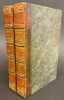
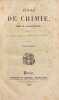
Edition originale du cours de chimie de Gay-Lussac, publié avec son autorisation, d'après les notes de Marmet, un de ses élèves. Cours professé du 1 avril au 1er août 1828, soit 33 leçons. Quelques rousseurs, mais dans l'ensemble très bel exemplaire. Peu courant.
Franz. Physiker.
O. O., (ca. 1822). Lithographie (Brustbild) von Julien Boilly. Bildformat: 24 x 19 cm. Blattformat: 27,5 x 35,5 cm.
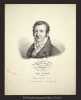
Angestaubt u. etwas fleckig.
GAY-LUSSAC (Joseph Louis) - [COLLET-DESCOSTILS (Hippolyte-Victor)].
Reference : 25774
(1815)
Notice sur Hippolyte-Victor Collet-Descostils.
(Paris), de l'Imprimerie de Feugueray, s.d. [circa 1815]. 1 plaquette au format in-8 (213 x 132 mm) de 8 pp., cousu, sous couverture d'attente de l'époque de plein papier bleuté.
![Notice sur Hippolyte-Victor Collet-Descostils.. GAY-LUSSAC (Joseph Louis) - [COLLET-DESCOSTILS (Hippolyte-Victor)].](https://static.livre-rare-book.com/pictures/BLS/25774_1_thumb.jpg)
Edition originale. Belle condition.
Relation d'un Voyage Aérostatique fait par M. Gay-Lussac. Le 29 fructidor an 12 (1804).
Paris, Chez Bernard, An XIII (1805). Contemp. hcalf., gilt spine. Top of spine with wear. In: ""Annales de Chimie"" Vol. 52. 358 pp. (The entire volume offered). Gay-Lussac's paper: pp. 75-94 a. large foldet ""Tableau des Observations"". Internally clean, printed on good paper.
First printing of the scientific account of Gay-Lussac's famous ascent in a hydrogen ballon in order to make observations on the composition of the air, pressure and the earth's magnetic force. This voyage together with the voyage in the same year with Biot is the first ascents with a scientific purpose.""Gay-Lussac made an ascent in a hydrogen ballon with Biot on 24 August 1804. The primary object of the ascent was to see whether the magnetic intensity at theearth's surface decreased with an increase in altitude. The concluded that it was constant up to 4,000 meters. They also carried long wires to test the electricity of different parts of the atmosphere. Another object was to collect a sample of air from a high altitude to compare its composition with that of air at ground level. Gay-Lussac made a second ascent, on 16. September 1804 (the paper offered), but this time by himself, in order to lessen the weight of the balloon and thus reach a greater high.He was able to repeat observations of pressure, temperature, and humidity and also make magnetic measurem,ents. He had taken two evacuated flasks, which he opened to collect samples of air when he had attained an altitude of over 6,000 meters. His subsequent analysiss of these samples showed that the portion of oxygen was identical with that in ordinary air. Gay-Lussac reached a calculated high of 7,o16 meters above sea level, a record not equaled for another half a century.""(DSB V, p. 318).Brockett: 5164 a - Tissandier p. 23.The volume contains other importent papers, Thenard ""Mémoire sur la liqueur fumante e Cadet"", Parmentier ""Experiences et Observations sur la collage et la clarification des vins, de la biere, etc."", Vauquelin ""Analyse des topazes"", Chenevix and others.
Mémoire sur l'iode. Lu à l'Institut royal, le 1er. août 1814.
Paris, Chez Crochard, 1814. Contemp. hcalf. Spine gilt. Top of spine with wear. A few scratches to binding. In: ""Annales de Chimie, ou Recueil de Mémoires concernant la Chemie"" Tome 91. - 336 pp. a. 1 engraved plate.(the entire volume offered). Gay-Lussac's paper: pp. 5-160. Some scattered brownspots.
First printing of Gay-Lussac's classic paper on Iodine, (discovered 1811 by J.C. Courtois), in which he showed that the new substance was an element analogous of chlorine and in which he named the substance Iode, from the Greek ioeides, meaning ""violet colored"".Gay-Lussac's and Davy's rechearches on iodine were carried out simultaneously, which makes it difficult to assaign priority. Gay-Lussac was annoyed at Davy's introsion. His work, however, is considered as a model of experimental research. (Leicester & Klickstein ""A Source Book of Chemistry"", p. 293).""Gay-Lussac's major publication on iodine was not ready to be read to the Institute until August 1814, by which time not only Davy but Vaquelin had explored the subject fairly extensively. Gay-Lussac, however, deserves full credit for his detailled study of hydrogen iodide, which he found to have a 50 percent hydrogen content by volume. He contrasted its thermal decomposition with the stability of hydrogen chloride. By the action of chlorine and iodine, he pepared, independently of Davy and at about the same time, iodine monochloride and trichloride. After further carefull study of the properties of iodine, he prepared and examined a number of iodides and iodates. He prepared for the first time ethyl iodide by distilling together concentrated hydriodic acid with absolute alcohol. The close analogy that he emphasized between chlorine and iodine led him to further investigation of the former, and he discovered chloric acid by the action of sulfuric acid on a solution of barium chlorate.""(DSB V, pp. 322-23). - Parkinson ""Breakthroughs"", 1814 C. - Duveen p. 237.The volume contains other importent chemical papers, A. Séguin: ""Premier-Second Mémoire sur le Quinquina"", pp.273-284 a. 304-317 and 3 other papers by him (one together with Lavoisier), by Guyton-Morveau, Payssé, Colin etc.
GAY-LUSSAC, (JOSEPH). - THE FIRST IDENTIFICATION OF AN ORGANIC RADICAL
Reference : 43079
(1815)
Recherches Sur l'acide prussique" Presentées à l'Institut, le 18 septembre 1815.
Paris, Chez Crochard, 1815 Contemp. hcalf. Spine gilt. Top of spine with wear. A few scratches to binding. In: ""Annales de Chimie, ou Recueil de Mémoires concernant la Chemie"" Tome 95. - 336 pp. (the entire volume offered). Gay-Lussac's paper: pp. 136-231. Some scattered brownspots throughout.
First appearance of this milestone paper in organic chemistry, in which Gay-Lussac describes the preparation, the chemical reactions, and the determination of the physical properties of prussic acid.""One of the most importent contributions of Gay-Lussac was his work on hydro-cyanid acid and its compounds. In the course of his investigations on the combining volumes of gases he had prepared gaseous hydrogen cyanide. This led him to the study of related compounds, and in 1815 he published a paper, ""Recherches sur l'acide prussique"" (the paper offered), wherein he announced the discovery of cyanogen and chlor-cyanogen and the composition of hydrocyanic acid. His demonstartion that hydrogen cyanide contains no oxygen added another oxygen-free acid to those already known (hydrogen halides and sulfide) and contributed to the overthrow of Lavoisier's oxygen theory of acids. Gay-Lussac found that the cyano radical,the first orgianic radical clearly recognized, could act as an element analogous to chlorine, passing unchanged through various reactions. This concept of an organic radical was importent to organic chemistry.""(Leicester & Klickstein ""A Source Book of Chemistry"", p. 293). - Partington IV, p.85 a. p. 253. - Roy G. Neville, p. 505. - Parkinson ""Breakthroughs"", 1815 C.
"GAY-LUSSAC, (JOSEPH). - THE ""GAY-LUSSAC LAW"" OF EXPANDING GASES ANNOUNCED.
Reference : 43078
(1802)
Recherches sur la dilatation des gaz et des vapeurs, lues à l'Institut National, le 11 pluvióse an 10.
Paris, Chez Fuchs, An X, (1802). Contemp. hcalf. Spine gilt. Top of spine with wear. A few scratches to binding. In: ""Annales de Chimie, ou Recueil de Mémoires concernant la Chemie"" Tome 43. 332,(4) pp., 2 engraved plates (the entire volume offered). Gay-Lussac's paper: pp. 137-175. The first 20 leaves a bit brownspotted, otherwise with a few marginal brownspots. 1 leaf (pp. 197-98) torn with loss of some letters. Gay-Lussac's paper fine and clean.
First printing of this extremely important discovery, in which Gay-Lussac first formulated the law, Gay-Lussac's Law, stating that if the mass and pressure of a gas are held constant then gas volume increases linearly as the temperature rises. This is sometimes written as V = k T, where k is a constant dependent on the type, mass, and pressure of the gas and T is temperature on an absolute scale. (In terms of the ideal gas law, k = n R / P.).""In 1802 he (Gay-Lussac) showed that different gases all expanded by equal amounts with rise in temperature. Charles had made the same discovery some years earlier but had not published it"" the credit therefore belongs to Gay-Lussac at least as much, and probably more. This was an extremely importent discovery, which Avogadro was to use within the decade to formulate hid long-neglected hypothesis that equal volumes of different gases at equal temperatures contained equal numbers of particles.""(Asimov).Magie ""A Source Book in Physics"", p.165-172 - Leicester & Klickstein ""A Source Book of Chemistry"", p. 374-379. - Parkinson ""Breakthroughs"" 1802 C.The volume contains other importent papers in chemistry by Humphrey Davy (first French translation of his announcement of the finding of ""Laughing Gas"" (Nitrous Oxide), Parmentier, Vauquelin, Clement et Desormes, Thenard, Guyton, Chenivix
"GAY-LUSSAC, (JOSEPH). - THE ""GAY-LUSSAC LAW"" OF EXPANDING GASES ANNOUNCED - GERMAN VERSION.
Reference : 44130
(1803)
Untersuchungen über die Ausdehnung der Gasarten und der Dämpfe durch die Wärme. (Vorgelesen im National-Institute am 11ten Pluv. J. 10"" 31sten Jan. 1801. Zusammengezogen aus den Annalen de Chimie t. 43, p. 137-175).
Halle, Rengerschen Buchhandlung, 1803. Without wrappers as extracted from ""Annalen der Physik. Herausgegeben von Ludwig Wilhelm Gilbert"", Bd. 12. Pp. 257-291 a. 1 folded engraved plate showing the experimental apparatus used.
First appearance in German of this extremely important paper in which Gay-Lussac first formulated the law, the Gay-Lussac's Law, stating that if the mass and pressure of a gas are held constant, then gas volume increases linearly as the temperature rises. This is sometimes written as V = k T, where k is a constant dependent on the type, mass, and pressure of the gas and T is temperature on an absolute scale. (In terms of the ideal gas law, k = n R / P.).""In 1802 he (Gay-Lussac) showed that different gases all expanded by equal amounts with rise in temperature. Charles had made the same discovery some years earlier but had not published it"" the credit therefore belongs to Gay-Lussac at least as much, and probably more. This was an extremely importent discovery, which Avogadro was to use within the decade to formulate hid long-neglected hypothesis that equal volumes of different gases at equal temperatures contained equal numbers of particles.""(Asimov).Magie ""A Source Book in Physics"", p.165-172 - Leicester & Klickstein ""A Source Book of Chemistry"", p. 374-379. - Parkinson ""Breakthroughs"" 1802 C.
"GAY-LUSSAC, (JOSEPH). - THE ""GAY-LUSSAC'S LAW"" OF COMBINING VOLUMES.
Reference : 43627
(1810)
Ueber die Verbindungen gasförmiger Körper eines mit dem andern. Frei übersetzt von Gilbert. (+) Ueber den salpetersauren Dampf und über das Salpetergas als eudiometrisches Mittel. Frei übersetzt von Gilbert. (2 papers).
Halle, Rengerschen Buchhandlung, 1810. Without wrappers as published in ""Annalen der Physik. Herausgegeben von Ludwig Wilhelm Gilbert"", Bd. 36, Neuntes Stück. The entire issue offered (=Heft 9). Titlepage to vol. 36. Pp. 1-112. a. 2 engraved plates. Gay-Lussac's papers: pp. 6-36 a. pp. 37-51.
First German edition of this classic paper in chemistry in which he states the law, that when two gases combine chemically, they do so that the volumes are in the ratio of whole small numbers.""In 1805, with Alexander von Humboldt he observed the already known fact that hydrogen and oxygen combines in the ratio of 2 to 1 by volume. Stimulated by this work he studied the reactions of other gases to see whether there were other simple relationshipas, and in 1808 he announced the la of combining volumes, which is now known as GAY-LUSSAC'S LAW, This generalization, obviously connected with some fundamental property of matter, was in part responsible for Avogadro's hypothesis.""(Leicester & Klickstein).Parkinson ""Breakthroughs"", 1809 C. - Leicester & Klickstein ""A Source Book in Chemistry"" pp. 292 ff.
Instruction sur l'essai des matières d'argent par la voie humide
Paris, Imprimerie Royale, 1832, in-4, 88 pp, 6 pl, Broché, couverture d'attente bleue de l'époque, Première édition. Rare. 6 planches gravées sur métal représentant le matériel de l'essayeur construit par Collardeau. Le chimiste Gay-Lussac (1778-1850), professeur de physique à la Sorbonne et de chimie à l'École polytechnique était aussi vérificateur des monnaies. C'est pour cette dernière fonction qu'il apporta d'importantes modifications dans les essais des matières précieuses (or et argent). Pour remplacer l'ancien procédé par coupellation pour déterminer le titre des matière d'argent, il proposa un procédé nouveau qui consistait en une dissolution de sel marin titré (procédé dit par la voie humide). Exemplaire non coupé conservé dans sa couverture d'attente muette, usée. Bolton, 471; Cole, 509; Poggendorff I, 861; Partington IV, p. 85. Couverture rigide
Bon 88 pp., 6 pl.
Rapport sur le mode d'essai des matières d'or et d'argent employé en France (Documens officiels relatifs à la rectification en France du mode d'essai des matières d'or et d'argent généralement suivi en Europe)
Paris, Imprimerie Royale 1830 vii + 80pp.+ 1 planche hors-texte (avec 4 figures), Edition originale, 26cm., sans couv. (comme paru), texte frais et sans rousseurs, bon état, rare, G88206

