 Write to the booksellers
-
Type
Book (5345)
Magazine (35)
Music sheets (3)
Photographs (8)
-
Latest
Last 24h (1)
Last 3 days (1)
Last month (72)
Last week (3)
-
Language
Czech (1)
English (3)
French (5374)
German (11)
Latin (1)
Spanish (1)
-
Century
17th (16)
18th (200)
19th (1142)
20th (2262)
21st (78)
-
Countries
Belgium (352)
Côte d'Ivoire (19)
Denmark (687)
France (3976)
Switzerland (357)
-
Syndicate
CLAM (2)
ILAB (3004)
NVVA (183)
SLACES (183)
SLAM (2110)
SNCAO (48)
Traité complet de mécanique appliquée aux Arts, contenant l'exposition méthodique des théories et des expériences les plus utiles pour diriger le choix, l'invention, la construction et l'emploi de toutes les espèces de machines. [Tome premier].
Paris, Bachelier, 1818. In-4, XXXIII, (1 errata)-428p-(1 table des matières) 43 planches gravée dessinées par Girard et gravées par Adam. Bon état intérieur, grandes marges (non coupé). Broché, couverture en papier violet d'attente, manque au dos.
Tome I seul sur un ensemble de 10, aujourd'hui rarement réunis. Ils parurent séparément en France chez Bachelier, entre 1818 et 1820. [Quérard, I, 418-419.]


Nouveaux éléments de chimie médicale et de chimie biologique.
Paris, Librairie J.-B. Baillière & Fils, 1878 ; in-16, VIII-768 pp., relié demi-cuir marron, dos lisse, tranches jaspées (cuir très abimé, épidermures, frottements). L'auteur était professeur à la Faculté de Médecine de Montpellier. Ouvrage traitant aussi les applications à l'hygiène, à la médecine légale et à la pharmacie. Avec 117 figures en noir et blanc in texte. Bon état.
Monographies provenant des centres de recherches médico-chimiques de la I.G. Farbenindustrie Aktiengessellschaft.
"Leverkussen s/ Rhin, ""Bayer-Meister Lucius"", 1933-1934. Deux volumes in 8 demi-reliures dos lisse, plats percaline, (reliures éditeurs), 233 et 434 pp."
****
Précis de diagnostic: chimique, microscopique et parasitologique.
Paris, F. R. de Rudeval, éditeur, 1906 ; in-12, XVI-960 pp. + 16 pp. D'extrait du catalogue, reliure d'éditeur pleine toile, dos lisse, tranches bleues. Envoi de Jules Guiart. Jules Guiart était docteur es-sciences, professeur de médecine à l'Université de Paris. L. Grimbert docteur es-sciences, professeur à l'Ecole supérieure de Pharmacie de Paris et pharmacien en chef de l'Hôpital Cochin. Livre à l'usage des médecins, des pharmaciens, et des étudiants en médecine préparant le troisième examen et des étudiants en pharmacie. Nombreuses illustrations en noir et blanc. Très bon état.
INTRODUCTION A LA CRITALLOGRAPHIE ET A LA CHIMIE STRUCTURALE
LOUVAIN-LA-NEUVE EDITIONS PEETERS 1983 Un volume grand in-8 de 849 pages , dans son cartonnage éditeur pleine toile avec titrage en blanc , et bien complet de sa jaquette , nombreuses illustrations , ex-libris , la jaquette est défraîchie , l'ouvrage est en très bon état . Bon Couverture rigide
Introduction à la cristallographie et à la chimie structurale.
Peeters Editions Peeters, 1984, 849 p., cartonnage éditeur sous jaquette, environ 25x19cm, des défauts sur la jaquette (des frottements, des déchirures sans manque en bordure), bon état pour le reste et intérieur bien propre.
Merci de nous contacter à l'avance si vous souhaitez consulter une référence au sein de notre librairie.
Zoologie des invertébrés 1. protistes et métazoaires primitifs 2. Des vers aux anthropodes 3. ARthropodes mandibulates et deutérostomiens (3 volumes)
Doin 1973 302+303+345 pages in8. 1973. Broché. 302+303+345 pages.
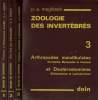
Bon Etat frais
Über das Schiesspulver. Eine chemisch=technische Abhandlung.
Halle, Hendels Verlag, 1814. Contemp. clothbacked boards. Stamp on title-page. (4),84 pp., 2 folded tables.
(Neue Schriften der naturforschenden Gesellschaft zu Halle., 2. Bd., Heft III). - Poggendorff II,104.
Chemischer Grundatlas. Ein Handbuch f¥r den Unterricht in geschichtlicher, technischer, anorganischer und allgemeiner chemie einschlisslich der mineralogie
Leipzig, Noske, 1933, un volume oblond relié en cartonnage (reliure de l'époque), 15pp., 95pp., figures dans le texte en noir et en couleurs
----Bon exemplaire**3632/CAV.G2
Description des chlorites et clintonites belges
Bruxelles, Hayez 1938 73pp., br.orig., 25cm., extrait des "Mémoires" publiés par l'Académie royale de Belgique (Classe des Sciences, t.XVII), non coupé
Analyse des matières cristallisées au moyen des rayons X
1936 Hermann et Cie éditeurs "collection ""actualités scientifiques et industrielles""" broché, 41p. Très bon état.
Table : analyses qualitatives - analyses quantitatives - évaluation des dimensions des cristallites.
Phone number : 04 76 97 79 28
"MENDELEEV, DIMITRI IVANOVITCH. (MENDELEYEV MENDELEV MENDELEJEFF)
Reference : 47884
(1884)
Sur la Dilatation des Liquides.
Paris, G. Masson, 1884. 8vo. Contemp. hcalf, raised bands, gilt spine. Light wear along edges and to top of spine. Small stamps on verso of titlepage. In: ""Annales de Chimie et de Physique"", 6e Series, Tome II. 568 pp. and 1 folded engraved plates. (Entire volume offered). Mendeleev's paper: pp. 271-282.
Mendeleev's first step towards his chemical theory of solutions.""After 1884, Mendeleev concerned himself with the expansion of liquids and in particular with the specific weights of aqueous solutions of various substances. He was able to conclude that in such solutions discontinuous relationships exist between the solvent and the solute, attesting to the existence of determinate chemical relationships - a necessary condition, according to chemical atomic theory. Mendeleev thus arrived at a chemical theory of solutions, which he opposed to the theory of electrolytic dissociation of dilute aqueous solutions set forth by Arrhenius.""(DSB).The volume contains further notable papers LECOQ DE BOISBAUDRAN ""Séparation du Gallium d'avec les autres Éléments"", pp. 176-271 - he discovered Gallium in 1877, this long paper describes describes the separation of a long sereis of other metals, also the rare earth metals. - 3 importent papers by FRANCOIS MARIE RAOULT on molecular weight of organic compounds, follwing up his discovery of Raoult's Law two years before.
MENDELEEV, DIMITRI IVANOVITCH. (MENDELEYEV MENDELEV MENDELEJEFF).
Reference : 34743
(1891)
Grundlagen der Chemie. Aus dem Russischen übersetz von L. Jawein und A. Thillot. - [THE PERIODIC LAW]
St. Petersburg, Carl Ricker, 1891. Royal8vo. Contemporary half calf with spine lettering. (2),1126,(1) pp. and 3 tables (1 folded). A fine fresh copy.
![Grundlagen der Chemie. Aus dem Russischen übersetz von L. Jawein und A. Thillot. - [THE PERIODIC LAW]. MENDELEEV, DIMITRI IVANOVITCH. (MENDELEYEV ...](https://static.livre-rare-book.com/pictures/LLX/34743_1_thumb.jpg)
![Grundlagen der Chemie. Aus dem Russischen übersetz von L. Jawein und A. Thillot. - [THE PERIODIC LAW]. MENDELEEV, DIMITRI IVANOVITCH. (MENDELEYEV ...](https://static.livre-rare-book.com/pictures/LLX/34743_2_thumb.jpg)
![Grundlagen der Chemie. Aus dem Russischen übersetz von L. Jawein und A. Thillot. - [THE PERIODIC LAW]. MENDELEEV, DIMITRI IVANOVITCH. (MENDELEYEV ...](https://static.livre-rare-book.com/pictures/LLX/34743_3_thumb.jpg)
First german edition: Dibner 48 - The Periodic Law.Mendeleev's milestone text book 'The Principles of Chemistry' first published in Russian 1869. In this work Mendeleev first published his great discovery that the elements exhibit an apparent periodicity of properties when arranged by their atomic mass.
MENDELEJEFF, (MENDELÉEV, MENDELEYEV, MENDELÉEFF), DIMITRY IVANOVICH. - A CLASSIC IN CHEMISTRY.
Reference : 50071
(1871)
Die periodische Gesetzmässigkeit der chemischen Elemente" (Aus dem Russischen von Felix Wreden). (On the periodical law of the chemical elements).
Leipzig und Heidelberg, C.F. Winter'sche Verlagshandlung, (1871) 1872. Recent marbled marbled boards. Spine gilt and with titlelabel in leather with gilt lettering: ""Annalen der Pharmacie VIII Suppl. Band. In ""Annalen der Chemie und Pharmacie. Hrsg. und Redigiert von Friedrich Wöhler, Justus Liebig und Hermann Kopp"", VIII. Supplementband. Pp. (4),392 pp. (entire volume offered). 2 small stamps on title-page. Mendelejeff's paper pp. 133-229, 2 (periodic) tables on p. 149 a. 151. Internally fine and clean.
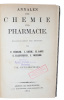
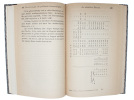
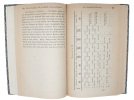
First printing of the first German translation of this milestone paper, ONE OF THE GREAT CLASSICS OF CHEMISTRY, in which Mendelejeff first coined the word ""periodic"", and in which he, for the first time, presented his great discovery of the periodicity of the elements in its full and complete form. At the same time the paper is the first to present his discoveries in a western language. In the paper he described and predicted the properties of a number of undiscovered elements - three of them were discovered in his lifetime. His periodic table was more complete than any of the preceding ones, and more thoroughly founded on experiment. The periodicity of the elements he himself formulated as ""Elements placed according to the value of their atomic weights present a clear periodicity of properties.""The offered paper is the German translation of his paper which was issued in ""Journal of the Russian Chemical Society"", vol. 3, pp. 25-56, the same journal in which he first announced his discovery (vol. 1, pp.66-77 (1869) ).""In March 1871, two years after his discovery of the law, Mendeleev first named it ""periodic"". That summer he published in Justus Liebigs Annalen der Chemie his article ""Die periodische Gesetzmässigkeit der chemischen Elemente."" - the paper offered - which he later characterized as ""the best summary of my views and ideas on the periodicity of the elements and the original after which so much was written later about this system. This was the main reason for my scientific fame, because much was confirmed - much later.""""(DSB IX, p. 289-90)""Lothar Meyer and Dimitri Mendeleev independently discovered the periodic system, but ""Meyer did not publish this work until after the appearance of Mendeleev's first paper on the subject in 1869. His table was very similar to that of Mendeleev, but it contained some improvements and was, perhaps, influential in causing some of the revisions made by Mendeleev in the second version of his table, published in 1870. In general, Meyer was more impressed by the periodicity of the physical properties of the elements, while Medeleev saw more clearly the chemical consequences of the periodic law.""(Source Book in Chemistry, p. 434).Horblitt, ""100 Books famous in Science"" (the Russian paper 1869) No 74. - Dibner, ""Heralds of Science"" No 48 (only the later book of 1891) - Partington IV: pp. 891-897. - Source Book in Chemistry pp. 442 ff. - PMM: 407 (under Moseley). - Neville ""Historical Chemical Library"" II: p. 162 (only the French edition from 1879).
"MENDELEJEFF, (MENDELÉEV, MENDELEYEV, MENDELÉEFF), DIMITRY IVANOVICH. - THE DECISIVE CONFIRMATION OF MENDELEEV'S PERIODIC TABLE OFTHE ELEMENTS.
Reference : 47272
(1875)
Remarque à propos de la découverte du gallium.
Paris, Gauthier-Villars, 1875. 4to. No wrappers. In: ""Comptes Rendus Hebdomadaires des Séances de L'Academie des Sciences"", Tome 81, No 21. Pp. (909-) 992. With titlepage to vol. 81. A stamp to verso of titlepage, showing on recto. Mendelejeff's paper: pp. 969-972.
First apperance of this importent paper which established that Gallium is identical with Eka-aluminum (the missing element between Aluminum and Indium) in Mendelejeff's periodic table. The properties of the new element corresponded well with those predicted. A bitter contorversy was raised between the discoverer of Gallium, Lecog de Boisbaudran and Mendelejeff. ""The discovery of the three elements predicted by Mendeleev was, however, of decisive importance in the acceptance of his law. In 1875 Lecoq de Boisbaudran, knowing nothing of Mendeleev’s work, discovered by spectroscopic methods a new metal, which he named gallium. Both in the nature of its discovery and in a number of its properties gallium coincided with Mendeleev’s prediction for eka-aluminum, but its specific weight at first seemed to be less than predicted. Hearing of the discovery, Mendeleev sent to France ""Zametka po povodu otkrytia gallia"" (the paper offered) (""Note on the Occasion of the Discovery of Gallium""), in which he insisted that gallium was in fact his eka-aluminum. Although Lecoq de Boisbaudran objected to this interpretation, he made a second determination of the specific weight of gallium and confirmed that such was indeed the case. From that moment the periodic law was no longer a mere hypothesis, and the scientific world was astounded to note that Mendeleev, the theorist, had seen the properties of a new element more clearly than the chemist who had empirically discovered it. From this time, too, Mendeleev’s work came to be more widely known""(DSB).Parkinson Breakthroughs"" 1875 C.
"MENDELÉEFF, D. (MENDELÉEV, MENDELEYEV, MENDELÉEFF). - THE DECISIVE CONFIRMATION OF MENDELEEV'S PERIODIC TABLE OFTHE ELEMENTS.
Reference : 49528
(1875)
Remarque à propos de la découverte du gallium.
Paris, Gauthier-Villars, 1875. 4to. No wrappers. In: ""Comptes Rendus Hebdomadaires des Séances de L'Academie des Sciences"", Tome 81, No 21. Pp. (909-) 992. With titlepage to vol. 81. Mendelejeff's paper: pp. 969-972. Titlepage lightly browned and with a punched stamp in lower margin. Otherwise clean and fine.
First apperance of this importent paper which established that Gallium is identical with Eka-aluminum (the missing element between Aluminum and Indium) in Mendelejeff's periodic table. The properties of the new element corresponded well with those predicted. A bitter contorversy was raised between the discoverer of Gallium, Lecog de Boisbaudran and Mendelejeff. ""The discovery of the three elements predicted by Mendeleev was, however, of decisive importance in the acceptance of his law. In 1875 Lecoq de Boisbaudran, knowing nothing of Mendeleev’s work, discovered by spectroscopic methods a new metal, which he named gallium. Both in the nature of its discovery and in a number of its properties gallium coincided with Mendeleev’s prediction for eka-aluminum, but its specific weight at first seemed to be less than predicted. Hearing of the discovery, Mendeleev sent to France ""Zametka po povodu otkrytia gallia"" (the paper offered) (""Note on the Occasion of the Discovery of Gallium""), in which he insisted that gallium was in fact his eka-aluminum. Although Lecoq de Boisbaudran objected to this interpretation, he made a second determination of the specific weight of gallium and confirmed that such was indeed the case. From that moment the periodic law was no longer a mere hypothesis, and the scientific world was astounded to note that Mendeleev, the theorist, had seen the properties of a new element more clearly than the chemist who had empirically discovered it. From this time, too, Mendeleev’s work came to be more widely known""(DSB).Parkinson Breakthroughs"" 1875 C.
Sur la cohésion de quelques liquides et sur la róle de la cohésion moléculaire dans les réactions chimiques des corps.
Paris, Gauthier-Villars, 1878. 4to. No wrappers. In: ""Comptes Rendus Hebdomadaires des Séances de L'Academie des Sciences"", Tome 51, No 3. Pp. (73-) 108. (Entire issue offered). Mendeleev's paper: pp. 97-99.
First appearance of an importent paper in which Mendeleev investigates the relation between capillarity, or cohesion and temperature. He became convinced that the force of chemical affinity was identical to the force of cohesion.
Sur la cohésion moléculaire de quelques liquides organiques.
(Paris, Mallet-Bachelier), 1860. 4to. No wrappers. In: ""Comptes Rendus Hebdomadaires des Séances de L'Academie des Sciences"", Tome 50, No 1. Pp. (13-) 59. (Entire issue offered). Mendeléef's paper: pp. 52-54.
First appearance of an importent paper in which he ""recognized a relation between the molecular cohesion of a liquid and its chemical reactivity. The esterification of an alcohol by an acid occurs in such a way that the sum of the molecular cohesions of the products of the reaction (ester + water) is much greater than that of reacting substances, an idea later applied to the influence of solvents""(Partington ""A History of Chemistry"", vol. 4, p. 893).
"MENDELÉEV (MENDELEJEFF, MENDELEYEV, MENDELÉEFF), DIMITRY IVANOVICH.
Reference : 44839
(1869)
Ueber die Verbindungen des Alkohols mit Wasser. Im Auszuge aus d. russischen Originalarbeit von Victor Richter. (On the Compounds of Alcohol with Water). (2 Theile).
Leipzig, Johann Ambrosius Barth, 1869. Conemp. hcalf. 5 raised bands, gilt spine and gilt lettering to spine. A few scratches to spine. Small stamp on verso of first -and general- titlepage and small stamps to verso of plates. In: ""Annalen der Physik und Chemie. Hrsg. von J.C. Poggendorff"", Fünfte Reihe Bd. 18 (138. Bd. der Reihe). X,652 pp. a. 6 folded plates (The entire volume offered). Mendeléev's paper: pp. 103-141 a. pp. 230-279. Clean and fine.
First German edition of Mendeléev's doctoral dissertation ""O soedineni spirta s vodoyu"" from 1865. ""In it he first developed the characteristic view that solutions are chemical compounds and that dissolving one substance into another is not to be distinguished from other forms of chemical combination. In this thesis, he also adhered to the principles of chemical atomism.""(DSB). - This work contributed to the birth of a popular legend, which claims that Mendeleev invented the standard for Russian vodka, saying it should contain 40% of alcohol by volume. Mendeléev is credited as being the creator of the first version of the periodic table of elements. Using the table, he predicted the properties of elements yet to be discovered.The volume contains other notable papers by Kohlrausch, Fizeau, Zöllner etc. and Julius Thomsen's ""Thermochemische Untersuchungen""
Cosmographie élémentaire, divisée en parties astronomique et géographique. Ouvrage dans lequel on a tâché de mettre les vérités les plus intéressantes de la Physique céleste, à la portée de ceux même qui n'ont aucune notion de Mathémathiques; avec des Planches et des Cartes.
Paris, Chez l'Auteur, 1781. Un volume in-8 de : XXIV pages (faux-titre, titre, épitre, avertissement, extrait des registres de l'Académie Royale des Sciences, table des articles, au verso emplacement des figures et cartes) , 429 pages et un feuillet de privilège. Bien complet des deux tableaux dépliants de figures et de sept cartes dépliantes réhaussées à l'époque. Basane fauve d'époque, dos à nerfs orné, pièce de titre de maroquin rouge, tranches rouges , bon état.
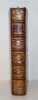
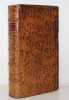
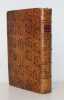
Cosmographie dédiée à Monseigneur le Duc d'Angoulême, par M. Mentelle, Historiographe de Mgr le Comte d'Artois, de l'Académie des Sciences & Belles-Lettres de Rouen. Bel exemplaire.
Contribution à l'étude biochimique de l'Acide Ascorbique
JOUVE et Cie. 1940. In-8. Broché. Bon état, Couv. fraîche, Dos satisfaisant, Intérieur frais. 123 pages.. . . . Classification Dewey : 540-Chimie et sciences connexes
Classification Dewey : 540-Chimie et sciences connexes
THESE PRESENTEE A L UNIVERSITE DE BORDEAUX I POUR L OBTENTION DU TITRE DE Dr EN CHIMIE, MENTION: CHIMIE ORGANIQUE / SYNTHESE DE DERIVES SULFONIQUES PAR VOIE ORGANOSILICIQUE- LE 14 FEVRIER 1972
UNIVERSITE DE BORDEAUX I. 1972. In-4. Broché. Bon état, Couv. convenable, Dos satisfaisant, Intérieur frais. 92 pages dactylographiées. . . . Classification Dewey : 540-Chimie et sciences connexes
3ème CYCLE D ENSEIGNEMENT SUPERIEUR- N° D ORDRE: 941 Classification Dewey : 540-Chimie et sciences connexes
Précis de Chimie conforme au programme d'admission à l'Ecole spéciale militaire de Saint-Cyr
Imprimerie Barutel. Non daté. In-8. Broché. Etat d'usage, Couv. convenable, Dos abîmé, Intérieur frais. 153 pages. Nombreuses illustrations en noir et blanc dans le texte. Coiffes abîmées. Rousseurs éparses sur les plats. Un tampon en page de faux titre. Tâche d'encre en première page.. . . . Classification Dewey : 540-Chimie et sciences connexes
Classification Dewey : 540-Chimie et sciences connexes
CHIMIE ORGANIQUE, PC
Bréal. 2000. In-4. Broché. Bon état, Couv. convenable, Dos satisfaisant, Intérieur frais. 400 pages. Illustré de nombreuses figures en noir et blanc dans le texte.. . . . Classification Dewey : 540-Chimie et sciences connexes
'Les Nouveaux Précis Bréal'. Cours, Méthodes, Exercices résolus. Classification Dewey : 540-Chimie et sciences connexes
CHIMIE, MPSI - PTSI
Vréal. 2000. In-4. Broché. Bon état, Couv. convenable, Dos satisfaisant, Intérieur frais. 319 pages.. . . . Classification Dewey : 540-Chimie et sciences connexes
'Les Nouveaux Précis Bréal'. Cours, Méthodes, Exercices résolus. Classification Dewey : 540-Chimie et sciences connexes

