 Write to the booksellers
-
Type
Autograph (1)
Book (5194)
Magazine (35)
Music sheets (3)
Photographs (8)
-
Latest
Last 24h (1)
Last 3 days (2)
Last month (8)
Last week (3)
-
Language
Czech (1)
English (3)
French (5224)
German (11)
Latin (1)
Spanish (1)
-
Century
17th (16)
18th (197)
19th (1143)
20th (2267)
21st (81)
-
Countries
Belgium (353)
Côte d'Ivoire (20)
Denmark (697)
France (3813)
Switzerland (358)
-
Syndicate
CLAM (2)
ILAB (3011)
NVVA (183)
SLACES (183)
SLAM (2106)
SNCAO (48)
Geschichte der Chemie von den ältesten Zeiten bis zur Gegenwart. Vierte verb.u. verm. Aufl.
Leipzig, Veit & Co., 1914. Contemp. hcalf. Gilt spine with gilt lettering. XIV,616 pp. Clean and fine.

Geschichte der Chemie von den ältesten Zeiten bis zur Gegenwart.
Leipzig, Veit & Co., 1889. Bound with orig. printed wrappers in a later solid halfbuckram. X,466 pp.
The first edition.
[Chez G. Cavelier] - MEYER, Frederich ; (DREUX, M. P. F. ; MEYER, Friedrich)
Reference : 62259
(1766)
Essais de Chymie, sur la Chaux Vive, la Matière élastique et électrique, le Feu, et l'Acide universel primitif ; Avec un Supplément sur les Eléments. Tome Premier (Tome 1 seul)
Traduits de l'Allemand de M. Frederich Meyer, Apothicaire à Osnabruck, par M. P. F. Dreux, ancien Apothicaire Aide-Major des Armées du Roi en Allemagne, 1 vol. in-12 reliure de l'époque plein veau marbré, dos à 5 nerfs orné, Chez G. Cavelier, Paris, 1766, 1 f. blanc, xliv-364 pp. avec une planche dépliante
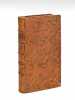
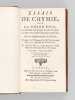
Tome 1 seul. Etat très satisfaisant (épidermures aux plats en coins, bon état par ailleurs)
Analyse et détermination de la constitution des composés organiques. Première édition française transcrite par Marcel Bernheim.
Albin Michel, 1924, 2 vol. gr. in-8°, lxxii-xxiv-1215 pp, 322 figures, reliures percaline rouge éditeur, dos lég. frottés, un mors fendu, mais bon exemplaire
Désormais les frais d'envoi sont de 6 € seulement pour les livres jusqu'à 1 kg (colissimo suivi), pour la France métropolitaine.
Analyse et détermination de la constitution des composés organiques
Albin Michel 1924 2 volumes. In-8 relié 22 cm sur 17 cart. éd. rouge. LXXII-568- XXIV- 647 pages. Cartonnage lég. passé, int. lég. jauni. Bon exemplaire.
Première édition française, transcrite par Marcel Bernheim. Bon état d’occasion
Essais de chymie, sur la chaux vive, la matière élastique et électrique, le feu, et l'acide universel primitif; avec un supplément sur les éléments ; traduits de l'allemand de M. Frederich Meyer, apothicaire à Osnabruck. Par M. P. F. Dreux, ancien apothicaire aide-major des Armées du Roi en Allemagne.
Paris, Cavelier, 1766. 2 vol. in 12 de XLIV-364 pp. ; 384 pp., 1 tableau replié, basane marbrée, dos orné à nerfs, pièces de titre et de tomaison en maroquin rouge et noir, tranches rouges (reliure de l'époque).
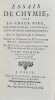
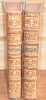
Première édition française établie par l'apothicaire Dreux des nouvelles expériences faites sur la chaux par l'apothicaire allemand Johann Friedrich Meyer (1705-1765) : « Je veux considérer la chaux comme une chose qui m'este entièrement inconnue et qu'il me faut étudier tout de nouveau par ses propriétés et ses rapports les plus évidents. Je veux en commencer la recherche par son origine primitive, et d'abord examiner la pierre à chaux crue le plus exactement qu'il m'est possible afin de pouvoir connaître ce qu'elle contient et ne contient pas, et savoir si la même substance qu'elle possède après la calcination peut être produite des mêmes principes que ceux qui existaient déjà dans la pierre à chaux. » Au XVIIIe siècle, Black et Lavoisier décrivirent la réaction chimique de la chaux tandis que Debray et Lechatelier découvrent d'autres qualités et applications dont le calcaire introduit pour la première fois dans le dentifrice. Bon exemplaire. Deux coins usés, accroc sur le caisson de pied au tome I.Duveen, p. 402 ; Caillet, III, 7492, pour un autre titre de Meyer.

"MEYER, LOTHAR. - THE PERIODIC TABLE & ""THE ATOMIC VOLUME CURVE"".
Reference : 43852
(1870)
Die Natur der chemischen Elemente als Function ihrer Atomgewichte. (Hierzu Tafel III).
Leipzig und Heidelberg, C.F. Winter'sche Verlagshandlung, 1870. No wrappers. In ""Annalen der Chemie und Pharmacie. Hrsg. und Redigiert von Friedrich Wöhler, Justus Liebig und Hermann Kopp"", VII. Supplementband. Pp. 354-364 a. 1 folded plate (The atomic volume curve). The entire volume offered ""VII. Supplementband."" (4),380 pp. and 3 folded plates. Small stamp on titlepage and verso of.
First appearance of this groundbreaking, classic paper in which Lothar Meyer first fully expressed his ideas of the relationsships between the atomic weight of the elements and their properties. In his ""Curve"" he plots the atomic volumes of the chemical elements against their weights and connects the points to obtain a curve with proonounced peaks and valleys. The periodicity in atomic volume and electrochemical behaviour revealed by this curve is matched by periodicities in other properties, such as fusibility and volatility etc.The ""Periodic Law"" may be stated in the words: The properties of the Elements are a periodic function of (or vary in a periodic manner with) the atomic weight. (Findlay).Lothar Meyer and Dimitri Mendeleev independently discovered the periodic system, but ""Meyer did not publish this work until after the appearance of Mendeleev's first paper on the subject in 1869. His table was very similar to that of Mendeleev, but it contained some improvements and was, perhaps, influential in causing some of the revisions made by Mendeleev in the second version of his table, published in 1870. In general, Meyer was more impressed by the periodicity of the physical properties of the elements, while Medeleev saw more clearly the chemical consequences of the periodic law.""(Source Book in Chemistry, p. 434). - Weeks p. 207 ff.
"MEYER, LOTHAR und KARL SEUBERT. - THE PERIODIC TABLE REVISED.
Reference : 44324
(1883)
Die Atomgewichte der Elemente aus den Originalzahlen neu berechnet.
Leipzig, Breitkopf & Härtel, 1883. Contemp. hcalf. Raised bands, gilt spine, titlelabel with gilt lettering. X,245,(1) pp. Internally fine and clean.
Scarce first edition of this importent work which is a large extension of Meyer's classic paper of 1870, in which he independently of Mendeleev, discovered that the properties of the elements are a periodic function of (or vary in a periodic manner with) the atomic weight - the Periodic Table.""The significance of atomic weights in the demonstration of chemical periodicity, and the suspicion that some atomic weights were not accurate, led Meyer and Seubert to examine critically and to recalculate all atomic weights then considered importent. Their study was published in 1883 (the work offered). All atomic weights were referred to the standard of unity for the atomic weight of hydrogen, a standard that Meyer championed.....In 1903 the newly created International Commission of Atomic Weeights decided to publish parallel tables based on H=1 and O=16, a practice followed for many years.""(DSB IX, pp. 351-352).
Handbuch der Technologie für Artillerie=Officiere.
Berlin, Posen und Hamburg, Mittler, 1835. Contemp. hcalf. Gilt spine with gilt lettering. A paperlabel pasted on upper part of spine. Stamps on title-page. VIII,218 pp. A few scattered brownspots.
Brève histoire des drogues et médicaments de l'esprit.
Editions Erès, 1985. 16 x 24, 144 pp., broché, bon état (couverture légèrement défraîchie).
envoi de l'auteur.
Brève histoire des drogues et médicaments de l'esprit.
Editions Erès, 1985. 16 x 24, 144 pp., broché, bon état (rousseurs sur les tranches et sur les 2 premières et 3 dernières pages).
La déduction relativiste.
In-8, demi-chagrin à coins de l'époque (lég. défr.), XVI, 396 p. Paris, Payot, 1925.
Edition originale. Réflexions sur la théorie de la relativité envisagée comme "un véritable système de déduction globale" (Bréhier). ('Dictionnaire des philosophes', P.U.F., p. 2004).
LES ENGRAIS CHIMIQUES EN HORTICULTURE - CONFERENCE DE M.F. BRIN AU IIE CONGRES DE L'EAU A TOULOUSE.
NON PRECISE. NON DATE. In-8. Broché. Etat d'usage, Livré sans Couverture, Agraffes rouillées, Intérieur frais. 23 pages agrafées - livré sans couverture.. . . . Classification Dewey : 631.4-Science des sols : chimie, physique, fertilité
Classification Dewey : 631.4-Science des sols : chimie, physique, fertilité
Analyse du Cours de Chimie Agricole.
Verdier. Rennes 1855 in-12 ( 185 x 120 mm ), broché de 244 pages sous couverture imprimée. Bel exemplaire non rogné.
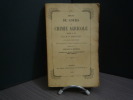
Analyse du Cours de Chimie Agricole.
Marteville Et Oberthur Rennes 1854 in-12 ( 185 x 120 mm ), broché de 172 pages sous couverture imprimée. Bel exemplaire non rogné.
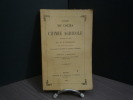
Cours de Chimie Agricole.
Verdier. Rennes 1860 in-12 ( 185 x 120 mm ), broché de 250 pages sous couverture imprimée. Bel exemplaire non rogné.
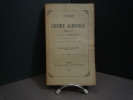
Cours de Chimie Agricole.
Oberthur. Rennes. 1858 in-12 ( 185 x 120 mm ), broché de 194 pages sous couverture imprimée. Bel exemplaire non rogné.
Cours de Chimie Agricole.
Verdier. Rennes. 1865 in-12 ( 185 x 120 mm ), broché de 157 pages sous couverture imprimée. Bel exemplaire non rogné.
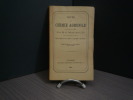
Cours de Chimie Agricole.
Verdier. Rennes. 1863 in-12 ( 185 x 120 mm ), broché de 157 pages sous couverture imprimée. Bel exemplaire non rogné
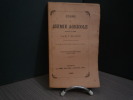
Cours de Chimie Agricole.
Verdier. Rennes. 1862 in-12 ( 185 x 120 mm ), broché de 165 pages sous couverture imprimée. Bel exemplaire non rogné
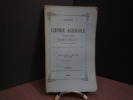
Cours de Chimie Agricole.
Verdier. Rennes. 1861 in-12 ( 185 x 120 mm ), broché de 154 pages sous couverture imprimée. Bel exemplaire non rogné.
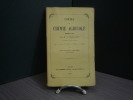
Cours de Chimie Agricole.
Verdier. Rennes. 1864 in-12 ( 185 x 120 mm ), broché de 162 pages sous couverture imprimée. Bel exemplaire non rogné.
Cours de Chimie Agricole.
Marteville Et Oberthur Rennes 1857 in-12 ( 185 x 120 mm ), broché de 215 pages sous couverture imprimée. Bel exemplaire non rogné.
ELEMENTS D'HISTOIRE NATURELLE et de CHIMIE. Tome 1.
1791 / 506 pages. Relié au format : 13 x 20,5 cm. Editions Cuchet.
Tête de dos rogné, intérieur très frais sans rousseur apparente. Bel état. Petit Prix ! LOT POSSIBLE AVEC LES REFERENCES : NAT030M & NAT031M
ELEMENTS D'HISTOIRE NATURELLE et de CHIMIE. Tome 2.
1791 / 496 pages. Relié au format 13 x 20,5 cm. Editions Cuchet.
Tête de dos rogné, intérieur très frais sans rousseur apparente, une mouillure visible sur 5 pages. Bel état. Petit Prix ! LOT POSSIBLE AVEC LES REFERENCES : NAT030M & NAT032M

