 Write to the booksellers
-
Type
Book (5361)
Magazine (35)
Music sheets (3)
Photographs (8)
-
Latest
Last 3 days (1)
Last month (87)
Last week (4)
-
Language
Czech (1)
English (3)
French (5390)
German (11)
Latin (1)
Spanish (1)
-
Century
17th (16)
18th (200)
19th (1144)
20th (2276)
21st (78)
-
Countries
Belgium (352)
Côte d'Ivoire (19)
Denmark (687)
France (3992)
Switzerland (357)
-
Syndicate
CLAM (2)
ILAB (3004)
NVVA (183)
SLACES (183)
SLAM (2110)
SNCAO (48)
Cours de chimie biologique et médicale. Fascicule II
CENTRE DE DOCUMENTATION UNIVERSITAIRE. 1941. In-4. Broché. Bon état, Couv. légèrement passée, Dos satisfaisant, Intérieur bon état. 163 pages. Texte dactylographié. Nombreuses figures et schémas en noir et blanc dans le texte.. . . . Classification Dewey : 540-Chimie et sciences connexes
Cours de l'Université de Bordeaux. Classification Dewey : 540-Chimie et sciences connexes
Mémorial pratique du Chimiste-Manufacturier, ou Recueil de procédés d'Arts et de Manufactures (3 Tomes - Complet) [ Edition originale de la traduction ]
Traduit de l'anglais sur la troisième édition de l'ouvrage de M. Colin Mackenzie, intitulé One thousand experiments in Chemistry, revu et considérablement augmenté par le traducteur, 3 vol. in-8 reliure demi-percaline marron, Chez Barrois l'Aîné, Paris, 1824, xxxiv-456 pp. avec 3 planches dépliantes ; 2 ff., 468 pp. ; 2 ff., 492 pp.
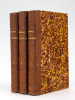
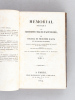
Bon état (qq. petites mouill. marginales) pour cette traduction française très enrichie du grand succès de l'écrivain et compilateur écossais Colin Mackenzie ; la faisabalité et la sécurité des expériences décrites eurant beau être remises en question dans plusieurs journaux du temps, cela n'entrava pas le succès d'une oeuvre qui connut 22 éditions en Europe et aux Amériques.
DICTIONNAIRE DE CHYMIE, contenant la théorie et la pratique de cette science. 2e édition.
A Paris chez P Fr Didot Jeune 1777. 3vol in-8 1f n ch III-XXXII 747 660 510pp. Pleine basane fauve marbrée, dos à nerfs orné de compartiments dorés, pièces de titre et de tomaison grenat, tranches marbrées, rel époque. 4 coins usés dont 2 avec petit manque de cuir. Duveen p377.

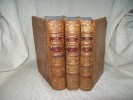
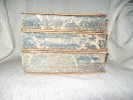
Dictionnaire de chymie contenant la théorie et la pratique de cette science, son application à la physique - à l'histoire naturelle - à la médecine et aux arts dépendants de la chymie. tome troisième seul.
Couverture rigide. Reliure basane à nerfs légèrement défraîchie (petits trous de vers). 520 pages. Cachet sur la page de titre.
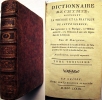
Livre. Chez les libraires associés (Collection : En Suisse), 1779.
Dictionnaire de Chymie, contenant la Théorie et la Pratique de cette Science, son application à la Physique, à l'Histoire Naturelle, à la Médecine et à l'Economie animale; avec l'Explication détaillée de la Vertu et de la manière d'agir des Médicamens Chymiques. Et les Principes fondamentaux des Arts, Manufactures et Métiers dépendans de la Chymie. [CHIMIE]
Paris, Lacombe, 1769. 2 Volumes, complet. In-8 - 11,5 x 18cm Reliure pleine basane d'époque.
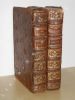
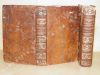
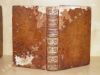
Importants manques de cuir sur les plats du second tome, reliure frottée, coiffes manquantes ou élimées, intérieur propre. 2 tomes, Complet. Premier dictionnaire de chimie dont l'édition originale date de 1766. - Clients Livre Rare Book : Les frais postaux indiqués sont ceux pour la France métropolitaine et la Corse, pour les autres destinations, merci de contacter la librairie pour connaître le montant des frais d'expédition, merci de votre compréhension. Livre Rare Book Customers : The shipping fees indicated are only for France, if you want international shipping please contact us before placing your order, thank you for your understanding. - Frais de port : -Colissimo France 11 € -Colissimo International (Union Européenne + Suisse : 23 €) (Reste du Monde : 55 €) -Mondial Relay France 7 €


Phone number : +33 6 18 71 03 67
éléments de chymie-théorique
in 12 plein cuir fauve raciné à nerfs pièce de titre cuir rouge fers,roulette dorés.faux-titre,titre orné d’une vignette gravée, mention de nouvelle édition,XII,1 feuillet,355 pages,XX table des matières,approbation,V explication des planches,4 planches dépliantes en fin de volume. Chez Jean Thomas Hérissant 1753 une mouillure angle intérieur gauche en début de volume sans gravité
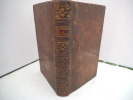
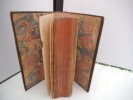
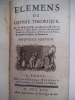
Il prit une part très importante dans le développement de l’industrie chimique en France.Il collabora avec LAVOISIER, il est le fondateur de la chimie expérimentale en France
DICTIONNAIRE DE CHYMIE, contenant la théorie et la pratique de cette science, son application à la Physique, à l'Histoire Naturelle, à la Médecine, & à l'economie animale. Seconde édition, revue & considérablement augmentée. Tome 3 seul (sur 3)
Paris Chez P. Fr. Didot jeune, Libraire 1777 in 8 (18,5x12) 1 volume reliure pleine basane fauve de l'époque, dos a nerfs orné, pièce de titre de cuir marron, tranches marbrées, 660 pages, petit trou vers dans la marge supérieure. Contenant la théorie et la pratique de cette science, son application à la Physique, à l'Histoire Naturelle, à la Médecine, & à l'economie animale; avec l'explication détaillée de la vertu & de la maniere d'agir des médicamens chymiques. Et les principes fondamentaux des arts, manufactures & metiers dépendans de la Chymie. Seconde édition, revue & considérablement augmentée. Tome 3 seul (sur 3). Bel exemplaire ( Photographies sur demande / We can send pictures of this book on simple request )
Très bon Reliure
Chemisches Wörterbuch, oder allgemeine Begrifft der Chymie nach alphabetischer Ordnung. Zweyte verbesserte und vermehrte Ausgabe. 6 vols [out of 7, missing vol. 5.]. - [""FIRST MODERN DICTIONARY OF CHEMISTRY""]
Leipzig, Weidmanns, 1788-1791. 8vo. In 6 contemporary blue card board bindings with paper title-label pasted on to top of spine. Wear to extremities and ex-libris pasted on to pasted down front free end-paper on all volumes. Small stamp to front free end-paper end title-page. Otherwise fine. Vol 1: LXII, 806, (2 blanks) pp + frontiespiece" Vol 2: (2), 853, (1) pp. Vol 3: (2), 788 pp. Vol 4: (2), 754 pp. Vol 6: (2), 813, (1) pp." Vol 7: (2), 1030,
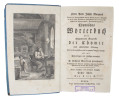
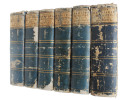
Third (second Leonhardi) German edition of this landmark work ""which may be regarded as the first scientific work of its class."" (Ferguson I:p.60) and is considered the ""first modern dictionary of chemistry"".""The second edition of the German translation of the second French edition of the Dictionnaire (Paris, 1778), revised by J. G. Leonhardi (1746-1823). Beginning his translation in 1780 while teaching medicine at Leipzig, he completed the work in 1783 after being appointed professor at Wittenberg . Leonhardi was a former pupil of Pörner, the title of whose translation he incorporated into his first edition (Leipzig, 1781-83"" 6 vols., 8vo). To the present edition Leonhardi added numerous notes of his own, plus some from Pörner's German and Keir's English translation and material from the Italian editions of Scopoli and Vairo."" (Neville vol. 2, P. 118).
Dictionnaire de Chymie, contenant la Théorie et la Pratique de cette Science, son Application á la Physique, à l'Histoire naturelle, à la Médiciné, & aux Arts dépendans de la Chymie. Nouvelle édition revue & corregée sur les précédentes. 5 vols (all).
A Neuchatel, De l'Imprimerie de la Societé Typographique, 1789. Bound in 5 cont. hcalf with gilt backs. Backs slightly rubbed. Paperlabels pasted on lower part of back. Internally in general clean and on good paper. Small rubber stamp on titles.
Macquer's researches are numerous, varied, and original. Though he worked just before the oxygen period he seems to have been conscious of the defects of the phlogistic hypothesis, and some of his work has a bearing upon the later development. His chief book was the Dictionary, which may be regarded as the first scientific work of its class. (Ferguson I:p.60).
Dictionnaire de Chymie, contenant la Théorie et la Pratique de cette Science, son Application á la Physique, à l'Histoire naturelle, à la Médiciné, & aux Arts dépendans de la Chymie. Seconde Edition, revue & considérablement augmentée. 4 vols.
Paris, Fr. Didot, 1778. 8vo. In four nice uniform contemporary sprinckled full calf bindings with five raised bands and richly gilt spines. Hinges with wear, otherwise a fine set. XXXVII, (3), 568 pp. (4), 208, 207-302,305-655, (1) pp. (4),520, (1) [errata] pp." (4),333, (1), 335-336, (1), 336-776 pp. Complete with half titles in volume I-III, not called for in volume IV.
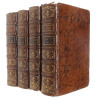
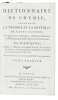
The genuine second edition - but fifth appearance - of Macquer's landmark work ""which may be regarded as the first scientific work of its class."" (Ferguson I:p.60). ""Although designiated as the second edition on each title page, this is the fifth appearance of the Dictionnaire in the French language. It is the genuine second edition as written by Marcquer, whose name now appears on the title and whose reputation had by this greatly increased. An important addition is the 168-page article on gas, a topic that was almost entirely new and had not been mentioned in the first edition. While the number of articles remains almost the same, the work, is nearly twice as long owing to the inclusion of an up-to date account of chemistry and much new material."" (Neville, vol. 2, p. 113).""By far the most important of Macquer's works: there had been technical dictionaries before but this was the first dictionary of theoretical and general chemistry"" its success soon produced many imitators"". (Duveen).
Dictionnaire portatif des Arts et Métiers, contenant en abrégé l'Histoire, la Description la Police des Arts et Métiers, des Farbiques et Manufactures de France des Pays Etrangers.
Paris, Lacombe, 1766. 8vo. In two nice contemporary full calf bindings with richly gilt spines and royal coat of arms [""Honi soit qui mal y pense""] to front and back board of both volumes. Wear to extremities and front board of volume 1 party detached. Part of tome-label on both volumes missing. Internally fine. XXIII, (1), 588 pp."" (4), 715, (1) pp.
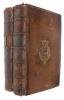
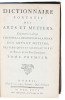
First edition of Marcquer's Dictionnaire in applied chemistry. ""In the avertissement Philippe states that his brother's dictionaire de chymie had recently appeared, and he suggests that the present work will form a logical sequelto the Dictionnaire raisonné d'histoire naturelle. Rare. Not in Blake, Collison, Watt, or the usual chemical bibliographies"". (Neville, vol. 2, p 110.)
Dictionnaire de chymie , contenant la théorie et la pratique de cette science , son application à la physique , à l'histoire Naturelle , à la mèdecine et à l'économie animale
Paris, Lacombe 1766 2 volumes in 12 veau époque , dos à nerfs ornés , pièces de titres et tomaisons rouges et vertes, tranches rouges . .
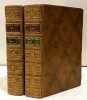
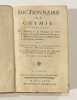
Bel exemplaire de l'un des premiers dictionnaires de Chimie en Première Edition et de la bibliothèque de François Michel de Léon dont il porte l'ex-libris . Pierre - joseph Macquer (1718-1784) fut professeur de Chimie et de Pharmacie au Jardin des Plantes . Après ses "Elémens de Chymie", il livre un dictionnaire par ordre alphabétique plus adapté à son public et plus complet avec des sujets qui ne trouvaient pas leur place dans un traité classique.
Dictionnaire de chymie, contenant la théorie et la pratique de cette science, son application à la physique, à l'Histoire naturelle, à la médecine, & aux autres arts dépendans de la chymie. Seconde édition.
Paris P. Fr. Didot 1777 Trois volumes petit in-8 plein veau raciné, dos à nerfs, caissons décorés, pièces de titre en maroquin noisette, pièces de tomaison en maroquin brun, filet doré sur les coupes, xxxii, 747, 660 et 510 pages, 10 planches dépliantes in fine. Tampon d'ex-libris en page de garde et en marge p. xvi. Bel exemplaire.
La librairie est ouverte du mardi au samedi de 9h30 à 12h30 et de 13h30 à 19h00. Commandes par courriel ou téléphone. Envoi rapide, emballage soigné.
Dictionnaire de Chymie, contenant la théorie & la pratique de cette Science, Son application à la physique, à l'histoire naturelle, à la médecine & à l'économie animale [3 volumes]
Yverdon, s.n. 1767 Ouvrage complet en 3 tomes; xxx,582 + 655,[i] + 647,[3] pp., 20cm., reliures uniformes en plein-cuir d'époque (qqs. traces d'usage aux coins et aux coiffes, titre et décorations dorées au dos), cachet ex-libris sur la page de titre du t.1, tranches marbrées, feuilles de garde décorées, texte frais avec peu de vagues taches, bon état, [Troisième édition, la plus complète, de cette première dictionnaire moderne de chimie. Cette édition suisse est la première éditée hors de la France. La suite du titre: "Avec l'explication détaillée de la vertu & de la maniere d'agir des médicamens Chymiques ; & les principes fondamentaux des Arts, Manufactures & métiers dépendans de la Chymie."], W94051
Dictionnaire de chymie, contenant la théorie & la pratique de cette science, son application à la Médecine & l’economie animale. 2 vols. - [""FIRST MODERN DICTIONARY OF CHEMISTRY""]
Paris, Lacombe, 1766. 8vo. In two contemporary full sprinckled full calf bindings with five raised bands and richly gilt spines. Corners and spines with wear, and waterstain affecting lower half of the last third of volume 1, otherwise a fine set. XXVI, (2), 616 pp."" (4), 686, (2) pp.
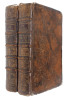
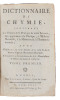
First edtion of this landmark work ""which may be regarded as the first scientific work of its class."" (Ferguson I:p.60) and is considered the ""first modern dictionary of chemistry"" .""An ecnyclopedia of all that was then known about chemistry, the Dictionnaire is Marcquer's most important work and a milestone of chemical literature. Begun in 1763, Macquer published it anonymously bacause he was concerned that his reputation might suffer as he had not been able to make it as perfect as he wished. He need not have worried, as the work received very favorably reviews shortly after it appeared. Containing more than five hundred articles in alphabetical order, it was preceded by a brief pattern for many later chemical dictionaries."" (Neville, vol2. p. 112).""By far the most important of Macquer's works: there had been technical dictionaries before but this was the first dictionary of theoretical and general chemistry"" its success soon produced many imitators"". (Duveen).Blake 282" Cole 862 Coleby 22 Duveen 377 Edelstein 1509 Ferchl 332
Élemens de chymie-pratique, contenant la description des opérations fondamentales de la chymie, avec des explications et des remarques sur chaque opération.
Paris, Hérissant, 1751 ; 2 t. petit in-8 ; veau havane marbré glacé, dos à nerfs décorés et dorés, pièces de titre fauve et de tomaison vert foncé, roulette sur les coupes, tranches rouges (rel. de l'époque) ; ((4), XVI, (8) (table), 517 pp., (3) pp. bl. ; (16), 574 pp., (1) f. bl., vignette gravée de titre, répétée, par R. Brunet d'après C. Challe, angelots qui s'activent au milieu des cornues auprès d'un fourneau.
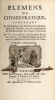
EDITION ORIGINALE (Fergusson, II-60 ; Duveen, 376). Issu d'une famille écossaise qui émigra en France à l'époque des Stuart, Macquer opéra une véritable révolution, faisant de la chimie une science à part et non une branche de la pharmacie, ouvrant la voie aux Lavoisier, Gay-Lussac, Thénard, etc. Il fut le premier à constater que l'arsenic est un métal, que les alcalins décolorent le bleu de Prusse, que les diamants ne perdent rien de leur poids lorsqu'on les calcine à l'abri de l'air, etc. Il a décrit les propriétés de l'alumine, de la magnésie, du sulfate de chaux, du sel d'Epsom. Ses travaux sur les métaux sont reconnus. Membre de l'Académie des Sciences, Censeur Royal, professeur de chimie au Jardin du Roi, enfin il modernisa la Manufacture de Sèvres. Minuscule usure à trois coins, petit travail de ver dans la marge extérieure en coin inférieur de quelques feuillets du Tome 1, sinon bel exemplaire, bien relié, avec juste quelques très rares rousseurs.
Dictionnaire de chymie, contenant la théorie et la pratique de cette science, son application à la physique, à l'histoire naturelle, à la médecine, & aux arts dépendans de la chymie. Seconde édition revue & considérablement augmentée. En 3 (= A - Suie), (sur 4) volumes.
Neuchâtel, Société typographique, 1778, in-8vo, XXXVIII + 3 p. n.n. + 568 p. / 2 ff. + 655 p. / 2 ff. + 510 p., reliure en cuir originale d’époque.
Macquer's chief publication. “Best known as the author of a widely read textbook and of the first chemical dictionary, Macquer... was an influencial member of the Paris scientific community and did much important, but unpublished research behind the scenes as a government scientific adviser” (DSB). Duveen remarks to the first edition of 1766: “By far the most important of Macquer's works: there had been technical dictionaries before but this was the first dictionary of theoretical and general chemistry; its success soon produced many imitators”. Poggendorff II/7-8; DSB VIII/618-624; Quérard V/418; Duveen 377-378; Norman Library 1413 (only a copy of the pirated edition); Neville & Smeaton, «Macquer's Dictionnaire de chymie. A bibliographical study» in «Annals of science» 38 (1981), p. 613-662; Honeyman coll. -; cf. Ferguson II/60; cf. Norman Library 1413 (only a copy of the pirated edition); .
(SLACES, NVVA)
Phone number : 41 (0)26 3223808
Dictionnaire de chymie, contenant la théorie & la pratique de cette science, son application à la physique, à l'histoire naturelle, à la médecine & à l'économie animale; avec l'explication détaillée de la vertu & de la manière d'agir des médicamens chymiques. Et les principes fondamentaux des arts, manufactures & métiers dépendans de la chymie. En 2 volumes.
Paris, Lacombe, 1766, in-8°, XXVIII + 616 p. / 2 ff. + 686 p. + 1 f., légèrement bruni, çà et là légèrement taché d'eau, exlibris ms. tracé ‘N. Debreuet 1777’, cachet sur titres, reliures en veau usé, dorure aux dos passée, frotté, accrocs aux coiffes, coins touchés, pièce de titre sur l'un des dos, pièce de tomaison sur l'autre dos, tranches marbrées.
Edition originale, la vraie, du premier dictionnaire de chimie théorique et général, parue sans nom de l'auteur, ouvrage principal de Macquer. Il existent également des exemplaires d'une édition piratée. Norman énumere les points de différence de la vraie édition originale. Les éditions suivantes fûrent publiées avec le nom de l'auteur.First edition (not the pirated one). “Best known as the author of a widely read textbook and of the first chemical dictionary, Macquer... was an influencial member of the Paris scientific community and did much important but unpublished research behind the scenes as a government scientific adviser” (DSB).“By far the most important of Macquer's works: there had been technical dictionaries before but this was the first dictionary of theoretical and general chemistry; its success soon produced many imitators” (Duveen). Dictionary of Scientific Biography VIII/618-624; Poggendorff II/7-8; Quérard V/418; Duveen 377; Bolton I/68; Norman Library 1413 (only a copy of the pirated edition); Neville & Smeaton, «Macquer's Dictionnaire de chymie. A bibliographical study» in «Annals of science» 38 (1981), p. 613-662; Partington III/80-90; Honeyman coll. -; cf. Ferguson II/60.
(SLACES, NVVA)
Phone number : 41 (0)26 3223808
Allgemeine Begriffe der Chymie nach alphabetischer Ordnung aus dem Französischen übersetzt und mit Anmerkungen vermehrt. Vol. 1 & 3 (out of 3). - [FIRST GERMAN TRANSLATION OF THE ""FIRST MODERN DICTIONARY OF CHEMISTRY""]
Leipzig, Weidmanns, 1768 & 1769. 8vo. In two later modest half cloth bindings. Soiling to extremities and internally with light occassional brownspotting. Small repair to upper margin of title page in volume 1. XL, 597 pp."" 654, (24) pp.
First German edition of this landmark work ""which may be regarded as the first scientific work of its class."" (Ferguson I:p.60) and is considered the ""first modern dictionary of chemistry"".It was transted by Carl Wilhelm Pörner, a chemist at the Meissen porcelain works in Saxony. ""It was made from the threevolume Yverdon (1767) edition, as each of those volumes appeared. Pörner added extensive notes of his own, and there is a separate alphabetical sequence of articles in each volume, as the order of entries was not the same in German after translation from the French. Although he did not know the author's name, the Dictionnaire having appeared anonymously, Pörner was enthusiastic about the book but preferred not to call it a dictionary. He regarded it as a useful general guide to chemistry rather than a mere explanation of the meanings of chemical terms and entitled it (in translation) General conceptions of chemistry, in alphabetical order."" (Neville).
The Development of Titrimetric Analysis till 1806.
Copenhagen, 1958. Orig. printed wrappers. 239 pp. Illustr.
Doctor-Dissertation.
Devant Dieu.
Paris, Fasquelle, 1937. In-12 de 252 pages. Edition originale sur "vélin bibliophile". Broché, couvertures orange imprimées. Très bon état avec un dos très légèrement insolé.
Tables annuelles de constantes et données numériques, 15 : EFFET RAMAN. Préface de J. Cabannes. Volume XII (1935-1936). Chapitre 26.
P., Hermann, 1937, grand in 8° cartonnage de l'éditeur, 146 pages ; traces de scotch sur les gardes.
...................... Photos sur demande ...................
Phone number : 04 77 32 63 69
Histoire d'un morceau de verre
1878 A Paris, Librairie d'éducation. Gérant : Amable Rigaud, Editeur, Collection "Bibliothèque de la science pittoresque" - 1878 - In-8, pleine percaline, titre et décors noir au dos et sur les plats - 216 p. - Avec de nombreuses gravures in et hors texte
Bon état malgré percaline défraîchie (frottements, piquée, decors ternie) - Rousseurs - Inscription à la plume sur la page miroir du titre
Le problème de chimie élémentaire (principes et exemples de solutions), à l'usage des candidats aux baccalauréats et aux écoles du gouvernement
Vuibert. 1921. In-8. Broché. Etat d'usage, Plats abîmés, Coiffe en pied abîmée, Intérieur bon état. 158 pp. - Plats déchirés sans manque, coiffe de tête abîmée. . . . Classification Dewey : 540-Chimie et sciences connexes
Classification Dewey : 540-Chimie et sciences connexes
Le problème de chimie élémentaire (principes et exemples de solutions).
Couverture souple. Broché. 158 pages. Quelques rousseurs.

Livre. A l'usage des candidats aux baccalauréats. Librairie Vuibert, 1930.

