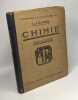
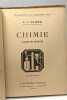
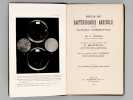
Couverture souple. Broché. 300 pages.
Livre. Editions Flammarion (Collection : La terre), 1949.
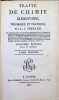
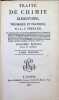
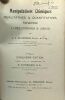
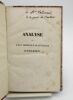
Béchet Jeune. 1836. In-4. Broché. Etat d'usage, Tâchée, Dos abîmé, Mouillures. 6 planches dépliables de gravures en noir et blanc + 15 planches de gravures en noir colorées. Etiquette de code sur le 1er plat. Tampon de bibliothèque en page de titre. Dos fendu.. . . . Classification Dewey : 540-Chimie et sciences connexes
2e édition revue et augmentée de la synonymie chimique des corps simples et composés les plus employés. Abrégé de Chimie, considérée comme science accessoire à l'étude de la Médecine, de la Pharmacie et de l'Histoire naturelle. Fer. Etain. Zinc. Arsenic... Classification Dewey : 540-Chimie et sciences connexes
LABE - 4° EDITION. 1846. In-12. Relié demi-cuir. Etat d'usage, Coins frottés, Dos abîmé, Quelques rousseurs. 819 pages. Titre, auteur, tomaison, filets, fleurons dorés sur le dos cuir marron. Des manques sur le dos.. . . . Classification Dewey : 540-Chimie et sciences connexes
Consiérée comme science accessoire à l'étude de la médecine, de la pharmacie, de l'histoire naturelle et de la technologie. Classification Dewey : 540-Chimie et sciences connexes
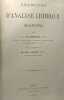
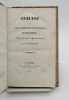
Bechet Jne et Labé. 1842. In-8. Relié. Etat d'usage, Coins frottés, Dos frotté, Rousseurs. 6 planches en noir et blanc, dont quelques unes dépliantes + 15 tableaux légèrement colorés. Plats et contreplats jaspés.. . . . Classification Dewey : 540-Chimie et sciences connexes
Classification Dewey : 540-Chimie et sciences connexes
Paris, Béchet et Labé, 1842. Grand in-8, broché, titre, 6 planches et 15 tableaux. Troisième édition revue, corrigée et augmentée et contenant 6 planches dont 5 dépliantes et 15 tableaux en couleurs. Couverture défraîchie et tachée, dos abîmé, rousseurs (principalement sur la page de titre).
Béchet Jeune/ Librairie de la faculté de médecine. 1836. In-8. Relié demi-cuir. Etat d'usage, Coins frottés, Dos abîmé, Intérieur frais. 611+685 pages. Tampon en page de titre. Nombreuses rousseurs. Dos partiellement manquants, fanés, Tomaisons, titre, auteur et filets en doré au dos, partiellement effacés. Plats jaspés.. . . . Classification Dewey : 540-Chimie et sciences connexes
Classification Dewey : 540-Chimie et sciences connexes
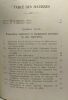
Librairie de la Faculté de Médecine, Béchet jeune – 1839 – Bien complet des 13 "tableaux chromascopiques des précipités" sur papier brun (les précipités sont coloriés à la main) et de l'Appendice au dictionnaire des réactifs. Quelques figures dans le texte. Réactifs employés dans toutes les expériences faites dans les cours publics et particuliers, les recherches médico-légales, les expertises, les essais, les analyses qualitatives et quantitatives des corps simples et de leurs composés utiles, soit dans les arts, soit en médecine.
Reliure dos cuir, 800 pages, format 13 x 22 - Assez bon état, coiffe supérieure usée, dos réparé mais reliure solide, cachet ancien propriétaire - Les frais d'envoi sont en sus, les envois se faisant en recommandé ou avec un suivi.
employés dans toutes les expériences faites dans les cours publics et particuliers. Les recherches médico-légales, les expertises, les essais, les analyses qualitatives et quantitatives des corps, simples et de leurs composés utiles, soit ans les arts soit en médecine. In 8 demi-cuir marron, titre et filets dorés, faux-titre, titre, IV, 801 pages, 1 pages d’errata. Tableau chronmascopique des précipité d’oxydes hydratés comparativement avec les mêmes oxydes anydres 13 pages. Sur papier brun, avec un appendice au dictionnaire des réactifs chimiques .Première édition , bien complet de l’appendice au dictionnaire et des 13 tableaux, sur papier brun. Les précipités sont colorés à la main, couverture frottée. Intérieur très bon état.
Hermann 1974 in8. 1974. Cartonné jaquette. 3 volume(s).
livres en bon état intérieurs propres cependant jaquette défraîchie ternies accrocs sur les bords
FLAMMARION. Déc. 1994. In-16. Broché. Bon état, Couv. fraîche, Dos satisfaisant, Intérieur frais. 126 pages. Quelques illustrations en noir et blanc, dans le texte.. . . . Classification Dewey : 540-Chimie et sciences connexes
"Collection ""Dominos"" Classification Dewey : 540-Chimie et sciences connexes"
HERMANN. 1993. In-8. Broché. Etat d'usage, Couv. convenable, Dos satisfaisant, Intérieur frais. 308 pages illustrées de nombreuses figures dans le texte - Nombreuses annotations sur la page de titre et de garde et soulignements dans le texte au crayon a papier - 1er plat illustré d'un dessin e nnoir et blanc.. . . . Classification Dewey : 540-Chimie et sciences connexes
Classification Dewey : 540-Chimie et sciences connexes

Armand Colin. 1969. In-4. Broché. Bon état, Couv. convenable, Dos fané, Intérieur frais. 119 pages. Illustré de nombreux schémas en noir et blanc. Annotation au dos du premier plat.. . . . Classification Dewey : 540-Chimie et sciences connexes

Du cours au applications, coll. fondée par P. Louquet. Classification Dewey : 540-Chimie et sciences connexes
ACEMT. sd. In-4. Cartonné. Bon état, Couv. convenable, Dos satisfaisant, Intérieur frais. 71 pages. cours polycopié du proffeseur LATTES 0 l'université Paul Sabatier Toulouse. 1ère année de médecine Nouveau régime. . . . Classification Dewey : 540-Chimie et sciences connexes
Classification Dewey : 540-Chimie et sciences connexes
Editions Doin Malicorne sur Sarthe, 72, Pays de la Loire, France 1967 Book condition, Etat : Bon broché, sous couverture imprimée éditeur grand In-8 1 vol. - 337 pages
102 figures dans le texte 1ere traduction en français infime pliure sur le coin de la couverture, sinon tres bon état
Editions Républicaines, 1932, in-12, xx-264 pp, préface de Henri La Fontaine, biblio, index, broché, couv. lég. salie, bon état. Edition originale, ex. signé par les deux auteurs
Les industries métallurgiques et chimiques avant, pendant, et après la Guerre mondiale. Dans la préface, Henry La Fontaine, président du Bureau international de la paix, vice-président du Sénat belge et prix Nobel de la paix, décrit les « marchands de canons » comme « le formidable organisme occulte », le « véritable état-major invisible » qui, « avec un art et une habileté exemplaires », poursuit « sa politique de mise en coupe réglée du monde ».
Paris Eyrolles 1975 15,5x22 300 pages - broché - trés bon etat
Très bon
P., Mallet-Bachelier, 1854, un volume in 8, broché, couverture imprimée défraîchie (manque de papier en bordure du deuxième plat de couverture, dos cassé, cachet de bibliothèque), 22pp., 464pp.
---- EDITION ORIGINALE ---- "LAURENT'S FAMOUS BOOK, Méthode de chimie, appeared in 1854, after his death. In the introduction, BIOT says : 'Cet ouvrage, rempli d'idées nouvelles... vous offre les convictions intimes d'un homme qui a enrichi la science de découvertes nombreuses et inattendues... Il attachait tant d'intérêt à laisser après lui cet héritage, qu'il a travaillé à le finir, jusque dans les bras de la mort". (Partington IV pp. 377/394) ---- "LAURENT WAS A CENTRAL FIGURE IN THE EMERGENCE OF ORGANIC CHEMISTRY AS A MATURE SCIENCE". (DSB VIII pp. 54/61) ---- Cole N° 759 : "LAURENT gives a collected and organized presentation of his system of formulae writing, compound classification and nomenclature, especially as applied to organic compounds. Published posthumously by his friend Jerome Mickles the work has an introduction by J.B. BIOT"**31430/3143/o6de
Paris, Mellet-Bachelier. 1854. in-8, xxii-464 pp., reliure de l'époque demi-basane rouge, dos lisse orné.
Edition originale. Posthume du plus fameux ouvrage de Laurent. Dans l’introduction, Biot dit: "Cet ouvrage, rempli d’idées nouvelles... vous offre les convictions intimes d’un homme qui a enrichi la science de découvertes nombreuses et inattendues... Il attachait tant d’intérêt à laisser après lui cet héritage, qu’il a travaillé à le finir, jusque dans les bras de la mort. » .(Partington IV pp. 377/394). “Laurent was a central figure in the emergence of organic chemistry as a mature science” . (DSB VIII pp. 54/61). Cole N 759 : “Laurent gives a collected and organized presentation of his system of formulae writing, compound classification and nomenclature, especially as applied to organic compounds.”. Publié après sa mort par son ami Jérôme Mickles avec une introduction de J.B. Biot. (C5)
Paris, Crochard, 1835. 8vo. In contemporary half calf with gilt lettering to spine. In: ""Annales de Chimie et de Physique, Par MM. Gay-Lussac et Arago."", 2e Series, tome 59, Entire volume offered. Wear to extremities, internally very fine and clean. Laurent's papers: pp. 107-111" 196-220 376-397" 397-422. [Entire volume: 446,(2) pp.].
First printing of these importent papers in the history of organic chemistry explaining the differences to Dumas' law of substitutions, and introducing a ""new type"" and what he calls ""fundamental and derived radicals"". The introduction of the ""Nucleus Theory"" was the basis for the unitary theory formulated by Gerhardt.""While studying the reactions of naphthalene and its compounds with the halogens and nitric acid, Laurent was from the start characteristically concerned with the construction of an explanatory theory that would account for these phenomena. Like most creative scientists, he generalized his solution to a specific problem through the imaginative use of analogy, leading to the elaboration of the first comprehensive theory adequate for dealing with the whole domain of contemporaneous organic chemistry."" (DSB).""A founder of modern organic chemistry, Laurent was one of the most important chemists of the nineteenth century. He considered the behavior of matter to be a manifestation of its intimate internal structure, which one cannot determine with certainty but which one has to investigate if one wants to understand. Laurent’s preoccupation was to construct a method that could guide the chemist forward along this path, from facts to their causes. He was the first chemist to intimately associate crystallo-graphic data and chemical studies. Louis Pasteur and Charles Friedel later followed the way.""(DSB).
Paris, Crochard, 1836. 8vo. In contemporary half cloth with gilt lettering to spine. In: ""Annales de Chimie et de Physique, Par MM. Gay-Lussac et Arago."", 2e Series, Tome 63. Entire volume offered. Some scattered brownspots, other fine with no institutional stamps. Laurent's papers: pp. 27-45, pp. 207-219 a. pp. 377-389. [Entire volume: 448 pp].
First apperance of 2 milestone papers in organic chemistry, in which Laurent ""converted Dumas' theory into a real theory theory of substitution by making the importent addition that when a compound undergoes chlorination, the chlorine takes the place , and, as it were, plays the part of the hydrogen, which is removed.""(Findley). In these papers Laurent published his table of chloridised compounds, many being then unknown. His table is THE FIRST ATTEMPT AT A CLASSIFICATION OF ORGANIC COMPOUNDS based on the generating hydrocarbonates. (Partington IV, p. 382-83). His system of classification had a profound influence on the development of organic chemistry. ""A founder of modern organic chemistry, Laurent was one of the most important chemists of the nineteenth century. He considered the behavior of matter to be a manifestation of its intimate internal structure, which one cannot determine with certainty but which one has to investigate if one wants to understand. Laurent’s preoccupation was to construct a method that could guide the chemist forward along this path, from facts to their causes. He was the first chemist to intimately associate crystallo-graphic data and chemical studies. Louis Pasteur and Charles Friedel later followed the way.""(DSB). The volume contains other notable papers: Gay-Lussac (5 papers), Boussingault, Pelouze, Justus Liebig etc. etc.
(Paris, Crochard, 1839) No wrappers. In: ""Annales de Chimie et de Physique, Par MM. Gay-Lussac et Arago."", tome 72, Cahier 4. Pp. 337-445 (entire issue offered). Laurent's papers: pp. 383-415 and pp. 415-427. With general titlepage to volume 72.
First printing of two importent papers on organic chemistry in which Laurent used halogens systematically, and these led him to distinguish two types of reactions, (equivalent) substitutions and additions, and to develop his nucleus theory. ""A founder of modern organic chemistry, Laurent was one of the most important chemists of the nineteenth century. He considered the behavior of matter to be a manifestation of its intimate internal structure, which one cannot determine with certainty but which one has to investigate if one wants to understand. Laurent’s preoccupation was to construct a method that could guide the chemist forward along this path, from facts to their causes. He was the first chemist to intimately associate crystallo-graphic data and chemical studies. Louis Pasteur and Charles Friedel later followed the way.""(DSB).
(Paris, Bachelier), 1836. 4to. No wrappers. In: ""Comptes Rendus Hebdomadaires des Séances de L'Academie des Sciences"", Tome 3, Séance Lundi 7 Novembre. Pp. (523-) 558. (Entire issue offered). Laurent's paper: pp. 552-553.
First apperance in print of Laurent's announcement of his fundamental discovery, rejected at first by the Academy, in which he ""converted Dumas' theory into a real theory of substitution by making the importent addition that when a compound undergoes chlorination, the chlorine takes the place , and, as it were, plays the part of the hydrogen, which is removed."" (Findlay).Laurent demomstrates that a chlorine atom can be substituted for a hydrogen atom in a chemical with little change in properties. As this refutes the prevailing concept, his work is rejected by the chemical community at first. (Bunch 1836 C).
"LAURENT, AUGUSTE. - CLEARING THE CONCEPTS EQUIVALENTS, ATOMS AND MOLECULES.
Reference : 45993
(1846)
Paris, Victor Masson, 1846. 8vo. Contemp. hcalf, raised bands, gilt spine. Light wear along edges. Small stamps on verso of titlepage. In: ""Annales de Chimie et de Physique"", Troisieme Series - Tome 18. 512 pp. and 2 folded engraved plates. Laurents paper: pp. 266-298. Somewhat brownspotted.
First printing of this classic work in the history of organic chemistry in which Laurent made clear ""the distinction between equivalents, atoms and molecules, by attaching to these terms meanings similar to those given to them at the present day. Like Avogadro and Ampère, Laurent regarded the molecules of hydrogen, of oxygen, of chlorine, etc., as consisting of two atoms and of forming ""homogenous Compounds"" which could then give rise to ""heterogenous compounds"" by double decomposition -(HH) + (CICI) = (HCI) + (HCI) - as had long before been pointed out by Avogadro.""(Findley ""A Hundred Years of Chemistry"", p. 32.""A founder of modern organic chemistry, Laurent was one of the most important chemists of the nineteenth century. He considered the behavior of matter to be a manifestation of its intimate internal structure, which one cannot determine with certainty but which one has to investigate if one wants to understand. Laurent’s preoccupation was to construct a method that could guide the chemist forward along this path, from facts to their causes. He was the first chemist to intimately associate crystallo-graphic data and chemical studies. Louis Pasteur and Charles Friedel later followed the way.""(DSB).
"LAURENT, AUGUSTE. - INTRODUCING THE ""NUCLEUS THEORY"" IN CHEMISTRY.
Reference : 45079
(1836)
Paris, Crochard, 1836. Contemp. hcloth. In: ""Annales de Chimie et de Physique, Par MM. Gay-Lussac et Arago."", 2e Series, Tome 66. 448 pp. a. 1 folded engraved plate. (Entire volume offered). Laurent's papers: pp. 136-213 a. pp. 314-335. Some scattered brownspots.
First printing of Laurent's long paper in which he tried to develope the rules of substitution into a chemical system oforganic compounds, the ""Nucleus theory"". Laurent is considered one of the most importent chemists in the 18th centuryHis first theoretical efforts were largely taxonomic in character. He then began to develop a pictorial model based on atomistic representations as considered by earlier French crystallographers. Laurent’s ""nucleus theory"" or ""theory of derived radicals""located every substance at the intersection of two kinds of transformations: substitutions, which operate on the matter inside the fundamental radical and do not affect its general chemical behavior, and external modifications, which influence various chemical functions. (DSB).""In his studies of the derivatives of naphtalene, Laurent was impressed by the fact the the fundamental properties of these compounds remained, in spite of the various substitutions which took place in them. A certain nucleus seemed to impose its properties on all its derivatives. This nucleus theory was the basis for the unitary which was specifically formulated by Gerhardt.""(Leicester & Klickstein ""A Source Book in Chemistry"", p. 345).The volume contains other notable papers by Regnault, D'Arcet, Chevreuil, Rose, Gay-Lussac and Carlo Matteucci's importent memoir ""Sur la Propagation du Courant Electriques dans les Liquides"", pp. 225-313.
"LAURENT, AUGUSTE. - INTRODUCING THE ""NUCLEUS THEORY"" IN CHEMISTRY.
Reference : 47788
(1836)
Paris, Crochard, 1836. 8vo. Contemp. hcalf. Raised bands, gilt spine. A few scratches to spine. In: ""Annales de Chimie et de Physique, Par MM. Gay-Lussac et Arago."", 2e Series, Tome 66. 448 pp. a. 1 folded engraved plate. (Entire volume offered). Laurent's papers: pp. 136-213 a. pp. 314-335. Internally fine and clean.
First printing of Laurent's long paper in which he tried to develope the rules of substitution into a chemical system oforganic compounds, the ""Nucleus theory"". Laurent is considered one of the most importent chemists in the 18th centuryHis first theoretical efforts were largely taxonomic in character. He then began to develop a pictorial model based on atomistic representations as considered by earlier French crystallographers. Laurent’s ""nucleus theory"" or ""theory of derived radicals""located every substance at the intersection of two kinds of transformations: substitutions, which operate on the matter inside the fundamental radical and do not affect its general chemical behavior, and external modifications, which influence various chemical functions. (DSB).""In his studies of the derivatives of naphtalene, Laurent was impressed by the fact the the fundamental properties of these compounds remained, in spite of the various substitutions which took place in them. A certain nucleus seemed to impose its properties on all its derivatives. This nucleus theory was the basis for the unitary which was specifically formulated by Gerhardt.""(Leicester & Klickstein ""A Source Book in Chemistry"", p. 345).The volume contains other notable papers by Regnault, D'Arcet, Chevreuil, Rose, Gay-Lussac and Carlo Matteucci's importent memoir ""Sur la Propagation du Courant Electriques dans les Liquides"", pp. 225-313.