 Write to the booksellers
-
Type
Book (5357)
Magazine (35)
Music sheets (3)
Photographs (8)
-
Latest
Last 3 days (3)
Last month (72)
Last week (1)
-
Language
Czech (1)
English (3)
French (5386)
German (11)
Latin (1)
Spanish (1)
-
Century
17th (16)
18th (200)
19th (1142)
20th (2261)
21st (78)
-
Countries
Belgium (352)
Côte d'Ivoire (19)
Denmark (687)
France (3988)
Switzerland (357)
-
Syndicate
CLAM (2)
ILAB (3004)
NVVA (183)
SLACES (183)
SLAM (2110)
SNCAO (48)
Tables annuelles de constantes et données numériques, 22 : EQUILIBRES ELECTROLYTIQUES, EQUILIBRES CHIMIQUES. Volume XIII (années 1931-1936). Chapitres 53-54.
P., Hermann, 1938, grand in 8° cartonnage de l'éditeur, 25-42 pages ; traces de scotch sur les gardes.
...................... Photos sur demande ...................


Phone number : 04 77 32 63 69
Précis de chimie organique
Masson et cie 1949 in8. 1949. Broché.
charnières fragilisée déchirure en haut du premier plat intérieur propre couverture défraîchie
TRAITE DE CHIMIE ORGANIQUE TOME VIII FASCICULE 2.
MASSON. VERS 1938. In-8. Relié. Etat d'usage, Couv. convenable, Dos abîmé, Intérieur frais. Paginé de 618 à 1256 - quelques figures en noir et blanc dans le texte - un tampon sur la page de garde et sur la page de titre.. . . . Classification Dewey : 540-Chimie et sciences connexes
Classification Dewey : 540-Chimie et sciences connexes
Traité de chimie organique - Tome 10 : Diacides et polyacides, matières grasses, dérivés sulfurés ou séléniés de la fonction acide par Goudet, Padova, Salmon-Legagneur.
Masson et cie. 1939. In-8. Relié. Etat d'usage, Tâchée, Dos satisfaisant, Intérieur frais. XIX + 807 pages .. . . . Classification Dewey : 540-Chimie et sciences connexes
Classification Dewey : 540-Chimie et sciences connexes
"GRIGNARD, (FRANCOIS AUGUSTE VICTOR). - DISCOVERY OF THE GRIGNARD REACTION.
Reference : 47268
(1900)
Sur quelques nouvelles combinaisons organométalliques du magnesium et leur application à des Synthèses d'alcools et d'hydrocarbures.
(Paris, Gauthier-Villars), 1900. 4to. No wrappers. In: ""Comptes Rendus Hebdomadaires des Séances de L'Academie des Sciences"", Tome 130, No 20. Pp. (1285-) 1344. (Entire issue offered). Grignard's paper: pp. 1322-24. One leaf repaired in upper margin affecting the text on verso (but without loss of letters). Light browning, poor paperquality.
First apperance of an importent paper in which Grignard revealed the ""Grignard Reagent"", an important means of preparing organic compounds from smaller precursor molecules. For this work, Grignard was awarded the Nobel Prize in Chemistry in 1912 jointly with fellow Frenchman Paul Sabatier.""A large number of general synthetic methods had been developed by the end of the nineteenth century. However, one of the most versatile and importent was first described as the new century opened. This was the Grignard synthesis."" (Leicester ""A Source book in Chemistry 1900-1950"", where this paper is translated ""Some New Organometallic Compounds of Magnesium and Their Application to the Synthesis ofAlchohols and Hydrocarbons"").""Grignard treated magnesium turnings in anhydrous ether with methyl iodide at room temperature, preparing what came to be known as the Grignard reagent, which could be used for reaction with a ketone or an aldehyde without first being isolated. On hydrolyzing with dilute acid, the corresponding tertiary or secondary alcohol was produced in much better yield than Barbier had been able to obtain. Grignard’s discovery was reported in a short paper at a meeting of the Académie des Sciences in May 1900 (the paper offered)."" (DSB).
GRIGNARD (V.) - DUPONT (G.) - LOCQUIN (R.) et BAUD (P.) sous la direction de.-
Reference : 52679
Traité de chimie organique.Tome 17, 1ère et 2ème partie : Cycles complexes homogènes à caractère aromatique - Condensation du noyau benzenique - Photo-oxydes spirannes, par MM. Boeseken - Bougault - Cattelain - Courtot - Etienne - Godfrin - Lichtenberger - Lozac'h - Martinet - Palfray - Perrot - Truhaut - Wahl - Willemart.
P. , Masson, 1949, 2 volumes grand in 8° reliure pleine toile noire décorée de l'éditeur, XIX-1879 pages en pagination continue.
PHOTOS SUR DEMANDE. ...................... Photos sur demande ...................
Phone number : 04 77 32 63 69
GRIGNARD (V.) - DUPONT (G.) - LOCQUIN (R.) et BAUD (P.) sous la direction de.-
Reference : 52680
Traité de chimie organique.Tome 18 : Heterocycles avec un atome d'oxygène, de souffre, de selenium ou d'azote, par MM. Decombe - Dolique - Grignard - Karrer - Paul - Rambaud.
P. , Masson, 1945, grand in 8° reliure pleine toile noire décorée de l'éditeur, XIX-662 pages.
PHOTOS SUR DEMANDE. ...................... Photos sur demande ...................
Phone number : 04 77 32 63 69
GRIGNARD (V.) - DUPONT (G.) - LOCQUIN (R.) et BAUD (P.) sous la direction de.-
Reference : 52666
Traité de chimie organique.Tome 1 : Analyse organique - Azeotropisme et distillation - Etat cristallin et état colloïdal - Composé défini et corps pur - Construction de l'édifice moléculaire - Association des atomes, chaines ouvertes et chaines fermées - Groupements fonctionnels - Représentation des édifices chimiques - Isométrie - Nomenclature, par MM. Bary - Delepine - Dufraisse - Dupont - Grignard - Lecat - Locquin - Mauguin - Pariselle - Timmermans.
P. , Masson, 1935, grand in 8° reliure pleine toile noire décorée de l'éditeur, XIX-1149 pages.
PHOTOS SUR DEMANDE. ...................... Photos sur demande ...................
Phone number : 04 77 32 63 69
GRIGNARD (V.) - DUPONT (G.) - LOCQUIN (R.) et BAUD (P.) sous la direction de.-
Reference : 52667
Traité de chimie organique.Tome 2, deuxième fascicule : Propriétés magnétiques et dielectriques - Parachor - Relations entre la constitution et l'action sur les sens - Mécanisme des réactions - Radicaux libres - Transpositions intra-moléculaires - Empêchement sterique - Catalyse - Antioxygènes.
P. , Masson, 1939, grand in 8° reliure pleine toile noire décorée de l'éditeur, 595 à 1273 pages.
...................... Photos sur demande ...................
Phone number : 04 77 32 63 69
GRIGNARD (V.) - DUPONT (G.) - LOCQUIN (R.) et BAUD (P.) sous la direction de.-
Reference : 52669
Traité de chimie organique.Tome 5 : Les métaux en chimie organique - Alcools dans toutes les séries - Formation des alcools par voie biochimique - Synthèse du méthanol - Industries de l'alcoolé Thylique - Ethers-oxydes - Ethers-sels des acides minéraux, par MM. Baud - Cocertot - Fromageot - Lichtenberger - Prévost - Senderens.
P. , Masson, 1936, grand in 8° reliure pleine toile noire décorée de l'éditeur, XIX-1047 pages.
PHOTOS SUR DEMANDE. ...................... Photos sur demande ...................
Phone number : 04 77 32 63 69
GRIGNARD (V.) - DUPONT (G.) - LOCQUIN (R.) et BAUD (P.) sous la direction de.-
Reference : 52671
Traité de chimie organique.Tome 9 : Monoacides - Ethers - Sels - Produits acétiques - Produits méthyliques, par MM. Aboulenc - Lichtenberger - Senderens - Truchet.
P. , Masson, 1939, grand in 8° reliure pleine toile noire décorée de l'éditeur, XIX-831 pages.
PHOTOS SUR DEMANDE. ...................... Photos sur demande ...................
Phone number : 04 77 32 63 69
Précis de CHIMIE ORGANIQUE
Paris Masson & Cie 1942 in 8 (25x16,5) Un volume reliure demi velin blanc de l'époque, dos lisse, pièce de titre de cuir gris, XVI et 828 pages. Publié par Roger Grignard et Jean Colonge. Deuxième édition entièrement refondue et mise à jour. Grignard Victor, Membre de l'Insttut, Prix Nobel. Bon exemplaire
Bon Couverture rigide
Précis de chimie organique - 2e édition entièrement refondue et mise à jour.
Masson et cie. 1942. In-8. Broché. Bon état, Couv. convenable, Dos satisfaisant, Intérieur frais. XVI + 828 pages.. . . . Classification Dewey : 540-Chimie et sciences connexes
Publié par les soins de Roger Grignard et Jean Colonge - préface de G.Urbain. Classification Dewey : 540-Chimie et sciences connexes
Précis de chimie organique . Préface de M. le Pr Urbain . 2ème édition entièrement refondue et mise à jour
,Paris, Masson et Cie 1942, 828 pp., 1 vol. in grand in 8 br. figures in texte
Traité de chimie organique Tome II [2 volumes]. Propriétés optiques des combinaisons organiques, structure des molécules et spectres d'absorption...
Masson 1936 2 volumes. Reliures éditeur pleine toile bleu marine, XV-1273 pp. en pagination continue, bibliographie, index, table.
Bon état d’occasion
Victor Grignard. 6 mai 1871 - 13 décembre 1935.
Sans lieu ni nom ni date (Lyon, Imp. Rey, 1936), in 8° broché, 79 pages ; portrait hors-texte ; des rousseurs et trace d'humidité marginale.
Victor Grignard reçut le Prix Nobel de Chimie en 1912.PHOTOS sur DEMANDE. ...................... Photos sur demande ...................
Phone number : 04 77 32 63 69
TRAITE DE CHIMIE ORGANIQUE - TOME VIII : QUINONES CETENES ALDEHYDES ALCOOLS ET CETONES ALCOOLS OSES ET HOLOSIDES GENERALITES SUR LES HETEROSIDES AMIDON CELLULOSE LICHENINE SOIES ARTIFICIELLES INDUSTRIES DES MATIERES AMYLACEES INDUSTRIES DES SUCRES ...
MASSON ET CIE. 1947. In-8. Relié. Etat d'usage, Coins frottés, Dos abîmé, Intérieur frais. XIX + 616 pages - un tampon sur la page de garde - dos partiellement désolidarisé - coins frottés.. . . . Classification Dewey : 540-Chimie et sciences connexes
TOME VIII : QUINONES CETENES ALDEHYDES ALCOOLS ET CETONES ALCOOLS OSES ET HOLOSIDES GENERALITES SUR LES HETEROSIDES AMIDON CELLULOSE LICHENINE SOIES ARTIFICIELLES INDUSTRIES DES MATIERES AMYLACEES INDUSTRIES DES SUCRES CARBONISATION DES BOIS ALDEHYDES PHENOLS ET CETONES PHENOLS. Classification Dewey : 540-Chimie et sciences connexes
TRAITE DE CHIMIE ORGANIQUE - TOME XI : ACIDES ALCOOLS ACIDES PHENOLS NOMENCLATURE DES CHAINES HETERO ATOMIQUES ACYCLIQUES COMPLEXES.
MASSON ET CIE. 1945. In-8. Relié. Etat d'usage, Coins frottés, Dos abîmé, Intérieur frais. XIX + 527 pages - dos désolidarisé - coins frottés.. . . . Classification Dewey : 540-Chimie et sciences connexes
Classification Dewey : 540-Chimie et sciences connexes
Précis de chimie organique.
Paris, Masson et Cie, 1958 1 volume In-8° (16,2 x 24cm) Reliure éditeur pleine toile rouge au 1er plat orné d'une petite vignette verte contrecollée, auteur, titre et adresse en blanc. XI + 901p., 1 feuillet, 1 feuillet tiré à part; 1 frontispice, figures et fac-similé in texte.
4e édition, "entièrement refondue et mise à jour" par les chimistes Roger GRIGNARD et Jean COLONGE, de ce "précis" de Victor GRIGNARD (1871-1935), Prix Nobel de chimie 1912, publié en 1937; préface (à la 1ère édition) de Georges URBAIN (1872-1938): "L'oeuvre de Victor Grignard - Son précis de chimie organique"; portrait en frontispice. Exemplaire relié, complet de son feuillet d'errata. Bon état sauf toile de reliure légèrement salie, au dos un peu insolé et très léger manque à la vignette du 1er plat; 1ère garde (garde de reliure, vierge) proprement découpée.
Aphorismes Basiliens ou Canons Hermétiques. - Traité des Sept Grades de la Perfection.
Arché Milano 1980 In-12 carré ( 170 X 120 mm ) de 26 pages, broché sous couverture imprimée. Très bel exemplaire. +++
Chimie organique élémentaire. Chimie inorganique élémentaire.
Paris, Germer Baillière, 1872-74. 115 X 180 mm. 2 ouvrages reliés en 1 volume, demi-veau marron, dos à nerfs avec titre doré, tête rouge (rel. de l'ép.). 379 et 475 pp. Avec 2 et 39 figures. Tables alphabétiques. Rel. lég. frottée, quelques rousseurs.
Phone number : 41 021 964 60 10
Chimie organique élémentaire. Leçons professées à la Faculté de Médecine. Troisième édition.
Paris, Germer Baillière 1881, 185x120mm, VI - 423pages, broché.
Pour un paiement via PayPal, veuillez nous en faire la demande et nous vous enverrons une facture PayPal
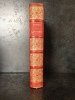
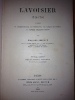
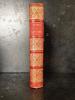
LAVOISIER .
1743 1743 -1794 . d 'après sa correspondance , ses manuscrits , ses papiers de famille et d ' autres documents inédits . DEUXIEME EDITION avec 10 gravures h.t , en taille-douce et en typographie . Paris . F. Alcan ed. 1896 . 1 Volume in 8 . percaline éd. rouge ; dos à nerfs , très orné de filets dorés ; plats percaline rouge , ornés de fleurons à froid ; exemplaire de prix ( lycée de Marseille) sur le premier plat . IX + 398 pp + table . BEL EXEMPLAIRE . avec un index alphabétique in fine .
DESTOCKAGE 30% de remise immédiate sur le prix marqué .
Lavoisier (1743-1794), d'après sa correspondance, ses manuscrits, ses papiers de famille et d'autres documents inédits.
Sceaux, Editions Jacques Gabay, 1992. In-8° à l'italienne, 400p. Broché.
Reprint de l'édition originale de 1896. A l'état de neuf.

