 Write to the booksellers
-
Type
Book (5346)
Magazine (35)
Music sheets (3)
Photographs (8)
-
Latest
Last 24h (1)
Last month (72)
Last week (4)
-
Language
Czech (1)
English (3)
French (5375)
German (11)
Latin (1)
Spanish (1)
-
Century
17th (16)
18th (200)
19th (1142)
20th (2263)
21st (78)
-
Countries
Belgium (352)
Côte d'Ivoire (19)
Denmark (687)
France (3977)
Switzerland (357)
-
Syndicate
CLAM (2)
ILAB (3004)
NVVA (183)
SLACES (183)
SLAM (2110)
SNCAO (48)
"DUMAS, (JEAN BAPTISTE-ANDRE) & (JUSTUS ) LIEBIG. - A NEW CLASSIFICATION IN ORGANIC CHEMISTRY.
Reference : 47237
(1837)
Note sur l'état actuel de la Chemie organique.
(Paris, Bachelier), 1837. 4to. No wrappers. In: ""Comptes Rendus Hebdomadaires des Séances de L'Academie des Sciences"", Tome V , No 17. (Entire issue offered). Pp. (567-) 572. Dumas & Liebig's paper: pp. (567-) 572.
First appearance of a historical paper in chemistry. stating a new way to organize organic chemistry.When Liebig visited Paris in 1837, he persuaded Dumas to accept the ethyl theory, and in a joint memoir (written by Liebig) presented on 23 October 1837 to the Paris Academy (the paper offered) they asserted that ""in inorganic chemistry the radicals are simple"" in organic chemistry they are compounds - that is the sole difference. The laws of combination, the laws of reaction, are the same in the two branches of chemistry"" (Partington, vol. IV, p. 351).""In the paper ""Note on the present state of organic chemistry"" .... (Dumas and Liebig)) claim to have found the key to systematically organizing organic chemistry, basing research not on the elements, as in inorganic chemistry, but on the radicals. The radicals in organic chemistry act analogous to the elements in mineral chemistry, with the same general principles of combination and reaction.""(Partington ""Breakthroughs"" 1837 C).
"DUMAS, JEAN BAPTISTE-ANDRE & PIERRE PELLETIER. - TOWARDS A CLASSIFICATION OF ORGANIC COMPOUNDS.
Reference : 44741
(1823)
Recherches sur la Composition élémentaire et sur quelques propriétes caractéristiques des bases salifiables organiques.
(Paris, Crochard, 1823). Without wrappers. In: ""Annales de Chimie et de Physique, par Gay-Lussac et Arago"", tome 24, Sec. Series, Cahier 2. Pp. 163-191. (Entire issue offered pp. 113-223.
First appearance of Dumas and Pelletier's importent paper in which they analyzed nine alkaloids by combustion and found for the first time the number of atoms of carbon, hydrogen, oxygen and nitrogen in them. Dumas' name is still associated with the two procedures which he devised here, the determination of vapor density and combustion analysis.""The most important problem with which Dumas was concerned throughout his career was the classification of chemical substances. He sought to devise comprehensive classificatory schemes for organic compounds and for the elements. Dumas’s earliest contribution to organic chemistry was his study of nine alkaloids, published in 1823, jointly with Pierre Pelletier.1 He analyzed the elemental constituents of these organic “bases” and attempted to prove that their relative proportions of oxygen followed Dalton’s law of multiple proportions. He had embraced the ideas of the two reigning theories in contemporary chemistry: dualism, with its division of substances into electronegative (acid) and electropositive (alkaline)"" and atomism, which Dalton had used to explain his law. Dumas spent the next few years attempting to create an adequate system of classification of organic compounds based upon these two theories.""(DSB).
Recherches sur la Composition élémentaire et sur quelques propriétes caractéristiques des bases salifiables organiques. - [TOWARDS A CLASSIFICATION OF ORGANIC COMPOUNDS.]
Paris, Crochard, 1823. 8vo. In contemporary half calf with gilt lettering spine and five raised bands. The original wrappers withbound in the back. In ""Annales de Chimie et de Physique"", tome 24. Entire volume offered. Paper label pasted on to top of spine. Two stamps to verso of title-page and stamos to verso of all plates. A few light occassional brownspots, otherwise a fine copy. Pp. 163-191. [Entire volume: 448 pp. + 4 folded plates.
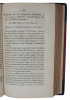
First appearance of Dumas and Pelletier's importent paper in which they analyzed nine alkaloids by combustion and found for the first time the number of atoms of carbon, hydrogen, oxygen and nitrogen in them. Dumas' name is still associated with the two procedures which he devised here, the determination of vapor density and combustion analysis. ""The most important problem with which Dumas was concerned throughout his career was the classification of chemical substances. He sought to devise comprehensive classificatory schemes for organic compounds and for the elements. Dumas’s earliest contribution to organic chemistry was his study of nine alkaloids, published in 1823, jointly with Pierre Pelletier.1 He analyzed the elemental constituents of these organic “bases” and attempted to prove that their relative proportions of oxygen followed Dalton’s law of multiple proportions. He had embraced the ideas of the two reigning theories in contemporary chemistry: dualism, with its division of substances into electronegative (acid) and electropositive (alkaline)"" and atomism, which Dalton had used to explain his law. Dumas spent the next few years attempting to create an adequate system of classification of organic compounds based upon these two theories.""(DSB). The Present volume also contain papers by Faraday, Becquerel and many other.
DUMAS, (JEAN BAPTISTE-ANDRE). - THE MAIN PAPER ON SUBSTITUTION AND THE THEORY OF TYPES.
Reference : 47109
(1840)
Mémoire sur la loi des substitutions et la Theorie des types" Séance du Lundi 5 Février 1840.
Paris, Bachelier, 1840 4to. No wrappers. In: ""Comptes Rendus Hebdomadaires des Séances de L'Academie des Sciences"", Tome X , No 5 (entire issue offered). Pp. (143-) 207. Dumas' paper: pp. 149-178.
First appearance of this paper, which was published the same year in 'Annales de Chimie et de Physique', is the most importent on the theory of structural types and the nomenclature of organic compounds, refuting the electrochemical theory of Berzelius. ""The development of this idea (type organique) into what is sometimes called the ""Older Type Theory"", as distinguished from Gerhardt's Type heory, is contained in Dumas' importent memoir on the substitution and the theory of types, presented on 3 febriary 1840.""(Partington IV, p. 365). ""Jean Baptiste Dumas advances a theory that the chemical properties of an organic compound are determined by its structure and not, as seems to be the case with inorganic compounds, by its electrical properties. he illustrates the concept with the example that the basic qualitative properties of acetic acid are retained even after replacing three fourths of the hydrogen by chlorine. As a consequence, he calls for a revision of chemical nomenclature for organic compounds, basing terms on common features, not on elemental composition.""(Parkinson ""Breakthroughs"" 1840 C).
DUMAS, (JEAN BAPTISTE-ANDRE). - THE MAIN PAPER ON SUBSTITUTION AND THE THEORY OF TYPES.
Reference : 51504
(1840)
Mémoire sur la loi des substitutions et la Theorie des types" Séance du Lundi 5 Février 1840.
Paris, Bachelier, 1840. 4to. No wrappers. In: ""Comptes Rendus Hebdomadaires des Séances de L'Academie des Sciences"", Tome X , No 5 (entire issue offered). Pp. (143-) 207. Dumas' paper: pp. 149-178. With half-title to Tome X.
First appearance of this paper, which was published the same year in 'Annales de Chimie et de Physique', is the most importent on the theory of structural types and the nomenclature of organic compounds, refuting the electrochemical theory of Berzelius. ""The development of this idea (type organique) into what is sometimes called the ""Older Type Theory"", as distinguished from Gerhardt's Type heory, is contained in Dumas' importent memoir on the substitution and the theory of types, presented on 3 February 1840.""(Partington IV, p. 365). ""Jean Baptiste Dumas advances a theory that the chemical properties of an organic compound are determined by its structure and not, as seems to be the case with inorganic compounds, by its electrical properties. he illustrates the concept with the example that the basic qualitative properties of acetic acid are retained even after replacing three fourths of the hydrogen by chlorine. As a consequence, he calls for a revision of chemical nomenclature for organic compounds, basing terms on common features, not on elemental composition.""(Parkinson ""Breakthroughs"" 1840 C).
"DUMAS, JEAN BAPTISTE ANDRÈ - ANNOUNCING THE LAW OF SUBSTITUTION.
Reference : 43539
(1834)
Recherches de Chimie organique. Lu à l'Academie des Sciences le 13 janvier 1834.
Paris, Crochard, 1834. No wrappers, as extracted from: ""Annales de Chimie et de Physique, Par MM. Gay-Lussac et Arago."", tome 56, pp.1-150. With titlepage to vol. 56. Titlepage with some browning to corners and some brownspots. Text with scattered brownnspots.
First printing of this milestone paper in organic chemistry which marks a very importent step toward a complete structural theory of organic chemistry, THE SUBSTITUTION THEORY.""In 1834 Dumas presented a long paper, ""Recherches de Chimie organique"", to the Academy of Sciences in Paris. In this he described chloroform and chloral and explained the mechanism by which chlorine acted upon ethyl alcohol. The paper was published soon afterwards (as offered here) and several years later was reprinted with the addition in the theoretical part of Dumas's theory of metalepsy.""(Leicester & Klickstein ""A Source Book in Chemistry"", p. 320 ff.). - Parkinson ""Breakthrough"" 1834 C. - Partington IV, pp. 360 ff.
Mémoire sur les Ethers composés.
(Paris, Crochard, 1828). No wrappers. In: ""Annales de Chimie et de Physique, Par MM. Gay-Lussac et Arago."", tome 37 (prem. cahier), pp. 5-112. (Entire issue offered). Dumas & Boullay's paper: pp. 15-53. Clean and fine.
First appearance of a classic paper on the theory of organic chemistry, being one of the main works to introduce the importence of ""radicals"" in chemical reactions.""Perhaps Duma's chief contribution to the theory of organic chemistry. In 1828, in collaboration with Polydore Boullay, he published a research on the esters of ethyl alcohol (the paper offered) wherein he showed that these compounds could be looked upon as salts of ethylene and acids, as reported in the first extract.On the basis of tis work, Berzelius in 1832 called ethylene a radical which he named aetherin and which took an importent place among the growing number of organic radicals.""(Leicester & Klickstein p. 320 ff). - Parkinson ""Breakthroughs"", 1828 C.In the same issue is also Wöhler's paper ""Sur l'Aluminium"", pp.66-80 the French version).
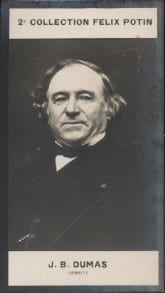
DUMAS (Jean-Baptiste) - (Photo de la 2e collection Félix Potin)
Reference : 50488
(1900)
Photographie de la collection Félix Potin (4 x 7,5 cm) représentant : Jean-Baptiste Dumas, chimiste.
- Photographie 4 x 7, 5 cm. Notice biographique collée au dos.
Photo. Né à Alais. 1800-1884. Félix Potin, Début XXe. Vers 1900.
DUMAS (Jean-Baptiste) - (Photo de la 2e collection Félix Potin)
Reference : 51412
(1900)
Photographie de la collection Félix Potin (4 x 7,5 cm) représentant : Jean-Baptiste Dumas, chimiste.
- Photographie 4 x 7, 5 cm. Notice biographique collée au dos.
Photo. Né à Alès. 1800-1884. Félix Potin, Début XXe. Vers 1900.
"DUMAS, J. (JEAN BAPTISTE ANDRÉ). - FORESHADOWING THE PERIODIC TABLE.
Reference : 43466
(1859)
Mémoire sur les Équivalents des Corps simples. Lu à l'Academie des Sciences le 9 novembre 1857 et le 27 decembre 1858.
Paris, Victor Masson, 1859. No wrappers as extracted from ""Annales de Chimie et de Physique"", Tome 55, Troisieme Série. Titlepage to tome 55, pp. 129-210 a. 1 folded engraved plate. Clean and fine.
First printing of Dumas's importent lecture on the chemical equivalents of the elements in which he attempts to prove that all elements is multiples of the hydrogen atom, Prout's thesis.""He also published two papers (the present) in which he tried to develop the view that for the classifications of the elements it was possible to discover 'generating' relations similar to thosee defining the series of organic compounds. The elements could be divided into 'natural families'. The atomic weights of all the members of the same family were linked by a simple arithmetic relationship"" they increased by multiples of sixteen.""(DSB IV, p.247). - Neville p. 397.
Leçons sur la Philosophie chimique professées au Collège de France, recueillies par M. Bineau.
Paris, Ebrard, (1837). 125 X 215 mm. relié plein veau fauve (reliure de l'ép.). 430 pp. Edition originale. "Ces leçons comprennent une partie théorique et une partie historique avec des études sur les plus grands alchimistes et chimistes, dont les plus remarquables sont celles consacrées à Lavoisier et Pirestley" (Caillet 3359, Vrain). Quelques rousseurs, reliure passée avec le plat sup. détaché et le dos manquant (à restaurer).
Phone number : 41 021 964 60 10
Traité de chimie appliquée aux arts (2 tomes (sur 6) en 1 seul volume).
Liège, Félix Oudard, 1847. 13 x 21, 588 + 543 pages, reliure dos/coins cuir, bon état (reliure un peu usagée mais solide).
Traité de Chimie appliqués aux Arts. Partie Inorganique. En 4 TOMES
OUDART Félix. 1848. In-12. Relié demi-cuir. Etat d'usage, Couv. légèrement passée, Dos abîmé, Intérieur frais. 509 + 601 + 567 + 496 pages. Titre, tomaisons, roulettes et fleurons dorés sur le dos cuir marron clair/foncé. Tranches marbrées. Manque de cuir sur les Tomes 2 et 4. Mors fendus et frottés. Epidermures. Légèrement déboité.. . . . Classification Dewey : 540-Chimie et sciences connexes
TOME I : Hydrogène - Eau - Acide hydrochlorique - Iode - Soufre - Acide Sulfureux - Acide Sélénique - Phosphore - Air Atmosphérique - Chlorure d'Arsenic - Charbon végétal - charbon animal - Cyanogène - Charbon de Tourbe ... TOME II : Métaux - Oxides métalliques - Iodures Métalliques - Sels - Sulfates - Carbonates - Sodium - Lithium - Calcium - Potasses - Sel Marin - Pierre à chaux - Verre - Cristal - Poteries - Tuiles ... TOME III : Fer - Etain - Zinc - Cadmium - Nickel - Cérium - Molybdène - Titane - Antimoine - Chrome - Urane - Cuivre - Plomb - Bismuth - Mercure - Or - Osmium - Platine ... TOME IV : Notions de Métallurgie - Zinc - Arsenic - Bismuth - Cuivre - Plomb - Mercure - Argent - Or - Laiton - Bronze - Minium - Monnaies - Fer - Classification Dewey : 540-Chimie et sciences connexes
Traité de Chimie. Partie Organique. En 4 Tomes.
OUDART Félix. 1847. In-12. Relié demi-cuir. Etat passable, Couv. défraîchie, Dos abîmé, Intérieur frais. 588 + 553 + 596 + 668 pages. Titre, tomaisons, roulettes et fleurons dorés sur le dos cuir marron clair/foncé. Tranches marbrées. Manque de cuir sur le dos et en coiffes, sur les tomes 1, 2 et 4.. . . . Classification Dewey : 540-Chimie et sciences connexes
TOME I : Acétates - Acide camphorique - Tartrates - Malates - Acide ulmique - Méthylène - Ether - Ether Oxalique - Chloral - Naphtaline - Juile de Térébenthine .. TOME II : Amidon, Fécules, Dextrine - Sucre de Betteraves - Raffinage du sucre - Glucose - Fermentation alcoolique - Fermentation acétique - Fermentation pectique - Pain ... TOME III : Huiles de pommes de terre - Mésitylène - Acide Chlorophénésique - Salicine - Chlorure de Salicyle - Acide nitranisique - Résines - Vernis - Bitume - Caoutchouc - Albumine - Caséine - Gélatine - Corroyage - Cyanures - Prussianoferrides - Acide Urique ... TOME 4 : Indigo - Tournesol - Curcuma - Teinture - Préparations des laines - Teinture sur soie - Impressions sur laines - Sang - Urine - Digestion - Lait ... Classification Dewey : 540-Chimie et sciences connexes
Leçons sur la Philosophie Chimique
GAUTHIER-VILLARS. 1878. In-12. Relié demi-cuir. Etat d'usage, Couv. légèrement passée, Dos satisfaisant, Rousseurs. 469 pages. 1er plat de la couverture brochée, conservé. Titre et fleuron doré sur le dos cuir marron / rouge. Coiffes et nerfs très légèrement frottés.. . . . Classification Dewey : 540-Chimie et sciences connexes
Lavoisier - Richter - Proust - Atomes - Polymérie - Priestley .... Classification Dewey : 540-Chimie et sciences connexes
Tableaux analytiques des minéraux
Bruxelles, Académie royale (impr.par Hayez) 1839 95pp., publié dans et extrait de "Nouveaux mémoires de l'Académie Royale des sciences et belles-lettres de Bruxelles" Tome XII (12), in-4, non coupé
La Terre Arable
Encyclopédie de l'agriculture et des Sciences Agricoles Editions Charles Amat 1907, 1ère édition Format in-12 : 12 par 18,5 cm Couverture rigide toilée 295 pages numérotées, catalogue en fin d'ouvrage Illustrations en noir Poids du livre : 396 gr, de l'envoi 500 gr.
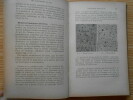
En bon état, marges un peu jaunies
Les Sols humides
LAROUSSE. Non daté. In-12. Broché. Bon état, Couv. légèrement passée, Dos satisfaisant, Non coupé. 180 pages. Quelques illustrations et schémas en noir et blanc, dans le texte. Quelques planches de photos en noir et blanc, hors-texte. Quelques tampons.. . . . Classification Dewey : 631.4-Science des sols : chimie, physique, fertilité
Bibliothèque rurale. Classification Dewey : 631.4-Science des sols : chimie, physique, fertilité
LISTE DE QUELQUES OUVRAGES COMPRIS DANS LE FASCICULE 6 : CHIMIE, INDUSTRIE DIVERSES, AGRICULTURE du catalogue Dunod qui contient tous les ouvrages sur ces matières avec leurs sommaires détaillés.
HEMMERLE, PETIT ET CIE. 1940. In-8. En feuillets. Bon état, Couv. convenable, Dos satisfaisant, Intérieur frais. 1 feuillet recto-verso. Texte sur 2 colonnes.. . . . Classification Dewey : 540-Chimie et sciences connexes
Classification Dewey : 540-Chimie et sciences connexes
Recherches sur l'acide o. nitrophénoxylacétique et dérivés.
Genève, Imprimerie Taponnier et Studer, 1887, in-8vo, 41 p., brochure originale.

(SLACES, NVVA)
Phone number : 41 (0)26 3223808
La grande rupture ? l'humanité face à son futur technologique
Robert Laffont 2010 377 pages 15 4x3 2x23 8cm. 2010. Broché. 377 pages.
Bon état
[Librairie Polytechnique Ch. Béranger] - DUPLAIX, Solange
Reference : 62425
(1948)
Détermination Microscopique des Minéraux des Sables
Préface de M. Jacques Bourcart, avec 69 figures de minéraux dans le texte, 1 vol. in-8 br., Librairie Polytechnique Ch. Béranger, Paris, Liège, 1948, 79 pp.
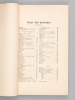
Etat satisfaisant (ex-libris ms. et cachet d'ex-libris, dos renforcé) pour cet ouvrage peu commun.
Antoine Laurent Lavoisier, fermier général né à Paris, le 16 août 1743. Jugé le 16 floréal l’an 2.
s.d. (1799) 42 x 27.5 cm, portrait de Lavoisier et scène „Lavoisier arreté dans son laboratoire par le comité revolutionnaire“, avec texte qui commence: „Robespierre s’attachoit...“ 1 feuille gravée,
Image disp.
(SLACES, NVVA)
Phone number : 41 (0)26 3223808
Du Pont de Nemours. De la poudre au nylon.
1961 Paris, Plon (Collection "Histoire des grandes entreprises"), 1961, petit in 8 broché, IV-193 pages ; trente-trois illustrations in et hors-texte et deux planches dépliantes.
...................... Photos sur demande ...................

Phone number : 04 77 32 63 69
Cours de Chimie Industrielle. TOME 1 : Généraliés - Les Combustibles.
GAUTHIER-VILLARS. 2ème édition. 1950. In-8. Broché. Bon état, Couv. fraîche, Dos satisfaisant, Intérieur frais. 295 pages. Nombreux dessins et schémas en noir et blanc, dans le texte.. . . . Classification Dewey : 540-Chimie et sciences connexes
Classification Dewey : 540-Chimie et sciences connexes

