 Write to the booksellers
-
Type
Autograph (1)
Book (5201)
Magazine (35)
Music sheets (3)
Photographs (8)
-
Latest
Last 24h (3)
Last 3 days (1)
Last month (10)
Last week (2)
-
Language
Czech (1)
English (3)
French (5231)
German (11)
Latin (1)
Spanish (1)
-
Century
17th (16)
18th (198)
19th (1146)
20th (2277)
21st (80)
-
Countries
Belgium (353)
Côte d'Ivoire (20)
Denmark (697)
France (3820)
Switzerland (358)
-
Syndicate
CLAM (2)
ILAB (3011)
NVVA (183)
SLACES (183)
SLAM (2106)
SNCAO (48)
The Chemistry of Acrylonitrile American Cyanamid Company - second edition
Cyanamid 1959 in8. 1959. Cartonné.
Bon état bonne tenue intérieur propre rousseurs sur la tranche
Chimie générale. Chimie minérale.
Couverture souple. Broché. 338 pages. papier bruni. Dactylographié.
Livre. Editions Scientifiques Claude Hermant, Vers 1950.
STEREOCHIMIE, ISOMERIES, MESOMERIE, MACROSTRUCTURES
Claude Hermant. Non daté. In-8. Broché. Etat d'usage, Couv. convenable, Dos satisfaisant, Intérieur acceptable. Paginé de 373 à 682. 1er cahier détaché.. . . . Classification Dewey : 540-Chimie et sciences connexes
Certificat de Chimie Générale. Classification Dewey : 540-Chimie et sciences connexes
STRUCTURE DES MOLECULES ET DES IONS COMPLEXES, LIAISONS CHIMIQUES, CERTIFICAT DE CHIMIE GENERALE
Claude Hermant. Non daté. In-8. Broché. Bon état, Couv. convenable, Dos satisfaisant, Intérieur acceptable. 371 pages. Illustré de nombreux schémas en noir et blanc dans le texte.. . . . Classification Dewey : 540-Chimie et sciences connexes
Ions complexes. Valence chimique... Classification Dewey : 540-Chimie et sciences connexes
Experiences sur les dissolutions & sur les fermentation froides de M. Geoffroy, réiterées dans les Vaves de l'Observatoire.
(Paris, Jean Boudot, 1706). 4to. Without wrappers. Extracted from ""Mémoires de l'Academie des Sciences. Année 1705"". Pp. 83-87.
First printing.
INTRODUCTION AU CALCUL DES REACTEURS CHIMIQUES -
ECOLE NATIONALE SUPERIEURE DE CHIMIE DE PARIS. NON DATE. In-4. Broché. Bon état, Couv. défraîchie, Dos satisfaisant, Intérieur frais. Environ 160 pages augmentées de quelques figures en noir et blanc dans le texte - annotations sur le 1er plat -. . . . Classification Dewey : 540-Chimie et sciences connexes
Introduction / Rappelk de Thermodynamique / Rappel de cinétique / Classification des réactions chimiques et des réacteurs / Etudes des réacteurs à marche isotherme dans le cas de réactions homogènes / Evolution des systèmes chimiques comportant plusieurs réactions / Etude des réacteurs à marche non isotherme dans le cas des réactions homogènes / Etude des réactions hétérogène / Etude des réactions catalytiques hétérogènes et application au cas d'un réacteur adiabatique à marche continue - Classification Dewey : 540-Chimie et sciences connexes
AMPERE (André-Marie), AMPERE (Jean-Jacques), BARTHELEMY-SAINT-HILAIRE (Jules)
Reference : 33642
Philosophie des deux Ampère, publiée par J. Barthélemy Saint-Hilaire.
In-12, pleine toile chagrinée rouge de l'époque, dos lisse orné de compartiments à froid, (4), xix, 461, (3) p., rousseurs. Paris, Didier, 1870.
Recueil d'oeuvres et de travaux philosophiques du physicien d'André-Marie Ampère, dont ses lettres à Maine de Biran, et de Jean-Jacques son fils. Introduction de Jules Barthélemy Saint-Hilaire.(Dictionnaire des philosophes, PUF, 94).
Mémoire sur une nouvelle Expérience électrodynamique, sur son application à la formule qui représente l'action mutuelle de deux élemend de conducteurs voltaïques, et sur de nouvelles conséquences déduites de cette formule (+) Lettre de M. Ampère à M.... - [""ONE OF THE MOST CELEBRATED MEMOIRS IN THE HISTORY OF NATURAL PHILOSOPHY""]
Paris, Crochard, 1825. 8vo. Bound in contemporary half calf with gilt lettering to spine. In: ""Annales de Chimie et de Physique, Par MM. Gay-Lussac et Arago."", tome 29. Entire volume offered. Very light occassional foxing, otherwise a fine and clean copy with no institutional stamps. Pp. 381-404"" 373-381. [Entire volume: 448 pp. + folded plate].
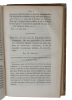
First appearance of this famous memoir, in which Ampère presented his collected results on electrodynamics to the French Academy, creating the foundation of 19th century developments in electricity and magnetism. In the words of James Clark Maxwell, ""We can scarcely believe that Ampère really discovered the law of action by means of the experiments which he describes. We are led to suspect, what, indeed, he tells us himself, that he discovered the law by some process which he has not shown us, and that when he had afterwards built up a pefect demonstration he removed all traces of the scaffolding by which he raised it."" The offered memoir was published BEFORE the famous ""Theorie mathématique des phénomènes électro-dynamiques uniquement déduite de L'expérience"", which did not appear until 1827. That 1827-Memoire incorporates, together with a new presentation of Ampère's results from 1820, 1822, 1823, the offered memoir (1825). (Horblit: 100 - Dibner: 62). ""From 1814 until 1820 Ampére did not perform the kind of research that would have made it into the annals of the histrory of science, but on September 11, 1820 when he heard Francois Arago speak about Oersted's work, he got fresh inspiration and started the work that made him famous. Arago related how Oersted had found that a steady electric current influences the orientation of a compass needle. After a weak Ampère had determined experimentally that that two straight, parallel, and current-carrying, wires execute a force on each other. The magnitude of the force is inversely proportional to the distance between the wires and proportional to the strenghts of the current..... During the following years he continued his researches, both experimentally and theoretically. he built an instrument for measuring electricity that later was developed into the galvanometer. Finally in 1825 he presented his collected results to the Academy IN ONE OF THE MOST CELEBRATED MEMOIRS IN THE HISTORY OF NATURAL PHILOSOPHY (The paper offered)."" (Citizen's Compendium, p. 2). - Norman No 47. The volumes contain many other notable papers by: Wöhler, Fresnel, Marcet, Berzelius, Felix Savart, De la Rive, Braconnet, Boussingault, Magnus, Poncelet, Vaugelin, Poisson, Gay-Lussac, Faraday, Laplace etc.
"AMPÈRE, ANDRÉ-MARIE. - THE CLASSIFICATORY SYSTEM OF AMPERE.
Reference : 43465
(1816)
Essai D'une Classification naturelle pour les Corps simples. (+) Suire De l'Essai i d'une Classification naturelle pour les Corps simples. (+) Suire D'une Classification naturelle pour les Corps simples. Suite du II. (+) Suite...Suite du II. (...
(Paris, Crochard, 1816) No wrappers as extracted fron 'Annales de Chimie et de Physique', Volume 1 and 2 (2e Series). Pp. 295-308 a. pp. 373-394 (Vol. 1), pp. 5-32 a. pp. 105-125 (Vol. 2). With both halftitles to vols. 1 a. 2. Htitles shaved in inner margins, no loss of letters. All 4 papers having some scattered brownspots.
First appearance of Ampere's notable memoir (issued in 4 parts) in which he tries to set up a classification system for the elementary entities in chemistry tieing the elements together in a natural classification, a dim foreshadowing of the periodic table.""Here (in the paper offered) he drew attention to the similarities between Lavoisier's and his fellowers classification of elements in terms of their reactions with oxygen and Linnaeus' classification of plants in terms of their sexual organs. Bernard de Jussieu had successfully challenged Linnaeus with a natural system that took the whole plant into account and sought affinities between all parts of the plant, not just the flowers, as the basic classification. Ampère now wished to do the same thing for chemistry. By discovering a natural classification, i.e., one that tied the elements together by real and rather than artificial relations, Ampère hoped to prove a new insight into chemical reactions. His classificatory scheme, therefore, was not merely an ordering ofthe elements but, like the later periodic table of Dimitri Mendeleev, a true instrument of chemical research. Ampères system was as artificial as Lavoisier's...Thepapermay be noted, however, as an early attempt to find relationships between elements that would bring some order into the constantly growing number of elementary bodies.""(DSB I, p. 143).
Uber die Antiseptischen Eigenschaften. Schwacher Chlorzink-Lösungen. Inaugural-Dissertation.
Leipzig, J. B. Hirschfeld, 1881, in-8vo, 24 S., Original-Broschüre.

(SLACES, NVVA)
Phone number : 41 (0)26 3223808
DICTIONNAIRE DE CHIMIE INDUSTRIELLE. TOME 1.
Bernard Tignol.. Non daté. In-4. Broché. A relier, Couv. légèrement passée, Dos abîmé, Quelques rousseurs. Environ 400 pages. 1ère de couverture illustrée en noir et blanc. Nombreuses illustrations en noir et blanc dans le texte. Ouvrage débroché. Manques sur le dos fendu. Manque le 2nd plat de couverture.. . . . Classification Dewey : 540-Chimie et sciences connexes
Les applications de la chimie. A l'industrie, à la métallurgie, à l'agriculture, à la pharmacie, à la pirotechnie at aux arts et métier. Classification Dewey : 540-Chimie et sciences connexes
DICTIONNAIRE DE CHIMIE INDUSTRIELLE CONTENANT LES APPLICATIONS DE LA CHIMIE A L'INDUSTRIE A LA METTALURGIE A L'AGRICULTURE A LA PHARMACIE A LA PIROTECHNIE ET AUX ARTS ET METIERS - EN 3 TOMES / TOMES 1 + 2 + 3.
BERNARD TIGNOL. NON DATE. In-4. Broché. Etat d'usage, Couv. légèrement passée, Dos fané, Quelques rousseurs. Environ 700 pages + environ 400 pages + environ 400 pages - non paginé - illustration en noir et blanc en frontispice dans le tome 1 - textes sur deux colonnes - ouvrages recouvert d'un plastique transparent - quelques rousseurs sans réelle conséquence sur la lecture - nombreuses figures en noir et blanc - 2 photos disponibles.. . . . Classification Dewey : 540-Chimie et sciences connexes
Classification Dewey : 540-Chimie et sciences connexes
LE SAVANT CHIMISTE. 150 EXPERIENCES ET MANIPULATIONS
GROUT. NON DATE. In-8. Broché. Etat d'usage, Couv. légèrement passée, Dos fané, Intérieur frais. 31 pages. Nombreuses figures en noir et blanc hors texte. Ecriture sur le premier plat.. . . . Classification Dewey : 540-Chimie et sciences connexes
Classification Dewey : 540-Chimie et sciences connexes
"Initiation à l'étude chimique des corps gras; conférences organisées et publiées avec le concours de l'I.R.H.O."
Paris, Société d'édition d'Enseignement Supérieur, 1963. 15 x 24, 365 pp., quelques figures, reliure pleine toile avec 2 pièces de titre, bon état.
Initiation à l'étude chimique des corps gras. Conférences organisées et publiées avec le concours de l'I.R.H.O. Préface de M. Marcel Delépine.
P., SEDES, 1963, grand in 8° broché, 365 pages ; portrait de Chevreul en frontispice ; traces de ruban adhésif sur les gardes.
PHOTOS sur DEMANDE. Fermeture du 1er au 23 Août

Phone number : 04 77 32 63 69
Chimie agricole, chimie du sol, tome 2
Baillières et Fils. 1930. In-8. Broché. Etat d'usage, Couv. convenable, Dos satisfaisant, Intérieur frais. 295p., couverture abimée légèrement, en l'état.. . . . Classification Dewey : 631.4-Science des sols : chimie, physique, fertilité
Encyclopédie agricole, 3 ème édition Classification Dewey : 631.4-Science des sols : chimie, physique, fertilité
CHIMIE AGRICOLE- CHIMIE VEGETALE- TOME 2- germination- respiration- composition minérale des végétaux- phénomènes d'accroissement
BAILLIERE ET FILS. 1924. In-8. Broché. Bon état, Couv. convenable, Coiffe en tête abîmée, Intérieur frais. 460 pages. . . . Classification Dewey : 540-Chimie et sciences connexes
Classification Dewey : 540-Chimie et sciences connexes
CHIMIE AGRICOLE. Chimie du sol. Encyclopédie agricole.
Paris Baillère 1913. In-12 XV 556pp 4 feuillets non chiffrés catalogue dont la page de garde et le contreplat. Cartonnage éditeur de papier vert orné de végétaux, titre en rouge sur le dos et le 1er plat. Orné de 5 figures dans le texte. Bel exemplaire. (4635)
CHIMIE AGRICOLE. Chimie végétale. Encyclopédie agricole.
Paris Baillère 1909. In-12 XII 560pp. Cartonnage éditeur de papier vert orné de végétaux, titre en rouge sur le dos et le 1er plat. Orné de 14 figures dans le texte. Bel exemplaire. (4636)
The Bakerian Lecture. - On the Continuity of the Gaseous and Liquid States of Matter. Received June 14, - Read June 17, 1869.
(London, Taylor and Francis, 1870). 4to. No wrappers as extracted from ""Philosophical Transactions"" 1869 - Vol. 159 - Part II. Pp. 575-590 and 1 plate. Clean and fine.
First apperance of the paper in which Thomas Andrews announces his discovery of the ""CRITICAL POINT"", which states that for every gas there was a temperature above which pressure alone could not liquefy it.""This was a crucial discovery for it pointed the way toward the liquefaction of the permanent gases by demonstrating the necessity of dropping the temperature below the critical point before exerting pressure. This new view led within half a century to the work of Dewar and Kammerlingh-Onnes and the liquefaction of all known gases.""(Asimov).Magie: A Source Book in Physics, pp. 187-192. - Parkinson, Breakthroughs: 1869 C.
The Bakerian Lecture. - On the Continuity of the Gaseous and Liquid States of Matter. Received June 14, - Read June 17, 1869.
(London, Taylor and Francis, 1870). 4to. No wrappers as extracted from ""Philosophical Transactions"" 1869 - Vol. 159 - Part II. Pp. 575-590 and 1 plate. Clean and fine.
First apperance of the paper in which Thomas Andrews announces his discovery of the ""CRITICAL POINT"", which states that for every gas there was a temperature above which pressure alone could not liquefy it.""This was a crucial discovery for it pointed the way toward the liquefaction of the permanent gases by demonstrating the necessity of dropping the temperature below the critical point before exerting pressure. This new view led within half a century to the work of Dewar and Kammerlingh-Onnes and the liquefaction of all known gases.""(Asimov).Magie: A Source Book in Physics, pp. 187-192. - Parkinson, Breakthroughs: 1869 C.
On the Constitution and Properties of Ozone. Received May 16, - Read June 21, 1855.
(London, Taylor and Francis, 1856). 4to. No wrappers as extracted from ""Philosophical Transactions"" 1856 - Vol. 146 - Part I. Pp. 1-13 a. 1 lithographed plates.
First printing of Andrew's paper in which he shows, that ozone is oxygen in allotropic form.Andrews subsequently turned his attention to the problem of the constitution of ozone. This had been investigated by a number of chemists, including Schöonbein, its discoverer. Its nature was still unknown, however, and it was by no means certain that the ozone obtained from different sources was one and the same substance" it was thought by some to contain hydrogen. Andrews says his researches extended over four or five years, and he finally reached the conclusion that all the supposed varieties of ozone were identical and that it was in fact oxygen in an altered or allotropic condition.
Correspondance et souvenirs (de 1793 à 1805) recueillis par madame H.C.
J. Hetzel & Cie | Paris 1873 | - | relié
Cinquième édition. Reliure en demi chagrin bleu marine, dos à cinq nerfs sertis de filets dorés, plats de papier marbré, gardes et contreplats de papier à la cuve, tranches mouchetées, reliure de l'époque. Quelques petites rousseurs. - Photographies et détails sur www.Edition-Originale.com -
L'industrie des matières colorantes organiques, T1
1921 Librairie Octave Doin encyclopédie scientifique reliure cartonnée éditeur, 350p. très bon état.
Table : les matières premières - les produits intermédaires et les méthodes générales de leur préparation - index.
Phone number : 04 76 97 79 28
Annales de chimie et de physique par Berthelot,Friedel,Mascart;
Reference : 9575
(1896)
Annales de chimie et de physique ;1896
1896 MASSON,Gauthiers-Villars,1896 7e serie tomes VII et VIII ,2 volumes in8 reliure demi basane,dos lisse,576p.+576p.,dessins in texte,
cachets bibliotheque,bon état Remise de 20% pour toutes commandes supérieures à 200 €

