 Write to the booksellers
-
Type
Book (2340)
Magazine (9)
-
Latest
Last 24h (2)
Last 3 days (1)
Last month (12)
Last week (2)
-
Language
English (1)
French (2347)
Italian (1)
-
Century
16th (1)
17th (5)
18th (85)
19th (513)
20th (930)
21st (127)
-
Countries
Belgium (421)
Côte d'Ivoire (4)
Denmark (630)
France (1083)
Netherlands (1)
Switzerland (210)
-
Syndicate
CLAM (1)
ILAB (1285)
NVVA (19)
SLACES (19)
SLAM (514)
Technologie der Maschinenbaustoffe
S. Hirzel verlag Stuttgart 1957 in8. 1957. Cartonné.
Bon état intérieur jauni rousseurs dans les plats intérieurs bonne tenue par ailleurs
Neue Architectura Hydraulika. Erster Theil die Statik, die Dynamik, die Hydrostatik, die Hydrodynamik und die allgemeine Lehre von Maschinen, den dabei anwendbaren Kräften und den verschiedenen Umständen, welche auf das Gleichgewicht und die Bewegung ...
Frankfurth am Main, Andräischen Buchhandlung, 1795. 4to. Contemp. hcalf. Gilt spine, titlelabel with gilt lettering. A paperlabel pasted on upper part of spine. Stamps on title-page. (10),652,72 pp. and 15 fine large folded engraved plates. Internally clean and fine.
First German edition. A second volume was published 1801.

Nouvelle Architecture Hydraulique, contenant l'art d´lever l'eau au moyen de différentes machines, de construire dans ce fluide, de le diriger, et généralement de l'appliquer. de diverses manieres, aux besoins de la société. 1.-2. Partie. 2 Vols.
Paris, Firmin Didot, 1790-96. Large 4to. 2 contemp. hcalf. Gilt spines. Titlelabes with gilt lettering. Wear to top of spines. A paperlabel pasted on spines. stamps on title-pages. XII,621,(3),71(tables)(2),203,(1) pp., 53 large folded engraved plates (numb. 1-52, no. 42 omitted (lacks ?), 16 + 47 bis). Occassional light browning to margins.
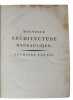
First edition of Prony's famous lectures on hydraulics, where volume two deals with the construction of steam-engines. At the time of publication he was inspector at the École des Ponts et Chaussés.
Rapport à MM. le Président et Conseillers de la Cour royale séante à Paris sur la nouvelle et l'ancienne Machine à Vapeur, établies à Paris, au Gros-Caillou... Avec deux notes ajoutées par l'auteur.
Paris, Huzard, 1826. 130 X 215 mm. relié cartonnage papier marbré, pièce de titre au dos (reliure postérieure). 101 pp. suivies de 3 planches gravées dépliantes. Relié sans la page de faux-titre, mouillure claire.
Phone number : 41 021 964 60 10
Cours de métallurgie des métaux autres que le fer
Ch. béranger 1912 in8. 1912. Cartonné. illustrations en noir et blanc
Bon Etat de conservation cependant couverture frottée défraîchie intérieur jauni propre
L ENCYCLOPEDIE DE LA BIERE. LE GUIDE COMPLET DE LA BIERE DANS LE MONDE.
CHEZ L AUTEUR.. 1996. In-4. Cartonnage d'éditeurs. Bon état, Couv. convenable, Dos satisfaisant, Intérieur frais. 224 pages. Nombreuses illustrations en noir et blanc et en couleurs dans le texte et hors texte.. . . . Classification Dewey : 663-Technologie des boissons

Classification Dewey : 663-Technologie des boissons

L'ENCYCLOPEDIE DE LA BIERE. LE GUIDE COMPLET DE LA BIERE DANS LE MONDE
DE L'OLYMPE. Non daté. In-4. Cartonnage d'éditeurs. Etat d'usage, Coins frottés, Dos satisfaisant, Intérieur acceptable. 224 pages. Nombreuses photos, illustrations, cartes en couleurs hors texte. Dos et deuxième plat déboité.. . . . Classification Dewey : 663-Technologie des boissons
Classification Dewey : 663-Technologie des boissons
"Le guide de l'expert et application de l'hydraulique : La fontaine de l'Ermitage; L'étang de Savigneux; L'usine de Régny; Le moulin de Saint-Nizier; La rivière de Janon; Les prés de la Fauvette; Engins et filets de pêche; La maison du Gris de Lin; Le chemin vicinal, N° 35; Le travail des roues hydrauliques et des machines à vapeur."
Paris/Liège, Librairie Polytechnique de Baudry, 1893. 14 x 22, 216 pp., 30 figures, reliure dos toilé, bon état (pages de garde : 1 cachet d'ex-propriétaire, 1 cachet de librairie, 1 cachet scolaire).
Die Metallindustrie Anatoliens in der Zeit von 1500-700 vor Chr. Rohstoffe, Technik, Produktion. Mit 2 Karten, 8 Tabellen und 149 Abbildungen auf 22 Tafeln.
Leiden, Brill, 1939. Folo. Hcloth. Spine with light wear. Stamps on foot of titlepage. XII,206 pp., 22 plates, 2 maps. Internally clean.
Internationales Archiv für Ethnographie. Band XXXVI, Supplement.
Manuel des Artificiers.
Rochefort, Goulard, 1837. Contemp. hcalf. A paperlabel pasted on lower part of spine. Stamps on title-page. XX,36 pp., 3 folded lithographed plates.
Medieval and Classical Traditions and the Renaissance of Physico-Mathematical Sciences in the 16th Century Proceedings of the XXth International Congress of History of Science (Liege, 20-26 July 1997) Vol. VIII,
Turnhout, Brepols, 2001 Paperback, 152 p., 155 x 240 mm. ISBN 9782503511986.
Ce volume est une contribution a l'histoire de la transition entre la science medievale et la science moderne, en ce qui concerne les mathematiques et la science du mouvement. Le processus de cette transformation a ete relativement peu etudie: les etudes historiques se sont concentrees de facon dominante sur la description de la phase finale de ce processus; le travail historique a etabli une description tres documentee et structuree de la situation de la philosophie naturelle a l'aube de la science classique. Au cours des dernieres decennies des travaux sur des auteurs et des oeuvres du XVIe siecle peu etudie font cependant apparaitre que cette description est alteree structurellement par des interpretations anachroniques de certains concepts qui y occupent manifestement une place centrale. Les etudes presentees dans ce volume sont un reflet des travaux effectues recemment dans ce sens sur deux aspects singuliers d'un tel programme: l'oeuvre scientifique de MAurolico d'une part, et l'emergence de la science galileenne du mouvement d'autre part. Languages : English, French.
Organizational Behaviour in Its Context (No. 3) (Aston Programme)
Saxon House 1977 206 pages 23x1 8x15 8cm. 1977. Cartonné. 206 pages.
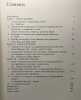
Bon Etat couverture un peu défraîchie intérieur propre
PYROTECHNICAL SIGNALLING - COULIER, (P.F.) et RUGGIERI (C.F.).
Reference : 57692
(1846)
Nouveau Code de Signaux de Jour et de Nuit, ou de Communication d'un Lieu a un autre ay moyen d'un Système Pyrotechnique a l'usage de la Marine, de la Guerre et de Chemins de Fer.
Paris, Chez l'Auteur, 1846. Orig. clothbacked printed boards. 67 pp.
Die Pyrotechnie oder theoretisch=praktische Anweisung zur Bereiten aller Arten Feuerwerke auf der Erde, in der Luft und auf dem Wasser nebst Anleitung zur Verfertigung der Theater=, Tafel=, Aerostaten= und Artilleriefeuerwerke nach den Vorschriften v...
Leipzig, Kummer, 1807. Contemp. full mottled calf. Richly gilt spine. Titlelabel with gilt lettering. Gilt lineborders on covers. A paperlabel pasted on spine. Stamp on title-page. XXIV,270 pp., 22 folded engraved plates. A few faint scattered brownspots. A fine copy.
First german edition. - Chris Philip, R070.1
TRAITÉ DE LA CHALEUR, et de ses applications aux arts et aux manufactures. [2 volumes].
1828 Paris, De Malher et Comp., 1828. Deux volumes in-8 (212 X 137 mm) demi-basane brune, dos lisse cloisonné de filets dorés, pièces de titre et de tomaison basane rouge, tranches teintes en jaune et mouchetées en bleu (Reliure de l'époque). Tome 1 : XII-400 pages, (1) f. de corrections et additions - Tome 2 : (2) ff. de faux-titre et titre, 532 pages. Rousseurs éparses, des feuillets brunis, mouillure claire allant s'amenuisant dans l'angle supérieur droit des 9 premiers feuillets du tome 2.
![TRAITÉ DE LA CHALEUR, et de ses applications aux arts et aux manufactures. [2 volumes].. PÉCLET (Eugène).](https://static.livre-rare-book.com/pictures/CTE/005694_1_thumb.jpg)
![TRAITÉ DE LA CHALEUR, et de ses applications aux arts et aux manufactures. [2 volumes].. PÉCLET (Eugène).](https://static.livre-rare-book.com/pictures/CTE/005694_2_thumb.jpg)
![TRAITÉ DE LA CHALEUR, et de ses applications aux arts et aux manufactures. [2 volumes].. PÉCLET (Eugène).](https://static.livre-rare-book.com/pictures/CTE/005694_3_thumb.jpg)
ÉDITION ORIGINALE peu commune de cet ouvrage fondamental dans le domaine de la thermodynamique et du transfert thermique. MANQUE l'atlas de planches qui accompagne ces deux volumes de texte. AGRÉABLE EXEMPLAIRE, conservé dans sa reliure d'époque en BEL ÉTAT. PLEASANT COPY. PICTURES AND MORE DETAILS ON REQUEST.
Machines à calculer électroniques arithmétiques et analogiques
Dunod 1959 in8. 1959. Broché.

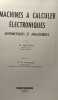
Bon état couverture défraîchie frottée intérieur propre sans jaquette
Recherches sur les mouvements de l'aiguille aimantée à Bruxelles.
Bruxelles, F. Hayez, 1879. In-4 de 29 pp., percaline bleue décorée de l'éditeur.
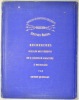
Tiré à part des Mémoires de l'Académie royale des sciences, des lettres et des beaux-arts de Belgique. Publié à l'occasion de l'Exposition internatinale d'électricité de Paris en 1881.
L'acoustique ou Les phénomènes du son. Bibliothèque des merveilles.
Paris, Librairie de L. Hachette, 1867. "12 x 18, 343 pp., reliure d'édition pleine toile bleue, dos et plats : riche décor doré, tranches rougies, bon état (peu de rousseurs sauf en tout début d'ouvrage; reliure très bien conservée)."
Ouvrage illustré de 114 figures par H. Loeschin et N. Jahandier.
Ueber Dampfmaschinen mit hoher Kolbengeschwindikgeit.
Wien, Carl Gerold's Sohn, 1892. 150 X 230 mm. relié toile d'éditeur. XV-367 pp. 3. umgearbeitete Auflage, mit 92 Holzschnitten im Text und 3 Tabellen in fine. Bel exemplaire.
Phone number : 41 021 964 60 10
"Isolation sonore et accoustique architecturale; problèmes techniques et solutions pratiques."
Paris, Editions Chiron, 1964. "16 x 24, 383 pp., nombreuses figures, reliure d'édition pleine toile, bon état (couverture défraîchie; 1 cachet d'ex-propriétaire)."
Le tournage du bois
Eyrolles. 1989. In-4. Relié. Bon état, Couv. convenable, Dos satisfaisant, Intérieur frais. 165 pages. Nombreuses photos et illustrations en couleurs et noir et blanc, dans le texte.Tampon encreur sur la dernière page .. . . . Classification Dewey : 674-Technologie du bois et du liège

Classification Dewey : 674-Technologie du bois et du liège
Science et Pratique des Chemins de Fer. Collection de Plans et Details de Construction dressés par les plus Célébres Ingenieurs D'Angleterre.
Paris, 1840. Folio-oblong. Cont.hcalf. Back worn. Lithogr.frontisp. (Chemin de Fer de Londres á Birmingham) and 77 lithogr. plates. A little brownspotted.
Ecole des Ponts et Chaussées. Collection de dessins distribués aux Elèves. 32 plates. - [COLLECTION OF PLATES RELATING TO TRAINS, RAILWAYS & STEAMENGINES]
(No place, nor year, but Paris, presumably 1875). Folio. 32 plates (505 x 640) loosely incerted in two portfolios. A few plates with a few small nicks, otherwise fine and clean.
Fine collection of plates distributed to pupils at ""Ecole des Ponts et Chaussées"". ROUTES / ROADSSerie 2_Section A_PL. 1Serie 2_Section A_PL. 2Serie 2_Section A_PL. 3Serie 2_Section A_PL. 4CHEMINS DE FER / RAILROADSSerie 4_Section D_PL. 6Serie 4_Section D_PL. 7Serie 4_Section D_PL. 8Serie 4_Section D_PL. 9Serie 4_Section D_PL. 10.Serie 4_Section D_PL. 11.Serie 4_Section D_PL. 12.Serie 4_Section D_PL. 13Serie 4_Section D_PL. 14PORTS MARITIMES / SEAPORTSSerie 6 Section F PL. 10Serie 6 Section F PL. 11Serie 6 Section F PL. 12Serie 6 Section F PL. 13TRAVAUX D'ASSAINISSEMENT DES VILLES / TOWN SANITATION WORKSSerie 8 Section B PL. 1Serie 8 Section B PL. 11Serie 8 Section B PL. 12MOTEURS À VAPEUR / STEAM ENGINESSerie 10_Section B_PL. 1Serie 10_Section B_PL. 2Serie 10_Section B_PL. 3Serie 10_Section B_PL. 4Serie 10_Section B_PL. 5Serie 10_Section B_PL. 6Serie 10_Section B_PL. 7Serie 10_Section B_PL. 8Serie 10_Section B_PL. 9Serie 10_Section B_PL. 10Serie 10_Section B_PL. 11Serie 10_Section B_PL. 12
The amateur lapidary
D. Bradford Barton 1969 in8. 1969. Cartonné.
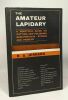
Très Bon Etat de conservation avec jaquette intérieur frais
"Manuel du brevété mécanicien; notions théoriques sur le moteur."
Paris/Nancy, Charles-Lavauzelle, 1938. 11 x 19, 413 pp., 191 figures, 3 planches dépliantes, reliure d'édition carton, bon état (dos défraîchi).

