 Write to the booksellers
-
Type
Book (2626)
Magazine (9)
-
Latest
Last 24h (2)
Last 3 days (1)
Last month (20)
Last week (4)
-
Language
English (1)
French (2633)
Italian (1)
-
Century
16th (1)
17th (5)
18th (85)
19th (529)
20th (1161)
21st (143)
-
Countries
Belgium (421)
Côte d'Ivoire (4)
Denmark (630)
France (1369)
Netherlands (1)
Switzerland (210)
-
Syndicate
CLAM (1)
ILAB (1286)
NVVA (19)
SLACES (19)
SLAM (515)
Die eiserne Eisenbahn oder neue einfache Eisen-Constructionen für Eisenbahnen, wodurch die wichtigsten Bau= und Betriebs=gegenstände ungleich solider, dauerhafter und billiger als bisher hergestellt werden können. Für Staats= und Eisenbahn=Verwaltunge...
Hannover, Karl Rümpler, 1863. Large 4to. Contemp. hcalf. Gilt spine. A paperlabel pasted on upper part of spine. Stamps on title-page. 146 columns (= 73 pp.) and 12 double-page folded lithographed plates. Text clean, scattered brownspots on plates.

Vorarbeiten, Erd-, Strassen-, Grund- und Tunnelbau. 1. Abteilung: Vorarbeiten, Einfluss des Betriebes auf das Alignement, Erd- und Felsarbeiten, sowie Bauleitung.
2. Aufl. Leipzig, Wilhelm Engelmann, 1883. Gr.-8°. XII, 486 S. Mit 75 Textholzschnitten, 16 lithogr. Tafeln und 3 gef. Tabellen. Halblederband der Zeit (berieben und bestossen). = "Handbuch der Ingenieurwissenschaften in vier Bänden", 1. Bd., 1. Abt.
Mit Beiträgen vom R. Koch, E. Mackensen, Gust. Meyer und R. Richard. - Besitzerstempel auf fl. Vorsatz. Vorsätze mit kl. leimschattigen Stellen. Durchgehend leicht gebräunt. Seite 140-150 mit 1 cm. Einriss und Spuren von entfernter Büroklammer. 2 Tafeln mit kl. Randläsuren.
Vorarbeiten, Erd-, Strassen-, Grund- und Tunnelbau. 2. Abteilung: Konstruktion der Stütz- und Futtermauern, Strassen- und Grundbau.
2. Aufl. Leipzig, Wilhelm Engelmann, 1884. Gr.-8°. XII, 455, X S. Mit 134 Textholzschnitten und 30 lithogr. Tafeln. Halblederband der Zeit (berieben und bestossen). = "Handbuch der Ingenieurwissenschaften in vier Bänden", 1. Bd., 2. Abt.
Mit Beiträgen vom E. Häseler, F. Laissle und Gust. Meyer. - Besitzerstempel auf fl. Vorsatz. Vorsätze mit kl. leimschattigen Stellen. Durchgehend gebräunt. Tafeln teilw. stockfleckig.
Night Rates as applied to Long Distance Telephonie Service.
(New York), American Telephonie & Telegraph Company, 1911. 8°. 15 p. Orig. wrappers (slightly bumped, browned, with a stain).
Leçons sur les Machines à Vapeur.
Paris, Dunod, 1885-91. 160 X 240 mm. 2 tomes reliés en 1 volume + 1 atlas (600 X 400 mm) reliés demi-toile noire à coins avec titre doré au dos, tr rouges (rel. de l'ép.). XVIII-1087 pp. Avec un atlas de 17 planches représentant de très nombreuses figures gravées sur bois. Reliure lég. frottée avec petite étiquette de bibliothèque en bas de dos, tampon de bibliothèque répété, y compris sur 7 planches, manque dans le coin inf. de la page 357 sans atteinte au texte.
Phone number : 41 021 964 60 10
Het depannage ABC voor superheterodynes (Blaupunkt-Schriftenreihe)
, Antwerpen, De Techniek s.d., 176pp. + 12pp.met ills., gecart.band
Materials, Research, Development and Applications. Proceedings of the XXth International Congress of History of Science (Liege, 20-26 July 1997) Vol. XV,
Turnhout, Brepols, 2002 Paperback, 246 p., 155 x 240 mm. ISBN 9782503513676.
The theme of materials in the history of technology has never been as well researched as other more popular areas like energy, production technology or transport and communication. The present collection of papers originating from the symposium on "Materials: Science, Technology and Early Applications" in conjunction with the 20th International History of Science Congress in Liege, 1997, make a contribution to remedying this unsatisfactory situation. They concentrate on the 19th and 20th centuries and range from research on the metallurgy of zinc in the late 18th and early 19th century to the prospects of ceramic materials to ameliorate contemporary environmental problems. Languages : English, French, German.
History of Modern Physics. Proceedings of the XXth International Congress of History of Science (Liege, 20-26 July 1997) Vol. XIV,
Turnhout, Brepols, 2002 Paperback, 356 p., 155 x 240 mm. ISBN 9782503512006.
Addressing modern physics in its largest perspective, the present volume, which includes 34 contributions, begins with a reappraisal of classical science. However, the stress is placed on the contemporary period with sections devoted to thermodynamics and mechanics, the centenary of the electron, Einstein, the quantum theory and particle physics. Languages : English.
Cours de résistance des matériaux à l'usage des Elèves des Ecoles Industrielles et Professionnelles moyennes et supérieures
A. De Boeck 1945 in8. 1945. Cartonné.
couverture ternie bords frottés intérieur jauni propre rousseurs dans les plats intérieurs
"HODKINSON, EATON. - A PIONEER WORK ON THE STRENGHT OF MATERIALS.
Reference : 42912
(1840)
Experimental Researches on the Strenght of Pillars of Cast Iron, and other Materials. received April 22, - Read May 14, 1840.
(London, Richard and John E. Taylor, 1840). 4to. No wrappers as extracted from ""Philosophical Transactions"" 1840 - Part II. Pp. 385-456 a. 3 lithographed plates (one folding). Clean and fine.
First printing of an influential paper in structural mechanics.""In 1840, Hodkinson presented his investigation on buckling of columns to the Royal Society (the paper offered). His purpose was to verify the theoretical formula of Euler...Cylindrical, solid and hollow specimens with rounded and flat ends were tested. Foer slender, solid struts, good accord was found with Euler's formula...It was also found that a strut with flat ends has the same strenght as a shorter strut og half its lenght which has rounded ends.""""Hodkinson baceme the professor of mechanical principles of engineering in University College, London, in 1847, and, during his tenure of the chair, he participated as a member of teh Royal Commission appointed to inquire into the application of iron to railway structures. In 1841 Hodgkinson was awarded a Royal Medal for his work on strenght of pillars and, in the same year he was elected a Fellow of the Royal Society.""(Timoshenko ""History of Strenght of Materials"", p. 128-29). - Darmsatedter, 1840 H.
Ældre dansk bøssemageri. Især i 1600-talet. With Summary and captations in English. 2 bd. (1: Tekst. 2: Plancher).
Kbhvn 1951. 4to. Orig. bogtrykte omslag, tekstbind lidt revet i ryggen. 282+(2) s. + 60 plancher.
Ældre Dansk Bøssemageri især i 1600-Tallet. Tekst + illustrationer. 2 Bd.
K., 1951. Lex8vo. 282 pp. samt 60 plancher.
Disputats.
Thyristor - Handbuch --- der thyristor als bauelement der leistungselektronik
Siemens 1965 in8. 1965. Cartonné.
Bon état général intériuer propre jaquette défraîchie bords un peu frottés accroc en haut du dos
Anweisung zum vervielfältigen einer Schrift oder Zeichnung, ausgeführt mit der feder oder reissfeder, durch Hülfe der galvanischen Kupferausscheidung. (Aus dem Dänischen übersetzt). Mit einer galvanographischen Tafel.
Kopenhagen, Reitzel, 1842. Clothbacked stiff blank wrappers. Stamp on title-page. Lower right corner of title-page defective, but no loss of letters. 22 pp., 1 galvanographic plate.
Early work on the galvanographic process.
Les Principes de politique de Benjamin Constant. La genèse d'une oeuvre et l'évolution de la pensée de leur auteur (1789-1806), 2 vol.
Couverture souple Droz 1980 Genève 23x15,5 cm
2 vol., broché, dos carré, couverture souple d'éditeur imprimée en rouge et noir - 459 pp.; 690 pp. Le tome II est intitulé: Principe de politique applicables à tous les gouvernements. Bel état. Travail de thèse à l'Université de Lausanne.
Fahrzeuge der Schweizer Armee
2000 Medienunternehmen Zofinger Tagblatt AG - 2000 - In-4, cartonnage illustré - 317 pages - Nombreuses illustrations en couleurs et en N&B, in et hors texte, dans l'ouvrage - Texte en allemand
Bon état - Légers frottements sur les coins et les coiffes Bon
Praktische Anleitung zum Nivelliren oder Wasserwägen, nach einer in vielen Stücken veränderten und erleichterten Methode, nebst Beschreibung der dazu gehörigen Wasserwage. Mit fünf, fast sämmtlich illuminirten Kupfertafeln.
Hannover, Helmingschen, 1800. Contemp. hcalf. Wear to extremities. Titlelabel gone. Stamps on foot of title-page. (2),252,(2) pp., 5 large folded engraved plates, of which 4 are handcoloured. Internally fine and clean.
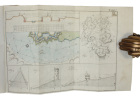
First edition. - Poggendorff I,1129.
Guide Pratique pour L'Application du Propulseur a Turbine Hélicoïde aux Navires et aux Bateaux de Rivières et de Canaux.
Paris, Chaix et Cie, 1856. Large 4to. Contemp. hcloth. Titlelabelwith gilt lettering on upper cover. 32 pp., 4 folded tables, 2 folded lithographed plates.
First edition.
Opfindernes Liv. 1.-2. Del. (2 Bd.).
Kbhvn. og Kria., 1914-15. Lex8vo. 2 solide private hshirtbd. med rygtitler i skind. 352,334 pp. Tekstillustr.
Libri Tres: In Quibus Primo Constructio Circini Proportionum Edocetur. - [THE INVENTION OF THE PROPORTIONAL COMPASS]
Mainz, Balthazar Lipp, 1605. 4to. Bound in a beautiful 18th century full mottled calf binding with double gilt line-borders to boards. Edges of boards gilt. Expertly rebacked perfectly matching the boards and the gilding. With gilt leather title-label and gilt ornamentations. End-papers renewed. B2 and B3 defective in lower blank margins, not affecting text. A nice and clean copy. 53, (1) pp. + 1 folded plate and numerous illustrations in text.
![Libri Tres: In Quibus Primo Constructio Circini Proportionum Edocetur. - [THE INVENTION OF THE PROPORTIONAL COMPASS]. HORCHER, PHILIPP.](https://static.livre-rare-book.com/pictures/LLX/60109_1_thumb.jpg)
![Libri Tres: In Quibus Primo Constructio Circini Proportionum Edocetur. - [THE INVENTION OF THE PROPORTIONAL COMPASS]. HORCHER, PHILIPP.](https://static.livre-rare-book.com/pictures/LLX/60109_2_thumb.jpg)
![Libri Tres: In Quibus Primo Constructio Circini Proportionum Edocetur. - [THE INVENTION OF THE PROPORTIONAL COMPASS]. HORCHER, PHILIPP.](https://static.livre-rare-book.com/pictures/LLX/60109_3_thumb.jpg)
The exceedingly rare first edition of the first work to describe the construction of the adjustable proportional compass – the first work to describe both its construction and its application. The adjustable proportional compass became an indipensable tool for calculations and measurements for over three centuries. The proportional compass was a seminal calculating instrument in use from the end of the sixteenth century until the nineteenth century. Consisting of two rulers of equal length joined by a hinge, it was a precursor to the sector and could be used for solving problems in proportion, multiplication and division, geometry, and trigonometry, and for computing various mathematical functions, such as square roots and cube roots. The sector derives its name from the fourth proposition of the sixth book of Euclid, where it is demonstrated that similar triangles have their like sides proportional. Some sectors also incorporated a quadrant, and sometimes a clamp at the end of one leg which allowed the device to be used as a gunner's quadrant. “The device was apparently first developed by Joost Bürgi and first published by Levinus Hulsius (1604). Hulsius offered the instrument for sale and thus limited himself to instructions for its use and did not detail its construction. The present work provides construction details on the hindge and the creation of the scales.” (Tomash & Williams). The sector was invented, essentially simultaneously and independently, by a number of different people prior to the start of the 17th century. Credit for the invention is often given to either Thomas Hood (who did not claim priority himself), a British mathematician, or to the Italian mathematician and astronomer Galileo Galilei. Galileo, with the help of his personal instrument maker Marc'Antonio Mazzoleni, created more than 100 copies of his proportional compass design and trained students in its use between 1595 and 1598. Of the credited inventors, Galileo is certainly the most famous, and earlier studies usually attributed its invention to him. James Kynvyn, Robert Beckit and Charles Whitwell all at some point also seem to have claimed to priority of the invention.Giordano Bruno, shortly before his death, also saw its potential. It could measure the infinitesimal fractions of the angular degrees and calculate the proportions between lines, geometric shapes and solids, working on the proportionality and commensurability of angles and segments. This new precision in calculations confirmed Bruno’s thesis of the existence of the physical minimumas opposed to the Aristotelian thesis of the infinite divisibility. (see: Zaffino, Giordano Bruno and the Proportional Eight Spike Compass) The many claims of invention, however, do not deprive Horcher of being the very first to describe the actual construction of the instrument, thus being of seminal importance in its widespread use over more than three hundred years. Tomash & Williams H164
Les machines à bois d'établis - Collection technique pour tous.
S.E.M.I.S.. non daté. In-8. Broché. Etat d'usage, Tâchée, Agrafes rouillées, Papier jauni. 95 pages agrafées - nombreuses figures en noir et blanc dans et hors texte - 1er plat tâché - légères rousseurs sur les plats.. . . . Classification Dewey : 674-Technologie du bois et du liège
Collection technique pour tous - Illustrations de Claude Cadeau. Classification Dewey : 674-Technologie du bois et du liège

HORST, TILEMAN VAN DER (AND JACOB POLLEY). - 18TH CENTURY BIBLE ON DUTCH CANAL AND DAM CONSTRUCTION.
Reference : 51848
(1757)
Theatrum Machinarum universale of Keurige Verzameling van verscheide grote en zeer fraaie Waterwerken, Schutsluizen, Waterkeringen, Ophaal- en Draaibruggen. met hare Gronden, Opstallen en Doorgesnedens Als: de grote Sluys te Muyden.... etc. etc. I-...
Amsterdam, Petrus Schenk, 1757-74. Large folio. (55 x 34,5 cm.). A large uncut copy in contemp. marbled boards, spine gone and later backed with buckram, original corners in leather a bit bumped. Stamps on foot of first title-page. Halftitel, title-pages in red/black with engraved vignettes. (2),2 engraved leafs with dedications, 14"(2),8 pp. and 25 + 24 large double-page or triple-page folded engraved plates + 6 additional plates (only sometimes present). With a total of 55 plates. On thick, heavy paper, wide-margined and internally fine and clean.

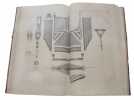
Second edition. ""Tileman van der Horst and Jan Schenk produced the Theatrum Machinarium Univesale, one of the most celebrated works on the construction of all those elements so necessary to keeping life dry in Amsterdam (the place of the book’s publication). It was perhaps the most important work then produced on dikes, sluices, dams, weirs, canals and swing-bridges, the very elements of existence in Holland. Jan Schenck was the engraver of this work, which may also be the most accurate and the most sumptuously illustrated book of its type in Holland in the 18th century - the technical aspects of the rendering was just superb."" - Brunet V,1082 - Graesse VII, 258.
Beskrivelse af Sir William Thomson's (Lord Kelvin) Recorder.
(Kjøbenhavn, Mai, 1874). 4to. Samtidigt hshirt. 8 pp. i zinkografisk tryk samt 1 stor foldet planche.
Scarce Danish description of Lord kelvin's syphon or siphon recorder, with a large folded plate.
Description of Sir Charles Wheatstone's Automatic Instrument.
Copenhagen, August 1874. 4to. Contemp. hcloth. 24 pp. in zinkography and 3 folded plates.
Scarce Danish description of Wheatstone's automatic transmitter (telegrapy) with 3 folded plates.
Guide des Épreuves électriques a faire sur les Cables télégraphiques. Traduit sur la seconde Édition Anglaise par A.L. Ternant.
Paris, Masson et Plon, 1882. Orig. clothbacked printed boards. Stamps on half-title. VIII,88 pp. and 11 full-page illustrations.

