 Write to the booksellers
-
Type
Art print (2)
Book (5895)
Magazine (20)
Manuscript (1)
Old papers (1)
Photographs (3)
-
Latest
Last 24h (1)
Last 3 days (1)
Last month (4)
Last week (4)
-
Language
English (10)
French (5907)
German (1)
Greek (1)
Italian (1)
Latin (2)
-
Century
16th (2)
17th (9)
18th (246)
19th (887)
20th (2967)
21st (134)
-
Countries
Belgium (266)
Canada (3)
Côte d'Ivoire (13)
Denmark (1365)
France (3974)
Switzerland (301)
-
Syndicate
ALAC (3)
CLAM (3)
ILAB (4128)
NVVA (139)
SLACES (139)
SLAM (2601)
SNCAO (15)
Le grand débat de la Théorie Quantique. Préface de Karl R. Popper. Traduction de Françoise et Philippe Guéret.
P., Flammarion (Nouvelle Bibliothèque Scientifique), 1986, in 8° broché, 230 pages ; bibliographie in-fine ; couverture illustrée.
...................... Photos sur demande ...................


Phone number : 04 77 32 63 69
Que sais-je? N° 1045 Le microscope électronique
Presses Universitaires de France Edition originale Première édition 1er trimestre 1963. 1963. In-12. Broché. Bon état, Couv. convenable, Dos satisfaisant, Intérieur frais. 128 pages illustrées de quelques dessins en noir et blanc. . . . Classification Dewey : 530-Physique
La première encyclopédie de poche fondée en 1941 par Paul Angoulvent, traduite en 43 langues, diffusée, pour les éditions françaises, à plus de 160 millions d'exemplaires, la collection Que sais-je? est l'une des plus importantes bases de données internationnales, construite pour le grand public par des spécialistes. 3800 titres ont été publiés depuis l'origine par 2500 auteurs. Classification Dewey : 530-Physique
Que sais-je? N° 1045 Le microsocpe électronique
Presses Universitaires de France Edition mise à jour. 1970. In-12. Broché. Bon état, Couv. convenable, Dos satisfaisant, Intérieur frais. 128 pages illustrées de quelques dessins en noir et blanc. . . . Classification Dewey : 530-Physique
La première encyclopédie de poche fondée en 1941 par Paul Angoulvent, traduite en 43 langues, diffusée, pour les éditions françaises, à plus de 160 millions d'exemplaires, la collection Que sais-je? est l'une des plus importantes bases de données internationnales, construite pour le grand public par des spécialistes. 3800 titres ont été publiés depuis l'origine par 2500 auteurs. Classification Dewey : 530-Physique
Some problems of chemical Kinetics and Reactivity. Revised and expanded by the author. Translated by J. E. S. Bradley.
1958 London, New York, Paris, Pergamon Press, 1958-1959, 2 tomes en un volume relié pleine toile rouge de l'éditeur, X-305 et X168 pages.
...................... Photos sur demande ...................
Phone number : 04 77 32 63 69
Ueber die bleiernen Schleudergeschosse der Alten und über zweckmässige Gestaltung der Wurfkörper im Allgemeinen. Ein Versuch die dynamische Entstehung gewisser Formen der Natur und in die Kunst nachzuweisen. Mit einem Anhange über Bewegung im Wiederst...
Frankfurt A/M, Verlag für Kunst und Wissenschaft, 1859. Contemp. hcloth, marbled boards. Stamp on titlepage and half title. (2),105,(4) pp., textillustrations and 7 lithographed plates, of which 6 are folded. Scattered brownspots.
First edition.
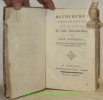
Recherches analytiques sur la nature de l'air inflammable.
Geneve, Chez Barthelemi Chirol 1784, 195x120mm, XXVIII - 387pages, reliure demi-veau à coins de l’époque. Coins abimées. Intérieur propre. Ex-libris.
Pour un paiement via PayPal, veuillez nous en faire la demande et nous vous enverrons une facture PayPal
"Traité pratique et complet de tous les mesurages, métrages, jaugeages de tous les corps; appliqué aux arts, aux métiers, à l'industrie, aux constructions, aux travaux hydrauliques, aux nivellements pour construction de route, de canaux, de chemins de fer, drainage, etc.; enfin à la rédaction de projets de toute espèce de travaux du ressort de l'architecture, du génie civil et militaire; terminé par une anlyse et une série de prix de 916 articles avec détails sur la nature, la qualité, la façon et la mise en oeuvre des matériaux (tome 2 )."
Paris, Librairie Scientifique, Industrielle et Agricole Eugène Lacroix, éditeur, 1868. 16 x 24, 667 pp., nombreux tableaux dont 1 dépliant, reliure dos/coins cuir, bon état (rousseurs).
"tome 2 seul; belle reliure : 5 nerfs, décor à la roulette, filets et fleurons."
Traité pratique et complet de tous les Mesurages, Métrages, Jaugeages de tous les Corps appliqué aux Arts, aux Métiers, à l'Industrie, aux Constructions, aux Travaux hydrauliques, aux Nivellements pour construction de routes, de canaux, de chemins de fer, drainage, etc.Atlas
Huitième édition, atlas de 47 planches gravées en taille-douce sur acier, 1 vol. in-folio reliure demi-chagrin bordeaux, dos à 5 nerfs, Librairie Polytechnique Baudry & Cie, Paris, 1885, avec 47 planches doubles
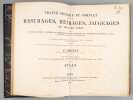
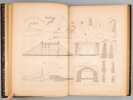
Atlas seul, bien complet des 47 planches doubles. Etat très satisfaisant (dos et coupes un peu frottés, petite mouill. en bas des feuillets, bon état par ailleurs).
Systèmes de référence et mouvements (physique classique). Le problème des mouvements réels. L'ancienne astronomie d'Eudoxe à Descartes. Mécanique newtonienne et gravitation. Le système absolu de la mécanique. L'optique des corps au repos. L'optique des corps en mouvement. L'esprit de la science classique -- EDITION ORIGINALE -- 7 FASCICULES (COMPLETE SET)
P., Hermann, 1937, 7 FASCICULES in 8 (COMPLETE SET), brochés, 688pp.
---- EDITION ORIGINALE**4761/M4-M6DE-CAV.F4
Systèmes de référence et mouvements (PHYSIQUE RELATIVISTE) - Genèse des théories relativistes. Principes de la théorie restreinte. Les systèmes privilégiés de la théorie restreinte. Principes de la théorie générale. Théorie relativiste de la gravitation. Les systèmes privilégiés de la théorie générale. Essai critique sur la doctrine relativiste -- EDITION ORIGINALE -- 7 fascicules (COMPLETE SET)
P., Hermann, 1937, 7 fascicules in 8, brochés, couvertures imprimées
---- EDITION ORIGINALE ---- BIEN COMPLET DE SES 7 FASCICULES**9088/M4
Le système absolu de la mécanique. Coll. Actual. scient. et industr. 482. Systèmes de référence et mouvements (Physique classique).
Paris, Hermann, 1937, gr. in-8vo, 2 ff. + 36 p. + 1 f., brochure originale illustrée.
(SLACES, NVVA)
Phone number : 41 (0)26 3223808
Mécanique newtonienne et gravitation. Coll. Actual. scient. et industr. 481. Systèmes de référence et mouvements (Physique classique).
Paris, Hermann, 1937, gr. in-8vo, 2 ff. + 143 p. + 2 ff., brochure originale illustrée.
(SLACES, NVVA)
Phone number : 41 (0)26 3223808
Systèmes de références et mouvements (physique relativiste) VII Essai critique sur la doctrine relativiste Collection Actualités scientifiques et industrielles N° 492
Hermann & Cie. 1937. In-8. Broché. Bon état, Couv. convenable, Dos satisfaisant, Non coupé. Paginé de 398 à 448 pages.. . . . Classification Dewey : 530-Physique
Etiquette sur coiffe en pied. Tampon bibliothèque. Collection Actualités scientifiques et industrielles N° 492. Classification Dewey : 530-Physique
Le Temps Absolu et l'Espace à quatre dimensions (La Gravitation - La Masse - La Lumière).
P., Albert Blanchard, 1928, in 8° relié demi-toile noire moderne à la bradel, dos lisse avec titre doré, (10)-IV-127 pages ; figures ; coins légèrement émoussés.
PHOTOS sur DEMANDE. ...................... Photos sur demande ...................
Phone number : 04 77 32 63 69
Geschichtliche Darstellung des Galvanismus. Erweiterte Ausarbeitung einer im Jahr von der philosophischen Facultät der Universität zu Heidelberg gekronten Preisschrift.
Stittgart u. Tübingen, J.G. Cotta, 1848. Bound in a very fine contemp. hcalf with profusely gilt spine. A stamp on titlepage and a closed tear, no loss. XXIV,638 pp. Internally clean and fine.
Importent early treatment of the development of electricity and electromagnetism, not only in their theoretical aspects but also describing their uses in chemistry, medicine etc. Extensive references to the literaure and papers in periodicals.
Memory Requirements in a Telephone Exchange (Manuscript Received Dec. 7, 1949).
(New York), American Telephone and Telegraph Company, 1950. 8vo. Volume XXIX, July, No. 3, 1950 of ""The Bell System Technical Journal"". In the original printed blue wrappers. A bit of minor browning to extremities. Wrapper only attached to back hinge. Internally fine and clean. Pp. 343-359. [Entire issue: Pp. 295-468].
First edition of Shannon's influential paper on how to construct a telephone exchange network. ""The problem of designing a good rearrangeable network was (probably first) considered in a paper of C. E. Shannon investigating memory requirements in a telephone exchange. On the networks that he considered he imposed the realistic ""separate memory condition"" to the effect that in operation a separate part of the memory can be signed to each call on progress. This means that completion of a new call or termination of an old call will not disturb the state of memory elements associated with any call in progress. [...] Shannon's separate memory condition is actually met by modern connecting networks [...]. (Benes, Vaclav Edward. Mathematical Theory of Connecting Networks and Telephone Traffic: 017, 1965, p. 119.) Claude Shannon is widely regarded as being the father of information theory and cryptography. Origins of Cyberspace 883.The present issue also includes:1. Southworth, George C. Principles and Applications of Waveguide Transmission. Pp. 295-342.2. Hartley, R.V.L. Matter, A Mode of Motion. Pp. 350-368.3. Hartley, R.V.L. The Reflection of Diverging Waves by a Gyrostatic Medium. Pp. 369-389.4. Pierce, J.R. Traveling-Wave Tubes (Third Installment). Pp. 390-460.
Memory Requirements in a Telephone Exchange (Manuscript Received Dec. 7, 1949).
(New York), American Telephone and Telegraph Company, 1950. 8vo. In the original printed blue wrappers. In Volume XXIX, July, No. 3, 1950 of ""The Bell System Technical Journal"". A bit of minor marginal browning to extremities, otherwise fine and clean. Pp. 343-359. [Entire issue: Pp. 295-468].
First edition of Shannon's influential paper on how to construct a telephone exchange network. ""The problem of designing a good rearrangeable network was (probably first) considered in a paper of C. E. Shannon investigating memory requirements in a telephone exchange. On the networks that he considered he imposed the realistic ""separate memory condition"" to the effect that in operation a separate part of the memory can be signed to each call on progress. This means that completion of a new call or termination of an old call will not disturb the state of memory elements associated with any call in progress. [...] Shannon's separate memory condition is actually met by modern connecting networks [...]. (Benes, Vaclav Edward. Mathematical Theory of Connecting Networks and Telephone Traffic: 017, 1965, p. 119.) Claude Shannon is widely regarded as being the father of information theory and cryptography. Origins of Cyberspace 883.The present issue also includes:1. Southworth, George C. Principles and Applications of Waveguide Transmission. Pp. 295-342.2. Hartley, R.V.L. Matter, A Mode of Motion. Pp. 350-368.3. Hartley, R.V.L. The Reflection of Diverging Waves by a Gyrostatic Medium. Pp. 369-389.4. Pierce, J.R. Traveling-Wave Tubes (Third Installment). Pp. 390-460.
Probability of Error for Optimal Codes in a Gaussian Channel. [Manuscript received October 17, 1958].
New York, American Telephone and Telegraph Company, 1959. 8vo. Volume XXXVIII, 1959 of The Bell System Technical Journal bound in a nice full green cloth with gilt title to spine. Library stamp to top of title page. Binding tight, clean and fresh. Also internally very nice and clean. Pp. 611-656. [Entire volume: 14, (2), 907 pp.]
First edition.From the introduction to the present article: ""A study is made of coding and decoding systems for a continuous channel with an additive Gaussian noise and subject to an average power limitation at the transmitter. Upper and lower bounds are found for the error probability in decoding with optimal codes and decoding systems. These bounds are close together for signaling rates near channel capacity and also for signaling rates near zero, but diverge between. Curves exhibiting these bounds are given."" Claude Shannon is widely regarded as being the father of information theory and cryptography.See:OOC 898.
The optical papers of isaac newton. Volume I the optical lectures 1670 - 1672.
Cambridge, Cambridge University Press, 2010 4to. In the original printed wrappers. Fine and clean. XVIII, 627 pp.
Bath-Tub Vortex. - [THE CORIOLIS EFFECT ON A BATHTUB VORTEX]
London, Macmillian, 1962. Royal8vo. Bound in contemporary full cloth with two black title label to spine. In ""Nature"", Vol. 196, October - December. Library labels to end paper and one library stamp to title page. Light soiling to extremities, internally fine and clean. Pp. 1080-1. [Entire colume: LII, 1346 pp.].
First appearance of Shapiro's famous paper in which he sought to describe a bathtub vortex with the Coriolis Effect. This eventually gave birth to the urban myth that a toilet vortex always will have a counter clockwise flow in the Northern Hemisphere. The Coriolis effect on a micro level is still disputed and has never been satisfyingly confirmed or rejected. Scientists were aware that Earth's rotation alters the trajectory of objects in motion. This phenomenon causes low-pressure weather systems to twist counterclockwise in the Northern Hemisphere and clockwise in the Southern Hemisphere. The Coriolis effect, as it's known, had long been well documented as the cause of hurricanes and tornadoes. But despite previous attempts, no one had shown that the effect-first described in 1835 by the French engineer and mathematician Gustave-Gaspard Coriolis-works on very small scales as well. Though in theory it should influence bathwater's exit through a drain, the Coriolis effect was thought to be too small to see.""For his experiment, Shapiro used a circular, flat-bottomed tub with a centered drain hole three-eighths of an inch in diameter to which he attached a 20-foot length of hose, plugged with a stopper at the end. He filled the tank six inches deep with clean, room-temperature water. Small variations-air movement, a temperature change, a surface disturbance-create buoyancy currents that overshadow the Coriolis effect. So Shapiro did much tinkering to cancel out these possible sources of interference-covering the tank with a sheet of plastic to keep out air currents, for example, and carefully controlling the room's temperature. He also filled the tank by swirling water in clockwise, so that if the water drained counterclockwise, the direction would not have been influenced by how the tank was filled.After 24 hours of letting the water settle, Shapiro carefully pulled the plug from the end of the hose, gently placing above the drain a small float made of two crossed slivers of wood an inch long. It took about 20 minutes for the tub to drain completely. For the first 12 to 15 minutes, the float remained motionless. Then it began to rotate almost imperceptibly, counterclockwise, reaching a peak speed of approximately one revolution every three to four seconds. Proving that the Coriolis effect can be detected in a bathtub-size tank, albeit under carefully controlled conditions, was a remarkable achievement. At MIT's latitude of 42°, the effect was ""only thirty-millionths that of gravity, which is so small that it will be overcome by filling and even temperature differences and water impurities,"" reported one of many newspapers and periodicals covering the experiment. Shapiro's results were published in Nature and verified by colleagues who used his technique to demonstrate a clockwise flow in the Southern Hemisphere. The findings fascinated a curious public of all ages. Shapiro would also become known for explaining and improving the aerodynamics of golf ball dimples, as well as for helping to develop the intra-aortic balloon for heart patients and devices to treat blood clots, asthma, emphysema, and glaucoma. But for more than a decade after the bathtub test, he would receive letters and newspaper clippings from all over the world about what was dubbed the ""bathtub vortex"" controversy. "" (MIT Technology Review).
LE CHARME DE LA PHYSIQUE La recherche des secrets de la matière
COLLECTION PLURIEL N°868-PREFACE DE GILLES COHEN TANNOUDJI-TRADUCTION DE L'ANGLAIS PAR OLIVIER COLARDELLE-322 PAGES-FORMAT POCHE-(5F)

HACHETTE COUVERTURE SOUPLE ETAT NEUF
La physique Collection Le monde des sciences
France Loisirs. 1990. In-4. Relié. Bon état, Couv. convenable, Dos satisfaisant, Intérieur frais. 160 pages augmentées de nombreuses photos en couleurs dans texte.. Avec Jaquette. . . Classification Dewey : 530-Physique
Collection Le monde des sciences. Classification Dewey : 530-Physique
Le monde des sciences. La Physique.
1990 Paris, France Loisirs, 1990, in 4° relié plein skyvertex bleu de l'éditeur, jaquette illustrée en couleurs, 160 pages.
Très nombreuses illustrations in et hors-texte, la plupart en couleurs. ...................... Photos sur demande ...................
Phone number : 04 77 32 63 69
La Physique
FRANCE LOISIRS. 1990. In-4. Relié. Très bon état, Couv. fraîche, Dos impeccable, Intérieur frais. 160 pages. Nombreuses illustrations et photos en noir et blanc et en couleurs dans le texte et en planches hors-texte. Relié en simili-cuir bleu nuit.. Avec Jaquette. . . Classification Dewey : 530-Physique
"""Le Monde des Sciences"". Molécules, la lumière, le magnétisme, l'électricité, l'électromagnétisme, atomes et éléments, monde quantique, rayonnements et radioacticité, fission et fusion nucléaire... Classification Dewey : 530-Physique"
LA PHYSIQUE
FRANCE LOISIRS/ EQUINOX. 1990. In-4. Relié. Bon état, Couv. convenable, Dos satisfaisant, Intérieur frais. 159 pages. Nombreuses photos et/ou illustrations en couleurs, dans et/ou hors texte.. Avec Jaquette. . . Classification Dewey : 530-Physique
LE MONDE DES SCIENCES Classification Dewey : 530-Physique

