 Write to the booksellers
-
Type
Art print (2)
Book (5911)
Magazine (20)
Manuscript (1)
Old papers (1)
Photographs (3)
-
Latest
Last 24h (3)
Last 3 days (1)
Last month (8)
-
Language
English (10)
French (5923)
German (1)
Greek (1)
Italian (1)
Latin (2)
-
Century
16th (2)
17th (9)
18th (243)
19th (886)
20th (2966)
21st (135)
-
Countries
Belgium (266)
Canada (3)
Côte d'Ivoire (13)
Denmark (1368)
France (3987)
Switzerland (301)
-
Syndicate
ALAC (3)
CLAM (3)
ILAB (4131)
NVVA (139)
SLACES (139)
SLAM (2601)
SNCAO (15)
PRINCIPES DE PHYSIQUE
CHEZ PHILIPPART. NON DATE. In-12. En feuillets. Etat d'usage, Couv. convenable, Dos satisfaisant, Rousseurs. 62 pages mobiles.. . . . Classification Dewey : 530-Physique
Classification Dewey : 530-Physique


Recherches sur la capillarité
Bruxelles, Académie royale (impr.par Hayez) 1861 199pp.+ 2 planches hors-texte, publié dans et extrait de "Mémoires couronnés et mémoires des savants étrangers publiés par l'Académie Royale des sciences, des lettres et des beaux-arts de Belgique" Tome XXX (1858-1861), in-4, non coupé
Remarques et Observations sur les Couleurs Prismatiques et sur L'Analyse Physique, et Metaphysique de la Sensation des Couleurs en Général.
(Berlin, Haude et Spener, 1766). 4to. No wrappers, as issued in ""Mémoires de l'Academie Royale des Sciences et Belles-Lettres"", tome XX, pp. 297-363 and 3 folded engraved plates.
Together with: Premontval, de la Psychocratie ou de l'Empire et du Gouvernement...dans le Corps est composé (and) Formey, Nouvelles Considerations sur L'Union des deux Substances dans L'Homme...pp. 364-414.
Recherches sur L'Existance des Corps Durs.
(Berlin, Haude et Spener, 1753). 4to. No wrappers, as issued in ""Mémoires de l'Academie Royale des Sciences et Belles-Lettres"", tome XII, pp. 331-355 a. 1 engraved plate.
Physique appliquée, cours et problèmes - Série Schaum
McGraw-Hill. 1992. In-4. Broché. Bon état, Couv. convenable, Dos satisfaisant, Intérieur frais. 273 pages - nombreux schémas et illustrations en noir et blanc dans le texte.. . . . Classification Dewey : 530-Physique
Trad. française par Michel Lobenberg. Classification Dewey : 530-Physique
LA PHYSIQUE ET LA CHIMIE - MISES A LA PORTEE DE LA JEUNESSE AVEC QUESTIONNAIRE.
DELALAIN FRERES. 1882. In-16. Cartonné. Etat d'usage, 1er plat abîmé, Dos satisfaisant, Intérieur acceptable. 350 pages illustrées de nombreuses figures en noiret blanc dans le texte. -Quelques mouillures sur le coin des 35èeres pages.. . . . Classification Dewey : 530-Physique
Classification Dewey : 530-Physique
LA PHYSIQUE ET LA CHIMIE MISES A LA PORTEE DES ENFANTS, AVEC QUESTIONNAIRES
Delalain. Non daté. In-18. Relié. Etat d'usage, Couv. légèrement passée, Dos satisfaisant, Intérieur bon état. 348 pages. Illustré de nombreuses gravures en noir et blanc dans le texte. Dos muet. Revêtements intérieurs des plats détachés.?. . . . Classification Dewey : 530-Physique
Vers 1860. 5e édition. Classification Dewey : 530-Physique
Architecture Hydraulique, ou L'Art de conduire, d'elever, et de menager les Eaux pour les differents Besoins de la Vie. 2 Vols. in 4 Parts. (Vol. I:1-2 - Vol. II:1-2). - [CLASSIC WORK ON ENGINEERING]
Paris, Jombert, 1737-53. 4to. Bound in 4 uniform contemporary full sprinckled calf. Tome-and title-labels in leather on backs. Five raised bands and richly gilt compartments. Some wear to spine ends. Small cracks in leather at hinges along upper and lower compartment at three volumes. Corners bumped. Some minor scratches to covers. A little rubbed. Engraved portrait, 2 engraved frontispieces, 3 engraved title-vignettes. (8), XII, (4), 412 (6), XIV, (2), 412, (32) (8), 480, (40)" VIII, 423, (1), XXVIII pp. and 219 (44+60+60+55) folded engraved plates. 3 plates a bit frayed in outer margin. A few scattered brownspots, but clean, with broad margins and printed on good paper.
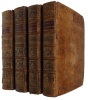
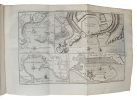
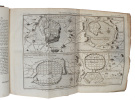
First edition of this pioneering work, a classic of engineering, which constitutes practically the first scientific text-books on engineering and the first to apply integral calculus to technical and practical problems. It became the international standard-work for nearly 100 years and proved invaluable to architects, builders and engineers as it covers engineering mechanics, civil construction, mills and waterwheels, pumps, harbours and sea work etc. According to Rosenthal (Litt. d. Technologie, p. 209) the work was reprinted 12 times and thus with the best impressions of the plates (the first edition) - ""Un tresor de recherches et de machines que l'Histoire de l'Hydraulique doit toujours annonce et célébrer."" (Montucla). - Poggendorff I:138 - Brunet I:740.
Architecture Hydraulique, ou l'Art de conduire, d'élever et de ménager les Eaux pour différents Besoins de la Vie. Nouvelle édition, avec des Notes et additions par M. Navier, Ingénieur du Corps Royal des Ponts-et-Chaussées. Première partie - Tome p...
Paris, Firmin Didot, 1819. 4to. Contemp. hcalf. Gilt spine. Gilt lettering. Tear in upper part of upper joint. Frontcover loosening. Spine rubbed. Stamp on htitle. Engraved portrait. (4),XII,(2),666,(2) pp., 56 folded engraved plates. Internally clean and fine, printed on good paper.
All published of this enlarged edition of the work. Additional plates and notes for the first time by Navier.
Architecture Hydraulique. Seconde Partie. Tome Premier. Qui comprend L'Art de diriger les Eaux de la Mer & des Rivieres à l'avantage de la défense des Places, du Commerce, & de l'Agriculture. (Halftitle reads:) Architecture Hydraulique, ou l'on e...
Paris, Jombert, 1750. 4to. Contemp. full marbled calf. Raised bands. Richly gilt spine. Titlelabel with gilt lettering. A paperlabel pasted on spine. Stamps on foot of title-page. (8),XIV,(2),412,(32) pp., engraved titlevignette, 1 large engraved vignette and 60 folded engraved plates. A few leaves with faint marginal dampstaining. A few scattered brownspots.
This part of Belidors great work deals exclusively with sluices and floodgates.
[Chez Jombert jeune] - BELIDOR, M. ; [ BELIDOR, Bernard Forest de ]
Reference : 60621
(1782)
Architecture hydraulique, ou l'Art de Conduire, d'élever et de ménager les Eaux pour les différens besoins de la Vie. Première partie. Tome Premier.
1 vol. in-4 reliure de l'époque plein veau marbré, Chez Jombert jeune, Paris, 1782, frontispice, 5 ff., xii-412 pp. avec 44 planches dépliantes
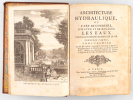
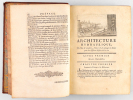
Premier tome (sur 4) de l'édition de 1782, bien complet des 44 belles planches dépliantes. Etat très satisfaisant (reliure frotte avec mq. en coiffes, mouill. en dos, mouill. en tête des ff. en fin d'ouvrage, le plus souvent très discrète, très bon état intérieur par ailleurs).
"BELL, ALEXANDER GRAHAM. - ""THE GREATEST INVENTION I HAVE EVER MADE"": THE PHOTOPHONE.
Reference : 46951
(1880)
On the Production and Reproduction of Sound by Light. (Read before the American Association for the Advancement of Science, in Boston, August 27, 1880).
(New Haven), 1880. 8vo. Modern plain wrappers. In: American Journal of Science"", Third series, Vol. XX, No. 118, October 1880. Frontispiece-plate. Pp. 257-352 (entire issue offered). Bell's paper: pp. 305-324 and 11 textillustrations. A small stamp to verso of plate and the first leaf.
First printing of this important paper in which Bell describes his and Charles Sumner Tainter's, his assistent, invention of the Photophone or Radiophone, THE PROGENITOR OF MODERN FIBER OPTICS. This invention made possible the world's FIRST WIRELESS TELEPHONE MESSAGE, and the first call was sent from the Franklin Scool to the window of Bell's laboratory, some 213 meter away.""On June 3, 1880, Alexander Graham Bell transmitted the first wireless telephone message on his newly invented ""photophone."" Bell believed the photophone was his most important invention. The device allowed for the transmission of sound on a beam of light. Of the eighteen patents granted in Bell's name alone, and the twelve he shared with his collaborators, four were for the photophone. Bell's photophone worked by projecting voice through an instrument toward a mirror. Vibrations in the voice caused similar vibrations in the mirror. Bell directed sunlight into the mirror, which captured and projected the mirror's vibrations. The vibrations were transformed back into sound at the receiving end of the projection. The photophone functioned similarly to the telephone, except the photophone used light as a means of projecting the information, while the telephone relied on electricity."" (Mary Bellis).The first successful attempts were based upon the properties of selenium: ""The electric resistance of which varies with the degree of illumination to which it is exposed. Hence, given a transmitting instrument, such as a flexible mirror, by which the vibrations of a sound could throw into vibrations a beam of light, a receiver, consisting of sensitive selenium, forming part of an electric circuit with a battery and a telephone, should suffice to translate the varying intensities of light into corresponding varying intensities of electric current, and finally into vibrations of the telephone disk audible once more as sound."" (Prescott, George. Bell's Electric Speaking Telephone. 313 p.).
"BELL, ALEXANDRE (ALEXANDER) GRAHAM. - BELL, ALEXANDER GRAHAM. - ""THE GREATEST INVENTION I HAVE EVER MADE"": THE PHOTOPHONE.
Reference : 48149
(1880)
De la Production et de la Reproduction du Son par la Lumière. Mémoire lu à l'Association américaine pour l'avancement des Sciences, au Congrès de Boston, le 27 août 1880. (+) Les Récepteurs photophoniques de Sélénium. (Cette Note fait suite au M´wem...
Paris, G. Masson, 1880. 8vo. Contemp. hcalf, raised bands, gilt spine. Light wear along edges. Small stamps on verso of titlepage. In: ""Annales de Chimie et de Physique"", 5e Series, Tome 21. 576 pp. and 2 folded engraved plates. (Entire volume offered). Bell's paper: 399-430. With 11 fine textillustrations (showing the apparatus). Clean and fine.
First French version of ""On the Production and Reproduction of Sound by Light"" (the French version published in November and the English in October 1880) of this importent paper in which Bell describes his and Charles Sumner Tainter's, his assistent, invention of the Photophone or Radiophone, THE PROGENITOR OF MODERN FIBER OPTICS. This invention made possible the world's FIRST WIRELESS TELEPHONE MESSAGE, and the first call was sent from the Franklin Scool to the window of Bell's laboratory, some 213 meter away.Also with Breguet's importent paper on the Selenium used in the technology.""On June 3, 1880, Alexander Graham Bell transmitted the first wireless telephone message on his newly invented ""photophone."" Bell believed the photophone was his most important invention. The device allowed for the transmission of sound on a beam of light. Of the eighteen patents granted in Bell's name alone, and the twelve he shared with his collaborators, four were for the photophone. Bell's photophone worked by projecting voice through an instrument toward a mirror. Vibrations in the voice caused similar vibrations in the mirror. Bell directed sunlight into the mirror, which captured and projected the mirror's vibrations. The vibrations were transformed back into sound at the receiving end of the projection. The photophone functioned similarly to the telephone, except the photophone used light as a means of projecting the information, while the telephone relied on electricity."" (Mary Bellis).The first successful attempts were based upon the properties of selenium: ""The electric resistance of which varies with the degree of illumination to which it is exposed. Hence, given a transmitting instrument, such as a flexible mirror, by which the vibrations of a sound could throw into vibrations a beam of light, a receiver, consisting of sensitive selenium, forming part of an electric circuit with a battery and a telephone, should suffice to translate the varying intensities of light into corresponding varying intensities of electric current, and finally into vibrations of the telephone disk audible once more as sound."" (Prescott, George. Bell's Electric Speaking Telephone. 313 p.).
EXERCICES DE PHYSIQUE ET CHIMIE, EXERCICES AVEC SOLUTIONS
Vuibert. 1981. In-12. Broché. Etat d'usage, 1er plat abîmé, Dos satisfaisant, Intérieur bon état. 256 pages. Annotation au dos du 1er plat. Cahiers se détachant. Quelques annotations dans le texte.. . . . Classification Dewey : 530-Physique
Complète le cours de physique et cours de chimie de J.P. Bellier. Classification Dewey : 530-Physique
ELECTRICITE - TERMINALE F1 - SECTION CONSTRUCTIN MECANIQUE
Delagrave. 1969. In-8. Cartonnage d'éditeurs. Bon état, Couv. convenable, Dos satisfaisant, Intérieur frais. 359 pages.. . . . Classification Dewey : 530-Physique
Classification Dewey : 530-Physique
De la production du son par l'energie radiante. - [FIRST FRENCH PUBLICATION OF BELL'S PHOTOPHONE]
Paris, Imprimerie Gauthier-Villars, 1881. 8vo. Contemporary half calf, raised bands, gilt spine. Light wear along edges. Two small stamps on verso of title-page, and one on verso of last plate. In ""Annales de Chimie et de Physique"", Cinquiéme Series - Tome XXIII. 576 pp. + 3 plates. G. Bell's paper: pp. 397-432, pp. and 14 figures of experimental apparatus etc. The entiree volume offered. Fine and clean copy.
First publication of the first French translation of Bell's ""On the Production and Reproduction of Sound by Light: the Photophone"", originally published in 1880. The device allowed for the transmission of sound on a beam of light, and Bell himself regarded this, not the telephone, to be his most important invention.""In the importance of the principles involved, I regard the photophone as the greatest invention I have ever made"" greater than the telephone."" Bell said in a 1921 interview. The photophone was the world's first wireless telephone communication and thereby anticipated Marconi's invention with several years.The first successful attempts were based upon the properties of selenium: ""The electric resistance of which varies with the degree of illumination to which it is exposed. Hence, given a transmitting instrument, such as a flexible mirror, by which the vibrations of a sound could throw into vibrations a beam of light, a receiver, consisting of sensitive selenium, forming part of an electric circuit with a battery and a telephone, should suffice to translate the varying intensities of light into corresponding varying intensities of electric current, and finally into vibrations of the telephone disk audible once more as sound."" (Prescott, George. Bell's Electric Speaking Telephone. 313 p.).Bell was so excited by his invention and its possibilities that he proposed that his second daughter should bear the name of the invention: Photophone. Fortunately for her, her mother was not quite as enthusiastic about the invention.
Mean Lives of Positrons in Aluminum and the Alkali Metals.
(Montreal), 1960. 8vo. In the original yellow printed stapled wrappers. Offprint from ""Canadian Journal of Physics"", no. 38, 652, 1960. Very fine and clean. Pp. (2), 653-664.
Offprint of Bell and Jørgensen's important paper in which they observed complex decay in both alkali metals and aluminum.
"Mon ami l'électron : l'électronique racontée aux enfants (Collection ""Je sais, Je sais...""n°7)"
Mame. 1957. In-8. Relié. Etat d'usage, Couv. convenable, Dos abîmé, Intérieur frais. 191 pages. Nombreuses illustrations en noir et blanc dans et hors texte. dont une en frontispice. Un tampon en page de titre. . . . Classification Dewey : 530-Physique
"Collection ""Je sais, Je sais..."". Illustrations de Joop Van Couwelaar. Adapté de l'américian par Michel Deutsch. Classification Dewey : 530-Physique"
Critique de la mesure
P., Hermann, 1937, un volume in 8 broché, 55pp.
---- EDITION ORIGINALE ---- Antinomie de la mesure - Conditions générales de la mesure - Les "postulats" de l'arithmétique - Origine de la ligne - Origine de la dimension numérique - Mesure de la force - La notion de masse - etc**364.CAV/F4
Trois physiciens genevois et l'Europe savante. Les De la Rive (1800-1920).
Genève, Georg, 1991. Petit in-8 broché de [6]-183 pages, couverture illustrée.
Illustrations in-texte en noir, souvent à pleine page. Quelques coins cornés pour repères, traits de stabylo au faux-titre et inscription à l'achevé d'imprimer.
Eléments de physique
Editions Médicales Flammarion Broché 1966 In-8 (14,5 x 20 cm), broché, 763 pages ; pliures sur le dos creusé, mors et bords des plats frottés, tranches brunies, par ailleurs intérieur frais, assez bon état général. Livraison a domicile (La Poste) ou en Mondial Relay sur simple demande.
BENSOUSSAN GUY, BOUIX DANIEL, CHATEIGNER GUY
Reference : RO60051687
(1995)
ISBN : 2040282505
JOKERS BORDAS, ELECTRONIQUE TERMINALE STI
Bordas. 1995. In-8. Broché. Bon état, Couv. légèrement pliée, Dos satisfaisant, Intérieur frais. 256 pages. Illustré de nombreuses figures en noir et blanc dans le texte.. . . . Classification Dewey : 530-Physique
Jokers Bordas, 008. Classification Dewey : 530-Physique
PRATIQUE ET THEORIE DE LA T.S.F. / 4E EDITION ENTIEREMENT REMANIEE ET MISE A JOUR CONSIDERABLEMENT AUGMENTEE.
PUBLICATIONS ET EDITIONS FRANCAISES DE TSF ET RADIOVISION. 1934. In-8. Relié. Bon état, Couv. convenable, Dos satisfaisant, Intérieur frais. XVIII + 949 pages - nombreuses figures en noir et blanc dans le texte.. . . . Classification Dewey : 530-Physique
Sommaire : acoustique - le système d'unités à CGS et les unités commerciales et industrielles - l'électricite et le système CGS - comparaisons hydrauliques - electromagnétisme - l'induction électromagnétique et ses lois - loi de joule - magnétisme -les ondes hertziennes - la radiotéléphonie etc. Classification Dewey : 530-Physique
Le Chaos, théorie et expériences. Préface de Yves Pmeau. Collection CEA, Commissariat à l’Energie Atomique. Serie Syntheses.
Paris, Editions Eyrolles 1988, 245x165mm, XVII - 388pages, broché. Sous jaquette. Haut du dos de la jaquette légèrement usé. Bel exemplaire.
Pour un paiement via PayPal, veuillez nous en faire la demande et nous vous enverrons une facture PayPal
Sciences physiques 6eme + Livre du professeur + complement - poids et masse, balances, soldies et liquides, l'etat gazeux, chaleur, tension electrique, electrocution, reaction chimique, combustions, bec bunsen, tabac : vice dangereux...
"ISTRA. 1977. In-8. Relié. Etat d'usage, Couv. légèrement passée, Dos satisfaisant, Quelques rousseurs. 90 + 190 +8 pages : 90 pages, nombreuses illustrations couleur, dans le texte- tampon "" exemplaire de documentation"" en page de titre (relié) + livre du professeur : 190 pages Nombreux graphiques/figures en noir et blanc, dans le texte ( broché). Inclus un livret, in-12, ""objectif programme instructions, complément livre du maitre"" de 8 pages.. . . A l'italienne. Classification Dewey : 530-Physique"
Classification Dewey : 530-Physique

