 Write to the booksellers
-
Type
Art print (2)
Book (5887)
Magazine (20)
Manuscript (1)
Old papers (1)
Photographs (3)
-
Latest
Last 24h (1)
Last month (4)
Last week (4)
-
Language
English (10)
French (5899)
German (1)
Greek (1)
Italian (1)
Latin (2)
-
Century
16th (2)
17th (9)
18th (246)
19th (887)
20th (2966)
21st (133)
-
Countries
Belgium (266)
Canada (3)
Côte d'Ivoire (13)
Denmark (1365)
France (3966)
Switzerland (301)
-
Syndicate
ALAC (3)
CLAM (3)
ILAB (4128)
NVVA (139)
SLACES (139)
SLAM (2601)
SNCAO (15)
Le Charme De La Physique . La Recherche Des Secrets De La Matière.
Bibliothèque Albin Michel - Sciences. 1997. In-8, broché, couverture bleue ciel, 322 pages. Très agréable exemplaire.
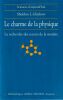
Idées clés, par Business Digest Seldon Glashow a été Prix Nobel de physique en 1979 avec Stephen Weinberg et Abdus Salam pour leur théorie de l'unification des forces nucléaires faibles et électro-magnétiques ; on lui doit par ailleurs la découverte du Quark charmé, l'une des briques fondamentales des particules. Dans cet ouvrage, le physicien nous éclaire, dans une constante bonne humeur d'expression, sur les raisons qui poussent les États à construire des machines de plus en plus gigantesques afin de créer les niveaux d'énergie correspondant aux nouvelles recherches. Mise à jour du Samedi 27 Juin 2026. Paiement PayPal immédiat, Mondial Relay pour : France, Allemagne, Autriche, Belgique, Espagne, Italie, Portugal, Luxembourg, Pays-Bas, Pologne (Communiquer votre point ou locker si connu). Une participation supplémentaire peut être demandée pour les colis lourds hors France où les envois compris entre 5 et 25 kg sont dégressifs : 2 à 4 kilogrammes - 7.99 / 5 à 10 kg - 15.99 / 15 -25 kg - 25.99. Certaines de nos collections ( Vian, Céline, Camus (...) peuvent être expédiées en Franco de port. Pour linternational hors Europe (Suisse, Canada, Japon, Etats-Unis, les frais dexpéditions peuvent varier selon le poids (mise à jour : 1 juin 2026).
The Quantum Theory of Optical Coherence. - [DEVELOPMENT OF QUANTUM OPTICS]
Lancaster, American Institute of Physics, 1963. Lex8vo. Volume 130, 15 June, No. 6, of ""The Physical Review"", Second Series. Entire volume offered in the original printed blue wrappers. Previous owner's stamp to front wrapper. Wear to spine and extremities. Internally fine and clean. Pp. 2529-38. [Entire issue: Pp. 2135-2622].
First publication of this seminal paper in which the first thorough development of the quantum theory of optical coherence was presented. The present paper led directly to Glauber being awarded the Nobel Prize in physics in 2005 ""for his contribution to the quantum theory of optical coherence"". His theories are today widely used in the field of quantum optics.""After the discovery of the maser and the laser in the sixties new ideas for quantum effects of the radiation field were in the air. However, there was no theory for their observation. It was only in 1963 that Roy [Glauber] had developed the quantum theory of optical coherence [in the present paper]. Here the concept of coherence state plays a central role. Coherent states had been proposed for the first time by Erwin Schrödinger in order to show that a wavepacket needs not always to be bound to spread. The coherent state became the crucial tool for Roy's theory of optical coherence. In particular, he could show that for coherent fields all correlation functions factorize."" (Scully. Quantum theory of optical coherence. 2009. P. xv.).Glauber's work was essential for understanding and the further development of the laser.
The Elements of Aerofoil and Airscrew Theory. Reprint of the second edition.
Cambridge University Press 1986. Paperback. 232 pp.
(Cambridge Science Classics).
Guide pratique du Chromage.
Paris, B.P.I., 1969, in 8°, cartonnage de l'éditeur, 133 pages.
PHOTOS sur DEMANDE. ...................... Photos sur demande ...................


Phone number : 04 77 32 63 69
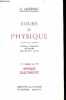
Cours de physique à l'usage des candidats à l'école spéciale militaire de Saint-Cyr - Tome 2 : optique, électricité.
Eugène Belin. 1937. In-8. Broché. Etat d'usage, Couv. convenable, Dos satisfaisant, Papier jauni. 325 pages - nombreuses figures en noir et blanc dans le texte.. . . . Classification Dewey : 530-Physique
Classification Dewey : 530-Physique
Le génial professeur Feynman.
Odile Jacob. 1994. In-8. Broché. Bon état, Couv. convenable, Dos satisfaisant, Intérieur frais. 574 pages - quelques planches de photos en noir et blanc - étiquette collée sur le 2ème plat.. . . . Classification Dewey : 530-Physique
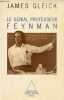
Traduit de l'anglais (Etats-Unis) par Jean-Paul Mourlon avec la collaboration de Bernard Pire. Classification Dewey : 530-Physique
Science Club N° 12 : La gravité
IMPRIMERIE CRETE. Février 1965. In-12. Broché. Très bon état, Couv. fraîche, Dos satisfaisant, Intérieur acceptable. Revue de 64 + XVI pages. Nombreuses photos en noir et blanc dans le texte et hors-texte. Nombreux dessins bicolores dans le texte. Complet de ses vignettes autocollantes en couleurs, dans le texte.. . . . Classification Dewey : 530-Physique
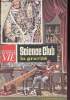
Avec la collaboration de Science et Vie. Classification Dewey : 530-Physique
Liquid-Propellant Rocket Development (with 11 plates). - [THE WORLD'S FIRST LIQUID-FUELED ROCKET]
Washington, The Smithsonian Institution, 1936. 8vo. In recent red full cloth with gilt lettering to front board. Published as part of ""Smithsonian Miscellaneous Collections, Volume 95, Number 3, Publication 3381"". A fine and clean copy. (2), 10 pp. + 11 photographic plates.
![Liquid-Propellant Rocket Development (with 11 plates). - [THE WORLD'S FIRST LIQUID-FUELED ROCKET]. "GODDARD, ROBERT H.](https://static.livre-rare-book.com/pictures/LLX/53754_1_thumb.jpg)
![Liquid-Propellant Rocket Development (with 11 plates). - [THE WORLD'S FIRST LIQUID-FUELED ROCKET]. "GODDARD, ROBERT H.](https://static.livre-rare-book.com/pictures/LLX/53754_2_thumb.jpg)
First edition of Goddard's paper on liquid-fueled rocket development. Goddard is credited with creating and building the world's first liquid-fueled rocket and is often referred to as the man who ushered in the Space Age (Pendray, Rocket Development). By temperament and training Goddard was not a team worker, yet he laid the foundation from which team workers could launch men to the moon"" (DSB). Goddard was secretive about his research and only published two papers"" ""A Method of Reaching Extreme Altitudes"" (1919) and the present. Goddard launched the first liquid-fuel rocket on 16 March 1926 near Auburn, Mass. The ten-foot rocket, nicknamed ""Nell"" reached an altitude of 41 feet, traveled a distance of 184 feet and landed 2.5 seconds after lift-off in a cabbage patch. ""Although his list of firsts in rocketry was distuguished, Goddard was eventually surpassed by teams of rocket research and development experts elsewhere, particularly in Germany."" (DSB).""Like the Russian hero Konstantin Tsiolkovsky and the German pioneer Hermann Oberth, Goddard worked out the theory of rocket propulsion independently [...] Having explored the mathematical practicality of rocketry since 1906 and the experimental workability of reaction engines in laboratory vacuum tests since 1912, Goddard began to accumulate ideas for probing beyond the Earth's stratosphere. His first two patents in 1914, for a liquid-fuel gun rocket and a multistage step rocket, let to some modest recognition and financial support from the Smithsonian Institution [...] With an eye toward patentability of demonstrated systems and with the aid of no more than a handful of technicians, Goddard achieved a series of workable liquid-fuel flights starting in 1926. Through the patronage of Charles A. Lindbergh, the Daniel and Florence Guggenheim Foundation, and the Carnegie and Smithsonian institutions, the Goddards and their small staff were able to move near Roswell, New Mexico. There, during most of the 1930s, Goddard demonstrated, despite many failures in his systematic static and flight tests, progressively more sophisticated experimental boosters and payloads, reaching speeds of 700 miles per hour and altitudes above 8000 feet in several test flights"" (DSB).
Liquid-Propellant Rocket Development (with 11 plates). - [THE WORLD'S FIRST LIQUID-FUELED ROCKET]
Washington, The Smithsonian Institution, 1936. 8vo. In recent red full cloth with gilt lettering to front board. Published as part of ""Smithsonian Miscellaneous Collections, Volume 95, Number 3, Publication 3381"". A fine and clean copy. (2), 10 pp. + 11 photographic plates.
![Liquid-Propellant Rocket Development (with 11 plates). - [THE WORLD'S FIRST LIQUID-FUELED ROCKET]. "GODDARD, ROBERT H.](https://static.livre-rare-book.com/pictures/LLX/54391_1_thumb.jpg)
![Liquid-Propellant Rocket Development (with 11 plates). - [THE WORLD'S FIRST LIQUID-FUELED ROCKET]. "GODDARD, ROBERT H.](https://static.livre-rare-book.com/pictures/LLX/54391_2_thumb.jpg)
![Liquid-Propellant Rocket Development (with 11 plates). - [THE WORLD'S FIRST LIQUID-FUELED ROCKET]. "GODDARD, ROBERT H.](https://static.livre-rare-book.com/pictures/LLX/54391_3_thumb.jpg)
First edition of Goddard's paper on liquid-fueled rocket development. Goddard is credited with creating and building the world's first liquid-fueled rocket and is often referred to as the man who ushered in the Space Age (Pendray, Rocket Development). By temperament and training Goddard was not a team worker, yet he laid the foundation from which team workers could launch men to the moon"" (DSB). Goddard was secretive about his research and only published two papers"" ""A Method of Reaching Extreme Altitudes"" (1919) and the present. Goddard launched the first liquid-fuel rocket on 16 March 1926 near Auburn, Mass. The ten-foot rocket, nicknamed ""Nell"" reached an altitude of 41 feet, traveled a distance of 184 feet and landed 2.5 seconds after lift-off in a cabbage patch. ""Although his list of firsts in rocketry was distuguished, Goddard was eventually surpassed by teams of rocket research and development experts elsewhere, particularly in Germany."" (DSB).""Like the Russian hero Konstantin Tsiolkovsky and the German pioneer Hermann Oberth, Goddard worked out the theory of rocket propulsion independently [...] Having explored the mathematical practicality of rocketry since 1906 and the experimental workability of reaction engines in laboratory vacuum tests since 1912, Goddard began to accumulate ideas for probing beyond the Earth's stratosphere. His first two patents in 1914, for a liquid-fuel gun rocket and a multistage step rocket, let to some modest recognition and financial support from the Smithsonian Institution [...] With an eye toward patentability of demonstrated systems and with the aid of no more than a handful of technicians, Goddard achieved a series of workable liquid-fuel flights starting in 1926. Through the patronage of Charles A. Lindbergh, the Daniel and Florence Guggenheim Foundation, and the Carnegie and Smithsonian institutions, the Goddards and their small staff were able to move near Roswell, New Mexico. There, during most of the 1930s, Goddard demonstrated, despite many failures in his systematic static and flight tests, progressively more sophisticated experimental boosters and payloads, reaching speeds of 700 miles per hour and altitudes above 8000 feet in several test flights"" (DSB).
Eléments de statistique quantique appliquée à la thermodynamique isotherme.
P., Dunod (Collection "Monographies Dunod" N°58), 1965, in 12 reliure pleine toile de l'éditeur, XIII-189 pages.
PHOTOS sur DEMANDE. ...................... Photos sur demande ...................
Phone number : 04 77 32 63 69
Färglära. Med introduktion, kommentar och efterskrift av Pehr Sällström.
Stockholm, Kosmos Förlag, 1976. Orig. helshirtbd. Smudsomslaget med rifter. 512 pp., tekstillustr. i sort g farver. I lomme til slut mange farveplancher m.v. i forskellige formater samt et prisme i plastik.
La gravimétrie. Collection : Que sais-je ?, N° 1030.
Paris, Presses Universitaires de France (PUF), 1963. 12 x 18, 126 pp., 6 figures, broché, bon état (1 cachet ex-propriétaire).
Que sais-je? N° 1030 La gravimétrie
Presses Universitaires de France Edition originale Première édition 1er trimestre 1963. 1963. In-12. Broché. Bon état, Couv. convenable, Dos satisfaisant, Intérieur frais. 128 pages illustrées de quelques dessins en noir et blanc. . . . Classification Dewey : 530-Physique
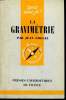
La première encyclopédie de poche fondée en 1941 par Paul Angoulvent, traduite en 43 langues, diffusée, pour les éditions françaises, à plus de 160 millions d'exemplaires, la collection Que sais-je? est l'une des plus importantes bases de données internationnales, construite pour le grand public par des spécialistes. 3800 titres ont été publiés depuis l'origine par 2500 auteurs. Classification Dewey : 530-Physique
LES RIVALITÉS ATOMIQUES 1939-1966
Paris Fayard 1967 in 8 (21,5x13,5) 1 volume broché, couverture à rabats, 340 pages, avec des illustrations hors texte en noir et blanc. Collection '' Les grandes études contemporaines ''. Bel envoi autographe signé de l'auteur. Bel exemplaire ( Photographies sur demande / We can send pictures of this book on simple request )
Très bon Signé par l'auteur
Dictionnaire des unités des grandeurs physiques.
CHIRON Etienne. 1947. In-12. Relié. Bon état, Couv. légèrement passée, Dos satisfaisant, Intérieur frais. 252 pages.. . . . Classification Dewey : 530-Physique
Préface de Sollima. A l'usage des Ingénieurs, des Techniciens et des Etudiants. Tableau de conversion des unités usuelles en unités PMKS (giorgi). Unités d'énergétique, mécaniques, thermiques, optiques, acoustiques, électriques et magnétiques.... Classification Dewey : 530-Physique
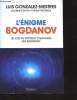
L'énigme Bogdanov : Ls clés de l'Odyssée scientifique des Bogdanov
SW Télémaque. 2015. In-8. Broché. Bon état, Couv. convenable, Dos satisfaisant, Intérieur frais. 318 pages.. . . . Classification Dewey : 530-Physique
Classification Dewey : 530-Physique
"Physique, cours expérimental et moderne (3 tomes); 1. La pesanteur; 2. Les ondes sonores, thermiques, lumineuses; 3. Electricité, cours élémentaire expérimental et moderne."
Louvain, J. Feyaerts, 1928-1931. 14 x 23, 3 tomes en 1 volume, 142 + 240 + 229 pages, nombreuses figures en N/B, 1 planche en couleurs, reliure dos/coins cuir, entre bon et très bon état (dos légèrement insolé).
4e édition conforme au nouveau programme, avec exercices intercalés et traduction flamande des termes techniques.
Lehrbuch der Anorganischen Chemie für den Unterricht auf Universitäten, Technischen Lehranstalten und für das Selbststudium mit Einschluss der experimentellen Technik. Sechste vollst. umgearb u. verb. Aufl.
Braunschweig, Vieweg u. Sohn, 1876. Cont. hcalf, back rubbed. XXIII,684 pp. and 1 folded spectralplate, many fine woodcut-illustr. in the text. Occasionally brownspotted.
Rapport sur les travaux de la société de physique et d'histoire naturelle de Genève depuis juillet 1865 à juin 1866. / Bulletin bibliographique. Extrait de ‘Mémoires de la société de physique et d'histoire naturelle de Genève’, tome XVIII, 2ème partie.
Genève, Schuchardt, 1866, in-4to, 39 p., sans brochure.
(SLACES, NVVA)
Phone number : 41 (0)26 3223808
Rapport du Président de la société de physique et d'histoire naturelle de Genève pour l'année 1888. Extrait de ‘Mémoires de la société de physique et d'histoire naturelle de Genève’, tome XXX, 2ème partie.
Genève, Aubert-Schuchardt, 1890, in-4to, 58 p., sans brochure.
(SLACES, NVVA)
Phone number : 41 (0)26 3223808
COURS DE PHYSIQUE, POUR LES CLASSES DE 3e, 2de ET PHILOSOPHIE
Hachette. 1885. In-12. Relié. Etat passable, Plats abîmés, Dos fané, Fortes mouillures. 656 pages. Couverture rouge dont le 1er plat est illustré de motifs décoratifs. Illustré de nombreuses gravures en noir et blanc dans le texte et hors texte. Une planche en couleur hors texte. 2e plat très abîmé. Toutes dernières pages collées par les mouillures.. . . . Classification Dewey : 530-Physique
Conforme aux programmes officiels de janv. 1885. Contenant 460 gravures et une planche en couleurs. Classification Dewey : 530-Physique
COURS ELEMENTAIRE DE PHYSIQUE, ENSEIGNEMENT SECONDAIRE SPECIAL, 4e ANNEE
Hachette. 1869. In-12. Relié. Etat passable, Plats abîmés, Dos abîmé, Rousseurs. 318 pages. Illustré de nombreuses gravures en noir et blanc dans le texte et hors texte. Dos et plats détachés. Cahiers se détachant. Pages légèrement passées.. . . . Classification Dewey : 530-Physique
Conforme aux programmes officiels de 1866. Classification Dewey : 530-Physique
Cours élémentaire de physique. Ouvrage rédigé conformément aux programmes officiels pour l'enseignement secondaire spécial
Hachette. 1875. In-8. Cartonnage d'éditeurs. Etat d'usage, Tâchée, Coiffe en tête abîmée, Quelques rousseurs. 304 pp., nombreuses figures dans le texte, un feuillet déchiré avec manque en pied, coins frottés, coiffe en pied légèrement abîmée - 1 PHOTO DISPONIBLE.. . . . Classification Dewey : 530-Physique
Classification Dewey : 530-Physique
Studies in gravitation theory
Bucharest (Romania), Central Institute of Physics Press 1988 iv + 258pp., 22cm., softcover, G, W69777
Que sais-je? N° 530 Les quanta et la vie
Presses Universitaires de France Edition originale Première édition 2ème trimestre 1952. 1952. In-12. Broché. Bon état, Couv. convenable, Dos satisfaisant, Intérieur frais. 128 pages illustrées de quelques dessins en noir et blanc. . . . Classification Dewey : 530-Physique
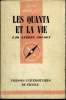
La première encyclopédie de poche fondée en 1941 par Paul Angoulvent, traduite en 43 langues, diffusée, pour les éditions françaises, à plus de 160 millions d'exemplaires, la collection Que sais-je? est l'une des plus importantes bases de données internationnales, construite pour le grand public par des spécialistes. 3800 titres ont été publiés depuis l'origine par 2500 auteurs. Classification Dewey : 530-Physique

