 Write to the booksellers
-
Type
Art print (2)
Book (5911)
Magazine (20)
Manuscript (1)
Old papers (1)
Photographs (3)
-
Latest
Last 24h (1)
Last month (4)
Last week (4)
-
Language
English (10)
French (5923)
German (1)
Greek (1)
Italian (1)
Latin (2)
-
Century
16th (2)
17th (9)
18th (247)
19th (891)
20th (2982)
21st (135)
-
Countries
Belgium (266)
Canada (3)
Côte d'Ivoire (13)
Denmark (1365)
France (3990)
Switzerland (301)
-
Syndicate
ALAC (3)
CLAM (3)
ILAB (4152)
NVVA (139)
SLACES (139)
SLAM (2625)
SNCAO (15)
Conference organized in Collaboration with The International Union of Physics and the Polish Intellectual Co-Operation Committee. Warsaw, May 30th - June 3rd 1938.
(Paris, 1939). Royal8vo. Orig. full cloth with dustjacket. XXI,247 pp.
With original contributions by Niels Bohr (The causality problems in atomic physics), L. de Broglie (Links between the quantum theory and relativity), O. Klein (On the theory of charged fields), L. Brillouin (Individuality of elementary particles...), A.S. Eddington (Cosmological application of the theory of quanta), E.A. Milne (A possible mode of approach to nuclear dynamics).
Opticks or a treatise of the reflections, refractions, inflections and colors of light based on the fourth edition London, 1730 with a foreword by Albert Einstein, an introduction by Sir Edmund Whittaker, a preface by Duane H.D. Roller
N.Y., Dover, 1952, un volume in 8, broché, 406pp.**3868/M7DE
Optice: sive de Reflexionibus, Refractionibus, Inflexionibus & Coloribus Lucis, Libri tres. Latine reddidit Samuel Clarke, S.T.P. Editio Secunda, auctior.
London, Impensis Gul. & Joh. Innys, 1719 (colophon: Londini: Ex Officina Gulielmi Bowyer, 1718). 8vo. Contemp. full calf. Corners, fronthinge and spineends professionally repaired. Inner hinges reinforced. Gilt lineborders on back. Titlelabel in red leather with gilt lettering. Old owners name stamped on titlepage (small).Instead of htitle is bound ""Catalogus Librorum prostantium apud Gul. & Joh. Innys"" (1 leaf), the Cataloque is furthermore bound at end, but with a different typography. (2),XI,(1),415 pp. and 12 folded engraved plates. Very light brownning to a few margins. Printed on good paper, in general fine and clean internally.
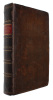
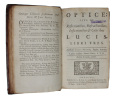
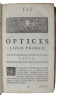
Scarce second Latin edition of Newton's ""Optics: or a Treatise of the Reflections, Refractions, Inflections, and Colours of Light. London 1704."", one of the great books in the history of science. ""Newton's Optics did for Light what his Principia had done for Gravitation, namely, placed it on a scientific basis."" (E.W. Brown). The translation was brought to light ""At the request of Newton, Dr. Samuel Clarke prepared a Latin edition of his Optics which appeared 1706, and he was generously presented by Sir Isaac with GBP 500, or GBP 100 for each of his five children, as a token of the appreciation and gratitude of the author. DeMoivre is said to have secured and taken charge of this translation, and to have spared neither time nor trouble in the task. Newton met him every evening at a coffe-house, and when they have finished their work he took De Moivre home with him to spend the evening in philosophical conversation.""(Brewster in his ""Newton"", 1855"").""In the accumulation of optical phenomena from his first paper (the short memoir in Philosophical Transaction, 1672) until the above book (the Optics,..) 33 years later, Newton had gathered explanations to many problems. The rainbow is fully explained and also ""Newton's rings"", produced by pressing the flat side of a plano-convex glass against a double convex lens of long focal lenght, producing rings of alternating brightness and darkness"" his explanation was not valid, as he did not know optical interference. He speculated on the double refraction of Icelandic spar...."" (Dibner in Heralds of Science No 148) - G.J. Gray No 180.
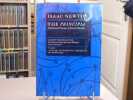
THE PRINCIPIA. Mathematical Principles of Natural Philosophy.
University Of California Press Berkeley 1999 Fort in-8 carré ( 255 x 180 mm. ) de XVIII-974 pages, broché sous couverture illustrée. A new translation by I. Bernard Cohen and Anne Whitman, assisted by Julia Budenz. Preceded by 'A Guide to Newton's Principia' by Bernard I. Cohen. Bel exemplaire.
Mathematische Principien der Naturlehre. Mit Bemerkungen und Erläuterungen herausgegeben von Prof. Dr. J. Ph. Wolfers.
Berlin, Robert Oppenheim, 1872. 8vo. Contemporary hcalf. Spine gilt and with gilt lettering. VIII,666,VI pp. Text diagrams. Internally clean. From the library of the Danish logician and philosopher Jørgen Jørgensen having his name on top of front free enpaper.
First German edition of Newton's groundbreaking ""Principia"". - Gray 39.
Mathematical principles of natural philosophy, and his System of the world. Translated into English by Andrew Mott in 1729. The translations revised, and supplied with an historical and explanatory appendix.
Recent Kissinger Reprint (Originally: Berkeley, University of California, 1946). 4to. In publisher's original printed boards. Binding with a few scratches, otherwise very fine and clean. 680 pp.
Physique.
Couverture rigide. Cartonnage de l'éditeur. Cachet de spécimen sur la première page.
Livre. Pour les Collèges d'enseignement technique, cours professionnels, et préparation au C.A.P. Editions Dunod, 1965.
PHYSIQUE, COLLEGES D'ENSEIGNEMENT TECHNIQUE, COURS PROFESSIONNELS, PREPARATION AU CAP
Dunod. 1965. In-8. Relié. Bon état, Couv. légèrement passée, Dos frotté, Intérieur bon état. 251 pages. Premier plat illustré de photos en noir et blanc. Illustré de nombreuses gravures en noir et blanc dans le texte.. . . . Classification Dewey : 530-Physique
6e édition revue. Bibliothèque de l'enseignement technique. Classification Dewey : 530-Physique
Leçons de physique. Classes de 3e. Ecoles nationales professionnelles, collèges techniques, sections techniques des lycées, collèges et cours complémentaires, préparation au B. E. I.
Couverture souple. Broché. 220 pages. Petit manque au dos.
Livre. Editions Dunod (Collection : Bibliothèque de l'enseignement technique), 1953.
Physique quantique - Introduction avec exercices.
Masson. 1991. In-8. Broché. Etat d'usage, Couv. légèrement pliée, Dos plié, Papier jauni. 446 pages, nombreuses figures dans le texte - dos insolé, coins frottés.. . . . Classification Dewey : 530-Physique
Classification Dewey : 530-Physique
PHYSIQUE STATISTIQUE - INTRODUCTION - AVEC EXERCICES.
MASSON. 1988. In-4. Broché. Etat d'usage, Couv. convenable, Dos satisfaisant, Intérieur acceptable. 283 pages illustrées de nombreuses figures dans le texte - Nombreuses annotations au crayon a papier et stylo rouge sur la page de garde - Nombreux soulignements dans le texte au stylo rouge et vert dans le texte.. . . . Classification Dewey : 530-Physique
Classification Dewey : 530-Physique
Saggi Scientifici. I. Breve Dissertazione su i fondamenti e i metodi della ricerca fisica. II. Una nuova ipotesi su la natura e la propagazione della luce.
Torino, Plinio Castello 1945, 250x175mm, 43pagine, in brossura. Stampa della biblioteca.
Pour un paiement via PayPal, veuillez nous en faire la demande et nous vous enverrons une facture PayPal
"NICHOLSON, WILLIAM. - THE FIRST ELECTROLYSIS WITH THE VOLTAIC PILE PERFORMED.
Reference : 43624
(1800)
Beschreibung des neuen electrichen oder galvanischen Apparats Alexander Volta's, und einiger wichtigen damit angestellten Versuche.
Halle, Rengerschen Buchhandlung, 1800. Without wrappers as published in ""Annalen der Physik. Herausgegeben von Ludwig Wilhelm Gilbert"", Bd. 6, Drittes Stück. The entire issue offered (=Heft 3). Titlepage to vol. 6. Pp. 249-376. Nicholson's paper: pp. 340-359. Light browning. A faint dampstain to upper right corners on some leaves.
First German edition of Nicholson's famous paper in which he, together with his friend Anthony Carlisle, succeeded in breaking up molecules into the constituent atoms of hydrogen and oxygen. They thus established the usefulness of the converse of the voltaic cell, by using electricity to produce chemical actions.""On March 20 of that year (1820) Volta wrote to Banks, president ofthe Royal Society, informing him of his construction of an electric battery. Nicholson heard of this and with the aid of a friend built his own Voltaic pile by May 2. It was the first in England. Nicholson's great contribution was to place wires attached to the two ends of the pile in water. He found that with the current flowing, bubbles of gaz (hydrogen and oxygen) ere given off. He had ""electolyzed"" water, breaking up the molecules into the individual elements. He thus reversed the demonstration of Cavendish, that hydrogen and oxygen could unite to form water. This was the first demonstration that an electric current could bring about a chemical reaction - the reverse of olta's demonstration that a chemical action could bring about an electrical current.""(Asimov). Parkinson ""Breakthroughs"" 1800 C. - Magie ""A Source Book in Physics"", pp. 431 ff.
LES ÉLECTRO-AIMANTS ET L'ADHÉRENCE MAGNÉTIQUE
Paris Librairie Scientifique, Industrielle et Agricole. E. Lacroix 1860 in 8 (21,5x13,5) 1 fascicule broché, sous couverture muette de papier marbré ancien, faux-titre, titre, VII, 1 faux-feuillet d'errata non chiffré, 302 pages, et 5 planches hors-texte lithographiées (dépliantes). Bel exemplaire ( Photographies sur demande / We can send pictures of this book on simple request )
Très bon
Parcelles d'infini. Promenade au jardin d'Escher. Par Alain Nicolas
Pour la science ,2006, in-8 de 183 pages ,illustrations in-texte et hors-texte ,broché ,Très bon état , .Isbn : 9782842450755.(4 photos du livre sur mon site https://www.vieuxlivre.fr) .Les frais de port pour la France sont offerts à partir de 25 euros d'achat (Mondial relay ). (colissimo suivi +6,90 ).
"NIEPCE DE SAINT-VICTOR, (CLAUDE FELIX ABEL). - DISCOVERING ""CHEMICAL RAYS"" (RADIOACTIVITY).
Reference : 58369
(1857)
Mémoire sur une nouvelle action de la lumière.
(Paris, Mallet-Bachelier), 1857. 4to. No wrappers. In: ""Comptes Rendus Hebdomadaires des Séances de L'Academie des Sciences"", Tome 45, No. 20. Pp. (785)-832. Entire issue offered. Niepce de Saint-Victor's paper: pp. 811-815,
First apperance of the first paper relating to his discovery of INVISIBLE ""CHEMICAL"" RAYS, and which, 30 years later, by Henry Becquerel was ""re-discovered"" as radioactivity (1896).The results of these investigations lead to these statement: Some compounds exposed to light exhibit in the dark the same effect as that produced by the direct action of light. - Cardboards impregnated with both uranium nitrate and tartaric acid are ""active"" - The ""activity"" remaining on the exposed cardboard is revealed by its action on a photographic plate - The effect is not due to phosphorescence - The activity is attributed to invisible ""chemical"" rays.It is amazing how closely these experiments resembled those performed by Henri Becquerel 30 years later.""When the work of Abel Niepce de Saint-Victor was brought to light, many persons thought that henri had been aware of these publications prior to his research on uranium. Severel facts seems to support this belief. Henri's father, Alexandre Edmond, had reported several details from Abel Niepce in a book entitled ""Light: its causes and effects"", published 1869. When Henri Carrington Bolton (1843-1903) reviewed in 1869 the work of Abel Niepce, he mentioned a ""remarkable property of uranium nitrate to absorb the actinic rays of light, retaining them in an active condition for a long time"". In 1866 and 1869, J. Jamin, Henri's first stepfather, lectured at the Ecole Polytechnique on the Niepce effects.""(Michel Genet ""The Discovery of Uranic Rays: A short Step for Henri Becquerel but a Giant Step for Science"" in Radiochimica Acta /0/71 1995).
Les rayons X et le radium. Bibliothèque des Merveilles.
Paris, Librairie Hachette, 1924. 12 x 19, 105 figures, 31 planches, broché, bon état (couverture légèrement défraîchie)
Code de mesurage du béton armé
, Bruxelles, Union des Géomètres-experts de Bruxelles 1948, 32pp.+ qqs.ills. dépliantes, bon état, W21654
ELEMENTS DE CHIMIE A L'USAGE DES CANDIDATS AUX ECOLES D'ARTS ET METIERS
Vuibert. 1930. In-12. Relié. Etat passable, Tâchée, Dos fané, Mouillures. 608 pages. Illustré de nombreuses gravures en noir et blanc dans le texte. Ouvrage très abîmé. Dos taché. Couverture détachée. Pages de garde et de titre déchirées, avec des manques, et annotées. Manque sur le bord inférieur du feuillet 1-2, altérant légèrement la lecture. Texte liisble. Tranche tachée.. . . . Classification Dewey : 530-Physique
Notions générales. Les métalloïdes. Classification Dewey : 530-Physique
L'art des expériences ou avis aux amateurs de la physique, sur le choix, la construction et l'usage des instruments ; sur la préparation et l'emploi des drogues qui servent aux expériences
P., Durand, 1784, 3 volumes in 12 reliés en pleine basane mouchetée, dos ornés de fers et caissons dorés, tranches rouges, étiquettes de maroquin rouge (reliures de l'époque), (1 coiffe légèrement usée et un mors légèrement fendu, mouillures pâles marginales à quelques feuillets), T.1 : 24pp., 508pp., 13 planches numérotées 1 à 8 et 1 à 5, T.2 : (2), 552pp., 23 planches numérotées 1 à 23, T.3 : (2), 528pp., 20 planches numérotées 1 à 20
---- Cet ouvrage est la suite des Leçons de physique expérimentale dans lequel l'Abbé Nollet "enseigne les différentes façons de travailler le bois, les métaux & le verre qui sont les principales matières dont nos instruments sont construits ; j'indique les outils dont on aura besoin, la manière de s'en servir et les différents états par lesquels chaque pièce doit passer pour arriver à sa perfection ; la seconde partie comprend une indication par ordre alphabétique des drogues simples dont il faut se pourvoir, la préparation de celles qui doivent être composées ; l'emploi des unes & des autres dans les expériences ; elle se termine par une instruction sur la composition des vernis... La troisième partie offre des avis particuliers sur chacune de nos expériences et sur celles que j'y ai ajoutées par occasion : on y trouvera la construction et l'usage d'un grand nombre de machines que je n'avais point assez fait connaître dans mes Leçons...". (Préface) - DSB X pp. 145/147 - Troisième édition pour le tome 1 et seconde édition pour les tomes 2 & 3**7983/ARB6-3891/ARM2A
Leçons de physique experimentale, Tome Premier
rue Galande, à la Sagesse, A Paris Chez Durand, Neuveu, Libraire 1783 Neuvième édition. Ex-Libris, Tome 1 seul, illustré de 19 gravures hors-texte rempliées, dont un frontispice. In-12 reliure d’époque plein veau marbré à l’éponge, dos à nerfs encadrés de motifs floraux. Tranches marbrées. Coiffe légèrement frottée, mors frottés en tête, gouttière irrégulière.Première page de garde fragilisée. Bon état.
Bon état d’occasion
Leçons de physique expérimentale.
Tome premier. Paris. Durand. 1782. Fort in-12 (17x10 cms). CIV-379 pages. Reliure de l'époque en pleine basane, dos à nerfs entièrement orné (plat inférieur en partie râpé).
Mention 19° édition. Portrait en frontispice et complet des 19 gravures dépliantes Préface et discours sur la physique par Nollet. Bon exemplaire.
Leçons de physique expérimentale. Par l'Abbé Nollet. Tome troisième [seul].
1456 Paris, Guerin, 1745, in 12 relié pleine basane caramel, dos à nerfs orné de filets dorés, 512 pages ; petits frottis.
Tome troisième seul, illustré de 19 planches dépliantes. ...................... Photos sur demande ...................


Phone number : 04 77 32 63 69
Leçons de Physique Expérimentale. TOME 3
DURAND. 7ème édition. 1779. In-12. Relié plein cuir. Etat d'usage, Couv. défraîchie, Dos abîmé, Intérieur frais. 512 pages. Quelques planches dépliantes d'illustrations en noir et blanc hors-texte. Relié plein cuir marron. Caissons et tomaison dorés sur le dos à 5 nerfs. Tranches rouges. Manque la pièce de titre. Epidermures. Manques de cuir sur le dos et le 2nd plat de couverture. Quelques manques en marges, dus à des insectes, altérant la lecture du texte. Quelques déchirures sur les planches.. . . . Classification Dewey : 530-Physique
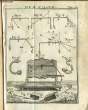
Sur la Méchanique - Propriétés de l'Air. Classification Dewey : 530-Physique

