 Write to the booksellers
-
Type
Art print (2)
Book (5904)
Magazine (20)
Manuscript (1)
Old papers (1)
Photographs (3)
-
Latest
Last 24h (3)
Last 3 days (1)
Last month (8)
-
Language
English (10)
French (5916)
German (1)
Greek (1)
Italian (1)
Latin (2)
-
Century
16th (2)
17th (9)
18th (245)
19th (886)
20th (2965)
21st (134)
-
Countries
Belgium (266)
Canada (3)
Côte d'Ivoire (13)
Denmark (1368)
France (3980)
Switzerland (301)
-
Syndicate
ALAC (3)
CLAM (3)
ILAB (4131)
NVVA (139)
SLACES (139)
SLAM (2601)
SNCAO (15)
Entdeckungen über die Theorie des Klanges. - [INAUGURATING THE FIELD OF ACOUSTICS]
Leipzig, Weidmanns Erben und Reich, 1787. 4to. Uncut in the original interrim boards. Small exlibris-stamp (J. L. Prevost) to front free end-paper. Light brownspotting throughout. An excellent unsophisticated copy. (4), 77, (1) pp + 11 plates (by S. Capieux).
First edition of Chladni’s landmark work on the production of sounds from solid bodies, inaugurating the field of acoustics. Here, he demonstrated the method by sprinkling sand on plates of glass or metal and drawing a bow down their sides to produce a visible vibration pattern called ""Chladni figures” or “Chladni patterns”. ""The production of sound from solid bodies was not clearly understood until Chladni devised the method of sand figures to illustrate the structure of vibrations in a solid body"" (Norman). Chladni ""was the first to reduce the general association between vibration and pitch to a tabular basis and thus to lay the foundation of the modern science of acoustics"" (PMM). In his famous 1787-experiment, Chladni drew a bow over a piece of centrally fixed metal plate covered with sand, and the vibration of the plate caused the sand to move and accumulate around the nodal lines where the surface remained still, forming Chladni figures. The experiments by Chladni are a corner stone of modern acoustics. However, the motion of particles before they settle to the nodal lines is still not very well understood, and only hypothetical models have been put forward. Chladni had visited the Paris Academy in 1808 and had demonstrated the vibration patterns before an audience that included not only the leading French scientists but Napoleon himself"" Napoleon set a prize for the best mathematical explanation but no satisfactory explanations came out of it. Napoleon famously remarked ""Chaldni mhas made sound visible"" (Dibner). Variations of this technique are still commonly used in the design and construction of acoustic instruments such as violins, guitars, and cellos. Since the 20th century, it has become more common to place a loudspeaker driven by an electronic signal generator over or under the plate to achieve a more accurate adjustable frequency. In quantum mechanics, Chladni figures (""nodal patterns"") are known to be related to the solutions of the Schrödinger equation for one-electron atoms, and the mathematics describing them was used by Erwin Schrödinger to arrive at the understanding of electron orbitals.Dibner 150PMM 233Norman 480Sparrow 39
Über die Longitudinalschwingungen der Saiten und Stäbe.
Erfurt, Georg Adam Keyser, 1796. 4to. Bound uncut in a nice recent cardboard-binding with red leather title-label to spine with gilt lettering. Internally two leaves with few black dots (ink?), not affecting text. Fine and clean. 14 pp.

Rare first edition of Chladni's work on the longitudinal vibrations of strings and rods. Chladni was the first to reduce the general association between vibration and pitch to a tabular basis, and thus to lay the foundation of the modern science of acoustics. His first results were first reported in New Discoveries in the Theory of Sound, 1787. In the present work, much rare than his 1787-work, Chladni examined the transverse vibrations of bars and strings (the movement of the body particles takes place transversely to the length of the bar or the side) and discovered the longitudinal vibrations and the torsional vibrations. With the help of the longitudinal vibrations he was able to determine the speed at which sound propagates in solid bodies and gases. (His 1787-work: PMM233a Dibner Heralds of Science 150 Norman 480 Sparrow Milestones of Science 39)
La structure des cristaux determinée au moyuen des rayon X
1924 Edité par la Société "journal de Physique" , 1924 , format in8, 276 pages plus tables. Recueil des conferences rapports de documentation sur la Physique
Ray E2
La Bérézina. Suisses et Français dans la tourmante de 1812. Collection Archives vivantes.
Bière, Editions Cabédita 2012, 240x165mm, 198pages, broché. Exemplaire à l'état de neuf.

photos n/b, Pour un paiement via PayPal, veuillez nous en faire la demande et nous vous enverrons une facture PayPal
Electrisation d'absorption. Colloïdes et membranes. Thèse présentée à la Faculté des sciences de l'Université de Paris
P., PUF, 1923,un volume in 8 broché, couverture imprimée (défraîchie, traces de poussière en bordure du premier plat de couverture), 62pp;, (1)
---- EDITION ORIGINALE**7889/M4
Le monde invisible et mystérieux des ondes, Livre II : Les TRANSMISSIONS GENERALES entre les CORPS par les ONDES.
Paris, Maloine, sans date, grand in 8° broché, VIII-333 pages.
Etudes des influences multiples et électriques entre les corps près et à distance par les ondes E. M. - Qu'est-ce que la Relativité ? Est elle restreinte ou générale ? Ses rapports avec l'électromagnétisme - Le mouvement et le rayonnement des corps - Aperçu sur l'infini... Radioactivité... etc... ...................... Photos sur demande ...................


Phone number : 04 77 32 63 69
Le monde invisible et mystérieux des ondes, Livre I.
Paris, Maloine, sans date, grand in 8° broché, XX-364 pages.
L'organisation du monde créé et les noyaux d'espèces. La matière et la vie. La terre dans l'Univers. L'Ether et le monde des images. L'Univers est-il habité ? Preuves de l'immortalité. Rayonnement général des corps dans l'espace. Influence universelle. ...................... Photos sur demande ...................
Phone number : 04 77 32 63 69
Lærebog i Fysik. 2 bd.
København, P.G. Philipsen, 1892-94. 2 samtidige hldrbd. med rygforgyldning. Papirsetiket påsat øverst på rygge. Stempel på titelblade. V,428(10),483 pp., tekstillustrationer.
L'ATOME POUR OU CONTRE L'HOMME.
PAX CHRISTI. 1958. In-8. Broché. Etat d'usage, Coins frottés, Dos frotté, Intérieur acceptable. XV+356 pages. Ex-dono sur la page de faux-titre. Nombreuses illustrations en noir et blanc dans et hors texte.. . . . Classification Dewey : 530-Physique
PREFACE DE LOUIS LEPRINCE-RINGUET. Classification Dewey : 530-Physique
E.B.Christofell.The Influence of His Work on Mathematical and the Physical Sciences.
Basel, Boston, Stuttgart, 1981. Royal8vo. Orig. full fabrikoid with dustjacket. XXIV,(2),761 pp.
Le Monde invisible et mystérieux des ondes. Livre II. Les transmissions générales entre les corps par les ondes...
Paris, Librairie Maloine, coll. « Sciences et philosophie » 1939 In-4 25,5 x 16,5 cm. Broché, couverture bleu-ciel, titre en rouge sur le premier plat, VIII-334 pp., notes en bas de page, bibliographie, table des matières. Couverture ternie avec mouillure angulaire, déchirure en coin de page.
Contient : études des influences multiples et électriques entre les corps, près et à distance par les E. M., Qu’est-ce que la relativité ? Aperçu sur l’infini, sur le temps et l’espace, etc. Henri Chrétien (1879-1956) reste surtout connu pour ses travaux en optique rachetés par la 20th century Fox (Cinemascope). Bon état d’occasion
Plant Response as a means of Physiological Investigation. With illustrations.
London, New York and Bombay, Longmans, Green, and Co. 1906, 225x160mm, XXXVIII - 781pages, editor's binding. Book in good condition.
Pour un paiement via PayPal, veuillez nous en faire la demande et nous vous enverrons une facture PayPal
LA SIMULATION DES SYSTEMES
DUNOD / MODULES. 1971. In-8. Broché. Etat d'usage, Couv. légèrement passée, Dos satisfaisant, Intérieur frais. 152 pages.. . . . Classification Dewey : 530-Physique
Classification Dewey : 530-Physique
Lehrbuch der Physik. Zweiter (2.) Band: Lehre vom Schall (Akustik) - Lehre von der strahlenden Energie. Übers. v. H. Pflaum. (1904) / Dritter (3.) Band : Die Lehre von der Wärme. Übers. v. E. Berg. (1905) / Vierter Band. Erste Hälfte (IV.1): Die Lehre von der Elektrizität. Übers. v. H. Pflaum. (1908).
Braunschweig, Vieweg, 1904 - 1908, gr. in-8vo, XII + 1056 S. + 2 Tafeln in Lasche / XI (+1) + 988 S. /XII + 915 S., Original-H.-Lederband mit Ecken, marbrierte Vorsätze, schönes Ex..
(SLACES, NVVA)
Phone number : 41 (0)26 3223808
Traité de physique suivie de Notes sur la physique théorique Tome cinquième premier fascicule champ magnétique variable
Librairie scientifique A. Hermann et Fils. 1914. In-8. Broché. A relier, Couv. défraîchie, Dos abîmé, Intérieur acceptable. 266 pages augmentées de 36 figures en noir et blanc dans texte.. . . . Classification Dewey : 530-Physique
Etiquette sur coiffe en pied. Tampon bibliothèque. Classification Dewey : 530-Physique
Traité de physique suivie deNotes sur la physique théorique Tome troisième troisième fascicule Propériété des vapeurs équilibre des substances en contact
Librairie scientifique A. Hermann et Fils. 1911. In-8. Broché. Etat d'usage, Livré sans Couverture, Dos abîmé, Intérieur acceptable. Paginé de 745 à 999 pages augmentées de quelques figures en noir et blanc dans texte.. . . . Classification Dewey : 530-Physique
Etiquette sur coiffe en pied. Tampon bibliothèque. Classification Dewey : 530-Physique
Traité de physique édition revue et considérablement augmentée suivie de Notes sur la physique théorique Tome 3 fascicule 2 Thermodynamique générale, Fusion, Vaporisation
Librairie scientifique J. Hermann. non daté. In-8. Broché. Etat d'usage, Couv. convenable, Dos abîmé, Non coupé. Paginé de 409 à 744 pages augmentées de 206 figures en noir et blanc dans texte.. . . . Classification Dewey : 530-Physique
Etiquette sur coiffe en pied. Tampon bibliothèque. Classification Dewey : 530-Physique
COURS DE PHYSIQUE : EXAMEN DE NIVEAU ET CONCOURS D ADMISSION DANS LES ECOLES PARAMEDICALES
VUIBERT. 1986. In-4. Broché. Bon état, Couv. convenable, Dos satisfaisant, Intérieur frais. 222 pages augmentees de nombreuses figures en noir et blanc dans le texte. . . . Classification Dewey : 530-Physique
Classification Dewey : 530-Physique
EXERCICES DE PHYSIQUE ET DE CHIMIE / EXAMEN DE NIVEAU ET CONCOURS D'ADOMISSION DANS LES ECLOES PARAMEDICALES.
VUIBERT. 1986. In-4. Broché. Bon état, Couv. convenable, Dos satisfaisant, Intérieur frais. 319 pages illustrées de nombreuses figures dans le texte.. . . . Classification Dewey : 530-Physique
Classification Dewey : 530-Physique
COURS DE PHYSIQUE, EXAMEN DE NIVEAU ET CONCOURS D'ADMISSION DANS LES ECOLES PARAMEDICALES
Vuibert. 1986. In-8. Broché. Bon état, Couv. convenable, Dos satisfaisant, Intérieur frais. 222 pages. Illustré de nombreux schémas en noir et blanc dans le texte.. . . . Classification Dewey : 530-Physique
Echanges thermiques et changements d'état. Mécanique. Electrostatique. Optique... Classification Dewey : 530-Physique
Berkeley : Cours de physique - En 5 volumes - volume 1 : mécanique - volume 2 : électricité et magnétisme - volume 3 : Ondes - volume 4 : physique quantique - volume 5 : physique statistique.
Armand colin. 1972. In-8. Relié. Bon état, Couv. convenable, Dos satisfaisant, Intérieur frais. XXII + 481 pages + XX + 460 pages + 603 pages + XIX + 423 pages + XXIV + 397 pages - nombreuses figures en noir et blanc dans et hors texte.. . . . Classification Dewey : 530-Physique
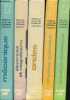
Collection U - volume 1 : mécanique - volume 2 : électricité et magnétisme - volume 3 : Ondes - volume 4 : physique quantique - volume 5 : physique statistique. Classification Dewey : 530-Physique
"CLAIRAUT, (ALEXIS CLAUDE de). - THE FIRST DIRECT CONFIRMATION OF THE COPERNICAN THEORY.
Reference : 46843
(1740)
De L'Abberation apparente des Etoiles, causée par le mouvement progressif de la Lumière.
(Paris, L'Imprimerie Royale, 1740). 4to. Without wrappers. Extracted from ""Mémoires de l'Academie des Sciences. Année 1737"". Pp. 205-227 a. 2 folded engraved plates.
First appearance of this extremely importent paper in which Clairaut directly confirms the rotation and the orbital movement of the Earth around the Sun, and giving an indirect proof of the axiom, that the velocity of light does not depend on whether the light source moves away or toward the observer. The Earth does move after all !!In 1728 James Bradley, trying to measure the stellar parallax, discovered stellar aberration - the angular displacement of the apparent direction of starlight due to the earth's motion - and attributed it to the combined effect of the finite velocity of light and the earth's orbital velocity. But Bradley had not given any theoretical proof, but Clairaut did in the offered paper.Aberration is ""the apparent change in direction of a source of light caused by an observers component of motion perpendicular to the impinging rays. During this time the telescope has moved a short distance, causing the photons to reach a spot on the focal plane, displayed from the former image position... This discovery provided the first direct physical confirmation of the Copernican theory. A second importent application of aberration has been its clear-cut demonstration that, as is axiomatic to special relativity, light reaching the earth has a velocity unaffected by the relative motion of the source toward or away from earth.""(McGraw-Hill ""Concise Encyclopedia..."").
"CLAIRAUT, (ALEXIS-CLAUDE) - STATING THE PRINCIPLE OF RELATIVE MOTION.
Reference : 46580
(1745)
Sur quelques Principes qui donnent la Solution d'un grand nombre de Problèmes de Dynamique.
Paris, L'Imprimerie Royale, 1745. 4to. Without wrappers. Extracted from ""Mémoires de l'Academie des Sciences. Année 1742"". Titlepage to Année 1742/1745. - 52 pp. (pp. 1-52) and 5 folded engraved plates. Clean and fine.
First appearance of this importent paper on the relative movement and the dynamics of a body in motion. It is Clairaut's main contribution to mechanics.The principle of ""Galilean invariace"" ""was stated most clearly by Cairaut in a paper published in 1745 (the paper offered)"" in effect, it is the modern principle of relative motion, according to which a body seen from a non-inertial frame experiences an ""apparent force"" per unit mass equal to the negative ofthe acceleration of that frame relative to inertial frame.""(Truesdell ""Essays in the History of Mechanics"", p. 131)
LA PHYSIQUE - LA NOUVELLE ENCYCLOPEDIE DES SCIENCES
FRANCE LOISIRS - ANDROMEDA OXFORD. 1995. In-4. Relié. Bon état, Couv. convenable, Dos satisfaisant, Intérieur frais. 158 Pages. Nombreuses illustrations et photos en couleur dans et hors texte. Jaquette en bon état.. Avec Jaquette. . . Classification Dewey : 530-Physique
Classification Dewey : 530-Physique
LA PHYSIQUE - TOME 1 EN 1 VOLUME
FRANCE LOISIRS / ANDROMEDA. 1994. In-4. Relié. Bon état, Couv. convenable, Dos satisfaisant, Intérieur frais. pages. Nombreuses photos et/ou illustrations en couleurs, dans et/ou hors texte. Jaquette en très bon état.. Avec Jaquette. . . Classification Dewey : 530-Physique
LA NOUVELLE ENCYCLOPEDIE DES SCIENCES. Classification Dewey : 530-Physique

