 Write to the booksellers
-
Type
Book (5472)
Magazine (20)
Manuscript (1)
Old papers (1)
Photographs (3)
-
Latest
Last month (4)
Last week (2)
-
Language
English (10)
French (5483)
German (1)
Greek (1)
Italian (1)
Latin (1)
-
Century
16th (2)
17th (8)
18th (243)
19th (885)
20th (2950)
21st (133)
-
Countries
Belgium (266)
Canada (3)
Côte d'Ivoire (13)
Denmark (1363)
France (3551)
Switzerland (301)
-
Syndicate
ALAC (3)
CLAM (3)
ILAB (4129)
NVVA (139)
SLACES (139)
SLAM (2604)
SNCAO (15)
Mécanique & Résistance des Matériaux. TOME 1 : Mécanique.
REPUBLIQUE FRANCAISE - PREFECTURE DE LLA SEINE. 1956 - 1957. In-4. Broché. Bon état, Couv. légèrement passée, Dos satisfaisant, Intérieur acceptable. 251 pages. Nombreuses figures en noir et blanc, dans le texte. Tampon sur la 1ère de couvertire.. . . . Classification Dewey : 530-Physique
Classification Dewey : 530-Physique
Electronique Tome 1.
P., Dunod, 1984, grand in 8° broché, IX-224-20 pages.
PHOTOS sur DEMANDE. Fermeture du 1er au 23 Août


Phone number : 04 77 32 63 69
COURS DE PHYSIQUE - POUR LES CLASSES DE MATHEMATIQUES SPECIALES (OPTIQUE) / COLLECTION SCIENTIFIQUE.
BAILLIERE ET FILS. 1936. In-12. Cartonné. Etat d'usage, Coins frottés, Dos satisfaisant, Intérieur acceptable. XII + 359 pages illustrées de nombreux schémas dans le texte.. . . . Classification Dewey : 530-Physique
Classification Dewey : 530-Physique
Cinématique appliquée.
P., Eyrolles, 1948, grand in 8°, cartonnage de l'éditeur, 310 pages ; frottis au cartonnage.
PHOTOS sur DEMANDE. Fermeture du 1er au 23 Août
Phone number : 04 77 32 63 69
Santé et Beauté par la culture physique. Préface des Dr Favory.
P., Montsouris, sans date (vers 1935), in 12 broché, 127 pages.
Couverture de M. Conq-Dessins de H. Marinellei. Fermeture du 1er au 23 Août
Phone number : 04 77 32 63 69
CHAUVEAU NADEGE, HENON J.-P., MONZAIN A.-M.
Reference : RO60028511
(1990)
ISBN : 227804043X
SCIENCES PHYSIQUES 6e, LIVRE DU PROFESSEUR
Didier. 1990. In-4. Broché. Bon état, Couv. convenable, Dos satisfaisant, Intérieur frais. 62 pages. Livre du professeur.. . . . Classification Dewey : 530-Physique
Coll. Secrétan. Classification Dewey : 530-Physique
LECONS DE MARIE CURIE - PHYSIQUE ELEMENTAIRE POUR LES ENFANTS DE NOS AMIS.
EDP SCIENCES. 2003. In-8. Broché. Etat d'usage, Couv. convenable, Dos satisfaisant, Intérieur frais. 124 pages illustrées de nombreux dessisn et photos monochromes dans le texte - 1er plat illustré de photos couleurs et monochromes.. . . . Classification Dewey : 530-Physique
Classification Dewey : 530-Physique
TRAITE DE PHYSIQUE ELEMENTAIRE suivi de problèmes
VICTOR MASSON & FILS. 1861. In-12. Relié demi-cuir. Bon état, Plats abîmés, Dos satisfaisant, Quelques rousseurs. 872pages. Dos cuir vert avec titre filet en doré. Coiffes abimée, épidermures. Quelques pages détaché de l'ouvrage.. . . . Classification Dewey : 530-Physique
Classification Dewey : 530-Physique
la Physique des Gens du monde enseignée en vingt lecons et sans le secours des mathématiques, ouvrage traduit et imité de l'anglais sur la 4e édition...
1825 Paris, Audin, Urbain-Canel, Ponthieu, 1825; in12 ; pleine basane brune mouchetée de l'époque, dos lisse orné de fleurons dorés, titre doré sur étiquete de maroquin rouge, tranches marbrées; X, 394, (1)pp. et 23 planches dépliantes.
Quelques rousseurs, petit manque de cuir aux coins et le long de la charnière inférieure. ( CO2)
La Physique des gens du Monde enseignée en Vingt leçons et sans le secours des mathématiques -
Paris, Audin, Urbain Canel, Ponthieu, 1825, 1825 In-12 In-12, X + 394 + 1 ff errata + 23 planches. Reliure d'époque, pleine basane, plats épidermé et coins émoussés, mais exemplaire acceptable.
Correct Pleine Basane
Analyse Générale des Corps Gras et Cires Organiques. TOME Ier.
BAILLIERE & FILS. 1903. In-12. Cartonné. Bon état, Couv. légèrement passée, Dos satisfaisant, Intérieur frais. 540 pages. Nombreuses illustrations en noir et blanc dans le texte. Quelques traces de crayon.. . . . Classification Dewey : 530-Physique
Préface de M. Hanriot. Encyclopédie Industrielle. Classification Dewey : 530-Physique
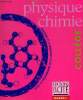
PHYSIQUE CHIMIE - COLLEGE
EDITIONS DELA CITE. . In-4. Broché. Bon état, Couv. convenable, Dos satisfaisant, Intérieur frais. 576 pages augmentées de nombreuses illustrations en couleur dans et hors texte - NON DATE. . . . Classification Dewey : 530-Physique
Classification Dewey : 530-Physique
TRAITE ELEMENTAIRE DE PHYSIQUE d'après M. GAY-LUSSAC. / Cheonologie ou dates des evenemens les plus remarquables / Physique végétale, ou traité élémentaire de Botanique.
PARIS. 1833. In-16. Relié plein cuir. Etat d'usage, Plats abîmés, Dos satisfaisant, Intérieur frais. 100 + 108 + 103 pages 1 1 planche depliante en noir et blanc - Signet conservé - contre-plats et tranches jaspés - Epidermures - Mors arrachés -. . . . Classification Dewey : 530-Physique
Classification Dewey : 530-Physique
CHEVALIER (Raymond) - CONTE (René) - LABRIE (Yvan) - LANDRY (Fernand) - NADREAU (Alphée).-
Reference : 66210
Eléments de métrologie.
Québec, La Liberté, P., Eyrolles, 1978, grand in 8° broché, 171 pages ; couverture illustrée.
PHOTOS SUR DEMANDE. Fermeture du 1er au 23 Août
Phone number : 04 77 32 63 69
[Chez Béchet Jeune] - CHEVALLIER, A. (dir.) [ CHEVALLIER, Jean Baptiste Alphonse (1793-1879) ] ; Collectif
Reference : 20606
(1839)
Journal des Connaissances Nécessaires et indispensables aux Industriels, aux Manufacturiers, aux Commerçants et aux Gens du Monde. Première et Deuxième Années
2 vol. in-8 reliure d'époque demi-basane mouchetée, Chez Béchet Jeune, Paris, 1839 - 1840, 670 ; 641 pp.
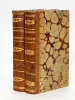
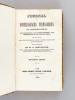
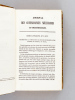
Etat très satisfaisant (petit accroc en coiffe sup. du premier volume, petit mq. de papier angulaire au plat sup., fortes rouss. à partir du cahier de septembre pour l'année 1839, bon état par ailleurs). Passionnant et peu courant. Le prof. Alphonse Chevallier, était professeur à l'école de de pharmacie et membre de l'Académie de médecine. Il est notamment l'auteur d'un Manuel de Pharmacie, ainsi que de d'un 'Dictionnaire des altérations et falsifications des substances alimentaires'. Il a beaucoup oeuvré pour l'hygiène publique urbaine, en particulier à Paris (désinfection des égouts, assainissement du canal Saint-Martin), ainsi que pour la protection de la santé des consommateurs de son époque. Hatin, 595
Problèmes de physique avec leurs solutions développées
Gauthier-Villars. 1872. In-12. Broché. Etat d'usage, Coins frottés, Dos frotté, Mouillures. 184 pages, coiffes abîmées, coins légèrement déchirés. Ouvrage écrit la main - 1 PHOTO DISPONIBLE.. . . . Classification Dewey : 530-Physique
Classification Dewey : 530-Physique
Cours de physique - cours de l'école polytechnique - 2 tomes (2 volumes) - tomes 1+2.
Gauthier-villars et cie. 1932. In-4. Relié. Bon état, Couv. convenable, Dos satisfaisant, Papier jauni. 663 pages + 632+188+6 pages - plats, contre plats et gardes jaspés - nombreuses figures en noir et blanc dans le texte - auteur, titre et filets dorés sur le dos.. . . . Classification Dewey : 530-Physique

Classification Dewey : 530-Physique
Molecular collision theory Sommaire: Classical scattering by a central force; Quantum scattering by a central force; Elastic scattering phase shifts ...
Academic press. 1974. In-8. Relié. Bon état, Couv. convenable, Dos satisfaisant, Intérieur frais. 300 pages.. . . . Classification Dewey : 530-Physique

Etiquette sur coiffe en pied. Tampon bibliothèque. Texte écrit en anglais. Sommaire: Classical scattering by a central force; Quantum scattering by a central force; Elastic scattering phase shifts ... Classification Dewey : 530-Physique
Entdeckungen über die Theorie des Klanges. - [INAUGURATING THE FIELD OF ACOUSTICS]
Leipzig, Weidmanns Erben und Reich, 1787. 4to. Uncut in the original interrim boards. Small exlibris-stamp (J. L. Prevost) to front free end-paper. Light brownspotting throughout. An excellent unsophisticated copy. (4), 77, (1) pp + 11 plates (by S. Capieux).
First edition of Chladni’s landmark work on the production of sounds from solid bodies, inaugurating the field of acoustics. Here, he demonstrated the method by sprinkling sand on plates of glass or metal and drawing a bow down their sides to produce a visible vibration pattern called ""Chladni figures” or “Chladni patterns”. ""The production of sound from solid bodies was not clearly understood until Chladni devised the method of sand figures to illustrate the structure of vibrations in a solid body"" (Norman). Chladni ""was the first to reduce the general association between vibration and pitch to a tabular basis and thus to lay the foundation of the modern science of acoustics"" (PMM). In his famous 1787-experiment, Chladni drew a bow over a piece of centrally fixed metal plate covered with sand, and the vibration of the plate caused the sand to move and accumulate around the nodal lines where the surface remained still, forming Chladni figures. The experiments by Chladni are a corner stone of modern acoustics. However, the motion of particles before they settle to the nodal lines is still not very well understood, and only hypothetical models have been put forward. Chladni had visited the Paris Academy in 1808 and had demonstrated the vibration patterns before an audience that included not only the leading French scientists but Napoleon himself"" Napoleon set a prize for the best mathematical explanation but no satisfactory explanations came out of it. Napoleon famously remarked ""Chaldni mhas made sound visible"" (Dibner). Variations of this technique are still commonly used in the design and construction of acoustic instruments such as violins, guitars, and cellos. Since the 20th century, it has become more common to place a loudspeaker driven by an electronic signal generator over or under the plate to achieve a more accurate adjustable frequency. In quantum mechanics, Chladni figures (""nodal patterns"") are known to be related to the solutions of the Schrödinger equation for one-electron atoms, and the mathematics describing them was used by Erwin Schrödinger to arrive at the understanding of electron orbitals.Dibner 150PMM 233Norman 480Sparrow 39
Über die Longitudinalschwingungen der Saiten und Stäbe.
Erfurt, Georg Adam Keyser, 1796. 4to. Bound uncut in a nice recent cardboard-binding with red leather title-label to spine with gilt lettering. Internally two leaves with few black dots (ink?), not affecting text. Fine and clean. 14 pp.

Rare first edition of Chladni's work on the longitudinal vibrations of strings and rods. Chladni was the first to reduce the general association between vibration and pitch to a tabular basis, and thus to lay the foundation of the modern science of acoustics. His first results were first reported in New Discoveries in the Theory of Sound, 1787. In the present work, much rare than his 1787-work, Chladni examined the transverse vibrations of bars and strings (the movement of the body particles takes place transversely to the length of the bar or the side) and discovered the longitudinal vibrations and the torsional vibrations. With the help of the longitudinal vibrations he was able to determine the speed at which sound propagates in solid bodies and gases. (His 1787-work: PMM233a Dibner Heralds of Science 150 Norman 480 Sparrow Milestones of Science 39)
La Bérézina. Suisses et Français dans la tourmante de 1812. Collection Archives vivantes.
Bière, Editions Cabédita 2012, 240x165mm, 198pages, broché. Exemplaire à l'état de neuf.

photos n/b, Pour un paiement via PayPal, veuillez nous en faire la demande et nous vous enverrons une facture PayPal
Le monde invisible et mystérieux des ondes, Livre II : Les TRANSMISSIONS GENERALES entre les CORPS par les ONDES.
Paris, Maloine, sans date, grand in 8° broché, VIII-333 pages.
Etudes des influences multiples et électriques entre les corps près et à distance par les ondes E. M. - Qu'est-ce que la Relativité ? Est elle restreinte ou générale ? Ses rapports avec l'électromagnétisme - Le mouvement et le rayonnement des corps - Aperçu sur l'infini... Radioactivité... etc... Fermeture du 1er au 23 Août
Phone number : 04 77 32 63 69
Le monde invisible et mystérieux des ondes, Livre I.
Paris, Maloine, sans date, grand in 8° broché, XX-364 pages.
L'organisation du monde créé et les noyaux d'espèces. La matière et la vie. La terre dans l'Univers. L'Ether et le monde des images. L'Univers est-il habité ? Preuves de l'immortalité. Rayonnement général des corps dans l'espace. Influence universelle. Fermeture du 1er au 23 Août
Phone number : 04 77 32 63 69
Lærebog i Fysik. 2 bd.
København, P.G. Philipsen, 1892-94. 2 samtidige hldrbd. med rygforgyldning. Papirsetiket påsat øverst på rygge. Stempel på titelblade. V,428(10),483 pp., tekstillustrationer.
L'ATOME POUR OU CONTRE L'HOMME.
PAX CHRISTI. 1958. In-8. Broché. Etat d'usage, Coins frottés, Dos frotté, Intérieur acceptable. XV+356 pages. Ex-dono sur la page de faux-titre. Nombreuses illustrations en noir et blanc dans et hors texte.. . . . Classification Dewey : 530-Physique
PREFACE DE LOUIS LEPRINCE-RINGUET. Classification Dewey : 530-Physique

