 Write to the booksellers
-
Type
Art print (2)
Book (5876)
Magazine (20)
Manuscript (1)
Old papers (1)
Photographs (3)
-
Latest
Last 24h (1)
Last 3 days (1)
Last month (34)
Last week (4)
-
Language
English (10)
French (5888)
German (1)
Greek (1)
Italian (1)
Latin (2)
-
Century
16th (2)
17th (9)
18th (246)
19th (886)
20th (2972)
21st (132)
-
Countries
Belgium (264)
Canada (3)
Côte d'Ivoire (13)
Denmark (1369)
France (3953)
Switzerland (301)
-
Syndicate
ALAC (3)
CLAM (3)
ILAB (4123)
NVVA (139)
SLACES (139)
SLAM (2592)
SNCAO (15)
THEORIES QUANTIQUES DE LA MATIERE ET DU RAYONNEMENT
Armand Colin. 1959. In-16. Broché. Etat d'usage, 1er plat abîmé, Manque en coiffe de pied, Intérieur acceptable. 223 pages.. . . . Classification Dewey : 530-Physique
Collection Armand Colin, CAC, Physique, 330. Classification Dewey : 530-Physique
Que sais-je? N° 1826 Le noyau atomique
Presses Universitaires de France 1ère édition. 1984. In-12. Broché. Bon état, Couv. convenable, Dos satisfaisant, Intérieur frais. 128 pages illustrées de quelques dessins en noir et blanc. . . . Classification Dewey : 530-Physique
La première encyclopédie de poche fondée en 1941 par Paul Angoulvent, traduite en 43 langues, diffusée, pour les éditions françaises, à plus de 160 millions d'exemplaires, la collection Que sais-je? est l'une des plus importantes bases de données internationnales, construite pour le grand public par des spécialistes. 3800 titres ont été publiés depuis l'origine par 2500 auteurs. Classification Dewey : 530-Physique
L’énergie atomique et ses applications. Préface de Louis de Broglie. Colllection Science d’Aujourd’hui.
Paris, Albin Mihcel 1949, 190x140mm, 261pages, broché. Pages non coupées. Bon état.
planches en n/b, Pour un paiement via PayPal, veuillez nous en faire la demande et nous vous enverrons une facture PayPal
Visions. Comment la science va révolutionner le XXIe siècle
Albin Michel Dos carré collé 1999 In-8 (24x15.5cm), dos carré collé sous couverture illustrée, 547 pages, figures en noir in texte ; petites traces de pliures au dos, bon état général. Livraison a domicile (La Poste) ou en Mondial Relay sur simple demande.
ETUDE DE L'ACTIVITE OPTIQUE VIBRATIONNELLE RAMAN ET ANALYSE DES COORDONNEES NORMALES DU 1-METHYLINDANE (THESE)
Imprimerie Nationale, Genève. 1984. In-8. Broché. Bon état, Couv. convenable, Dos satisfaisant, Intérieur frais. 135 pages. Etiquette de code sur le dos. Tampons et annotation de bibliothèque sur le 1er plat et en page de titre.. . . . Classification Dewey : 530-Physique
Institut de Chimie Physique de l'Univ. de Fribourg. Thèse n° 859. Classification Dewey : 530-Physique
ANNABAC, 1992, SCIENCES PHYSIQUES C, E, CORRIGES
Hatier. 1991. In-8. Broché. Bon état, Couv. légèrement passée, Dos frotté, Intérieur bon état. 237 pages.. . . . Classification Dewey : 530-Physique
Des corrigés complets et détaillés: tous les sujets de sept. 1990 et juin 1991. Classification Dewey : 530-Physique
ANNABAC 2001, PHYSIQUE, S, CORRIGES
Hatier. 2000. In-8. Broché. Bon état, Couv. convenable, Dos satisfaisant, Intérieur frais. 341 pages. Coiffe en tête légèrement abîmée. Annotation en page de titre (ex-libris).. . . . Classification Dewey : 530-Physique
Nouvelle formule. Les sujets 2000. Plus de 50 exercices... Classification Dewey : 530-Physique
ANNABAC, 93, SCIENCES PHYSIQUES C, E, CORRIGES
Hatier. 1992. In-8. Broché. Etat d'usage, Couv. légèrement passée, Dos satisfaisant, Intérieur bon état. 237 pages. Scotch sur les plats. Annotation en page de titre.. . . . Classification Dewey : 530-Physique
Corrigés complets des sujets de sept. 1991 et juin 1992. Classification Dewey : 530-Physique
ANNABAC 93, SCIENCES PHYSIQUES, C, E, CORRIGES
Hatier. 1992. In-8. Broché. Etat d'usage, Tâchée, Dos satisfaisant, Intérieur acceptable. 237 pages.. . . . Classification Dewey : 530-Physique
Des corrigés des sujets de juin 1992 et sept. 1991. Des sujets complémentaires... Classification Dewey : 530-Physique
ANNABAC 96, PHYSIQUE, CHIMIE, S, CORRIGES
Hatier. 1995. In-8. Broché. Bon état, Couv. convenable, Dos satisfaisant, Intérieur acceptable. 295 pages. Annotations au crayon dos du 1er plat.. . . . Classification Dewey : 530-Physique
Les corrigés des sujets de juin 1995 et sept. 1994. Des conseils... Classification Dewey : 530-Physique
ANNABAC HATIER 97, PHYSIQUE S, CORRIGES
Hatier. 1996. In-8. Broché. Bon état, Couv. convenable, Dos satisfaisant, Intérieur frais. 272 pages. Annotation au crayon en page de titre.. . . . Classification Dewey : 530-Physique
Plus de 40 exercices corrigés. Les sujets du bac 96... Classification Dewey : 530-Physique
Recherches sur LA PHOTOELASTICIMETRIE -- EDITION ORIGINALE
P., Hermann, 1944, un volume in 8, broché, couverture imprimée, 7pp., 164pp., (1)
---- EDITION ORIGINALE ---- BEL EXEMPLAIRE**8848/o7ar
Contribution to the quantum theory of light scattering.
København, Ejnar Munksgaard, 1951. 8vo. In the original printed wrappers. Offprint from ""Det Kongelige Danske Videnskabernes Selskab"", bind, 26, nr. 15. Very fine and clean. 77 pp.
Offprint of Kampen's dissertation in which he showed how to deal with singularities in quantum mechanical scattering processes, which was an important step in the development of renormalization, according to Kramers.During his Ph.D. studies he spent a year at Niels Bohr's institute in Copenhagen, and in 1952 he graduated cum laude at the university of Leyden.
Gedanken von der wahren Schätzung der lebendigen Kräfte und Beurtheilung der Beweise derer sich Herr von Leibnitz und andere Machaniker in dieser Streitsache bedienet haben, nebst einigen vorhergehenden Betrachtungen welche die Kraft der Körper überha... - [FIRST EDITON OF KANT'S FIRST PUBLICATION]
Königsberg, Martin Eberhard Dorn, 1746. 8vo. Nice newer full vellum with gilt spine. Title-page a bit soiled and with neat reapair to blank margins, far from affecting text. A bit of occasional browning and soiling. one plate repared from verso, no loss. Title-page + 16 pp. + pp. (3) - 240 + 2 folded engraved plates. Fully complete.
The exceedingly scarce first edition of Kant's debut, the first work that he ever published, at the mere age of 22. The work constitutes a milestone in the modern discussion of dimensionality.Immanuel Kant (1724-1804) - now considered, along with Plato and Aristotle, the most important philosopher of all time -, entered the university of Königsberg at the age of 16, in 1740. Here he studied mainly mathematics and physics under Martin Knutzen and Johann Teske, until his father's death in 1746. These years proved formative for the young philosophical genious, and his profound interest in the philosophy of science stems from this period. When his father died, however, Kant was forced to break off his studies to help provide for the family, which he did by working as a private tutor for three different families over a period of about nine years. Finally in 1755 he was able to resume his studies at the university, and the same year he received his doctorate of philosophy" in 1770 he was finally given a permanent position, as professor of logic and metaphysics at the University of Königsberg. It is here that he writes the works that have changed the entire trajectory of modern thought - his three seminal critiques, that of pure reason, that of practical reason, and that of judgment. The foundation of Kant's philosophy is laid during his early years of studying, which culminate is this his first publication, ""Thoughts on the True Estimation of Living Forces"", which constitutes an attempt to determine space dimensionality from a physical law. Kant initially adapted Leibnitz's view and tried to explain the nature of space by means of the forces of monads that cause such substances to interact. Although its basic idea was abandoned during his critic period, Kant's first work nonetheless constitutes amilestone in the modern discussion of dimensionality. ""The two main influences on Kant in his philosophical reflections on science were Leibniz and Newton. During his first period of study at the University of Königsberg, from 1740 to 1746, Knutzen taught that version of Leibniz's metaphysics which the German philosopher Christian von Wolff had made popular. He also taught the mathematical physics which Newton had developed. He revealed to the young Kant the various oppositions, puzzles, and contradictions of these two great natural philosophers. The nature of space and time was what interested the young Kant most in these disputes between Leibniz and Newton. He studied the famous exchange of letters between Leibniz and Samuel Clarke, a defender of Newton's philosophy. [...] In his early years Kant pondered the nature of space and time first from the point of view of Leibniz and then of Newton, but eventually he found both positions unsatisfactory."" (Ellington, in DSB: VII, pp. 225-26). The nature of space and space dimensionality that Kant attempts to uncover and explain in this his first work comes to found a basis for all his later thought. The role that physics, especially the concepts of space and time, plays for his view of the world and for the development of his philosophical thought is immense, and his earliest thoughts on the subject understream all of his later thought.Warda nr. 1.
Atomism in England from Hariot to Newton.
Oxford, Clarendon Press, 1966. Orig. full cloth. (8),168 pp.
Cours d'éléctrotechnique. "Technique soviétique".
Moscou, MIr, 1967, gr. in-8vo, 679 p., ill., reliure en toile originale.

(SLACES, NVVA)
Phone number : 41 (0)26 3223808
Carte signée avec portrait photographique collé à l'occasion de l'attribution du Prix Nobel de Physique en 1966 -
Carte imprimée (21 x13,5cm)
Photographie (10 x 8,5cm) [Alfred Kastler et son épouse] avec quelques mots de remerciements et signature autographe -
Cours moderne de calcul des probabilités. Collection: Progrès des Sciences et Techniques.
Paris, Editions Albin Michel 1965, 240x160mm, 459pages, reliure d'éditeur sous jaquette. Taches brunes adhesive sur les pages de garde supérieure et inférieure, et nom du possesseur sur le haut de la page de garde supérieure, autrement bel exemplaire.
Pour un paiement via PayPal, veuillez nous en faire la demande et nous vous enverrons une facture PayPal
Die magnetische Ablenkbarkeit der Kathodestrahlen und ihre Abhängigkeit vom Entladungspotential.
Leipzig, Johann Ambrosius Barth, 1897. No wrappers. In: ""Annalen der Physik und Chemie, Neue Folge"", Bd. 61, No 7. Titlepager to vol. 61. Pp. 417-640 a. 1 folded plate. (Entire issue offered). Kaufmann's paper: pp. 544-552, textillustrations. A stamp to upper corner of titlepage. Clean and fine.
First printing of this landmark paper in particle physics, in which Kaufmann found that the cathode are negatively charged particles, that certain properties of the cathode rays are independent of the nature of the gas that they traverse, and determining the ratio e/m. (charge/mass)""To define the 'birth of an era' is perhaps best left for parlor games. Let me write of the BIRTH OF PARTICLE PHYSICS nevertheless, define it to take place in April 1897, and appoint Kaufmann and Thomson as keepers of the gate. Their respective experimental arrangements...are of comparable quality, their experimental results equally good.""(Pais ""Inward Bound"", p. 84.).""In 1897 three physicists, Weichert, Kaufmann, and Thomson, in independent experiments, found that cathode rays are indeed negatively charged particles having the peculiar property that the ratio of the mass and the charge of these particles is in the order of 1000 times smaller than for the lightest ion, the ion of the hydrogen. The term 'electron', which had previously been used to denote the 'elementary charge' , was soon adopted as the name of the new particle. The electron was the first of the later so-called 'elementary particles' to be discovered."" (Siegmund Brandt ""The Harvest of a Century"" No. 4 (p.16 ff.).
Die Electronentheorie (Rede gehalten in der Aula der Universität Bonn zur Geburtstagfeier seiner majestät des Kaisers am 27.Januar 1903)
Bonn, Röhrscheid & Ebbecke 1903 32pp., 25cm., original softcover, few foxing, G, rare
La Boîte Magique. Rare jeu, équipé d’une manette qui permet d’actionner un aimant et d’animer des petits sujets.
Paris, K-B (Kratz-Boussac), circa 1906. 26,5 x 20 x 5 cm. Boîte recouverte de papier rouge. Titre doré sur le couvercle. La Boîte Magique est un jouet magnétique créé à l'origine par Abraham Martin, ingénieur mécanicien, qui déposa son brevet en France le 21 décembre 1894 avant de céder ses droits à Henri Kratz-Boussac en janvier 1906. Ce dernier, fondateur de la célèbre "Société des inventions brevetées" et de la marque Euréka, commercialisa alors le jouet sous sa propre marque. Malgré son nom évocateur, le principe est purement magnétique : à l'intérieur d'un boîtier en métal chromé, un mécanisme entraîne en rotation un ou plusieurs volants à axe aimanté, lequel — actionné par une crémaillère — communique son mouvement à des figurines [en chromos, en papier crépon et cure pipe, en simple fil de fer torsadé, ou encore en tôle lithographiée (train et poisson)] posées sur des patins métalliques glissant sur la surface lisse de la boîte, s'animant ainsi en va-et-vient ou en rotation. Cette version de la boîte magique de Kratz-Boussac, avec ses sept compartiments, correspond vraisemblablement à la version de luxe, bien plus généreuse en figurines et accessoires que les modèles courants à deux compartiments décrits dans les catalogues de l'époque.

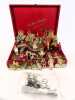

Quelques infimes traces d'usure notamment sur le couvercle de la boîte, quelques figurines légèrement abimées, sinon très bel état de conservation pour cet exceptionnel jouet qui fonctionne encore parfaitement. - Clients Livre Rare Book : Les frais postaux indiqués sont ceux pour la France métropolitaine et la Corse, pour les autres destinations, merci de contacter la librairie pour connaître le montant des frais d'expédition, merci de votre compréhension. Livre Rare Book Customers : The shipping fees indicated are only for France, if you want international shipping please contact us before placing your order, thank you for your understanding. - Frais de port : -Colissimo France 9,5 € -Colissimo International (Union Européenne + Suisse : 20 €) (Reste du Monde : 40 €) -Mondial Relay France 6 €

Phone number : +33 6 18 71 03 67
Thermochimie.
P., Hermann, 1939, grand in 8° broché, 34-35 pages. Texte anglais et français.
Tables annuelles de constantes et données numériques, volume XII (1935-1936) Chapitre 12. PHOTOS sur DEMANDE. ...................... Photos sur demande ...................
Phone number : 04 77 32 63 69
Au seuil de l'inconnu. Traduit du russe par A. Karvovski.
Moscou, Editions de la Paix, sans date, petit in 8° broché, 240 pages ; nombreuses illustrations ; couverture illustrée en couleurs, doublée par la couverture blanche des editions de Moscou.
PHOTOS sur DEMANDE. ...................... Photos sur demande ...................
Phone number : 04 77 32 63 69
"KELVIN, LORD (WILLIAM THOMSON), MAGNUS MCLEAN & ALEXANDER GALT.
Reference : 44048
(1898)
Electrification of Air, of Vapour of Water, and Other Gases. Received and Read, June 17, 1897.
(London, Harrison and Sons, 1898). 4to. No wrappers as extracted from ""Philosophical Transactions"" Year 1897, Volume 191 - Series A. - Pp. 187-228 a. textillustrations showing experimental apparatus.
First printing of a joint paper ""in which we describe a long series of experiments on the electrification of air and other gases, with which we have been occupied from May, 1894, up to the present time (June, 1897).""
General Principles of Quantum Mechanics. Part I + II.
(Menasha, George Banta Publishing, 1929-1930.). Royal8vo. 2 volumes both in the original orange printed wrappers. In ""Reviews of Modern Physics"", Volume 1, October, Number 2 & Volume 2, January, Number 1. Entire issues offered. Previous owner's name to top of both front wrappers. The 1929-issue with soiling to wrappers and a stain to front wrapper affecting first four leaves. Two small stains on top of wrappers on the 1930-issues. Otherwise fine. Pp. 157-215" Pp. 1-58. [Entire volumes: Pp. 157-240" 121 pp.].
First printing of Edwin's two-paper series constituting the first review-paper on Quantum Mechanics: ""In 1929 Kemble would publish the first review article on quantum mechanics for Reviews of Modern Physics"". (Pais, Inward bound).

