 Write to the booksellers
-
Type
Autograph (20)
Book (18918)
Magazine (13)
Manuscript (6)
Photographs (4)
-
Latest
Last 3 days (2)
Last month (32)
Last week (1)
-
Language
English (41)
French (18910)
German (2)
Japanese (1)
Latin (2)
Polish (1)
Portuguese (1)
Russian (1)
Spanish (1)
Swedish (1)
-
Century
16th (5)
17th (35)
18th (293)
19th (3730)
20th (11416)
21st (1468)
-
Countries
Belgium (394)
Côte d'Ivoire (19)
Denmark (1339)
France (17057)
Switzerland (152)
-
Syndicate
CLAM (8)
ILAB (16688)
NVVA (27)
SLACES (27)
SLAM (15314)
SNCAO (12)
Etude de quelques transformations des courbes et des surfaces
Bruxelles, Hayez 1923 72pp., br.orig., non coupé, 25cm., extrait des 'Mémoires' publiés par l'Académie royale de Belgique (classe des sciences, in-8, t.VII)
LES MATHS SANS PROBLEMES - OU COMMENT EVITER D'EN DEGOUTER SON ECOLIER.
CALMANN-LEVY. 1996. In-8. Broché. Etat d'usage, Couv. convenable, Dos satisfaisant, Papier jauni. 161 pages - Nombreuses annotations sur les pages de garde et de titre et soulignements dans le texte au crayon a papier.. . . . Classification Dewey : 372.7-Livre scolaire : mathématiques
Préface par Stella BARUK. Classification Dewey : 372.7-Livre scolaire : mathématiques
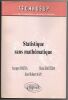
Statistique sans mathématique.
ELLIPSES - Coll Technisup Les Fillières Technologiques des enseignements supérieurs. 1997 - Grand In-8 ( 17.5 x 26cm ), Broché, couverture sobre, 213 pages, index, annexes, Tableaux de coubes...etc, bel exemplaire.
Bon Etat d'usage. Mise à jour du Samedi 27 Juin 2026. Paiement PayPal immédiat, Mondial Relay pour : France, Allemagne, Autriche, Belgique, Espagne, Italie, Portugal, Luxembourg, Pays-Bas, Pologne (Communiquer votre point ou locker si connu). Une participation supplémentaire peut être demandée pour les colis lourds hors France où les envois compris entre 5 et 25 kg sont dégressifs : 2 à 4 kilogrammes - 7.99 / 5 à 10 kg - 15.99 / 15 -25 kg - 25.99. Certaines de nos collections ( Vian, Céline, Camus (...) peuvent être expédiées en Franco de port. Pour linternational hors Europe (Suisse, Canada, Japon, Etats-Unis, les frais dexpéditions peuvent varier selon le poids (mise à jour : 1 juin 2026).
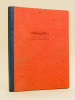
Cours partiel et provisoire de Mathématiques I. Année 1963-1964
Rédigé par Mademoiselle Helsmoortel, 1 vol. in-4 br., 1963, 143 pp. et 11 ff.
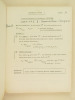
Bon état (qq. annotations).
MATHEMATIQUES / CLASSE DE 4è / CYCLE D'OBSERVATION LYCEES ET COLLEGES D'ENSEIGNEMENT GENERAL.
SUDEL. 1963. In-4. Broché. Etat d'usage, Couv. convenable, Dos satisfaisant, Intérieur acceptable. 363 pages illustrées de quelques figures.. . . . Classification Dewey : 372.7-Livre scolaire : mathématiques
Classification Dewey : 372.7-Livre scolaire : mathématiques
Probability and Statistics. Models for Research.
New York, John Wiley & Sons Inc. 1971, 235x175mm, XVIII - 686pages, editor's binding. Book in good condition.
Pour un paiement via PayPal, veuillez nous en faire la demande et nous vous enverrons une facture PayPal
Some Identities in Combinatory Analysis. [Received 12 November, 1943. - Read 16 December, 1943.] [In: Proceedings of the London Mathematical Society. Second Series. Volume 49]. - [FIRST PUBLICATION OF ""BAILEY PAIRS"".]
London, Hodgson & Son, 1947. Royal 8vo. Bound with all the six original front-wrappers for all six parts of the volume (bound in at rear) in a very nice contemporary blue full cloth binding with gilt lettering and gilt ex-libris (""Belford College. Univ. London"") to spine. Very minor bumping to extremities. Binding tight, and in excellent, very nice, clean, and fresh condition, in- as well as ex-ternally. Small circle-stamp to pasted-down front free end-papers and to title-page (""Bedford College for Women""). Discreet library-markings to upper margin of pasted-down front free end-paper and book-plate stating that the book was presented to the Library of Bedford College by ""Professor H. Simpson./ 1946-47."" Pp. 421-435. [Entire volume: (4), 481pp.].
First publication of Bailey's seminal work on what is later known as a Bailey pair.While studying the second proof of the Rogers-Ramanujan identities, Bailey discovered how to find a pair of sequences satisfying certain relations. In 1984 George E. Andrews introduced the Bailey chain, a series of Bailey pairs.
MATHEMATIQUES GENERALES - COURS THEORIQUE ET PRATIQUE
LIBRAIRIE JOSEPH GIBERT. non daté. In-8. Broché. Etat d'usage, 2ème plat abîmé, Dos satisfaisant, Intérieur frais. 462 pages. Ecritures sur le dernier plat, au stylo.. . . . Classification Dewey : 510-Mathématiques
Renfermant de nombreuses figures et près de 2500 exercices avec réponses dont plus de 350 entièrement résolus. Traduit de l'anglais par A. Sallin. Classification Dewey : 510-Mathématiques
Mathématiques. Terminale D. Tomes 1 et 2.
Couverture souple. 2 volumes brochés, 500 pages. Trace de scotch sur une page.
Livre. Editions Bordas, 1971.
Bailleul M./Manoury F.-X./Préteseille S.
Reference : R300303546
(2022)
ISBN : 234006659X
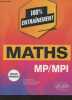
"Maths MP/MPI - Nouveaux programmes - ""100% entraînement"""
Ellipses. 2022. In-8. Broché. Bon état, Couv. convenable, Dos satisfaisant, Intérieur frais. 581 pages.. . . . Classification Dewey : 372.7-Livre scolaire : mathématiques
Classification Dewey : 372.7-Livre scolaire : mathématiques
Les casse-tête logiques de Baillif
Dunod 1979, in-8 cartonnage illustré de l'éditeur, 150 p. (très bon exemplaire ; non réédité) Un passionné de mathématiques, ancien polytechnicien, propose ici de nombreux problèmes… avec les solutions !
LES CASSE-TETE LOGIQUES DE BAILLIF
1979 cartonné éditeur (hard-back editor) in-octavo carré, dos blanc (white spine), premier plat illustré en couleurs (front cover illustrated in colours), illustrations : in et hors-texte (in text and full page engraving), 152 pages, 1979 à Paris Dunod,
bon état (very good condition)
Mon Carnet de Mathématique moderne
BAILLY et WETTSTEIN. 1984. In-8. Broché. Bon état, Couv. convenable, Dos satisfaisant, Intérieur frais. 56 pages. Nombreuses figures en noir et blanc dans le texte.. . . . Classification Dewey : 510-Mathématiques
Notions de logique, Les ensembles, relations binaires, fonctions- applications, lois de compositions internes, l'ensemble Z... Classification Dewey : 510-Mathématiques
Mon carnet de mathématique moderne. Collection : Mes carnets.
Saint-Martin-en-Haut, Editions Bailly, 1981. 11 x 21, 56 pp., broché, très bon état.
Leçons sur les fonctions discontinues professées au Collège de France
Paris, Gauthier-Villars 1905 viii + 128pp., 26cm., br.orig., qqs. rousseurs, bon état, W85662
Lecons sur les Fonctions Discontinues professées au College de France.
Paris, Gauthier-Villars, 1905. Contemp. hcalf. Back somewhat worn. Stamp on titlepage. VIII,127,(1) pp. Internally clean.
First edition of Baires third work which had a profound influence on the teaching of mathematics in France.
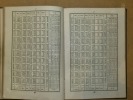
Leçons sur les théories générales de l'analyse. Tomes I et II.
Gauthier-Villars, Cours d'Analyse de la Faculté des Sciences de Dijon, 2 tomes reliés en 1 volume, 1907, 232-347 pp, demi-percaline à coins, un tampon sur la page de titre, reliure frottée.
Merci de nous contacter à l'avance si vous souhaitez consulter une référence au sein de notre librairie.
Théorie des nombres irrationnels des limites et de la continuité - 4e édition.
Vuibert. 1931. In-8. Broché. Etat d'usage, Couv. convenable, Dos satisfaisant, Papier jauni. 59 pages.. . . . Classification Dewey : 510-Mathématiques
Classification Dewey : 510-Mathématiques
Lecons sur les Fonctions Discontinues professées au College de France. Rédigées par A. Denjoy.
Paris, Gauthier-Villars, 1905. Lex8vo. Uncut in orig. printed wrappers. Stamp on foot of titlepage. VIII,128 pp. From the library of the Danish logician and philosopher Jørgen Jørgensen with his name on frontcover. Internally fine and clean.
First edition of Baires third work which had a profound influence on the teaching of mathematics in France
LES PUISSANCES DE DIX / ARITHMETIQUE DES CALCULS SCIENTIFIQUES ET TECHNIQUES.
HACHETTE. 1968. In-8. Broché. Etat d'usage, Tâchée, Dos satisfaisant, Intérieur acceptable. 127 pages - mouillures en pied de page en fin d'ouvrage sans conséquence sur la lecture - coins frottés.. . . . Classification Dewey : 372.7-Livre scolaire : mathématiques
Classification Dewey : 372.7-Livre scolaire : mathématiques
ELEMENTS DE COSMOGRAPHIE - COLLECTION G. FOULON
ECOLE ET COLLEGE. 1941. In-8. Relié. Etat d'usage, Couv. convenable, Dos satisfaisant, Papier jauni. 172 pages augmentées de nombreuses illustrations en noir et blanc dans et hors texte. . . . Classification Dewey : 372.7-Livre scolaire : mathématiques
CLASSE DE MATHEMATIQUES EEMENTAIRES Classification Dewey : 372.7-Livre scolaire : mathématiques
A First Course in Mathematics, for students of engineering and the physical sciences
Van Nostrand Company, 1943 15,5 x 23,5, 295 pp., 143 figures, cartonnage, Très bon état - 3ème édition
AN IMPLICIT NUMERICAL METHOD FOR SOLVING THE TWO-DIMENSIONAL HEAT EQUATION
***. non daté. In-8. En feuillets. Bon état, Couv. convenable, Dos satisfaisant, Intérieur frais. Paginé de 361 à 372. Ouvrage en anglais. Document photocopié.. . . . Classification Dewey : 510-Mathématiques
Classification Dewey : 510-Mathématiques
Méthodes numériques. Analyse, algèbre, équations différentielles ordinaires. Traduit par Irina Petrova.
1976 Moscou, Editions Mir, 1976, in 8° relié pleine toile noire de l'éditeur, jaquette (avec petits défauts), 606 pages.
...................... Photos sur demande ..........................


Phone number : 04 77 32 63 69
Amusements Mathématiques
Paris Dunod 1957 In-8 204 pp, traduit par H.Borzer, couverture illustrée, brochage légèrement passé.
Bon État Broché à raba

