 Write to the booksellers
-
Type
Autograph (1)
Book (1502)
Drawings (3)
Engraving (1)
Magazine (120)
Maps (28)
Music sheets (3)
Old papers (2)
Photographs (2)
Posters (6)
-
Latest
Last 3 days (1)
Last month (24)
Last week (2)
-
Language
English (1)
French (1653)
German (1)
Polish (12)
Spanish (1)
-
Century
16th (2)
17th (12)
18th (49)
19th (128)
20th (623)
21st (70)
-
Countries
Belgium (201)
Brazil (1)
Canada (1)
Côte d'Ivoire (6)
Denmark (4)
France (1249)
Greece (3)
Switzerland (203)
-
Syndicate
ALAC (1)
ILAB (445)
NVVA (76)
SLACES (76)
SLAM (356)
SNCAO (10)
La Question européenne, improprement appelée polonaise.. Réponse aux objections présentées par MM. Pogodine, Schédo-Ferroti, Porochine, Schnitzler, Solowiew, etc., contre le polonisme des provinces lithunao-ruthènes et contre le non-slawisme des Moscovites
Paris, E. Dentu, 1863 in-8, XX-228 pp., broché sous couverture imprimée de l'éditeur. Dos défraîchi.
Aborde la question polonaise sous deux éclairages complémentaires : une opposition à la présence russe en Europe (y compris donc dans sa possession de la Finlande et des provinces baltiques) ; la promotion d'un modèle fédératif pour une Europe à contruire jusqu'au Dniestr. - - VENTE PAR CORRESPONDANCE UNIQUEMENT - LIEN DE PAIEMENT, NOUS CONSULTER.
Un « voyage d'amitié » en Tchécoslovaquie et en Pologne.
Chambéry, Bureau des Œuvres Diocésaines, s.d. (1935), gr. in-8°, 205 pp, préface de Mme Rosa Bailly, 90 photos et dessins dans le texte, 2 cartes, broché, bon état
Après un bref passage en Tchécoslovaquie (un chapitre de 14 pages), l'ouvrage traite principalement de la Pologne : un copieux rappel de son histoire, des origines à la Guerre de 1914-1918 et à l'après-guerre (60 pages), puis le récit du voyage : Katowice, Zakopane, Cracovie, Czestochowa, Varsovie, Torun, Gdynia, Danzig, Gniezno, Poznan, le retour, avec de nombreuses photos. L'auteur était chanoine honoraire de Chambéry. Désormais les frais d'envoi sont de 6 € seulement pour les livres jusqu'à 1 kg (colissimo suivi), pour la France métropolitaine.
Les relations polono-allemandes et polono-soviétiques au cours de la période 1933-1939. Recueil de documents officiels
Flammarion Paris, Flammarion 1940. Grand In-8 broché de 252 pages non coupées. Index des personnalités citées. République de Pologne. Ministère des affaires étrangères. Bon état
![Les relations polono-allemandes et polono-soviétiques au cours de la période 1933-1939. Recueil de documents officiels. RELATIONS INTERNATIONALES ]](https://static.livre-rare-book.com/pictures/MAS/183382_1_thumb.jpg)
Toutes les expéditions sont faites en suivi au-dessus de 25 euros. Expédition quotidienne pour les envois simples, suivis, recommandés ou Colissimo.
Sources documentaires concernant l'histoire du Régiment des Chevau-Légers de la Garde de Napoléon Ier.. D'après des manuscrits originaux et des documents édités, publiés et précédés d'une préface (Préface en français par C. Przeclawski et E. Titeux). Edition de la Bibliothèque du Majorat Krasinski à Varsovie
Varsovie, X. Rubieszewsli et Ch. Wrotnowski, 1899 fort vol. in-4, [4]-CLXVIII-830 pp., avec 92 planches hors-texte (17 fac-similés de documents, 10 planches d'uniformes en couleurs sous serpentes, 65 vues et portraits en noir), index, demi-chagrin bleu nuit, dos à nerfs, premier plat de couv. (avec manque) cons. (reliure moderne).
Edition originale de toute rareté.Publication des "Notices historiques" du général Dautancourt. On y trouve également le registre des états de service des officiers des chevau-légers, la liste des soldats du régiment et l'"Essai sur le maniement de la lance" du comte Krasinski, dont l'unique et rare édition date de 1811. A noter que l'introduction et quelques documents sont bilingues (français-polonais).Très important document sur ce régiment polonais.Davois III, 133.Bon exemplaire. - - VENTE PAR CORRESPONDANCE UNIQUEMENT - LIEN DE PAIEMENT, NOUS CONSULTER.


Phone number : 06 46 54 64 48
POLOGNE
Un ouvrage de 128 pages, format 180 x 250 mm, illustré, relié cartonnage couleurs, publié en 2005, Parma Press, bon état
Découverte de la Pologne
Phone number : 04 74 33 45 19
REPIUBLIQUE DE POLOGNE . MINISTERE DES AFFAIRES ETRANGERES
Reference : 99935537
(1940)
LES RELATIONS POLONO-ALLEMANDES ET POLONO-SOVIETIQUES AU COURS DE LA PERIODE 1933 - 1939 . RECUEIL DE DOCUMENTS OPFFICIELS.
Flammarion Flammarion 1940, In-4 broché, 252 pages. Bon état.
Toutes les expéditions sont faites en suivi au-dessus de 25 euros. Expédition quotidienne pour les envois simples, suivis, recommandés ou Colissimo.
"[REPUBLIC OF POLAND. MINISTRY OF FOREIGN AFFAIRS]. [Jan Karski].
Reference : 60182
(1943)
THE MASS EXTERMINATION of JEWS in GERMAN OCCUPIED POLAND. Note addressed to the Governments of the United Nations on December 10th, 1942, and other documents. - [INFORMING THE WEST OF THE HOLOCAUST]
London, New York, Melbourne (printed in Great Britain), Published on behalf of the Polish Ministry of Foreign Affairs, (1943). 8vo. Stapled as issued. Title-page printed in red. Stapels with rust, slightly affecting surrounding paper. A very fine, near mint, copy. 16 pp.
The scarce first printing of this hugely important publication, which constitutes one of the very first official reports on Holocaust and one of the most accurate accounts that had been presented to the West, changing their knowledge of what was actually going on. This seminal pamphlet consists of 1) Raczynski's account of the ongoing Holocaust, based among other reports, on the eye-witness-report by Jan Karski, a Polish Government emissary in occupied Poland, who bribed his way into a German concentration camp and witnessed the mass extermination of Jews, 2) the seminal ""Joint Declaration"" by members of the United Nations, in which ""The above-mentioned Govenments and the French National Committee condemn in the strongest possible terms this bestial policy of cold-blooded extermination. They declare that such events can only strengthen the resolve of all free-loving peoples to overthrow the barbarous Hitlerite tyranny. They reaffirm their solems resolution to ensure that those responsible for these crimes shall not escape retribution, and to press on with the necessary practical measures to this end."" (p. 12), 3) an extract of Deputy Prime Minister Mikolajczy's statement on behalf of the Polish Government, and 4) the text of Raczynski's broadcast of December 1942, in which pleaded for action, wishing to make the public and the Allied nations ""understand how real is the tragedy which is taking place not so very far from the shores of this island, on the continet of Europe - on the soil of Poland. For more than three years the Germans have consistently done everything they could to hide from the eyes of the world the martyrdom of the Polish nation, the like of which has never been known in the history of humanity. But ""when we would keep silence the very stones will cry out""."" (p. 15). While the details were neither complete nor wholly accurate, the Allies were aware of most of what the Germans had done to the Jews at a relatively early date. The mass murder of the Jews was of such dimensions, however, that, at first, they could not believe the reports that reached them. This quickly changed, though. In February of 1942 Jacob Grojanowski, an escaped prisoner of the Chelmno extermination camp, provided the Oneg Shabbat group with detailed information about what went on at the Chelmno camp. His report became known as the Grojanowski Report. It was smuggled out of the Warsaw Ghetto via the Polish underground and reached London in June of 1942. It is not known exactly what happened to the report at that point, but by February of 1942, the United States Office of War Information had decided not to release information about the extermination of Jews (thinking that there was a risk of the public viewing the war as only being a Jewish problem). Thus, the Grojanowski Report was not released. By at least October of 1942 British radio had broadcast news of the gassing of Jews to the Netherlands, and in December 1942, the Western Allies released their Joint Declaration [which is printed in the present publication], describing and condemning in the strongest manner Hitler's violent attempts at exterminating the Jews of Europe. In 1942 Jan Karski (1914-2000), a Polish World War II resistance movement fighter and later professor at Georgetown University gave his first report to the Polish, British, and U.S. governments on what was going on in the German extermination camps in Poland.Karski reported to the Polish government in exile (i.e. Raczynski, who was the Ambassador and one of its most prominent leaders) and the Western Allies on the situation in German-occupied Poland. Karski personally met with Franklin Roosevelt and British Foreign Secretary Anthony Eden to explain what went on in Poland, and Raczynski wrote up the report. Eventually, the American Government confirmed the reports to Jewish leaders in late November 1942, and shortly thereafter they were publicized [i.e. in the present publication]. Karski's report (through Raczynski) became one of the most important reports in the history of the Holocaust, being a major factor in informing the West. It sparked one of the first official publications from the Allies on the mass extermination of Jews in Poland and resulted in the official reports and condemnations from the Allied countries, i.e. the ""Joint Declaration"" [also published here]. ""The purpose of this publication is to make public the contents of the Note of December 10th, 1942, addresses by the Polish Government to the Governments of the United Nations concerning the mass extermination of Jews in the Polish territories occupied by Germany, and also other documents treating on the same subject. [...] In the hope that the civilized worlds will draw the appropriate conclusions, the Polish Government desire to bring to the notice of the public, by means of the present White Paper, these renewed German efforts at mass extermination, with the employment of fresh horrifying methods."" (From the Introductory Note, p. 3). ""Most recent reports present a horrifying picture of the position to which the Jews in Poland have been reduced. The new methods of mass slaughter applied during the last few months confirm the fact that the German autorities aim with systematic deliberation at the total extermination of the Jewsih population of Poland and of the many thousands of Jews whom the German authorities have deported to Poland from Western and Central European countries and from the German Reich itself.The Polish Government consider it their duty to bring to the knowledge of the governments of all civilized countries the following fully authentical information received from Poland during recent weeks, which indicates all too plainly the new methods of extermination adopted by the German authorities."" (p. 4).
"[REPUBLIC OF POLAND. MINISTRY OF FOREIGN AFFAIRS]. [Jan Karski].
Reference : 60436
(1943)
THE MASS EXTERMINATION of JEWS in GERMAN OCCUPIED POLAND. Note addressed to the Governments of the United Nations on December 10th, 1942, and other documents. - [INFORMING THE WEST OF THE HOLOCAUST]
London, New York, Melbourne (printed in Great Britain), Published on behalf of the Polish Ministry of Foreign Affairs, (1943). 8vo. Stapled as issued. Title-page printed in red. Stapels with rust, slightly affecting surrounding paper. A very fine, near mint, copy. 16 pp.
The scarce first printing of this hugely important publication, which constitutes one of the very first official reports on Holocaust and one of the most accurate accounts that had been presented to the West, changing their knowledge of what was actually going on. This seminal pamphlet consists of 1) Raczynski's account of the ongoing Holocaust, based among other reports, on the eye-witness-report by Jan Karski, a Polish Government emissary in occupied Poland, who bribed his way into a German concentration camp and witnessed the mass extermination of Jews, 2) the seminal ""Joint Declaration"" by members of the United Nations, in which ""The above-mentioned Govenments and the French National Committee condemn in the strongest possible terms this bestial policy of cold-blooded extermination. They declare that such events can only strengthen the resolve of all free-loving peoples to overthrow the barbarous Hitlerite tyranny. They reaffirm their solems resolution to ensure that those responsible for these crimes shall not escape retribution, and to press on with the necessary practical measures to this end."" (p. 12), 3) an extract of Deputy Prime Minister Mikolajczy's statement on behalf of the Polish Government, and 4) the text of Raczynski's broadcast of December 1942, in which pleaded for action, wishing to make the public and the Allied nations ""understand how real is the tragedy which is taking place not so very far from the shores of this island, on the continet of Europe - on the soil of Poland. For more than three years the Germans have consistently done everything they could to hide from the eyes of the world the martyrdom of the Polish nation, the like of which has never been known in the history of humanity. But ""when we would keep silence the very stones will cry out""."" (p. 15).While the details were neither complete nor wholly accurate, the Allies were aware of most of what the Germans had done to the Jews at a relatively early date. The mass murder of the Jews was of such dimensions, however, that, at first, they could not believe the reports that reached them. This quickly changed, though.In February of 1942 Jacob Grojanowski, an escaped prisoner of the Chelmno extermination camp, provided the Oneg Shabbat group with detailed information about what went on at the Chelmno camp. His report became known as the Grojanowski Report. It was smuggled out of the Warsaw Ghetto via the Polish underground and reached London in June of 1942. It is not known exactly what happened to the report at that point, but by February of 1942, the United States Office of War Information had decided not to release information about the extermination of Jews (thinking that there was a risk of the public viewing the war as only being a Jewish problem). Thus, the Grojanowski Report was not released. By at least October of 1942 British radio had broadcast news of the gassing of Jews to the Netherlands, and in December 1942, the Western Allies released their Joint Declaration [which is printed in the present publication], describing and condemning in the strongest manner Hitler's violent attempts at exterminating the Jews of Europe. In 1942 Jan Karski (1914-2000), a Polish World War II resistance movement fighter and later professor at Georgetown University gave his first report to the Polish, British, and U.S. governments on what was going on in the German extermination camps in Poland.Karski reported to the Polish government in exile (i.e. Raczynski, who was the Ambassador and one of its most prominent leaders) and the Western Allies on the situation in German-occupied Poland. Karski personally met with Franklin Roosevelt and British Foreign Secretary Anthony Eden to explain what went on in Poland, and Raczynski wrote up the report. Eventually, the American Government confirmed the reports to Jewish leaders in late November 1942, and shortly thereafter they were publicized [i.e. in the present publication]. Karski's report (through Raczynski) became one of the most important reports in the history of the Holocaust, being a major factor in informing the West. It sparked one of the first official publications from the Allies on the mass extermination of Jews in Poland and resulted in the official reports and condemnations from the Allied countries, i.e. the ""Joint Declaration"" [also published here].""The purpose of this publication is to make public the contents of the Note of December 10th, 1942, addresses by the Polish Government to the Governments of the United Nations concerning the mass extermination of Jews in the Polish territories occupied by Germany, and also other documents treating on the same subject. [...] In the hope that the civilized worlds will draw the appropriate conclusions, the Polish Government desire to bring to the notice of the public, by means of the present White Paper, these renewed German efforts at mass extermination, with the employment of fresh horrifying methods."" (From the Introductory Note, p. 3).""Most recent reports present a horrifying picture of the position to which the Jews in Poland have been reduced. The new methods of mass slaughter applied during the last few months confirm the fact that the German autorities aim with systematic deliberation at the total extermination of the Jewsih population of Poland and of the many thousands of Jews whom the German authorities have deported to Poland from Western and Central European countries and from the German Reich itself.The Polish Government consider it their duty to bring to the knowledge of the governments of all civilized countries the following fully authentical information received from Poland during recent weeks, which indicates all too plainly the new methods of extermination adopted by the German authorities."" (p. 4).
Les relations polono-allemandes et polono-soviétiques au cours de la période 1932-1935
Flammarion 2026 in8. 2026. Broché.
mauvais etat couverture abimee ex-libris quelque pages abimee
REPUBLIQUE DE POLOGNE. MINISTERE DES AFFAIRES ETRANGERES.
Reference : 9991501
(1940)
LES RELATIONS POLONO-ALLEMANDES ET POLONO-SOVIETIQUES AU COURS DE LA PERIODE 1933 - 1939. RECUEIL DE DOCUMENTS OFFICIELS.
Flammarion Flammarion 1940, In-4 broché de 252 pages. Bon état.
Toutes les expéditions sont faites en suivi au-dessus de 25 euros. Expédition quotidienne pour les envois simples, suivis, recommandés ou Colissimo.
J. F. KOENIG. John Franklin Koenig et le lyrisme de l'étendue
Paris Galerie Arnaud 1960 in 8 carré (21,5x18,5) 1 volume broché, couverture à rabats, portrait en frontispice, 97 pages, avec des illustrations en noir et blanc. Texte en français et en anglais. John Franklin Koenig. Georges Annenkov (Yury Pavlovich Annenkov), Petropavlovsk 1889 - Paris 1974, artiste peintre, dessinateur et costumier français. Séverin Rajjchman, dit Sevek, né en 1918 d'un père polonais et d'une mère austro-tchèque - Annecy 1994. Edition originale. Bel envoi autographe signé par John Franklin Koenig à Georges Annenkov. Bel exemplaire ( Photographies sur demande / We can send pictures of this book on simple request )
Très bon Ed. originale
Revue " Connaissance de l'histoire " - Hachette - Numéro spécial - La guerre de Coréee Le Sopwith Camel - Le triomphe de la Pologne en 1920 - Le North American B25 Mitchell - Thermophyles 1941 - Les canons antichars - Arras 1940 - La poche de la Ruhr en 1945
1 vol in-4 broché - N° 48 de septembre 1982 - illustrations noir et blanc et couleurs en et hors texte
bel état
Revue de psychologie des peuples 1951 N° 4 : Italie - Allemagne - Pologne - Russie - Ecosse … 6 e année. N° 4.
Couverture souple. Revue. 80 pages.
Périodique. Institut havrais de sociologie économique et de psychologie des peuples, 4e trimestre 1951.
Revue des deux mondes - 15 décembre 1857 L'écueil de Lovelace (Paul de Molènes) - Benvenuto Cellini d'après de nouveaux documens (Henri Delaborde) - Souvenirs d'un officier-général de la marine. La jeunesse d'un homme de mer. I. Une éducation maritime d'autrefois (E. Jurien de La Gravière) - Du génie anglais dans l'Inde. Le grand-juge William Jones et le poète-évêque Réginald Heber (M. Villemain) - Tendances nouvelles de la zoologie. La zoologie physiologique (A. de Quatrefages) - Olivier Goldsmith, sa vie et ses écrits (C. Clarigny) - Le mouvement musical de 1857. Opéras nouveaux. La musique en Pologne (P. Seudo) - Poésie. La ferme du Val-Calvin (André Theuriet) - Les ennéades de Plotin (M. Emile Saisset)
Seconde période - Tome douzième - XXVIIe année - 15 décembre 1857 - 4e livraison - Paris. Bureau de La Revue des Deux Mondes - grand in-8 broché - 236 pages
assez bon état - Quelques pages très légèrement piquées
Revue d'Histoire de la Deuxième Guerre Mondiale et des conflits contemporains
Reference : 29290
(1991)
Revue d'Histoire de la Deuxième Guerre Mondiale et des conflits contemporains:Les lecteurs des Décombres de Lucien Rebatet: un témoignage inédit du sentiment fasciste sous l'Occupation (Robert Belot) - Les relations entre les Etats-Unis et les démocraties occidentales de 1938 à 1941: la prétention américaine au "leadership" mondial (Bernd Martin) - Les milices d'autoprotection de la communauté allemande de Pomérélie, Posnanie et Silésie polonaise (1939-1940) (Georges Jérôme) - La mission de Christian Fouchet en Pologne (28 décembre 1944-31 mars 1945) (Jean-Louis Pierron) - Le 20 juillet 1944 vu d'Amérique (Birdsall S. Viault) - Documentation: Léon Papeleux. Le Saint-Siège et l'Union soviétique (1941-1945) - Chroniques de l'Institut d'Histoire des Conflits contemporains - Comptes rendus - Résumés
1991 1 vol in-8 - N° 163 de Juillet 1991 - 41e année - Presses universitaires de France - Broché - 128 pages
bon état
Revue d'Histoire de la Deuxième Guerre Mondiale et des conflits contemporains
Reference : 29603
(1999)
Revue d'Histoire de la Deuxième Guerre Mondiale et des conflits contemporains:Dossier: La France à la recherche de sécurité (1920-1922)Présentation (Jacques Bariéty) - L'Allemagne: un danger pour la France en 1920? (Chantal Metzger) - Entre partenariat et alliance: rapports diplomatiques et militaires de la Belgique avec la France en 1920 (Nicolas Fleurier) - La France et la Pologne, 1920-1922: relations bilatérales ou parties d'un système de sécurité français en Europe centre-orientale, septembre 1920-décembre 1921 (Traian Sandu) - Une conception traditionaliste de la politique orientale de la France. Le vicomte de Fontenay, envoyé plénipotentiaire auprès du roi Pierre Ier Karageorgevitch (1917-1921) - Le projet de pacte franco-britannique, 1920-1922 (Jacques Bariéty) - La France et la Société des Nations en 1922 (Marie-Renée Mouton) - La trace ténue d'une ancienne alliance: la France et la Russie, 1920-1922 (Anne Hogenhuis-Seliverstoff)
1999 1 vol in-8 - N° 193 de Septembre 1999 - 48e année - Presses universitaires de France - Broché - 144 pages
bon état
Revue du Nord. Pologne au XVII e - Liberté d'enseignement à la veille de 1848, l'opinion belge en 1848. Cathares - Louis XVIII à Gand - Cambrai ...
Couverture souple. Revue d'environ 200 pages.
Périodique. Université de Lille, Juillet- septembre 1967.
Revue Historique de l’Armée - N° 3 de 1953L’organisation du Service de Santé aux Armées de l’Ancien Régime - Le comte de Guibert - l’Ecole de Mars - Arago : de l’Ecole Polytechnique à l’observatoire de Paris - Lunéville garnison de cavalerie - le débarquement allié et la bataille de Normandie - LA Pologne Terrassée 1939 - Jean de Lattre maréchal de France
1953 N° 3 de 1953 - grand in-8 broché - revue illustrée
assez bon état
Revue historique des armées - Gal BERTIN - Cel LEGRAD - Cel MULLER de SCHONCOR - Cel GUINARD - Cel DONNART - Chef de Bataillon PERCHET - Lt-Cel GUILLEMEAU - Cel GUELTON - Cel LE GOYET - Commissaire de la Marine RENAUD - Cel HERVE - Cap. PETIT - Chef de Bataillon de PREVILLE - Cel HUMMERICH - Chef de Bataillon ROBERT - Cel de MAUPEOU d'ABLEIGES - I. ROGER-NOEL - Gal E. LACOMBE - Sophie REYNAUD - N. HORTA RODRIGUEZ - P. LADRANGE - Chef de Bataillon POUPART - Cel FORKEL
Reference : 18617
Revue historique des armées - N° 3, 1970 - Numéro Spécial "La III è Région Militaire" - Bretagne - Vendée - Anjou - Maine - Basse-Normandie 1870-1970(L'année terrible (1870-1871) - Les Volontaires de l'Ouest - Le 2 è de ligne à la bataille de Spicheren - La contre-attaque de loigny - La bataille du Mans - Le 117 è R.I. à Virton (08/1914) - le 41 è R.I. sous arras (10/1914) - Le 137 è R.I. Régiment de la tranchée des Baionnettes (1916) - L'épopée des fusilliers-marins - Le glorieux sacrifices de la 21 è D.I. en 05/06/1940 - La défense de lorient en 06/1940 - L'ile de Sein répond à l'appel (06/1940) - Saint-Nazaire et l'opération "Chariot" (03/1942) - Heurt, malheur et grandeur de lorient (1941-1943) - Les Maquis bretons - La prise de cherbourg vue du côté allemand (06/1944) - Les Parachutistes S.A.S. dans les Côtes-du-nord (06/1944) - La percée d'avranches (07/1944) - La bataille de brest (avant 09/1944) - Le siège de Saint-Malo (08/09-1944
PARIS, Ministère De la Défense - I Couverture illustrée - Publication trimestrielle - In-8, 24 x 16 cms - Broché - couverture ilustrée d'armoiries - Nombreuses photos et reproductions - 221pages + VI - bon exemplaire
Conformément à nos conditions générales de vente :Les frais de port sont affichés à titre indicatif. Il se peut que nous devions vous contacter pour vous informer du coût de laffranchissement supplémentaire en fonction du poids et du nombre de livres, surtout pour les envois internationaux Cependant vu l'augmentation des tarifs postaux à l'internationale, nous pouvons expédier les ouvrages en point relais MONDIAL RELAY pour les pays suivants : Allemagne, Autriche, Belgique, Espagne, Italie, Luxembourg, Pays-Bas, Pologne, et Portugal. Merci de nous indiquer en retour le point relais choisi ainsi que votre numéro de téléphone mobile & adresse Courriel pour assurer le suivi du colis.N'hésitez pas à nous interroger.In accordance with our general terms and conditions of sale:Shipping costs are displayed for informational purposes only. We may need to contact you to inform you of the additional postage costs depending on the weight and number of books, especially for international shipments.However, given the increase in international postal rates, we can ship books via Mondial Relay to the following countries: Germany, Austria, Belgium, Spain, Italy, Luxembourg, Netherlands, Poland, and Portugal. Please provide us with your chosen Mondial Relay point, as well as your mobile phone number and email address to ensure package tracking.Please feel free to contact us with any questions
[revue] Objets et Mondes tome 24 fascicule 3-4. Numéro spécial Pologne.
Paris: Musée de l'Homme, Museum National d'Histoire Naturelle, 1987 in-4, nombreuses illustrations. Broché, très bon état.
[revue] Objets et Mondes tome 24 fascicule 3-4. Numéro spécial Pologne. (Paris: Musée de l'Homme, Museum National d'Histoire Naturelle, 1987). [M.C.: revue, Ethnologie, Pologne]
[revue] Objets et Mondes tome 2 [tome II] fascicule 3. Automne 1962. (Auteurs: Jacqueline DELANGE, Annette LAMING-EMPERAIRE, Jacques MILLOT et Yvette LAPLAZE, Marie-Louise PASQUINO, Monique ROUSSEL de FONTANES)
Reference : 1353994
[revue] Objets et Mondes tome 2 [tome II] fascicule 3. Automne 1962. Sommaire: Jacqueline DELANGE, Les arts anciens de la plaine du Tchad. - Annette LAMING-EMPERAIRE, Travaux archéologiques en Amérique du Sud. - Jacques MILLOT et Yvette LAPLAZE, Les felana malgaches. - Marie-Louise PASQUINO, Un costume finnois du XIIe siècle. - Monique ROUSSEL de FONTANES, Une exposition de papiers découpés polonais.
Paris: Musée de l'Homme, Museum National d'Histoire Naturelle, 1962 in-4, nombreuses illustrations. Broché. Très bon état, cachet. Sommaire: Jacqueline DELANGE, Les arts anciens de la plaine du Tchad. - Annette LAMING-EMPERAIRE, Travaux archéologiques en Amérique du Sud. - Jacques MILLOT et Yvette LAPLAZE, Les felana malgaches. - Marie-Louise PASQUINO, Un costume finnois du XIIe siècle. - Monique ROUSSEL de FONTANES, Une exposition de papiers découpés polonais.
[revue] Objets et Mondes tome 2 [tome II] fascicule 3. Automne 1962. Sommaire: Jacqueline DELANGE, Les arts anciens de la plaine du Tchad. - Annette LAMING-EMPERAIRE, Travaux archéologiques en Amérique du Sud. - Jacques MILLOT et Yvette LAPLAZE, Les felana malgaches. - Marie-Louise PASQUINO, Un costume finnois du XIIe siècle. - Monique ROUSSEL de FONTANES, Une exposition de papiers découpés polonais. (Paris: Musée de l'Homme, Museum National d'Histoire Naturelle, 1962). [M.C.: revue, ethnologie, art africain, Tchad, Amérique du Sud, Patagonie, Madagascar, Finlande, Pologne]
LES PAYSANS. Tome I : L'automne - l'hiver. Tome II : Le printemps - l'été.
Lausanne, Editions L'Age d'Homme, 1981. 2 tomes en 2 vol. in-8, couv. rempliées ill. en coul., 439 et 502 pp.
Collection "Classiques Slaves" dirigée par Jacques Catteau, Georges Nivat et Vladimir Dimitrijevic.W adys aw Reymont, de son vrai nom Stanis aw W adys aw Rejment, (1867-1925 ) est un journaliste et écrivain polonais. Bon ensemble. - Frais de port : -France 6,9 € -U.E. 11 € -Monde (z B : 18 €) (z C : 31 €)
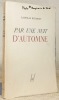
Par une nuit d’automne et autres contes traduits du polonais par Franck-Louis Schoell.
Fribourg, Egloff, Librairie de l’Université 1944, 185x120mm, 112pages, broché. Bon état.
Pour un paiement via PayPal, veuillez nous en faire la demande et nous vous enverrons une facture PayPal
Les diverses émissions et oblitérations de la Russie Subcarpathique et de la Slovaquie du Sud (1860 - 1965)
BISCHWILLER, Ed. de l'Echangiste Universel - Sans date (vers 1965) - In-8 - Broché - Carte en frontispice - Carte centrale sur double page - illustrations en texte - 63 pages - Très propre
Conformément à nos conditions générales de vente :Les frais de port sont affichés à titre indicatif. Il se peut que nous devions vous contacter pour vous informer du coût de laffranchissement supplémentaire en fonction du poids et du nombre de livres, surtout pour les envois internationaux Cependant vu l'augmentation des tarifs postaux à l'internationale, nous pouvons expédier les ouvrages en point relais MONDIAL RELAY pour les pays suivants : Allemagne, Autriche, Belgique, Espagne, Italie, Luxembourg, Pays-Bas, Pologne, et Portugal. Merci de nous indiquer en retour le point relais choisi ainsi que votre numéro de téléphone mobile & adresse Courriel pour assurer le suivi du colis.N'hésitez pas à nous interroger.In accordance with our general terms and conditions of sale:Shipping costs are displayed for informational purposes only. We may need to contact you to inform you of the additional postage costs depending on the weight and number of books, especially for international shipments.However, given the increase in international postal rates, we can ship books via Mondial Relay to the following countries: Germany, Austria, Belgium, Spain, Italy, Luxembourg, Netherlands, Poland, and Portugal. Please provide us with your chosen Mondial Relay point, as well as your mobile phone number and email address to ensure package tracking.Please feel free to contact us with any questions

