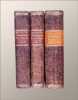
Paris, Guillaumin, 1843. Royal8vo. Bound in 2 contemp. hcalf, spines gilt, tome-and titlelabels with gilt lettering. One tome-label scratched. Stamps on titlepages. Engraved portrait as frontispiece. LXXIX,520"(4),714,(2) pp. Some leaves with light browning, some scattered brownspots.
Third translation into French of Smith's ""An Inquiry into the Nature and Causes of the Wealth of Nations"". ""A third and better translation by Count Germain appeared at Paris An. X (1802) in 5 volumes 8vo, with a portrait of Aam Smith. Other editions were issued in 1809 and 1822, the former in 3 the latter in 6 volumes 8vo, one being a volume of notes. This edition was revised by Jerome Adolphe Blaqui, and was republished in Paris in 1843 in 2 volumes 8vo (the offered item) as volume 5 and 6 of Guillaume's ""Collection des Économistes"".(David Murray in: Adam Smith across Nations. Edited by Cheng-chung Lai)
Londres, Pierre J. Duplain, 1788. 8vo, Two nice uniform contemporary full calf bindings with gilt spines. Some loss of leather to back hinge and lower capital of volume one and minor loos of leather to spine of volume two, all due to worming. Worming is not bad and does not affect anything but outer layer of small parts of the bindings. Apart from the worming a very nice, fresh and clean copy indeed. (8), IV, 503" (4), 496 pp. With both half-titles, the advertisment, both prefaces and the table of contents.
Rare early French translation of Adam Smith's political and economic classic, the ""Wealth of Nations"". Translated by Blavet. The present edition constitutes the third reprint of the second French translation. The second French translation was done by Blavet and is the first translation into French of which the translator and publisher are known. ""The reprint of Blavet's version appeared at Yverdon in 1781 in 6 volumes 12mo, and at Paris in the same year in 3 volumes 12mo, and again at London and Paris in 1788 in 2 volumes 8vo [the present edition], and revised and corrected, with Blavet's name as translator, at Paris An, ix (1800-01) in 4 volumes 8vo.He [Blavet] had no intention of publishing it until his friend M. Ameilhon happened to complain of scarcity of interesting articles for his Journal de l'Agriculture, du Commerce, des Arts et des Finances, which had just come under the control of the Mercantilist. It struck him that he might offer it to him which he did, with the explanation that it was far from perfect. It was accepted, and appeared in the issues of the Journal between January, 1779, and December 1780. He did not anticipate that it would go further. The edition of 1788 likewise appeared without his knowledge or consent, and was still more marred by errors than that of Yverdon"". (Lai, Cheng-chung. Adam Smith Across Nations: Translations and Receptions of The Wealth of Nations, Clarendon Press, UK, 2000). Hailed as the ""first and greatest classic of modern thought"" (PMM 221), Adam Smith's tremendously influential main work has had a profound impact on thought and politics, and is considered the main foundation of the era of liberal free trade that dominated the nineteenth century. Adam Smith (1723-1790) is considered the founder of Political Economy in Britain, mainly due to his groundbreaking work, the ""Wealth of Nations"" from 1776. The work took him 12 years to write and was probably in contemplation 12 years before that. It was originally published in two volumes in 4to, and was published later the same year in Dublin in three volumes in 8vo. The book sold well, and the first edition, the number of which is unknown, sold out within six months, which came as a surprise to the publisher, and probably also to Smith himself, partly because the work ""requires much thought and reflection (qualities that do not abound among modern readers) to peruse to any purpose."" (Letter from David Hume, In: Rae, Life of Adam Smith, 1895, p. 286), partly because it was hardly reviewed or noticed by magazines or annuals. In spite of this, it did evoke immense interest in the learned and the political world, and Buckle's words that the work is ""in its ultimate results probably the most important book that has ever been written"", and that it has ""done more towards the happiness of man than has been effected by the united abilities of all the statesmen and legislators of whom history has preserved an authentic account"" (History of Civilisation, 1869, I:214) well describes the opinion of a great part of important thinkers then as well as now. Considering the groundbreaking views presented in ""Wealth of Nations"", it comes as no surprise that the work was considered part of the revolutionary cultural development in France. As Adam Smith's friend, the Marquis of Lansdowne, said after quoting Smith's work: ""With respect to French principles, as they had been denominated, those principles had been exported from us to France, and could not be said to have originated among the population of the latter country."" (Quoted in: Rae, p. 291). The ideas of Adam Smith were often considered so dangerously closely connected with French ideas at the time that the term ""political economy"" almost became synonymous with questions concerning the constitution of governments. ""The French Revolution seems to have checked for a time the growing vogue of Smith's book and the advance of his principles in this country, just as it checked the progress of parliamentary and social reform, because it filled men's mind with a fear of change, with a suspicion of all novelty, with an unreasoning dislike of anything in the nature of general principle."" (Rae, p. 293). There can be no question that this seminal work greatly influenced French opinion at the time.
Paris, Agasse, an X-1802 5 vol. in-8, portrait, basane fauve marbrée, dos lisse orné, grecque en encadrement sur les plats, tranches citron (rel. de l'époque). Qqs épid. sur les plats, certains coins usés.
La meilleure édition française de ce classique.Très bon exemplaire. - - VENTE PAR CORRESPONDANCE UNIQUEMENT - LIEN DE PAIEMENT, NOUS CONSULTER.
Paris, Alfred Costes, 1950 in-8, LI pp., 394 pp., avec un portrait-frontispice, broché, non coupé.
Unique partie publiée de cette édition, qui est en fait intéressante pour ses pièces liminaires, parues en anglais dès 1904 (Preface, introduction, notes, marginal summary to : An Inquiry into the nature and causes of the wealth of nations by Adam Smith). L'économiste britannique Edwin Cannan (1861-1935) était spécialiste de l'histoire de la pensée économique. - - VENTE PAR CORRESPONDANCE UNIQUEMENT - LIEN DE PAIEMENT, NOUS CONSULTER.
Londres et Paris, chez Pierre J. Duplain, 1788. 2 vol. in-8, [4]-IV-503-[5] pp. + [4]-496 pp., basane marbrée fauve, dos à nerfs orné de caissons dorés, pièce de titre rouge, tranches rouges (épidermures, coiffes supérieures arasées, quelques taches, rousseurs, marques de lecture au crayon).
Nouvelle édition de la traduction par l'abbé Blavet du traité de Smith. Il s'agit de son plus célèbre ouvrage, paru pour la première fois au Royaume-Uni en 1776. Il rencontre un succès immédiat et pas moins de cinq éditions en anglais sont publiées durant la vie de l'auteur. Entre 1778 et 1843, il sera publié 17 éditions françaises. Cet ouvrage est considéré comme le premier de l'économie moderne et du libéralisme. Ex-libris manuscrits aux titres F[rançois] L[ouis] de Barville et Ch[ar]les de Sailly. Lai, Adam Smith Across Nations; 80 Economic Bestsellers before 1850, XXVI. Voir photographie(s) / See picture(s) * Membre du SLAM et de la LILA / ILAB Member. La librairie est ouverte du lundi au vendredi de 14h à 19h. Merci de nous prévenir avant de passer,certains de nos livres étant entreposés dans une réserve.
Paris, H.Agasse, an X - 1802. 5 vol. in-8, CXXVII-368 pp. 1 pl. + 493 pp. + 564 pp. + 556 pp. + 588 pp., veau raciné havane, filet à froid en encadrement sur les plats, dos long orné de filets et motifs dorés, pièce de titre rouge, pièce de tomaison verte, tranches mouchetées (minuscules épidermures, légère décharge au portrait).
Édition originale de la traduction française par Germain Garnier et dont tout le dernier volume est constitué de notes de celui-ci. Elle est ornée d'un portrait de l'auteur en frontispice, gravé par Prévost. L'édition originale de cet ouvrage, souvent considéré comme le premier véritable livre d'économie politique, a paru en Angleterre en 1776. Smith y aborde tous les aspects, économiques, sociaux et politiques qui contribuent à la richesse des nations, se fondant principalement sur l'observation des systèmes alors en cours en Grande-Bretagne. Il établit ainsi les fondements de ce qui sera dénommé la théorie classique en économie dont il demeure aujourd'hui le chef de file. Cet ouvrage aura d'innombrables répercussions économiques et politiques, connaîtra de nombreuses rééditions et traductions. Brunet, IV, 299 : "traduction, dont la première édition parut en 1802 (5 vol. in-8), est justement préférée à celle de Blavet". Ex-libris héraldique des Harcourt, de la bibliothèque du château de St Eusoge, propriété de la famille. * Membre du SLAM et de la LILA / ILAB Member. La librairie est ouverte du lundi au vendredi de 14h à 19h. Merci de nous prévenir avant de passer,certains de nos livres étant entreposés dans une réserve.
Yverdon 1781 in 12 (18x11) 1 volume reliure cartonnée muette ancienne, VIII et 298 pages, non rogné. Adam Smith, 1723-1790. Première édition de la première traduction française. Tome 1 seul (sur 6). Bon exemplaire ( Photographies sur demande / We can send pictures of this book on simple request )
Bon Couverture rigide
Yverdon 1781 in 12 (18x11) 1 volume reliure cartonnée muette ancienne, 292 pages, non rogné, trace de mouillure claire sur la moitié supérieure des 40 premières pages. Adam Smith, 1723-1790. Première édition de la première traduction française. Tome 3 seul (sur 6). Bon exemplaire ( Photographies sur demande / We can send pictures of this book on simple request )
Bon Couverture rigide
Yverdon 1781 in 12 (18x11) 1 volume reliure cartonnée muette ancienne, 310 pages, non rogné. Adam Smith, 1723-1790. Première édition de la première traduction française. Tome 5 seul (sur 6). Bon exemplaire ( Photographies sur demande / We can send pictures of this book on simple request )
Bon Couverture rigide
St Petersburg, I. I. Glazunov, 1868. 8vo. In contemporary half calf with with embossed boards. Three raised bands and gilt lettering to spine. Spine with wear. Small label pasted on to top left corner of pasted down front free end-paper. Removed stamp to half-title and title-page with stamp and a a few number written to top of title-page. A few light occassional underlining in pencil, otherwise internally fine and clean. (1)-515, (1), IV pp.
Rare first Russian translation of Adam Smith's 'The Theory of Moral Sentiments'.The translator, Pavel Bibikov (1831-1875), also translated the 'Wealth of Nations' in 1866, both being part of his series the Library of Classical European Writers. Bibikov regarded the two works as complementing each other, as he remarks in his preface to this translation, ""the works reinforce each other. That is why, having published in Russian Adam Smith's great work of political economy, I decided to translate and publish his other work, which is no less remarkable, and yet known even less to Russian society than the first"" (p. 5). ""Bibikov's translation, probably done via French, remained the only Russian version available until 1997"". (National Library of Scotland).Adam Smith developed a comprehensive and unusual version of moral sentimentalism in his Theory of Moral Sentiments (1759, TMS). He did not expressly lay out a political philosophy in similar detail, but a distinctive set of views on politics can be extrapolated from elements of both TMS and his Wealth of Nations. Although these economic doctrines had not been unheard of in Russia prior to the rise of Anglophile feelings at the beginning of the nineteenth century, ""it was not until interest and admiration for things British was firmly rooted that classical economics could secure its ground in Russia"" (Tanaka, The Controversies Concerning Russian Capitalism - An Analysis of the Views of Plekhanov and Lenin), this processes coincided with the present publication which became important in the spreading of Adam Smith's economic principles in Russia. OCLC only locates three copies.
Paris, Barrois l'aîné, 1830. 2 vol. in-8, XI-398 pp. + 445 pp., broché, couverture muette (exemplaire défraîchi, annotations).
Deuxième édition de la traduction française par Sophie de Grouchy, marquise de Condorcet (la 4e en français du texte). Cette traduction fut effectué sur la septième édition anglaise et elle comprend une Dissertation sur l'origine des langues qui n'apparaît dans la Théorie des sentiments moraux qu'à partir de la deuxième édition. La traductrice, épouse du scientifique et philosophe Nicolas de Condorcet, a ajouté, in fine, 8 lettres à Cabanis, l'époux de la soeur de Sophie de Grouchy, sur la théorie des sentiments moraux. Cet ajout, ainsi que celui du sous-titre Essai analytique, constitue un commentaire critique de Grouchy face à la théorie de Smith dont elle perçoit la limite. Cette traduction, qui prévaudra longtemps, constitue l'une des introductions en France de la philosophie morale de Smith en France. Biziou, "Traductions et retraductions françaises de la Théorie des sentiments moraux dAdam Smith. Linsoutenable légèreté de (re)traduire" in La philosophie, la traduction, lintraduisible, 2013, p. 229-263 [en ligne]. Voir photographie(s) / See picture(s) * Membre du SLAM et de la LILA / ILAB Member. La librairie est ouverte du lundi au vendredi de 14h à 19h. Merci de nous prévenir avant de passer,certains de nos livres étant entreposés dans une réserve.
Kiøbenhavn [Copenhagen], 1779-80. 8vo. Two very nice contemporary brown half calf bindings with raised bands, gilt ornamentations and gilt leather title- and tome-labels. Volume two with a bit of wear to upper capital. Corners slightly bumped. Pencil annotations to verso of title-page in volume one" title-page in volume two mounted to cover up a small hole caused by the removal of an old owner's name. Internally very clean and bright. All in all a very nice, clean, fresh, and tight copy. Engraved (by Weise, 1784) armorial book plate to inside of front boards (Gregorius Christianus Comes ab Haxthausen). (12), 575" (8), 775, (3, - errata) pp.
The extremely scarce first Danish edition of Adam Smith's seminal main work, ""the first and greatest classic of modern economic thought"" (PMM 221), the main foundational work of the era of liberal free trade. This publication constitutes the first Danish work worth mentioning in the history of economic thought - in spite of the great interest in political economy that dominated Danish political thought in the last quarter of the 18th century. The value of Smith's work was not immediately recognized in Denmark at the time of its appearance and a quarter of a century had to go by for its importance to be acknowledged and for Danish political economy to adapt the revolutionizing theories of Adam Smith. Few copies of the translation were published and sold, and the book is now a great scarcity. As opposed to for instance the German translation of the work, Smith concerned himself a great deal with this Danish translation. As is evident from preserved correspondence about it, he reacted passionately to it and was deeply concerned with the reaction to his work in Scandinavia (see ""Correspondence of Adam Smith"", Oxford University Press, 1977).- As an example, Smith writes in a letter to Andreas Holt on Oct. 26th, 1780: ""It gives me the greatest pleasure to hear that Mr. Dreby has done me the distinguished honour of translating my Book into the Danish language. I beg you will present to him my most sincere thanks and most respectful Compliments. I am much concerned that I cannot have the pleasure of reading it in his translation, as I am so unfortunate as not to understand the Danish language."" The translation was made by Frants Dræby (1740-1814), the son a whiskey distiller in Copenhagen, who mastered as a theologian and was then hired by the great Norwegian merchant James Collett as tutor to his son. There can be no doubt that Dræbye's relation to the Collett house had a great impact upon his interest in economics. In the middle of the 1770'ies, Dræbye accompanied Collett's son on travels throughout Europe, which took them to England in the year 1776, the same year that the ""Wealth of Nations"" was published for the first time. Through the Colletts, Dræbye was introduced to the mercantile environment in England and here became thoroughly acquainted with English economics and politics at the time. It is presumably here that he gets acquainted with Adam Smith's freshly published revolutionary work. When Dræbye returned to Denmark at the end of 1776, he was appointed chief of the Norwegian secretariat of the Board of Economics and Trade. He began the translation of the ""Wealth of Nations"" that he brought back with him from England immediately after his return.""WN [i.e. Wealth of Nations] was translated into Danish by Frants Dræbye and published in 1779 (three years after the first English edition). The translation was initiated by Andreas Holt and Peter Anker, who were acquainted with Smith. Dræbye was a Dane who lived mainly in Norway, reflecting the fact that Norway was much more British-oriented than Denmark proper (Denmark and Norway were united until 1814, when Sweden took Norway away from the Danes"" in 1905 Norway became an independent state). Norwegian merchants lived from exporting timber to Britain and tended on the whole to be adherents of a liberal economic policy, whereas the absolutist government in Copenhagen was more German-oriented and had economic views similar to those in contemporary Prussia."" (Cheng-chung Lai (edt.): ""Adam Smith Across Nations"", p. (37)). The last quarter of the eighteenth century in Denmark was dominated by a lively discussion of monetary policy and the institutional framework best suited to realize that policy. There was a vital interest in questions of economic concern, and contemporary Danish sources refer to the period as ""this economic age"" and state things such as ""never was the world more economically minded"" (both from ""Denmark and Norway's Economic Magazine""). During this period, Smith's revolutionary ideas did not play a major role, however, and only at the beginning of the 19th century did Danish politicians and economists come to realize the meaning of Smith's views. ""Without exaggeration it can essentially be said that a quarter of a century was to pass from the time of the publication of the book in Denmark before Danish political economy fully made Adam Smith's theories and points of view its own. It took so long a time because the economic conditions as a whole in the years from 1780-1800 did not make desirable or necessary the changing of their concepts. That glorious commercial period had to pass before it was understood that we had altogether too little help in our own natural resources and that a different course was, therefore, necessary. Only when one had come so far could the new thinking find a nourishing soil so that it could develop strength with which to push aside the old ideas.""(Hans Degen: ""On the Danish Translation of Adam Smith and Contemporary Opinion Concerning It."" Translated by Henrietta M. Larson. In: Adam Smith Across Nations, p. 51). This first Danish translation is one of the very earliest translations of ""Wealth of Nations"""" it is only preceded by the German (1776-78) and the extremely scarce French (1778-79). As a comparison, the Italian translation does not appear until 1790-91, the Spanish 1792, the Swedish 1800-1804, the Russian 1802, etc.Adam Smith Across Nations: A4 - nr. 1. ""All five books were translated"" appears to be a complete translation. The long letter from Governor Pownall to Adam Smith (25 Sept. 1776) is added as the Appendix (vol. 2, pp. 683 ff.).""(PMM 221 - first edition)
Kiøbenhavn [Copenhagen], 1779-80. 8vo. Two nice contemporary half calf bindings with four raised bands and gilt leather title label to spines. Volume one lacking one cm of upper part of spine. Volume two with a small tear to lower part of spine. Both volumes with light brown spotting throughout, however, mainly affecting first and last five leaves of both volumes. A fine set. (12), 575"" (8), 775, (3, - errata) pp.
The extremely scarce first Danish edition of Adam Smith's seminal main work, ""the first and greatest classic of modern economic thought"" (PMM 221), the main foundational work of the era of liberal free trade. This publication constitutes the first Danish work worth mentioning in the history of economic thought - in spite of the great interest in political economy that dominated Danish political thought in the last quarter of the 18th century. The value of Smith's work was not immediately recognized in Denmark at the time of its appearance and a quarter of a century had to go by for its importance to be acknowledged and for Danish political economy to adapt the revolutionizing theories of Adam Smith. Few copies of the translation were published and sold, and the book is now a great scarcity. As opposed to for instance the German translation of the work, Smith concerned himself a great deal with this Danish translation. As is evident from preserved correspondence about it, he reacted passionately to it and was deeply concerned with the reaction to his work in Scandinavia (see ""Correspondence of Adam Smith"", Oxford University Press, 1977).- As an example, Smith writes in a letter to Andreas Holt on Oct. 26th, 1780: ""It gives me the greatest pleasure to hear that Mr. Dreby has done me the distinguished honour of translating my Book into the Danish language. I beg you will present to him my most sincere thanks and most respectful Compliments. I am much concerned that I cannot have the pleasure of reading it in his translation, as I am so unfortunate as not to understand the Danish language."" The translation was made by Frants Dræby (1740-1814), the son a whiskey distiller in Copenhagen, who mastered as a theologian and was then hired by the great Norwegian merchant James Collett as tutor to his son. There can be no doubt that Dræbye's relation to the Collett house had a great impact upon his interest in economics. In the middle of the 1770'ies, Dræbye accompanied Collett's son on travels throughout Europe, which took them to England in the year 1776, the same year that the ""Wealth of Nations"" was published for the first time. Through the Colletts, Dræbye was introduced to the mercantile environment in England and here became thoroughly acquainted with English economics and politics at the time. It is presumably here that he gets acquainted with Adam Smith's freshly published revolutionary work. When Dræbye returned to Denmark at the end of 1776, he was appointed chief of the Norwegian secretariat of the Board of Economics and Trade. He began the translation of the ""Wealth of Nations"" that he brought back with him from England immediately after his return.""WN [i.e. Wealth of Nations] was translated into Danish by Frants Dræbye and published in 1779 (three years after the first English edition). The translation was initiated by Andreas Holt and Peter Anker, who were acquainted with Smith. Dræbye was a Dane who lived mainly in Norway, reflecting the fact that Norway was much more British-oriented than Denmark proper (Denmark and Norway were united until 1814, when Sweden took Norway away from the Danes"" in 1905 Norway became an independent state). Norwegian merchants lived from exporting timber to Britain and tended on the whole to be adherents of a liberal economic policy, whereas the absolutist government in Copenhagen was more German-oriented and had economic views similar to those in contemporary Prussia."" (Cheng-chung Lai (edt.): ""Adam Smith Across Nations"", p. (37)). The last quarter of the eighteenth century in Denmark was dominated by a lively discussion of monetary policy and the institutional framework best suited to realize that policy. There was a vital interest in questions of economic concern, and contemporary Danish sources refer to the period as ""this economic age"" and state things such as ""never was the world more economically minded"" (both from ""Denmark and Norway's Economic Magazine""). During this period, Smith's revolutionary ideas did not play a major role, however, and only at the beginning of the 19th century did Danish politicians and economists come to realize the meaning of Smith's views. ""Without exaggeration it can essentially be said that a quarter of a century was to pass from the time of the publication of the book in Denmark before Danish political economy fully made Adam Smith's theories and points of view its own. It took so long a time because the economic conditions as a whole in the years from 1780-1800 did not make desirable or necessary the changing of their concepts. That glorious commercial period had to pass before it was understood that we had altogether too little help in our own natural resources and that a different course was, therefore, necessary. Only when one had come so far could the new thinking find a nourishing soil so that it could develop strength with which to push aside the old ideas.""(Hans Degen: ""On the Danish Translation of Adam Smith and Contemporary Opinion Concerning It."" Translated by Henrietta M. Larson. In: Adam Smith Across Nations, p. 51). This first Danish translation is one of the very earliest translations of ""Wealth of Nations"""" it is only preceded by the German (1776-78) and the extremely scarce French (1778-79). As a comparison, the Italian translation does not appear until 1790-91, the Spanish 1792, the Swedish 1800-1804, the Russian 1802, etc.Adam Smith Across Nations: A4 - nr. 1. ""All five books were translated"" appears to be a complete translation. The long letter from Governor Pownall to Adam Smith (25 Sept. 1776) is added as the Appendix (vol. 2, pp. 683 ff.).""
Leipzig, Weidmann, 1776-78. 8vo. Bound in two nice uniform contemporary half calf bindings with five raised bands and gilt lettering to spine. Ex-libris pasted on to pasted down front free end-papers and a small embossed stamp to front free end paper on volume 1 (""Buchhändler u. Antiquar Carl Helf""). Stamp to p. 1 of both volumes. Spines with light soiling and capital on volume 1 lacking a small part of the leather. A few light brown spots throught. A fine set. VIII, 632 pp"" XII, 740 pp.
First German edition, also being the very first overall translation, of Adam Smith's ground-breaking main work, the ""Inquiry into the Nature and Causes of the Wealth of Nations"". This seminal first translation of the work was undertaken by J.F. Schiller, who finished the first part of the translation in time for it to appear as soon as 1776, the same year as the original English edition. The second part appeared in 1778, the same year as the exceedingly scarce first French translation. This first German translation has been of the utmost importance to the spreading of Smith's ideas throughout Europe, and, after the true first, this must count as the most important edition of the work.""The influence of the Wealth of Nations [...] in Germany [...] was so great that 'the whole of political economy might be divided into two parts - before and since Adam Smith"" the first part being a prelude, and the second a sequel."" (Backhouse, Roger E., The Methodology of Economics: Nineteenth-Century British Contributions, Routledge, 1997.)""The first review of the translation, which appeared in the Göttingische gelehrte Anzeigen for March 10, 1777, by J. G. H. Feder, professor of Philosophy at the University of Göttingen, was very favorable. In the words of the reviewer: ""It is a classic"" very estimable both for its thorough, not too limited, often far-sighted political philosophy, and for the numerous, frequently discursive historical notes,"" but the exposition suffers from too much repetition."" (Lai, Cheng-chung. Adam Smith Across Nations: Translations and Receptions of The Wealth of Nations, Clarendon Press, UK, 2000).Until 1797, [...], the work of Adam Smith received scant attention in Germany. While Frederick II was living, Cameralism held undisputed sway in Prussia, and the economic change which began with the outbreak of the French Revolution had still not gained sufficient momentum to awake the economic theorists from their dogmatic slumber."" (Lai, Cheng-chung. Adam Smith Across Nations: Translations and Receptions of The Wealth of Nations, Clarendon Press, UK, 2000).Various German economist read the german translations and was inspired by it.""Christian Garve, [...], must be considered as among the important contributors to the spread of Smith's views. Himself a popularizer of philosophical doctrines, he was early attracted by the Scotch writers and became one of their foremost exponents in Germany."" In 1791 Garve began a second translation of the Smith's work and in the introduction to the the translation he wrote: ""It (Smith's work) attracted me as only few books have in the course of my studies through the number of new views which it gave me not only concerning the actual abject of his investigations, but concerning all related material from the philosophy of civil and social life"". Georg Sartorius, August Ferdinand Lueder and, perhaps the most important economist of the period, Christian Jacob Kraus, were all important figures in the spread of Smith's thought. ""The most significant of Kraus' works and that also which shows his conception of economic science most clearly is the five-volume work entitled State Economy. The first four volumes of this work are little more than a free paraphrase of the Wealth of Nations"". Kraus was: ""to a large extent responsible for the economic changes which took place in Prussia after 1807, in so far as they can be ascribed to Smithan influence."" (Lai, Cheng-chung. Adam Smith Across Nations: Translations and Receptions of The Wealth of Nations, Clarendon Press, UK, 2000).Kraus wrote of the present volume: ""[T]he world has seen no more important book than that of Adam Smith.... [C]ertainly since the times of the New Testament no writing has had more beneficial results than this will have.... [Smith's doctrines form] the only true, great, beautiful, just and beneficial system."" (Fleischacker, Samuel , A Third Concept of Liberty, Princeton University Press, 1999.)_____________Hailed as the ""first and greatest classic of modern thought"" (PMM 221), Adam Smith's tremendously influential main work has had a profound impact on thought and politics, and is considered the main foundation of the era of liberal free trade that dominated the nineteenth century. Adam Smith (1723-1790) is considered the founder of Political Economy in Britain, mainly due to his groundbreaking work, the ""Wealth of Nations"" from 1776. The work took him 12 years to write and was probably in contemplation 12 years before that. It was originally published in two volumes in 4to, and was published later the same year in Dublin in three volumes in 8vo. The book sold well, and the first edition, the number of which is unknown, sold out within six months, which came as a surprise to the publisher, and probably also to Smith himself, partly because the work ""requires much thought and reflection (qualities that do not abound among modern readers) to peruse to any purpose."" (Letter from David Hume, In: Rae, Life of Adam Smith, 1895, p. 286), partly because it was hardly reviewed or noticed by magazines or annuals. In spite of this, it did evoke immense interest in the learned and the political world, and Buckle's words that the work is ""in its ultimate results probably the most important book that has ever been written"", and that it has ""done more towards the happiness of man than has been effected by the united abilities of all the statesmen and legislators of whom history has preserved an authentic account"" (History of Civilisation, 1869, I:214) well describes the opinion of a great part of important thinkers then as well as now. Kress S. 2567Goldsmith 11394Menger 521Not in Einaudi
Leipzig, Weidmann, 1776-78. 8vo. Bound in two nice uniform contemporary half calf bindings with five raised bands, black title-label and gilt lettering to spine. Small paper-label to upper compartment (Catalogue-number from an estate-library). Light wear to extremities, otherwise a very nice set. VIII, 632 pp" XII, 740 pp.
First German edition, also being the very first overall translation, of Adam Smith's ground-breaking main work, the ""Inquiry into the Nature and Causes of the Wealth of Nations"". This seminal first translation of the work was undertaken by J.F. Schiller, who finished the first part of the translation in time for it to appear as soon as 1776, the same year as the original English edition. The second part appeared in 1778, the same year as the exceedingly scarce first French translation. This first German translation has been of the utmost importance to the spreading of Smith's ideas throughout Europe, and, after the true first, this must count as the most important edition of the work.""The influence of the Wealth of Nations [...] in Germany [...] was so great that 'the whole of political economy might be divided into two parts - before and since Adam Smith"" the first part being a prelude, and the second a sequel."" (Backhouse, Roger E., The Methodology of Economics: Nineteenth-Century British Contributions, Routledge, 1997.)""The first review of the translation, which appeared in the Göttingische gelehrte Anzeigen for March 10, 1777, by J. G. H. Feder, professor of Philosophy at the University of Göttingen, was very favorable. In the words of the reviewer: ""It is a classic"" very estimable both for its thorough, not too limited, often far-sighted political philosophy, and for the numerous, frequently discursive historical notes,"" but the exposition suffers from too much repetition."" (Lai, Cheng-chung. Adam Smith Across Nations: Translations and Receptions of The Wealth of Nations, Clarendon Press, UK, 2000).Until 1797, [...], the work of Adam Smith received scant attention in Germany. While Frederick II was living, Cameralism held undisputed sway in Prussia, and the economic change which began with the outbreak of the French Revolution had still not gained sufficient momentum to awake the economic theorists from their dogmatic slumber."" (Lai, Cheng-chung. Adam Smith Across Nations: Translations and Receptions of The Wealth of Nations, Clarendon Press, UK, 2000).Various German economist read the german translations and was inspired by it.""Christian Garve, [...], must be considered as among the important contributors to the spread of Smith's views. Himself a popularizer of philosophical doctrines, he was early attracted by the Scotch writers and became one of their foremost exponents in Germany."" In 1791 Garve began a second translation of the Smith's work and in the introduction to the the translation he wrote: ""It (Smith's work) attracted me as only few books have in the course of my studies through the number of new views which it gave me not only concerning the actual abject of his investigations, but concerning all related material from the philosophy of civil and social life"". Georg Sartorius, August Ferdinand Lueder and, perhaps the most important economist of the period, Christian Jacob Kraus, were all important figures in the spread of Smith's thought. ""The most significant of Kraus' works and that also which shows his conception of economic science most clearly is the five-volume work entitled State Economy. The first four volumes of this work are little more than a free paraphrase of the Wealth of Nations"". Kraus was: ""to a large extent responsible for the economic changes which took place in Prussia after 1807, in so far as they can be ascribed to Smithan influence."" (Lai, Cheng-chung. Adam Smith Across Nations: Translations and Receptions of The Wealth of Nations, Clarendon Press, UK, 2000).Kraus wrote of the present volume: ""[T]he world has seen no more important book than that of Adam Smith.... [C]ertainly since the times of the New Testament no writing has had more beneficial results than this will have.... [Smith's doctrines form] the only true, great, beautiful, just and beneficial system."" (Fleischacker, Samuel , A Third Concept of Liberty, Princeton University Press, 1999.)_____________Hailed as the ""first and greatest classic of modern thought"" (PMM 221), Adam Smith's tremendously influential main work has had a profound impact on thought and politics, and is considered the main foundation of the era of liberal free trade that dominated the nineteenth century. Adam Smith (1723-1790) is considered the founder of Political Economy in Britain, mainly due to his groundbreaking work, the ""Wealth of Nations"" from 1776. The work took him 12 years to write and was probably in contemplation 12 years before that. It was originally published in two volumes in 4to, and was published later the same year in Dublin in three volumes in 8vo. The book sold well, and the first edition, the number of which is unknown, sold out within six months, which came as a surprise to the publisher, and probably also to Smith himself, partly because the work ""requires much thought and reflection (qualities that do not abound among modern readers) to peruse to any purpose."" (Letter from David Hume, In: Rae, Life of Adam Smith, 1895, p. 286), partly because it was hardly reviewed or noticed by magazines or annuals. In spite of this, it did evoke immense interest in the learned and the political world, and Buckle's words that the work is ""in its ultimate results probably the most important book that has ever been written"", and that it has ""done more towards the happiness of man than has been effected by the united abilities of all the statesmen and legislators of whom history has preserved an authentic account"" (History of Civilisation, 1869, I:214) well describes the opinion of a great part of important thinkers then as well as now. Kress S. 2567Goldsmith 11394Menger 521Not in Einaudi
Paris, Briasson, 1764 ; 2 tomes in-12, veau marbré, dos lisse décoré «à la grotesque» de croisillons étoilés, pièce de titre et de tomaison havane (reliure de l'époque) ; VIII (le premier feuillet est blanc), 302 pp. , (1) f. blanc ; (4), 370, (2) pp. (privilège).
Edition originale rare de ce premier texte d'Adam Smith en Français, traduit par Marc-Antoine Eidous, né à Marseille (1724-1790), collaborateur de l'Encyclopédie (450 articles dont l'héraldique et l'art de monter), traducteur de nombreux ouvrages dont le célèbre Dictionnaire universel de médecine de Robert James, en collaboration avec son ami Denis Diderot, Julien Busson, Eidous et François-Vincent Toussaint. Philosophe, économiste et même fondateur de l'économie politique, Adam Smith, Ecossais, va mener une carrière universitaire ; d'abord professeur de logique à l'université de Glasgow, puis de philosophie morale, il va se faire connaitre en Grande-Bretagne et en Europe grâce au présent ouvrage où il développe l'idée d'immédiateté et d'universalité de jugements moraux en affirmant que les individus partagent les sentiments les uns envers les autres par un mécanisme de sympathie. Les convictions religieuses d'Adam Smith sont relativement floues et font référence au «Grand Architecte de l'Univers» cher aux Francs-Maçons. On peut lire sur sa pierre tombale : Ci-gît Adam Smith, auteur de «Les sentiments moraux» et «La Richesse des Nations». Minuscule accroc à la coiffe supérieure et usure à l'inférieure du tome 1er avec petite fente au mors, sans gravité. Table des matières manuscrite en fin de chaque tome, bon exemplaire dans l'ensemble.
Phone number : 06 60 22 21 35
Paris, Buisson, An 3 de la République, . Tome 1 : 1 feuillet blanc-(6)-438p-1fb sur bon papier vergé. Tome 2 : 1fb-(4)-494p-1fb. Tome 3 : 1fb-(4)-624p-1fb. Tome 4 : 1fb-(2)-411p-1fb. Tome 5 : 1fb-(4)-370p-1fb. 5 volumes in8 en plein veau brun raciné, dos plat orné, pièce de titre et de tomaison, gardes marbrées. certaines coiffes de queue et de tête abimées.
Agréable exemplaire en reliure d'époque de la seconde édition de cette traduction, augmentée par Roucher. Publiée sous la révolution française.L'histoire des traductions en langue française de la recherche sur la nature et la cause de la richesse des nations, débute à Paris où Adam Smith rencontra Turgot, Quesnay, Necker, et bien d'autres penseurs encore.L'ouvrage parut initialement à Londres en 1776 et connut immédiatement un grand succès. La première traduction français date de 1778,faite par un anonyme, elle est de qualité plus que médiocre. En 1778 Adam Smith s'adressa à Jean Louis Blavet pour traduire son ouvrage, malheureusement celui ci n'avait aucune formation en économie, et le résultat fut très décevant. Sous la révolution en 1790 Jean Antoine Roucher poète de son Etat se lança dans l'entreprise, son travail, eu au moins l'intéret de restituer un stylé absent des précédentes tentatives. Il publia une seconde édition fortement remaniée en 1795 (an III de la république) qui est l'exemplaire que nous proposons ici. Il fallut ensuite attendre encore plusieurs années avant que Germain Garnier ne publie l'édition considérée comme définitive de ce texte fondateur.
Bern, A. Francke, 1927, gr. in-8°, 72 S., Original-Broschüre.
Phone number : 41 (0)26 3223808
A Paris, chez Buisson, Libraire, rue Hautefeuille, N° 20, AN 3° de la République (1794-1795), 5 volumes in-8 de 215x135 mm environ, tome 1 : vij-438 pages - tome 2 : 494 pages - tome 3 : 624 pages - tome 4 : 411 pages - tome 5 : 370 pages, demi basane havane, titres et tomaisons dorés sur dos lisses, ornés de fers frises et filets dorés, gardes marbrées. Des tampons et N° de bibliothèque sur le dos et dans le texte par endroits, des rousseurs, petits défauts, taches et mouillures marginales, feuillets non rognés et non coupés par endroits, des passages soulignés et petites notes dans les marges. C'est la troisième traduction de ce texte.
Adam Smith (5 juin 1723 - 17 juillet 1790) est un philosophe et économiste écossais des Lumières. Il reste dans lhistoire comme le père des sciences économiques modernes, dont l'uvre principale, publiée en 1776, La Richesse des nations, est un des textes fondateurs du libéralisme économique. Professeur de philosophie morale à l'université de Glasgow, il consacre dix années de sa vie à ce texte qui inspire les grands économistes suivants, ceux que Karl Marx appellera les « classiques » et qui poseront les grands principes du libéralisme économique. Merci de nous contacter à l'avance si vous souhaitez consulter une référence au sein de notre librairie.
OXFORD UNIV PR 1978 654 pages in8. 1978. Cartonné jaquette. 654 pages.
Bon état avec sa jaquette intérieur propre bonne tenue
London, Hodder and Stoughton, 1894, lg. in-8°, XVIII + 692 p., ill with 6 maps, untrimmed copy, small printed card - With the Author’s Compliments -, on first free end-paper, original clothbound. Spine faded some stains on covers.
George Adam Smith, D. D. was Professor of Hebrew and Old Testament Exegesis at Free Church College, Glasgow. Fine untrimmed copy internally clean.
Phone number : 41 (0)26 3223808
Thames and Hudson 19 x 24 Jaquette en très bon état Couverture rigide London 1979 Jaquette illustrée, reliure pleine toile de l'éditeur, 128 pp. Chronology, bibliography, index. Riche iconography. Exemplaire à l'état quasi neuf.(ThC103)
Très bon
Faber and Faber. 1963. In-8. Broché. Etat passable, Coins frottés, Dos fané, Intérieur acceptable. 412 pages. Rares rousseurs. Texte en anglais. Dos plié.. . . . Classification Dewey : 420-Langue anglaise. Anglo-saxon

Classification Dewey : 420-Langue anglaise. Anglo-saxon
2011 Paris, Belfond, 2011 14 x 22,5 cm, 205 pp Neuf car service de presse
Traduit de l'allemand par Pierre Deshusses Collection L'Esprit d'ouverture.
Paris, Librairie Armand Colin-Collection Sciences Politiques, 1968. In-8 broché, 269 pp. - Découverte nouvelle de notions anciennes du marxisme - La conception marxiste de l'individu - L'individu et ses uvres. Le problème de l'aliénation - L'individu et l'histoire. Le problème de la liberté - L'humanisme marxiste - Le communisme et l'individu.