 Write to the booksellers
-
Type
Book (7262)
Disk (45)
Drawings (1)
Engraving (9)
Magazine (89)
Maps (4)
Music sheets (136)
New book (4)
Old papers (1)
Photographs (19)
Posters (1)
-
Latest
Last 24h (2)
Last 3 days (5)
Last month (122)
Last week (9)
-
Language
Czech (1)
Dutch (9)
English (158)
French (7389)
German (4)
Italian (2)
Japanese (1)
Latin (3)
Russian (4)
-
Century
16th (17)
17th (43)
18th (199)
19th (882)
20th (2485)
21st (1574)
-
Countries
Belgium (1156)
Canada (34)
China (56)
Côte d'Ivoire (7)
Denmark (1063)
France (4902)
Germany (1)
Netherlands (181)
Switzerland (155)
United Kingdom (12)
United States of America (4)
-
Syndicate
ALAC (27)
CLAM (25)
CLAQ (2)
ILAB (2251)
NVVA (15)
SLACES (15)
SLAM (1038)
SNCAO (4)
"CLAUSIUS, R. (RUDOLF) - ANNOUNCING THE ""TEOREM OF EQUIVALENCE""
Reference : 45071
(1862)
Ueber die Anwendung des Satzes von der Aequivalenz der Verwandlungen auf die innere Arbeit. (Vorgelen in der Züricher naturforschenden Gesellschaft am 27. Januar 1862).
Leipzig, Johann Ambrosius Barth, 1862. Without wrappers. In ""Annalen der Physik und Chemie. Hrsg. von J.C. Poggendorff"", Bd. 116, No. 5. Pp. 1-192 a. 1 folded lithographed plate. (Entire issue offered). Clausius' paper: pp. 73-112. With titlepage to volume 116.
First appearance of the paper in which Clausius makes importent contributions to the generalization and understanding of the Second Law of Thermodynamics by introducing the concept of disgregation and proving the equivalence of the transformation of heat.""Clausius began that search for understanding in 1862 by introducing the concept of disgregation, a concept that, he said, was based on an idea he had long held: that the force of heat for performing mechanical work (both internal and external together) was proportional to the absolute temperature.13 Clausius had never stated this idea explicitly before, although he had argued in 1853, by adopting an analogy between a reversible steam engine and a thermocouple, that the potential difference at a thermocouple junction should be proportional to the absolute temperature. In any event, he now wished to assert that the work which can be done by heat in any change of the arrangement of a body is proportional to the absolute temperature multiplied by a function of molecular arrangement, the disgregation Z. Given this assumption and his postulate that the heat in a body H was only a function of temperature, he was able (1) to prove his theorem of the equivalence of transformations and (2) to separate the equivalence function (entropy) into a temperature-dependent term and a configurational-dependent term...""(DSB).The issue contains other notable papers, Plücker ""Ueber recurrente Ströme und ihre Anwendung zur Darstellung von Gasspectra"", pp. 27-54, Tyndall ""Ueber Strahlung und Absorption der Wärme durch gasförmige Materie"", pp. 1-27.

"CLAUSIUS, R. (RUDOLF) - HELMHOLTZ, HERMANN von. - THE ""CENTRAL FORCE"" CONTROVERSY.
Reference : 43449
(1853)
Ueber einige Stellen der Schrift von Helmholtz ""über die Erhaltung der Kraft""" (and Helmholtz:) Erwiederung auf die Bemerkungen von Hrn. Clausius" (and Clausius:) Ueber einige Stellen der Schrift von Helmholtz ""über die Erhaltung der Kraft"", zweite No...
Leipzig, Johann Ambrosius Barth, 1853-54. No wrappers. ""Annalen der Physik und Chemie. Hrsg. von J.C. Poggendorff"", Vol. 89, No 8 and vol. 91 No 2 a. 4. Pp. 497-628, pp. 161-320 a. pp. 497-628 a. 1 folded plate. (3 entire issues offered). Clausius's papers pp. 568-579 (vol. 89, ""Heft"" 8) a. pp. 601-604 (vol. 91,""Heft"" 4). Helmholtz paper: pp. 241-260 (vol. 91, ""Heft"" 4). With titlepages to both volumes 89 a. 91. All three issues clean and fine.
First printing of the 3 main papers in the famous Helmholtz-Clausius controversy about the principle of the ""Conservation of Energy"". His reply to Clausius contains very importent additons to his conservation law, as it clarifies his use of the concepts of ""energy"", ""vis viva"", ""electrical tension"" , ""potentials"" etc.Helmholtz famous work Über die Erhaltung der Kraft"" from 1847 gave the first comprehensive statement of the first law of thermodynamics: All modes of energy, heat, light, electricity, and all chemical phenomena, are capable of transformation from one to the other but are indestructible and cannot be created. Clausius (in the papers offere) critized helmholtz on his theory of heat over the consistency of the physical interpretation and of the use mathematics. He argued that Helmholtz's demonstration of his conservation law was valid only for Helmholtz's particulat model of matter, and that he had not understood the notion of the potential. This criticism lead Helmholtz expand and clarify the central concepts of physics, importent steps in the history of theoretical physics.
"CLAUSIUS, R. (RUDOLF). - RADIANT HEAT AND THE SECOND THERMODYNAMIC LAW.
Reference : 45076
(1864)
Ueber die Concentration von Wärme- und Lichtstrahlen und die gränzen ihrer Wirkung. (Vorgetragen in der Züricher naturforschenden Gesellschaft am 22. Juni 1863).
Leipzig, Johann Ambrosius Barth, 1864. Without wrappers. In ""Annalen der Physik und Chemie. Hrsg. von J.C. Poggendorff"", Bd. 121, No 1. Pp. 1-192 a. 2 plates. (Entire issue offered). Clausius' paper: pp. 1-44. With titlepage to volume 121.
First apperance of an importent paper in which Clausius shows that radiant heat is not an exception to the Second Law of Thermodynamics"" - it is and answer to some suggested counter-entropic processes.""In 1864 he answered it in a long and detailled paper in which he made use of Kirchhoff's recent work on heat or blackbody radiation. Clausius' conclusion was unambiguous: radiant heat was no exception to the second law and it could not provide a means for escaping the heat death.""(Helge Kragh ""Matter and Spirit in the universe.."", p. 48.
Ueber ein neues Grundgesetzt der Elektrodynamik. (Vorgetragen in d. Niederrhein. Gesellschaft f. Natur- und Heilkunde am 6. december 1875 und mitgetheilt vom Hrn. Vefasser).
Leipzig, Johann Ambrosius Barth, 1875. Without wrappers. In ""Annalen der Physik und Chemie. Hrsg. von J.C. Poggendorff"", Bd. 156, No 12 . Pp. 497-668 a. 1 plate. Clausius' paper: pp. 657-660. With titlepage to volume 156. A nick to inner margin of titlepage.
First appearance of Clausius first paper on electrodynamics in which he replaced Weber's Law with another that would not give an unwanted force between charge and current.""Clausius’ major effort in mathematical physics after 1875 involved his quest for an adequate electrodynamic theory. He spelled out the fundamental tenets to his approach in 1875: (Weber’s law was incorrect for the case where only one kind of electricity is assumed to move, since the equation entails that a current exert a force on a charge at rest" (2) a revision would be possible if one assumed that the electrodynamic action occurred via an intervening medium, for then electric particles that are not moving relative to each other (moving at equal velocities) could still exert forces on one another by virtue of their absolute motion in the medium" forces should not be restricted to the line joining two charges. In 1876 Clausius simplified the equation he had previously proposed by subjecting it to the condition of the conservation of energy. In doing so, however, he ignored the possibility that energy changes might occur in the intervening medium.""(DSB).
"CLAUSIUS, R. (RUDOLF). - THE HEATH-DEATH OF THE UNIVERSE - ESTABLISHING THE SECOND LAW OF THERMODYNAMICS.
Reference : 43057
(1854)
Ueber eine veränderte Form des zweiten Hauptgesatzes der mechanichen Wärmetheorie.
Leipzig, Johann Ambrosius Barth, 1854. No wrappers as extracted from: ""Annalen der Physik und Chemie. Hrsg. von J.C. Poggendorff"", Vierte Reihe Bd. 3, (= Poggendorff Bd. 93, No. 12). Pp. 481-506. Clean and fine.
First printing of this milestone paper in thermodynamics, which together with his paper from 1850, established the second law of thermodynamics. In the offered paper Clausius introduces the symbol T for the universal function of temperature (a + 1) and he introduces the concept of ""entropy"" (the greek word for 'transformation'), but without using the word (Clausius introduced the word later in 1865), he calls this new theorem ""the principle of the equivalence of transformations"". This principle paints a dramatic picture of the end of the world, the so-called ""heath-death of the universe"".""Entropy, on the other hand, of the complementary experience of water seeking its own level, of hot bodies cooling, of springs untensing, of magnetism wearing off and electrical charges leaking away, of a destiny suchThat no life lives forever" - That dead men rise up never" that even the weariest river Winds somewhere safe to sea: a world getting old and running down.""(Gillespie in ""The edge of Objectivity"" p. 400-01.).""Clausius discovered that if he took the ratio of the heat content of a system and its absolute temperature, this ration would always increase in any process taken place in a closed system. (A closed system is one that loses no energy to the outside world and gains no energy from it.) With perfect efficiency, which is never realized in the real world, of course, the ratio would remain constant, but i would never, under any circumstances, decrease.""(Asimov). - Parkinson: Breakthroughs 1854 C.
"CLAUSIUS, R. (RUDOLF). - THE HEATH-DEATH OF THE UNIVERSE - ESTABLISHING THE SECOND LAW OF THERMODYNAMICS
Reference : 44808
(1854)
Ueber eine veränderte Form des zweiten Hauptgesatzes der mechanichen Wärmetheorie.
Leipzig, Johann Ambrosius Barth, 1854. No wrappers in ""Annalen der Physik und Chemie. Hrsg. von J.C. Poggendorff"", Bd. 93, No 12 (entire issue offered). Titlepage to vol. 93. Pp. 481-632. Clausius's paper pp. 481-506.
First printing of this MILESTONE PAPER IN THERMODYNAMICS, which together with his paper from 1850, established the second law of thermodynamics. In the offered paper Clausius introduces the symbol T for the universal function of temperature (a + 1) and he introduces the concept of ""entropy"" (the greek word for 'transformation'), but without using the word (Clausius introduced the word later in 1865), he calls this new theorem ""the principle of the equivalence of transformations"". This principle paints a dramatic picture of the end of the world, the so-called ""heath-death of the universe"".""Entropy, on the other hand, of the complementary experience of water seeking its own level, of hot bodies cooling, of springs untensing, of magnetism wearing off and electrical charges leaking away, of a destiny suchThat no life lives forever" - That dead men rise up never" that even the weariest river Winds somewhere safe to sea: a world getting old and running down.""(Gillespie in ""The edge of Objectivity"" p. 400-01.).""Clausius discovered that if he took the ratio of the heat content of a system and its absolute temperature, this ration would always increase in any process taken place in a closed system. (A closed system is one that loses no energy to the outside world and gains no energy from it.) With perfect efficiency, which is never realized in the real world, of course, the ratio would remain constant, but i would never, under any circumstances, decrease.""(Asimov). - Parkinson: Breakthroughs 1854 C.
"CLAUSIUS, R. (RUDOLF). - THE HEATH-DEATH OF THE UNIVERSE - ESTABLISHING THE SECOND LAW OF THERMODYNAMICS.
Reference : 46907
(1854)
Ueber eine veränderte Form des zweiten Hauptgesatzes der mechanichen Wärmetheorie.
Leipzig, Johann Ambrosius Barth, 1854. Contemp. marbled boards. In: ""Annalen der Physik und Chemie. Hrsg. von J.C. Poggendorff"", Vierte Reihe Bd. 3, (= Poggendorff Bd. 93,). Entire volume offered. Two stamps to titlepage. X,632 pp. and 4 folded engraved plates. Clausius's paper: pp. 481-506. Internally clean and fine.
First printing of this milestone paper in thermodynamics, which together with his paper from 1850, established the second law of thermodynamics. In the offered paper Clausius introduces the symbol T for the universal function of temperature (a + 1) and he introduces the concept of ""entropy"" (the greek word for 'transformation'), but without using the word (Clausius introduced the word later in 1865), he calls this new theorem ""the principle of the equivalence of transformations"". This principle paints a dramatic picture of the end of the world, the so-called ""heath-death of the universe"".""Entropy, on the other hand, of the complementary experience of water seeking its own level, of hot bodies cooling, of springs untensing, of magnetism wearing off and electrical charges leaking away, of a destiny suchThat no life lives forever" - That dead men rise up never" that even the weariest river Winds somewhere safe to sea: a world getting old and running down.""(Gillespie in ""The edge of Objectivity"" p. 400-01.).""Clausius discovered that if he took the ratio of the heat content of a system and its absolute temperature, this ration would always increase in any process taken place in a closed system. (A closed system is one that loses no energy to the outside world and gains no energy from it.) With perfect efficiency, which is never realized in the real world, of course, the ratio would remain constant, but i would never, under any circumstances, decrease.""(Asimov). - Parkinson: Breakthroughs 1854 C.
Ueber einen Grundsatz der mechanischen Wärmetheorie. (The mechanical theory of heat). (Vorgetragen am 25. August 1863 in der zu Samaden abgehaltenes Versammlung der schweizerischen naturforschenden Gesellscahft).
Leipzig, Johann Ambrosius Barth, 1863. Without wrappers. In ""Annalen der Physik und Chemie. Hrsg. von J.C. Poggendorff"", Bd. 120, No.11. Pp. 337-512 a. 2 plates. (Entire issue offered). Clausius' paper: pp. 426-452. With titlepage to volume 120.
First appearance of one of Clausius' importent papers in which he gives further proofs of the Second Law of thermodynamics.""Clausius discovered that if he took the ratio of the heat content of a system and its absolute temperature, this ration would always increase in any process taken place in a closed system. (A closed system is one that loses no energy to the outside world and gains no energy from it.) With perfect efficiency, which is never realized in the real world, of course, the ratio would remain constant, but i would never, under any circumstances, decrease.""(Asimov).
"CLAUSIUS, RUDOLF. - INTRODUCING THE SECOND LAW OF THERMODYNAMICS.
Reference : 53436
(1850)
Ueber die bewegende Kraft der Wärme und die Gesetze, welche sich daraus für die Wärmelehre selbst ableiten lassen.
Leipzig, Johann Ambrosius Barth, 1850. Contemp. marbled boards. Gilt spine, titlelabel with gilt lettering. Light wear to spineends, corners and edges. Stamps on title-page (Gusstahlfabrik Fried. Krupp). In ""Annalen der Physik und Chemie"", Dritte Reihe, 19. Band (79. Band der ganzen Reihe). IX,(1),580 pp. and 3 folded engraved plates. (Entire volume offered). Endpapers and the first and last few leaves with brownspots. Clausius's paper: pp. 368-397 a. pp. 500-524. Internally clean.

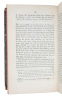
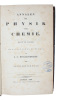
First edition of this monumental, famous paper in thermodynamics in which Clausius for the first time states the Second Law of Thermodynamics, one of the most importent laws of Nature having a huge impact on the development of physical theory, cosmology, communications and information theory. The law states that a) the energy of the Universe is constant, and b) the Entropy of the Universe tends to a maximum.""Clausius' contribution to thermostatics is comparable to those of Newton and Maxwell to mechanics and electromagnetism, respectively. In the obituary J.W. Gibbs remarked that Clausiu's first memoir ""marks an epoch in the history of physics....."""" (Chowdhury and Stauffer in ""Principles of Equilibrium Statistical Mechanics"").In ""The Nature of the Physical World"" Eddington writes: ""The Law that entropy increases - the Second Law of Thermodynamics - holds, I think, the supreme position among the laws of Nature. If someone points out to you that your pet theory of the Universe is in disagreement with Maxwell's equations - then so much the worse for Maxwell's equations. If it is found to be contradicted by observation - well, these experimentalists do bungle things sometimes. But if your theory is found to be against the Second Law of Thermodynamics I can give You no hope"" there is nothing for it but to collapse in deepest humiliation."".Parkinson ""Breakthroughs"", 1850 P.
CLAUSIUS, RUDOLF. - INTRODUCING THE SECOND LAW OF THERMODYNAMICS IN FRENCH.
Reference : 53454
(1852)
Sur la Puissance motrice de la chaleur" par M. Clausius. Extraits par M. Verdet. (Ueber die bewegende Kraft der Wärme....).
Paris, Victor Masson, 1852. 8vo. Contemp. hcalf. Raised bands, gilt spine. A bit rubbed along edges. One hinge starting. In: ""Annales de Chimie et de Physique"", 3ieme Serie, Tome 35. 512 pp. a. 2 folded engraved plates. (Entire volume offered). Clausius' paper: pp. 482-503. Stamp to verso of titlepage. Faint scattered brownspots.
First French version of this monumental, famous paper in thermodynamics in which Clausius for the first time states the Second Law of Thermodynamics, one of the most importent laws of Nature having a huge impact on the development of physical theory, cosmology, communications and information theory. The law states that a) the energy of the Universe is constant, and b) the Entropy of the Universe tends to a maximum.The volume contains further importent papers, extracts of HERMANN HELMHOLTZ announcement of his invention of the Ophthalmoscope, pp. 125-126 with a drawing of its construction. WILLIAM THOMSON (Lord Kelvin) ""Examen de la Theorie de la puissance motrice de la chaleur... (On the Dynamical Theory of Heat)"", pp. 248-255. A founding paper in Thermodynamics. - JAMES JOULE ""Mémoire sur les Changements de temperature produits par la Condensation et la Raréfaction de l'air"" and ""Sur l'équivalent mécanique de la chaleur"" (The conservation of energy-paper), pp. 118-125 a. 1 plate.
HABITUDE EN DROIT PENAL -L-
LGDJ
LIVRE A L’ETAT DE NEUF. EXPEDIE SOUS 3 JOURS OUVRES. NUMERO DE SUIVI COMMUNIQUE AVANT ENVOI, EMBALLAGE RENFORCE. EAN:9782275043807
Rungstedlund - En Have. Et Grafisk Værk af Erik Clemmensen.
Kbhvn. 1941. Folio. Orig.papbd.m.shirtryg. i Kassette. Kassetten lettere slidt. Fremstillet i 25 eksemplarer - hvoraf dette er No 19. Litograf.titelblad, raderet indholdsfortegnelse. 11 raderinger samt 8 litograferede blade.Orig. clothbacked cased boards in slipcase. Limited to 25 copies, of which this is no. 19. Lithographed titlepage, etched contents page. 11 etchings and 8 lithographs.
Beautiful and very scarce book on the garden of Rungstedlund. Before her death, Karen Blixen established the Rungstedlund Foundation, which owns the property and its 16-hectare (40-acre) garden and bird sanctuary. The gardens have long been open to the public, but in 1991 the foundation invited Queen Margrethe to open the museum.
TABAC ET SOCIETE - LA PLANTE SACREE
MUSEE DU TABAC. 1986. In-8. Relié. Bon état, Couv. convenable, Dos satisfaisant, Intérieur frais. 85 pages illustrées de nombreuses photos dans le texte.. . . . Classification Dewey : 633.7-Plantes alcaloïdes (tabac, thé, cacao, café, pavot)
Classification Dewey : 633.7-Plantes alcaloïdes (tabac, thé, cacao, café, pavot)

The Protestant Guardian - Volume I & II
London: Seeleys 1828
All published of this Anti-Catholic journal. Begun in July 1827, it ceased in 1828. Brown buckram boards with gilt titles to the spine. Volumes I & 2 bound as one. Bookplate of the Law Society to the inside board. Contemporary owner's signature to the half title. Contents to the beginning of volume I. The boards are in excellent condition. The pages of the journals are very clean and tidy, with only a touch of foxing or edge wear to them. The contents are a variety of articles and letters aimed at proving the superiority of the the Protestant Faith over Popish Superstition. There is even an article on Prophecies showing the overthrow of the Roman Church in volume II. It seems that the editors didn't prophecies the demise of the journal, as it ends at the end of the final issue without any comment. ii, 1-380. 1-288 pp.
TREASURES OF THE FRENCH RENAISSANCE,
New York, Harry N. Abrams, 1998 Bound, green cloth, illustrated dustjacket in colour, 270 x 320mm., 304pp., very profound colour illustration. ISBN 0810938839.
Architecture, sculpture, paintings, drawings. Photographs by Serge Chirol. Book is in good condition.
Karajan Confidences
Bleu nuit editeur 2008 191 pages 14 4x2x20 4cm. 2008. Broché. 191 pages.
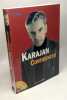

très bon état de conservation

