 Write to the booksellers
-
Type
Book (7819)
Disk (44)
Drawings (1)
Engraving (9)
Magazine (89)
Maps (4)
Music sheets (135)
New book (2)
Old papers (1)
Photographs (19)
Posters (1)
-
Latest
Last 24h (4)
Last 3 days (10)
Last month (1034)
Last week (6)
-
Language
Czech (1)
Dutch (11)
English (156)
French (7943)
German (4)
Italian (2)
Latin (3)
Russian (4)
-
Century
16th (17)
17th (43)
18th (199)
19th (885)
20th (2806)
21st (1770)
-
Countries
Belgium (1167)
Canada (34)
China (56)
Côte d'Ivoire (6)
Denmark (1063)
France (5448)
Germany (1)
Netherlands (181)
Switzerland (155)
United Kingdom (9)
United States of America (4)
-
Syndicate
ALAC (27)
CLAM (27)
CLAQ (2)
ILAB (2238)
NVVA (15)
SLACES (15)
SLAM (1026)
SNCAO (4)
Athanasius Alexandrinus, Evagrius Antiochenus, Anonymus (auths), Lois Gandt, Pascal H.E. Bertrand (eds)
Reference : 66053
Vitae Antonii Versiones latinae. Vita beati Antonii abbatis Evagrio interprete. Versio uetustissima
, Brepols, 2019 Hardback, ccxlii + 363 pages, Size:155 x 245 mm, Illustrations:8 tables b/w., Languages: Latin, English, German. ISBN 9782503577487.
Summary Shortly after the death of Egypt's most famous hermit in 356, Athanasius of Alexandria wrote the Life of Antony, a text that had an immediate as well as enduring influence on monastic life and thought. While Athanasius's vivid description of the life of Antony the Great initiated the genre of the saint's life in Christian literature, his inclusion of many of his own theological ideas also provides insight into the turbulent doctrinal disputes of the fourth century. The significance of the Life of Antony is demonstrated by the fact that it was translated into Latin twice within two decades after its composition. The first version, prepared by an anonymous translator shortly after Athanasius completed his Greek text, provides a literal translation that is extant in only one complete manuscript. The literary translation prepared by Evagrius of Antioch in 373 was rapidly and widely transmitted throughout the Latin West. New editions of both translations are presented in this volume, with the edition of Evagrius's translation based on 28 manuscripts dating from the ninth to the eleventh century. In recognition of the close relationship between these ancient Latin translations and the Greek original of the Life of Antony, this volume also includes an Appendix in which the text of these new editions is provided in parallel columns alongside the edition of the Greek text that was published by G.J.M. Bartelink in 1994 (Sources Chr tiennes, 400). TABLE OF CONTENTS Athanasius Alexandrinus - Vita Antonii (versio vetustissima interpretis anonymi) ( - ) CPG 2101a - ed. L. Gandt Athanasius Alexandrinus - Vita Antonii (sec. translationem Evagrii Antiocheni) ( - ) CPG 2101 - ed. P.H.E. Bertrand
Bibliotheke Ellenon Pateron Kai Ekklesiastikon Suggrapheon. Volumes 30-37 : Megas Athanasios (meros 1-8), & Peri ten apeianiken erin, I. Apospasmata II. Asterios o sofistes (meros 1)
Athenai [Athens], Ekdosis tes apostoloikes diakonias tes ekklesias tes Ellados 1962-1965 Complete in 8 volumes: 364 + 481 + 360 + 397 + 403 + 394 + 352 + 340pp., containing critical text editions (8 parts) of Athanasius of Alexandria (c.296-373 A.D.) and of some other Greek church fathers and ecclesiastical writers (in vol.37), 22cm., text in classical Greek, publishers full cloth bindings, copies from the collection of the Belgian Byzantinist J. Mossay (with stamp and ex-libris), text is clean and bright, good condition, weight: 4.5kg., R113680
Bibliotheke Ellenon Pateron Kai Ekklesiastikon Suggrapheon. Volume 30 : Megas Athanasios (meros 1)
Athenai [Athens], Ekdosis tes apostoloikes diakonias tes ekklesias tes Ellados 1962 364pp., containing critical text editions (first part of 8) of Athanasius Alexandria (c.296-373 A.D.), 22cm., text in classical Greek, publishers full cloth binding, text is clean and bright, good condition, R113881
Bibliotheke Ellenon Pateron Kai Ekklesiastikon Suggrapheon. Volume 31 : Megas Athanasios (meros 2)
Athenai [Athens], Ekdosis tes apostoloikes diakonias tes ekklesias tes Ellados 1962 481pp., containing critical text editions (second part of 8) of Athanasius of Alexandria (c.296-373 A.D.), 22cm., text in classical Greek, publishers full cloth binding, text is clean and bright, good condition, R113882
Bibliotheke Ellenon Pateron Kai Ekklesiastikon Suggrapheon. Volume 32 : Megas Athanasios (meros 3)
Athenai [Athens], Ekdosis tes apostoloikes diakonias tes ekklesias tes Ellados 1963 360pp., containing critical text editions (third part of 8) of Athanasius of Alexandria (c.296-373 A.D.), 22cm., text in classical Greek, publishers full cloth binding, text is clean and bright, good condition, R113883
Bibliotheke Ellenon Pateron Kai Ekklesiastikon Suggrapheon. Volume 33 : Megas Athanasios (meros 4)
Athenai [Athens], Ekdosis tes apostoloikes diakonias tes ekklesias tes Ellados 1963 397pp., containing critical text editions (fourth part of 8) of Athanasius of Alexandria (c.296-373 A.D.), 22cm., text in classical Greek, publishers full cloth binding, text is clean and bright, good condition, R113884
Bibliotheke Ellenon Pateron Kai Ekklesiastikon Suggrapheon. Volume 34 : Megas Athanasios (meros 5)
Athenai [Athens], Ekdosis tes apostoloikes diakonias tes ekklesias tes Ellados 1964 403pp., containing critical text editions (fifth part of 8) of Athanasius of Alexandria (c.296-373 A.D.), 22cm., text in classical Greek, publishers full cloth binding, text is clean and bright, good condition, R113885
Bibliotheke Ellenon Pateron Kai Ekklesiastikon Suggrapheon. Volume 35 : Megas Athanasios (meros 6)
Athenai [Athens], Ekdosis tes apostoloikes diakonias tes ekklesias tes Ellados 1964 394pp., containing critical text editions (sixth part of 8) of Athanasius of Alexandria (c.296-373 A.D.), 22cm., text in classical Greek, publishers full cloth binding, text is clean and bright, good condition, R113886
Bibliotheke Ellenon Pateron Kai Ekklesiastikon Suggrapheon. Volume 36 : Megas Athanasios (meros 7)
Athenai [Athens], Ekdosis tes apostoloikes diakonias tes ekklesias tes Ellados 1965 352pp., containing critical text editions (sixth part of 8) of Athanasius of Alexandria (c.296-373 A.D.), 22cm., text in classical Greek, publishers full cloth binding, text is clean and bright, good condition, R113887
Results of excavations conducted by the American School of Classical Studies at Athens. Vol. 20: The church of the Holy Apostles. By A. FRANTZ.
Princeton, The American School of Classical Studies at Athens, 1971.
XIII,44 p.; 40 pls. Cl. 31 cm (3 very small marginal ballp. stripes)
When Will There Be Good News?: (Jackson Brodie) (Jackson Brodie 3)
Black Swan 2009 480 pages 19 6x3 6x12 4cm. 2009. Broché. 480 pages.
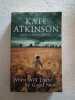

Bon état
The Sea-Coasts of France, from Calais to Bayone. Described in Fifteen Large Charts. Surveyed and Printed by the order of the French King. From the Original, done at Paris, and the Remarks Explained in English, and Published for the Use of His Majesty'...
London, Printed for William Mount and Thomas Page on Tower Hall, no date (c. 1715). Folio. 53X35 cm. Cont. hcalf with marbled boards. Rebacked and recornered in old style with raised bands. Engraved typographical titlepage with a large engraved vignette showing the English King's Coat of Arms. With all 15 double-page engraved sea-charts (numbered (1)-(15) in lower right corners). Neat repairs to inner margins of free endpapers and titlepage. Some browning to charts. Chart 5 (45x75,5 cm) having the right margin shaved reaching the printed frame.
Second edition of this scarce ""Atlas Maritime"". According to Shirley it was first published by Richard Mount and Thomas Page in 1701 and re-issued with undated title (as this) in ab. 1715, but with the charts unchanged and a new engraved titlepage. A third issue came out in 1737 with a dated title. The fine charts are copied from Pieter Mortier's famous ""Neptune Francois"" (1693-1702) and reduzed in size.""The charts in this early Mount & Page atlas ""The Sea-Coasts of France"" are re-engravings, reduzed in size, from the charts in the French Neptune of 1693. The charts may also be found in the 1702 edition of Mount and Page's Atlas Maritimus Novus..."" (Rodney Shirley). - Not in Phillips. - Shirley Vol. II: M.M&P - 12 b.

"DISQUE VINYLE 33T TRIUMPHAL MARCH ""AIDA"", OVERTURE ""SI J'ETAIS ROI"", INTERMEZZO ""CAVALLERIA RUSTICANA"", DANCE OF THE HOURS ""LA GIOCONDA"", OVERTURE ""DONNA DIANA"", POLOVTSIAN DANCE ""PRINCE IGOR"", WALTZ ""EUGEN ONEGIN"", POLONAISE ""EUGENE ONEGIN""."
TELEFUNKEN. non daté. In-12. Broché. Bon état, Couv. convenable, Dos satisfaisant, Intérieur frais. Pochette en couleurs, The Bamberg Symphony Orchestra, direction: KURT WOSS. Une photo en noir et blanc dérrière la pochette.. . . . Classification : 410-33 Tours
Disque n° SMA 110 Classification : 410-33 Tours

Mijn Labour Party [Engeland]
, Amsterdam/Brussel/Londen/New York, Elsevier, 1946, 155pp.+ 7pp.ill., gecart.band met stofwikkel, G12124
Aubret Francine,Hélian Jacques,Combelle Alix,Blareau Richard,Van Burg Louis,Bonneau Paul,Caroll Anne " The Lady Crooner ",Mouqué Georges - Mouqué Georges - Scarella,Senn Kennneth,Steinberg Richard
Reference : 99473
(1945)
Partition de la chanson : Armorial Armorial ( Allied Officers Night Club ) Le Cabaret des Champs-Elysées
Partitions sur Paris Paname S.E.M.I 1945
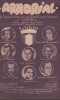
Bon état Petit format
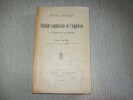
ETUDE CRITIQUE de la politique commerciale de l'Angleterre à l'égard de ses colonies.
Toulouse Rivière 1904. In-8 broché XII 490pp. Manque sur la page de faux-titre, dos légèrement bruni. Exemplaire solide et bien complet. Des origines des colonies jusqu'à 1902.
Chante matin cahier d'exercices
Edl 1975 48 pages 15 2x0 6x21 6cm. 1975. Broché. 48 pages.

Bon état

Auger Antoine Casali Dimitri Thers Nicolas
Reference : 500106623
(2001)
ISBN : 9782740411827
A TALE OF TRANSFORMATIONS
BURNS ET OATES LTD. NON DATE. In-12. Broché. Etat d'usage, Couv. convenable, Dos abîmé, Quelques rousseurs. 94 pages. Texte en anglais. Une écriture au stylo sur la première de couverture.. . . . Classification Dewey : 420-Langue anglaise. Anglo-saxon
14 ème édition Classification Dewey : 420-Langue anglaise. Anglo-saxon
Le Service Du Restaurant, Des étages, Du salon de Thé, Du bar.
Flammarion Livre broché au format 14x22cm, couverture orange et rouge glacée de l'éditeur, 247 pages, nombreux dessins explicatifs, croquis, photographies en noir, ensemble complet et très sérieux. Très agréable état d'usage.

Bon Etat Mise à jour du Samedi 27 Juin 2026. Paiement PayPal immédiat, Mondial Relay pour : France, Allemagne, Autriche, Belgique, Espagne, Italie, Portugal, Luxembourg, Pays-Bas, Pologne (Communiquer votre point ou locker si connu). Une participation supplémentaire peut être demandée pour les colis lourds hors France où les envois compris entre 5 et 25 kg sont dégressifs : 2 à 4 kilogrammes - 7.99 / 5 à 10 kg - 15.99 / 15 -25 kg - 25.99. Certaines de nos collections ( Vian, Céline, Camus (...) peuvent être expédiées en Franco de port. Pour linternational hors Europe (Suisse, Canada, Japon, Etats-Unis, les frais dexpéditions peuvent varier selon le poids (mise à jour : 1 juin 2026).
VUE D'OPTIQUE :" A VIEW OF THE GRAND PALACE OF WESTMINSTER"- 1790 -(titre inscrit, en caractères inversés)
Paris CHEREAU 1790 une vue d'optique en couleurs, GRAVÉE A L'EAU-FORTE ET AQUARELLÉE SUR PAPIER DE FORMAT: 33,4 x 43,7 cm. (1790) à Paris chez CHEREAU Editeur
Les vues doptiques sont un type particulier destampes populaires publiées en Europe au XVIIIe siècle. Ces estampes étaient une forme de divertissement destinée à être vue à travers des appareils appelés « machines optiques », « optiques », « zograscopes ». Ces estampes étaient exposées par des forains ambulants dans les rues de toute lEurope et étaient également collectionnées par les professionnels et les classes supérieures qui possédaient des machines optiques chez eux. Il y avait une grande curiosité pour lapparence des villes européennes non visitées et des lieux exotiques aux confins du globe, et ces estampes étaient lun des seuls moyens pour le grand public davoir un aperçu du monde. Les machines optiques utilisées pour ces gravures étaient équipées d'une lentille qui améliorait pour les spectateurs le grossissement et la perception de la profondeur tridimensionnelle des scènes représentées. Un miroir était souvent utilisé pour que les gravures en perspective puissent être vues à plat, et dans ces cas, les images étaient vues à l'envers. Il n'est donc pas rare que les scènes représentées soient dessinées à l'envers, et il y a souvent aussi un titre imprimé à l'envers en haut, permettant aux spectateurs de le lire rapidement. Il y avait généralement un texte supplémentaire au bas des gravures, souvent en plusieurs langues, qui pouvait être lu par l'opérateur de l'optique au bénéfice de son public ........... rare gravure ........... en bon état (good condition). en bon état
The black watch. Volume 1
Richard BENTLEY, Londres. 1834. In-12. Relié demi-cuir. Etat d'usage, Couv. convenable, Dos satisfaisant, Rousseurs. 318 pages. Pièce de titre avec titre doré arrachée. Dos orné de palettes dorées. Texte n anglais.. . . . Classification Dewey : 0-GENERALITES
Classification Dewey : 0-GENERALITES
Stockport, official handbook
J. Burrow & Co.. Non daté. In-8. Broché. Etat passable, Tâchée, Dos satisfaisant, Mouillures. 100 pages. Quelques planches publicitaires en couleurs. Nombreuses photos monochromes dans et hors texte. Texte en anglais.. . . . Classification Dewey : 420-Langue anglaise. Anglo-saxon

Classification Dewey : 420-Langue anglaise. Anglo-saxon

