 Write to the booksellers
-
Type
Book (7253)
Disk (44)
Drawings (1)
Engraving (9)
Magazine (89)
Maps (4)
Music sheets (135)
New book (2)
Old papers (1)
Photographs (19)
Posters (1)
-
Latest
Last 24h (1)
Last 3 days (5)
Last month (970)
Last week (3)
-
Language
Czech (1)
Dutch (9)
English (156)
French (7379)
German (4)
Italian (2)
Latin (3)
Russian (4)
-
Century
16th (17)
17th (43)
18th (199)
19th (881)
20th (2482)
21st (1566)
-
Countries
Belgium (1156)
Canada (34)
China (56)
Côte d'Ivoire (7)
Denmark (1063)
France (4886)
Germany (1)
Netherlands (181)
Switzerland (161)
United Kingdom (9)
United States of America (4)
-
Syndicate
ALAC (27)
CLAM (25)
CLAQ (2)
ILAB (2236)
NVVA (15)
SLACES (15)
SLAM (1026)
SNCAO (4)
Transformation des aldéhydes et des acétones en alcools.
(Paris, Mallet-Bachelier), 1860. 4to. No wrappers. In: ""Comptes Rendus Hebdomadaires des Séances de L'Academie des Sciences"", Tome 55, No 1. Pp. (5-) 67. (Entire issue offered). Friedel's paper: pp. 53-58.
First apperance of the paper in which Charles Friedel described how he did the first preparation of isopropyl, the first secondary alcohol.Parkinson ""Breakthroughs"", 1862 C.

Nimegische Friedens-Tractaten. Das ist: Zusammen-Fassung aller Acten, Memorialien, Brieffen, Declarationen, Protestationen, Remonstrationen, General- und Particular Conferentien, welche deme zu Nimegen getroffenen Friedens-Schluss vorgegangen, und zu dessen Negotiation gedienet: Sammt den General- und Particular Tractaten die zu Nimegen geschlossen worden. Mit Fleiss zusammen getragen, verteutscht, und männiglichen zur Nachricht an das Liecht gegeben.
O.O., o. Dr., 1678. Kl.-4°. (4) Bl. (1 leer), 214 S., (1) leeres Bl. Pappband d. 18. Jh.
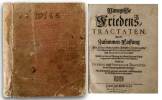
VD 17 12:194778A. - Enthält die bis 1678 geschlossenen Verträge zur Beilegung des Französisch-Niederländischen Krieges, weitere Verträge wurden 1679 in Saint-Germain abgeschlossen. Der auch als Holländischer Krieg bezeichnete Konflikt war ein gesamt europäischer, welcher von 1672-1678 dauerte, ausgelöst durch einen Angriff Frankreichs unter Ludwig XIV. und seinen Verbündeten England, Schweden und der Fürstbistümer Münster und Lüttich auf Holland. Um eine Vorherrschaft Frankreichs zu verhindern, verbündeten sich Spanien und das Hl. Römische Reich sich mit den Niederlanden. - Leicht gebräunt und teilw. mit kleinen Flecken. - Unter dem Impressung kleiner Zettel eingeklebt "Johannes W. à Iuvaltis (von Juvalt) Samadenensis Rhaetus, A. 1680" und hs. Einträge auf fliegendem Blatt vorn und im hinteren Innendeckel. - Einband berieben fleckig, Rücken abgeschabt und am Fuss defekt, hs. Inschrift auf Deckel IWI 88.
Probing the Limits of Representation: Nazism and the "Final Solution"
Harvard university press 1992 414 pages 15 1x22 8x2 9cm. 1992. Broché. 414 pages.

Très bon état tranche un peu ternie intérieur propre bonne tenue
Men against Mccarthy
Columbia University Press 1976 428 pages 22 86x3 302x15 494cm. 1976. Cartonné. 428 pages. Ce livre publié au Royaume-Uni sous le titre 'The Canary That Sang' et aux États-Unis sous le titre 'The Valachi Papers' est la biographie de Joseph Valachi un ancien membre de la famille criminelle Genovese. Il raconte son témoignage historique en tant que premier indicieux issu de la mafia américaine détaillant l'organisation et les activités du crime organisé
Bon état sans jaquette fiche universitaire agrafée sur la garde intérieur propre
Aforismi e schizzi sulla storia
EDIZIONI SCIENTIFICHE ITALIANE - NAPOLI in8. Sans date. Broché. Dans 'The Future as History' l'économiste Robert L. Heilbroner analyse les courants de son époque en les reliant à leurs racines historiques et en examinant leur direction future. Il soutient que notre philosophie dominante est devenue trop étroite pour faire face aux réalités contemporaines et que notre maîtrise du monde est désormais remise en question
Bon état jaquette défraîchie dos annoté intériuer propre non daté
Microelectronics and Society: For Better or for Worse (Club of Rome Publications)
Pergamon 1982 370 pages 14 6x2 4x20 6cm. 1982. Broché. 370 pages.
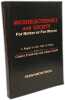
Très bon état de conservation intérieur propre étiquette sur la 4e de couverture
"FRIEDRICH, W., P. KNIPPING, MAX v. LAUE. - THE NATURE OF X RAYS AND THE ATOMIC STRUCTURE OF CRYSTALS.
Reference : 43821
(1913)
Inteferenzerscheinungen bei Röntgenstrahlen. (+ M. Laue:) Eine quantitative Prüfung der Theorie für die Inteferenzerscheinungen bei Röntgenstrahlen. (+ M. Laue und F. Tank:) Die gestalt der Interferenzpunkte bei den Röntgenstrahlinterferenzen. (3 pape...
(Leipzig, Ambrosius Barth, 1913). Without wrappers in ""Annalen der Physik"", Vierte Folge, Bd. 41, No.10. The entire issues offered. Pp. 873-1064 a. 6 plates. Laue's papers: pp. 971-988, pp. 989-1002 a. pp. 1003-1011. With the 5 famous plates in collotype (reproductions of the photographic plates), showing the X-Ray diffraction spectrum of different salt and substances (The ""Laue diagram"").
These papers represents the first full exposition of Laue's and his co-worker's discovery of the nature of X-Rays. The first two papers were printed the year before in ""Münchener Sitzungsberichte"", but finds their final form here and with the experimental confirmation by Laue and Tank. He showed that the regular spacing of the atoms in a crystal can serve as a grating of the desired precision, and he measures the wave-lenght of the X-rays.That crystals might be the appropriate grating for the X-rays proved to be well founded when Knipping, Friedrich and Tank found experimental confirmation of the theory.""It was in 1895 that Röntgen discovered a new form of radiation, to which, as its nature was so uncertain, he gave the name of the X-ray.....It was not until 1912, when von Laue showed it could be diffracted like ordinary light, that it was recognized with certainty as an ether wave of extremely short wave-lenght.Laue used a crystal for his diffraction grating...The X-ray is therefore identical with with light in respect to its nature, but differs greatly in quality: a state of things which is very favourable to an extension of our general knowledge of such radiations.""(William Bragg in ""The Universe of Light"", pp. 228 ff.).""It was the work of Laue and the experiments done by Friedrich and Knipping on his suggestion that cleared up the nature of X rays once and for all and that, moreover, beautifully demonstrated that crystals are composed of atoms arranged in a regular lattice......As in the case of Röntgen's original discovery, the photographs were extremely convincing. Other researchers immediately were attracted by the new field of X-ray spectroscopy and the discoveries by the Braggs and Mosely soon followed.""(Siegmund Brandt ""The harvest of a Century"", Episode 20, p. 80 ff.).""The awarding of the Nobel Prize in physics for 1914 to Laue indicated the significance of the discovery that Albert Einstein called ""ONE OF THE MOST BEAUTIFUL IN PHYSICS"". Subsequently it was possible to investigate X radiation itself by means of wavelenght determinations as well as to study the structure of the irradiated material. In the truest sense of the word scientists began to cast light on the structure of matter.""(DSB VIII, p. 51).PMM: 406 (the first 2 papers in Münchener Sitzungsberichte).The offered issue of ""Annalen"" contains also an importent paper by P. DEBYE & A. SOMMERFELD: ""Theorie des lichtelektrischen Effektes vom Standpunkt des Wirkungsquantums"", pp. 873-930
Forordning om udvidet Handelsfrihed for Island. Frederiksberg, den 11te September 1816.
Kiøbenhavn, Johan Frederik Schultz, (1816). 4to. 11 pp. De sidste sider lettere brunplettede.
Originaltrykket. - Fiske I:345.
La Passion de détruire
Paris Robert Laffont 2001 In-8 Bon état, texte français paru pour la première fois en 1975
Bel État De Fraicheur Couverture souple
Plantes Aromatiques
Rustica 1996 1x22x16cm. 1996. Broché.
Très bon état - légères marques de lecture et/ou de stockage mais du reste en très bon état- expédié soigneusement depuis la France
Idées gourmandes : Tisanes et infusions
Editions du Chêne 2003 In-12 relié. 106 pp. Sous jaquette illustrée, photographie couleurs. Nombreuses illustrations couleurs. Livre comme neuf. 430 grammes.
Très bon état d’occasion
Fronty l. - Duronsoy Y., Duronsoy Yves
Reference : 66354
(1996)
ISBN : 2851089757 9782851089755
TISANES ET INFUSIONS
Editions du Chêne 1996 In-8, relié, 127pp, nombreuses illustrations couleurs, jaquette illustrée en couleurs.
Très bon état d’occasion
Le petit crocodile: Qui es-tu
Mango 2005 32 pages 19 8x0 8x23 4cm. 2005. Broché. 32 pages.
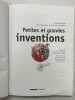
Très bon état
Belgie in het Vatikaans Archief. Nunciatuur te Brussel. 1875-1904. Regestenlijst,
Turnhout, Brepols, 1989 Paperback, 514 p., 210 x 295 mm. ISBN 9789074461320.
Nieuw.
ANTWERP the New Spring
Antwerpen, Ortelius Series, 1991 Hard cover, 440pp., 23x30 cm, a very nice copy with very colorfull pictures and paintings. ISBN 9034104702.
Annual of Advertising and Editorial Art and Design, n° 40. 40th Art Directors Annual, 1961.
New York Farrar, Straus and Cudahy 1961 in-4 cartonnage éditeur New York, Farrar, Straus and Cudahy, 1961. 29 x 21 cm, in-4, 356 pp., abondante iconographie en noir et en couleurs, cartonnage de l'éditeur sous étui.

Bel exemplaire. Très bon
The Lady who loved Insects. Translated by Arthur Waley. Dry-points by Hermine David.
London, The Blackamore Press, 1929. 150 X 210 mm. relié toile écrue d'édit. sous étui, tête dorée, non rogné. 40 pp. Illustré de 4 eaux-fortes d'Hermine David. Edition tirée à 550 ex., dont 50 ex. num. sur papier fait main. Notre exemplaire est justifié à la plume: "out of series. For Vincent Muselli with my friendship. JB Pouterman, 16.12.29." Vincent Muselli a écrit à la suite: "et redonné par moi, le 17 juillet 1942, à Madame Hélène Desmaroux, en témoignage de respectueuse et fervente amitié. Vincent Muselli". Sans l'étui, dos lég. bruni.
Phone number : 41 021 964 60 10
Paesaggi della paura. Vita e natura nel Medioevo (Biblioteca storica)
Il Mulino 1994 360 pages 66x546x406cm. 1994. Cartonné jaquette. 360 pages.
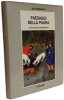
Comme neuf
De la Cantharide Officinale.
Paris, Germer Baillière, 1867. 4to. Orig. printed wrappers. Backstrip partly gone. (4),58 pp. and 5 lithographed plates, one depicting 7 species of Cantharis handcoloured. Some brownspots to plates.
This is the authors doctoral thesis ""These de Pharmacie Presentée et soutenue a L'École Superieure de Pharmacie"", dealing with the toxical, poisonous character of these kinds of beetles with the popular name of ""Spanish Fly"". - The Marquis de Sade is claimed to have given aniseed-flavored pastilles that were laced with Spanish fly to prostitutes at an orgy in 1772. He was sentenced to death for poisoning and sodomy, but later reprieved on appeal.
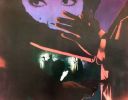
The Ipcress File (Danger immédiat).
Photomontage en couleurs réalisé pour la promotion de ce film d'espionnage de Sidney J. Furie, sorti en 1965 en Angleterre. Vintage offset print, impression sur papier réalisée en Italie (23,6/30 cm). Présenté sous encadrement. Très bon état.
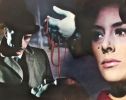
The Ipcress file (Danger immédiat).
Photomontage en couleurs réalisé pour la promotion de ce film d'espionnage de Sidney J. Furie, sorti en 1965 en Angleterre. Vintage offset print, impression sur papier réalisée en Italie (23,6/30 cm). Présenté sous encadrement, très bon état.
Fra Færøerne - Úr Føroyum. I-III (3 bd.).
København, Dansk Færøsk Samfund, 1964-66. 4to. Orig. bogtrykt omslag. Upagineret. 47,50,58 pp. Illustreret i s/h og farve. Velbevarede eksemplarer af de tre første årgange.
Med originalbidrag af William Heinesen, Hedin Brú, Jørgen- Franz Jacobsen m.fl.
Færøerne.
Udg.af Dansk-Færøsk Samfund. 2 Bd. K., 1958. 4to. 2 orig.hldrbd. 406,310 pp. Illustrationer og kort.
Færøerne I-II. Udgivet af Dansk-Færøsk samfund. '
2 bd. Kbh., 1958. 4to. 406, 310 pp. Løst kort mgl.
Turistruter paa Færøerne. I. Oprejse. Land og Folk. II. Fra Ø til Ø.
Kbhvn., 1915-19. Orig. omslag. Omslag løst og ryg med defekter. Indvendig frisk. 130,148 pp. Rigt tekstillustreret samt 1 foldekort.

