 Write to the booksellers
-
Type
Book (7819)
Disk (44)
Drawings (1)
Engraving (9)
Magazine (89)
Maps (4)
Music sheets (135)
New book (2)
Old papers (1)
Photographs (19)
Posters (1)
-
Latest
Last 24h (4)
Last 3 days (10)
Last month (1034)
Last week (6)
-
Language
Czech (1)
Dutch (11)
English (156)
French (7943)
German (4)
Italian (2)
Latin (3)
Russian (4)
-
Century
16th (17)
17th (43)
18th (199)
19th (885)
20th (2806)
21st (1770)
-
Countries
Belgium (1167)
Canada (34)
China (56)
Côte d'Ivoire (6)
Denmark (1063)
France (5448)
Germany (1)
Netherlands (181)
Switzerland (155)
United Kingdom (9)
United States of America (4)
-
Syndicate
ALAC (27)
CLAM (27)
CLAQ (2)
ILAB (2238)
NVVA (15)
SLACES (15)
SLAM (1026)
SNCAO (4)
Welche Züge der Lichtquantenhypothese spielen in der Theorie der Wärmestrahlung eine wesentlich Rolle ? (Which Features of the Quantum Hypothesis Play an Essential Role in the Theory of Heat Radiation).
Leipzig, Johann Ambrosius Barth, 1911. Later full cloth. Stamps on title-page. In ""Annalen der Physik"", Vierte Folge, Band 36. - VIII,1088 pp. and 4 plates. (Entire volume offered). Ehrenfest's paper: pp. 91-118.
First edition of the paper in which the term ""Ultraviolet Catastrophe"" appeared for the first time. ""Ehrenfest was one of the first to try to understand the significance of the strange new concept of energy quanta that Max Planck had introduced into physics in 1900 in his theory of blackbody radiation. In a series of papers culminating in his major study of 1911 (the paper offered), ""Which Features of the Quantum Hypothesis Play an Essential Role in the Theory of Heat Radiation?,"" Ehrenfest picked out the essentials of the early quantum theory and showed how they fit together. He proved rigorously that the energy of electromagnetic vibrations cannot take on all values - cannot vary continuously - if the total energy of the blackbody radiation in an enclosure is to be finite: Planck’s assumption that energy is a discrete variable was, therefore, logically necessary and not just sufficient. Ehrenfest also showed, by an analysis of Wien’s displacement law, that the ratio of energy to frequency was the only variable that could be quantized for a harmonic oscillator, if one wanted to maintain the statistical interpretation of entropy.""(DSB).

BEHIND THE SCENES OF TIFFANY GLASSMAKING. THE NASH NOTEBOOKS.
New York, Estate of Leslie H. Nash, 2001 Bound, hardcover with gold print, original editor's jacket in colour, 23.8x28.3 cm., 236 pp., illustrated in b/w and colour. ISBN 0312282656.
Including Tiffany Favrile Glass by Leslie Hayden Nash. In association with Christie's Fine Arts Auctioneers.
Kvædi i fra Holti.
Selfossi, 1961. Orig. bogtrykt omslag. 100 pp. Med stor dedikation til digteren Jakob Thorarensen.
Originaludgaven.
Lichtsgeschwindigkeit und Statik des Gravitationsfeldes (&) Zur Theorie des statischen Gravitationsfeldes"
(Leipzig, Barth),1912. 8vo. No wrappers. In: ""Annalen der Physik IV, Bd. 38"", No 7. Pp.249-472 a. 3 plates. (Entire issue offered). Einstein's papers: pp. 355-369 and pp. 443-458. Clean and fine.
Both papers in first edition, and they are considered as the first appearance of a Nonlinear Field Equation for Gravitation. ""Einstein published two remarkable memoirs in 1912 which were efforts to construct a complete theory of gravitation incorporating the equivalence principle. In these memoirs Einstein supposed that the gravitational field can be characterized completely by one function, the local speed of light, analogous to the Newtonian description, where only the gravitational potential appears. By an extraordinary argument he extended the potential equation of Newton...In his second Memoir in 1912, he used the equivalence principle to show the influence of a static gravitational field on electromagnetic and thermal processes."" (DSB IV p.320 ff). - Weil No. 47 and 48.
"EINSTEIN, ALBERT. - THE FIRST EXPLICIT STATEMENT OF THE ENERGY-MASS EQUATION !!
Reference : 47457
(1907)
Über die vom Relativitätsprincip geforderte Trägheit der Energie. (On the Inertia of Energy Required by the Relativity Principle).
Leibzig, Johann Ambrosius Barth, 1907. 8vo. Contemp. hcalf. Spine gilt. Title-and tomelabels with gilt lettering. Slightly rubbed. In ""Annalen der Physik"", Vierte Folge, Band 23. VIII,1000 pp. a. 4 plates. (The entire volume offered). Einstein's paper: pp.371-384. A small stamp on titlepage (Gmelin.Institut.). Internally clean and fine.
First edition of the first explicit statement of Einstein's energy-mass equation E=mc2.Nearly all descriptions of Einstein's scientific work state that the mass-energy equivalence E=mc2 was first formulated in Einstein's 1907 review paper 'Über das Relativitätsprinzip und die aus demselben gezogenen.' published in 'Jahrbuch der Radioaktivität und Elektronik' (see Weil no. 21 and Dictionary of Scientific Biography, vol. 4 pp.323 for examples). However, in his paper 'Über die von Relativitätsprincip geforderte Trägheit der Energie' [the offered paper] which predates the former mentioned by six months, Einstein gave a clear statement of the mass-energy equivalence E=mc2. See Lanczos: The Einstein Decade, pp.149-150 and 153 as well as Volume 2 of 'The Collected Papers of Albert Einstein' pp. 428.Einstein's first paper regarding the relation E=mc2 is his fourth 1905 paper, 'Ist die Trägheit eines Körpers von seinem Energieinhalt abhängig?'. In this short paper Einstein showed that a body releasing the energy E in the form of radiation will have its mass decreased by E/c2, and concluded that the mass of a body is a measure of its energy content, e.g., that all energy has mass. The next time Einstein returns to the subject is in his 1906 paper 'Das Prinzip von der Erhaltung der Schwerpunkts Bewegung und die Trägheit der Energie.'. Here Einstein concluded that one must either ascribe the inertial mass E/c2 to any form of energy E or else give up the fundamental law mechanics regarding conservation of the motion of the center of gravity. Then finally in the 1907 paper 'Über die von Relativitätsprincip geforderte Trägheit der Energie.' [the offered paper] Einstein makes the decisive step of assuming that all mass has energy. On page 382 Einstein considers the total energy of a moving mass point as the sum of its kinetic energy and its rest energy. In classical mechanics it is most convenient to set the second term to zero but in relativistic mechanics one obtains the simplest expression by setting the rest energy equal to mc2. Einstein then continues to show that this stipulation cannot lead to a contradiction in any relativistic argument. In a footnote on page 382 Einstein states for the first time the equation E=mc2 and mentions that this equation is the expression of the principle of the equivalence of mass and energy - see Volume 2 of 'The Collected Papers of Albert Einstein' pp. 428.The volume contains another paper by Einstein ""Bemerkungen zu der Notiz von Hrn. Paul Ehrenfest: ""Die Translation deformierbarer Elektronen und der Flächensatz"""", pp.206-208. - Weil No. 18.Collected Works, Doc. 45. Weil 19. Boni 19.
"EINSTEIN, ALBERT. - THE FIRST EXPLICIT STATEMENT OF THE ENERGY-MASS EQUATION !!
Reference : 53408
(1907)
Über die vom Relativitätsprincip geforderte Trägheit der Energie. (On the Inertia of Energy Required by the Relativity Principle).
Leibzig, Johann Ambrosius Barth, 1907. 8vo. Contemp. hcalf. Spine gilt and with gilt lettering. Slightly rubbed and light wear to spineends. In ""Annalen der Physik"", Vierte Folge, Band 23. VIII,1000 pp. a. 4 plates. (The entire volume offered). Einstein's paper: pp.371-384. Stamps on titlepage (Allgemeine Electricitäts-Gesellschaft a. AEG Forschungsinstitut). Internally clean.
First edition of the first explicit statement of Einstein's energy-mass equation E=mc2.Nearly all descriptions of Einstein's scientific work state that the mass-energy equivalence E=mc2 was first formulated in Einstein's 1907 review paper 'Über das Relativitätsprinzip und die aus demselben gezogenen.' published in 'Jahrbuch der Radioaktivität und Elektronik' (see Weil no. 21 and Dictionary of Scientific Biography, vol. 4 pp.323 for examples). However, in his paper 'Über die von Relativitätsprincip geforderte Trägheit der Energie' [the offered paper] which predates the former mentioned by six months, Einstein gave a clear statement of the mass-energy equivalence E=mc2. See Lanczos: The Einstein Decade, pp.149-150 and 153 as well as Volume 2 of 'The Collected Papers of Albert Einstein' pp. 428.Einstein's first paper regarding the relation E=mc2 is his fourth 1905 paper, 'Ist die Trägheit eines Körpers von seinem Energieinhalt abhängig?'. In this short paper Einstein showed that a body releasing the energy E in the form of radiation will have its mass decreased by E/c2, and concluded that the mass of a body is a measure of its energy content, e.g., that all energy has mass. The next time Einstein returns to the subject is in his 1906 paper 'Das Prinzip von der Erhaltung der Schwerpunkts Bewegung und die Trägheit der Energie.'. Here Einstein concluded that one must either ascribe the inertial mass E/c2 to any form of energy E or else give up the fundamental law mechanics regarding conservation of the motion of the center of gravity. Then finally in the 1907 paper 'Über die von Relativitätsprincip geforderte Trägheit der Energie.' [the offered paper] Einstein makes the decisive step of assuming that all mass has energy. On page 382 Einstein considers the total energy of a moving mass point as the sum of its kinetic energy and its rest energy. In classical mechanics it is most convenient to set the second term to zero but in relativistic mechanics one obtains the simplest expression by setting the rest energy equal to mc2. Einstein then continues to show that this stipulation cannot lead to a contradiction in any relativistic argument. In a footnote on page 382 Einstein states for the first time the equation E=mc2 and mentions that this equation is the expression of the principle of the equivalence of mass and energy - see Volume 2 of 'The Collected Papers of Albert Einstein' pp. 428.The volume contains another paper by Einstein ""Bemerkungen zu der Notiz von Hrn. Paul Ehrenfest: ""Die Translation deformierbarer Elektronen und der Flächensatz"""", pp.206-208. - Weil No. 18. Further with 2 importent papers by Max v. Laue.Collected Works, Doc. 45. Weil 19. Boni 19.
Zur Theorie der Lichterzeugung und Lichtsabsorption" (Eingegangen 13. März 1906). (On the Theory of Light Production and Light Absorption).
(Leipzig, Johann Ambrosius Barth, 1906). No wrappers. Extracted from ""Annalen der Physik"" Vierte Folge. Bd. 20. Pp. 199-206. Clean and fine.
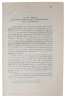
First printing of one of the papers for which Einstein was awarded the Nobel Prize in 1921. It was for the papers ""Ueber einen die Erzeugung und Verwandlung des Lichtes betreffenden heuristischen Gesichtspunkt"" of 1905 and ""Zur Theorie der Lichterzeugung...( Theory of light emission and absorption), the offered item, that Einstein received the prize: ""for his services to theoretical physics and especially for his discoveryof the law of the photoelectrical effect"" - his reward was not based on relativity.""The quantum theory has affected virtually every branch of physics. Its earliest and one of its most significant developments was Einstein's application of the theory to what is known as the 'photo-electrical effect'....Einstein explained this effext by suggesting that the classical view that light is emitted in the form of continous waves must be abandoned. The photo-electrical effect could be explained only as an example of quantum action where the waves of light or X-rays are emitted in minute particles or bullets. It is he size of the bullet (the wave-lenght of the radiation) which determines the number of electrons ejected. It was for this, and not for the theory of relativity, that Einstein was awarded the Nobel Prize in 1921. Einstein's two fundamental papers on this subject are ""Ueber einem Erzeugung...."" 1905 and Zur Theorie der Lichterzeugung (the paper offered here)"" (PMM the note to 391).Weil: 12 (with an asterix, denoting a major paper) - Boni:12.
Zur Theorie der Lichterzeugung und Lichtsabsorption (withbound:) Das princip von der Erhaltung der Schwerpunktsbewegung und die Trägheit der Energie" (2 papers).
Leipzig, Johann Ambrosius Barth, 1906. Bound together in one contemp. hcloth. Small tears to spine ends. (=) ""Annalen der Physik. Vierte Folge. Band 20. Herausgegeben von Paul Drude."" , Portrait (Paul Drude), VIII,1048 pp. and 6 plates. Einstein papers: pp. 199-206 and 627-33. Internally fine and clean. The whole volume offered.
Both papers first edition. It was for the papers ""Ueber einen die Erzeugung und Verwandlung des Lichtes betreffenden heuristischen Gesichtspunkt"" of 1905 and ""Zur Theorie der Lichterzeugung...( Theory of light emission and absorption), the offered item), that Einstein was awarded the Nobel Prize in 1921.""The quantum theory has affected virtually every branch of physics. Its earliest and one of its most significant developments was Einstein's application of the theory to what is known as the 'photo-electrical effect'....Einstein explained this effext by suggesting that the classical view that light is emitted in the form of continous waves must be abandoned. The photo-electrical effect could be explained only as an example of quantum action where the waves of light or X-rays are emitted in minute particles or bullets. It is he size of the bullet (the wave-lenght of the radiation) which determines the number of electrons ejected. It was for this, and not for the theory of relativity, that Einstein was awarded the Nobel Prize in 1921. Einstein's two fundamental papers on this subject are ""Ueber einem Erzeugung...."" 1905 and Zur Theorie der Lichterzeugung (the paper offered here)"" (PMM the note to 391). In the second paper (Principle of the conservation of the centre of mass motion and the inertia of energy) he shows that the conservation of mass is a special application of his energy principle (E= Mc2) - Weil: 12 & 13.Among the many papers in this volume we have Max von Laue: Zur Thermodynamik der Inteferenzerscheinungen. pp. 365-378.
Zur Theorie der Lichterzeugung und Lichtsabsorption (withbound:) Das princip von der Erhaltung der Schwerpunktsbewegung und die Trägheit der Energie" (2 papers).
Leipzig, Johann Ambrosius Barth, 1906. Bound together in one contemp. halfcalf. Spine gilt. Minor scratches to spine. A stamp to titlepage and htitle. ""Annalen der Physik. Vierte Folge. Band 20. Herausgegeben von Paul Drude."" , Portrait (Paul Drude), VIII,1048 pp. and 6 plates. Einstein papers: pp. 199-206 and 627-33. The entire volume offered.
Both papers first edition. It was for the papers ""Ueber einen die Erzeugung und Verwandlung des Lichtes betreffenden heuristischen Gesichtspunkt"" of 1905 and ""Zur Theorie der Lichterzeugung...( Theory of light emission and absorption), the offered item), that Einstein was awarded the Nobel Prize in 1921.""The quantum theory has affected virtually every branch of physics. Its earliest and one of its most significant developments was Einstein's application of the theory to what is known as the 'photo-electrical effect'....Einstein explained this effext by suggesting that the classical view that light is emitted in the form of continous waves must be abandoned. The photo-electrical effect could be explained only as an example of quantum action where the waves of light or X-rays are emitted in minute particles or bullets. It is he size of the bullet (the wave-lenght of the radiation) which determines the number of electrons ejected. It was for this, and not for the theory of relativity, that Einstein was awarded the Nobel Prize in 1921. Einstein's two fundamental papers on this subject are ""Ueber einem Erzeugung...."" 1905 and Zur Theorie der Lichterzeugung (the paper offered here)"" (PMM the note to 391). In the second paper (Principle of the conservation of the centre of mass motion and the inertia of energy) he shows that the conservation of mass is a special application of his energy principle (E= Mc2) - Weil: 12 & 13.Among the many papers in this volume we have Max von Laue: Zur Thermodynamik der Inteferenzerscheinungen. pp. 365-378.
EINSTEIN, ALBERT. - THE PHOTOELECTRIC EQUATION - THE NOBEL PRIZE PAPERS.
Reference : 59121
(1906)
Zur Theorie der Lichterzeugung und Lichtsabsorption (withbound:) Das princip von der Erhaltung der Schwerpunktsbewegung und die Trägheit der Energie" (2 papers).
Leipzig, Johann Ambrosius Barth, 1906. Full cloth. Spine with gilt lettering. In: ""Annalen der Physik. Vierte Folge. Band 20. Herausgegeben von Paul Drude."" , Portrait (Paul Drude), VIII,1048 pp. and 6 plates. Einstein papers: pp. 199-206 and 627-33. Internally fine and clean. The entire volume offered. Broad margins.
Both papers first edition. It was for the papers ""Ueber einen die Erzeugung und Verwandlung des Lichtes betreffenden heuristischen Gesichtspunkt"" of 1905 and ""Zur Theorie der Lichterzeugung...( Theory of light emission and absorption), the offered item), that Einstein was awarded the Nobel Prize in 1921. ""The quantum theory has affected virtually every branch of physics. Its earliest and one of its most significant developments was Einstein's application of the theory to what is known as the 'photo-electrical effect'....Einstein explained this effext by suggesting that the classical view that light is emitted in the form of continous waves must be abandoned. The photo-electrical effect could be explained only as an example of quantum action where the waves of light or X-rays are emitted in minute particles or bullets. It is he size of the bullet (the wave-lenght of the radiation) which determines the number of electrons ejected. It was for this, and not for the theory of relativity, that Einstein was awarded the Nobel Prize in 1921. Einstein's two fundamental papers on this subject are ""Ueber einem Erzeugung...."" 1905 and Zur Theorie der Lichterzeugung (the paper offered here)"" (PMM the note to 391). In the second paper (Principle of the conservation of the centre of mass motion and the inertia of energy) he shows that the conservation of mass is a special application of his energy principle (E= Mc2) - Weil: 12 & 13.Among the many papers in this volume we have Max von Laue: Zur Thermodynamik der Inteferenzerscheinungen. pp. 365-378.
"EINSTEIN, A., L. INFELD, and B. HOFFMANN. - THE ROUND OFF OF GENERAL RELATIVITY - ASSOCIATION COPY.
Reference : 46475
(1938)
The gravitational Equations and the Problem of Motion. (Part I). (Received June 16, 1937). (+) II. (Received May 29, 1939). 2 Papers (Paper II only Einstein and Infeld).
(Princeton, NJ.), Annals of Mathematics, 1938 a. 1940. Both papers in orig. printed wrappers. Offprints from ""Annals of Mathematics"", Vol. 39, No. 1, january, 1938 and Vol. 41, No. 2, April, 1940. Pp. 65-100 and pp. 455-464. Both clean and fine. This copy has belonged to Abraham Pais (1918-2000) - the famous Einstein scholar, theoretical physicist and Einsteins collegue at Princeton - and having his name on top of both frontwrappers ""A Pais"".
First editions, in the scarce offprint versions, of Einstein's last and highly important contributions to General relativity, and in which is shown that the equation of motion follows directly from the field equation that defined the geometry.""Einstein's last importent contribution to general relativity deals again with the problem of motion. It is the work done with Leopold Infeld and Banash Hoffmann on the N-body problem of motion. In these papers, the gravitational field is no longer treated as external. Instead, it and the motion of its (singular) sources are treated simultaneously. Anew approximationscheme is introduced in which the fields are no longer necessarily weak but in which the source velocities are small compared with the light velocity .... The equations obtained have found use in situations where Newtonian interaction must be included. '(These equations) are widely used in analyses of planetary orbits in the solarsystem. For example, the Cal Tech Jet Propulsion Laboratory uses them, in modified form, to calculate ephmerides for high-precision tracking of planets and spacecraft.""(Pais ""Subtle is the Lord"", p. 290-91).""The problem of the equation of motion of bodies is the following. The 1916 theory had a classical structure in the sense that there were both field equations (the curvature of space-time is determined by the mass and motion of bodies in space-time) and equations of motion of bodies (the world line of small mass is a geodesic). Are these two statements really separate? If the field equations were linear, they indeed would be. They are not linear, however, and Einstein showed (in the papers offered) that if matter is represented by a point singularity of the metric field, these singularities are located on world lines that are geodesics of space-time, provided its metric satisfies the equation of general relativity.""(DSB).Weil: 202 a. 295 (both with an asterix denoting a major paper). - Boni: 236 a. 236.1.
"EINSTEIN, A., L. INFELD & B. HOFFMANN. - EINSTEIN'S LAST CONTRIBUTION TO GENERAL RELATIVITY - THE ROUND OFF OF GENERAL RELATIVITY.
Reference : 46954
(1938)
The gravitational Equations and the problem of Motion. (I-) II. (Part II only with Infeld).
Baltimore, Princeton University Press, 1938 a.1940. Royal8vo. Bound in 2 full cloth, gilt lettering to spines. In: Annals of Mathematics"", Series 2, Vol. 39 and vol. 40. (Entire volumes offered). The papers: pp. 65-100 a. pp. 455-464. Clean and fine.også on a generalization...... pais p. 496
First appearance of these two importent papers on the General theory of Relativity, in which is shown that the equation of motion follows directly from the field equation that defined the geometry.""Einstein's last importent contribution to general relativity deals again with the problem of motion. It is the work done with Leopold Indfeld and Banesh Hoffmann on the N-body problem of motion. In these papers, the gravitational field is no longer treated as external. Instead, it and the motion of its (singular) sources are treated simultaneously. A new approximation scheme is introduced in which the fields are no longer necessarily weak but in which the source velocities are small compared with the light velocity... (These equations) are widely used in analyses of planetary orbits in the solar system.""(Pais ""Subtle is the Lord"", pp. 290-91).Weil: 202 a. 205, both with an asterix, denoting a major paper. - Boni: 236 a. 236.1.
"EINSTEIN, A. & N. ROSEN. - THE SILBERSTEIN-EINSTEIN CONTROVERSY.
Reference : 47073
(1936)
Two-Body Problem in General Relativity Theory.
Lancaster, American Physical Society, 1936. 4to. In: ""The Physical Review"", Vol. 49, Second Series. X,971 pp. (Entire volume offered). Einstein & Rosen's paper: pp. 404-405.
First printing of Einstein and Rosen's answer to Silberstein's critique of Einstein's Theory of Relativity ..""Ludwik Silberstein, who initially was a supporter of the special theory, objected at different occasions against general relativity. In 1920 he argued that the deflection of light by the sun, as observed by Arthur Eddington et al. (1919), is not necessarily a confirmation of general relativity, but may also be explained by the Stokes-Planck theory of complete aether drag. However, such models are in contradiction with the aberration of light and other experiments (see ""Alternative theories""). And in 1935, Silberstein claimed to have found a contradiction in the Two-body problem in general relativity. However, also this claim was refuted by Einstein and Rosen (1935) (in the paper offered).""(Wikipedia).
Demonstration of the Non-Existence of Gravitational Fields with a non-vanishing total Mass free of Singularities.
Tucuman, Argentina, 1941. Royal8vo. Orig. printed wrappers. Offprint from ""Revista. Universidad Nacional de Tucuman"", Series A Matematicas y Fisica Teorica, Vol. 2, Diciembre de 1941, Nos 1 y 2. Pp. 11-15. Fine and clean.
First edition of a scarce paper in the offprint version. The paper ""represents the basis of the one written by the same author in collaboration with Wolfgang Pauli in 1943, in which, by following analogous lines, the proof of the non-existence of regular particle-type solutions was generalized to the case of cilyndrical geometries in Kaluza-Klein theory (Einstein & Pauli, 1943). Besides, other generalizations were subsequently presented. The (non)-existence of such solutions in classical unified field theory was undoubtedly an important criterion leading Einstein's investigations.""Galvagno and Giribet).""In his search for a unified field theory that could undercut quantum mechanics, Einstein considered five-dimensional classical Kaluza-Klein theory. He studied this theory most intensively during the years 1938-1943. One of his primary objectives was finding a non-singular particle solution. In the full theory this search got frustrated, and in the x5-independent theory Einstein, together with Pauli, argued it would be impossible to find these structures."" (Jeroen van Dongen).Weil: 208. - Boni: 243.
Demonstration of the Non-Existence of Gravitational Fields with a non-vanishing total Mass free of Singularities.
Tucuman, Argentina, 1941. Royal8vo. Orig. printed wrappers. Offprint from ""Revista. Universidad Nacional de Tucuman"", Series A Matematicas y Fisica Teorica, Vol. 2, Diciembre de 1941, Nos 1 y 2. Pp. 11-15. Fine and clean. This copy has belonged to Abraham Pais (1918-2000) - the famous Einstein scholar, theoretical physicist and Einsteins collegue at Princeton - and having his name on top of the frontwrapper ""A Pais""
First edition of a scarce paper in the offprint version. The paper ""represents the basis of the one written by the same author in collaboration with Wolfgang Pauli in 1943, in which, by following analogous lines, the proof of the non-existence of regular particle-type solutions was generalized to the case of cilyndrical geometries in Kaluza-Klein theory (Einstein & Pauli, 1943). Besides, other generalizations were subsequently presented. The (non)-existence of such solutions in classical unified field theory was undoubtedly an important criterion leading Einstein's investigations.""(Galvagno and Giribet).""In his search for a unified field theory that could undercut quantum mechanics, Einstein considered five-dimensional classical Kaluza-Klein theory. He studied this theory most intensively during the years 1938-1943. One of his primary objectives was finding a non-singular particle solution. In the full theory this search got frustrated, and in the x5-independent theory Einstein, together with Pauli, argued it would be impossible to find these structures."" (Jeroen van Dongen).Weil: 208. - Boni: 243.
Illuminated Crusader Histories for Philip the Good of Burgundy,
Turnhout, Brepols, 2012 Hardback, 312 p., 38 b/w ill. + 38 colour ill., 190 x 250 mm. ISBN 9782503518046.
Philip the Good, duke of Burgundy from 1419 to 1467, distinguished himself as a patron of illuminated histories and historical romances, and as host of the most lavish entertainment of the middle ages. The Banquet of the Pheasant was a response to the Fall of Constantinople, and it was staged to enlist support for the coming crusade. Two splendid tributes to heroic crusaders from the duke's family tree, commissioned in the 1450s, provide an opportunity to bring these elements of his reputation - bibliophile and would-be crusader--under the same lens. Our perception of the Charlemagne Chronicle in Brussels (BR, MS 9066-68) and the Jerusalem Chronicle in Vienna (ONB, Cod. 2533) is enhanced when we consider other examples of "crusade literature" and remember the perennial goal of recovering Jerusalem. This study of the visual and literary projects that supported Philip's efforts to launch a crusade, long after the days of the "classic" crusades, sets these manuscripts in the context of his court's interest in history writing and updated historical romances, and against the background of the French crusading tradition and the Burgundian incarnation that succeeded it. Languages: English.
Italian Drawings from the Sixteenth Century,2 VOL
Turnhout, Brepols, 2008 Hardback, XXXIV 628 p., 572 b/w ill. 17 colour ill., 220 x 280 mm. 2 VOLUMES FINE COPY ISBN 9781905375103.
Paintings, sculpture, and classical antiquities are the most valuable resources of any museum, and are the first objects to be published in each museum''s own collection catalogue or online inventory. Collection catalogues, however, have customarily included only a small sample of the riches to be found in Midwestern collections of master drawings. This volume of sixteenth-century drawings has been largely the work of Burton L. Dunbar (University of Missouri-Kansas City), director of the project and a specialist in the arts of northern Europe, and Edward J. Olszewski (Case Western Reserve University), co-editor for the series, a well-known authority on drawings of the Italian Renaissance. This volume covers the sixteenth century, including artists born as a rule between 1480 and 1580, with the exception of Giovanni Baglione (ca. 1573-1644) and the Carracci. This study represents a gathering of drawings from forty institutions between Ohio and Oklahoma based on a census of seventy-five museums and art centers. Jacob Burckhardt?s contention that the Renaissance was, in many respects, an age of paganism is readily belied here by the 471 Italian drawings, the great majority of which are religious subjects. Antiquity provided a veneer beneath which sixteenth century artists could cloak their Christianity to make it seem fresh, reminding believers of the origins of their faith, and reviving the purity of Christian doctrine in its early years. It is no surprise, then, to find numerous drawings of antiquities, and mythologies among the many subjects. A corpus this large can be representative in many ways, offering a cross-section of media, subjects, drawing types, and collectors. Of the 471 Italian drawings scattered across Midwestern America, here we reassemble many that were at one time in one or more prominent collections. Every drawing was examined for the following information: Artist, place of birth and death with dates, biography, title of drawing, date of drawing, dimensions in mm (and in inches), media, institutional credit line, accession number, technical condition, inscriptions, collectors? marks, watermark, provenance, exhibitions, bibliography, comments. New book.
Les aires du réel (Gordon Eklund) - Les étoiles si elles sont divines (Gregory Benford et Gordon Eklund)
1979 Editons Opta / Club du Livre d’Anticipation - N°70 - 1979 - In-8, cartonnage toilé décoré de l'éditeur, sous jaquette rhodoïd - 635 pages - Exemplaire numéroté 2979 / 3000
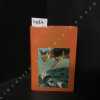
Bon état - Menus frottements sur la jaquette Bon
Minjar og Menntir. Afmælisrit helgad...6. des. 1976.
Reykj., 1976. Lex8vo. Oshirt. XVIII, 576 pp., illustr.
Anti-Jewish Greek Texts in Late Medieval Crete. The Case of Manouel Savios and Angelos Gregorios
, Brepols, 2026 Paperback, Pages: 184, Size:170 x 240 mm, Language: English. ISBN 9789603711124.
Summary The present study explores Greek anti-Jewish writings in Venetian Crete within a framework of Christian-Jewish coexistence. Although Jews were economically and socially integrated, they encountered stereotypes and episodic violence grounded in inherited religious prejudice. Unlike Byzantium, Crete produced no systematic anti-Jewish polemic; hostile views surfaced sporadically in vernacular and didactic texts. Ecclesiastical conflicts among Orthodox, Catholics, and unionists eclipsed Jewish participation. In such a limited circulation of manuscripts of anti-Jewish content in late Venetian Crete, the texts of Manouel Savios and Angelos Gregorios constitute an exception. TABLE OF CONTENTS Preface List of Abbreviations Introduction I. Hemanuelis Savii disputatio contra Iudaeos (MS Lond. Add. 34060) 1. The manuscript 2. The scribe 3. The author 4. The treatise 5. The text II . Angeli Gregorii Iudaeorum quaestiones et rationes (MS ludwig XV 2) 1. The manuscript 2. The scribe 3. The author 4. The treatise 5. The text Appendix 1. Anonymous' Dialogus Adversus Iudaeos (MS Lambeth Palace 2794) 2. Archival documents 3. Tables of MSS Bibliography Indices 1. Index of Mss cited 2. Index of names
Blocks on the Road to Instructional Design Prescriptions. A Methodology for I.D.-Research Exemplified.
Leuven, Universitaire Pers, 1995 Paperback, English, original editor's jacket, 16x24 cm., xii-274 pp. ISBN 9789061867081.
Studia Paedagogica : 8. The development of instructional design as a linking science and, more specifically, the formulation of theoretically sound, empirically valid, and applicable prescriptions may contribute to bridge the gap between theory and practice. In this study, a heuristic approach is proposed that conceptualizes the steps involved in prescriptive research. It is assumed that prescriptions are tight to learning or cognitive tasks, which represent instructional problems in a specific instructional setting. Furthermore, it is argued that prescriptions are to be embedded in an overarching framework. This framework determines the meaning of the prescriptions, restricts their applicability, and may guarantee their mutual compatibility. I.D.-models have been argued to offer such frameworks. The first step of the proposed approach, then, consists of the construction of an I.D.-model. In a second step, this model is elaborated in order to tune it to the learning or cognitive tasks for which prescriptions will be formulated. An analysis of both the available research embedded in the descriptive knowledge base and the specifications of the referent system, results in a number of problem detection- and prediction-rules. These rules provide indications on problems learners may encounter in their efforts to execute the selected task, or link learner characteristics and instructional interventions to learning outcomes. The last step consists of the validation of the prespecified rules in an ecological setting. This empirical validation may lead to prescriptions which applicability is restricted to the settings specified in the referent system. The approach above is followed as an exemplar of prescriptive I.D.-research. A definition of instructional design is provided and five structural components (descriptive knowledge base, referent system, design parameters, design procedures, and design/development processes) of I.D.-models are identified. An analysis of the influence of cognitive research outcomes on instructional design and the elaboration of the approach for prescriptive instructional design research (Chapter 1), precedes the construction of a cognitive oriented instructional design model (C.I.D.-model). The model is completed by outlining design/development processes and the features of some design procedures (Chapter 2). The model gets further elaborated by taking the referent system more fully into account and specifying the model toward a specific cognitive task: determining importance of information-elements in printed instructional materials (Chapter 3). Considering the outcomes of descriptive research about the influence of both learner and text characteristics on both learning from text and text comprehension, an empirical validation study is presented (Chapter 4). Arguing that descriptive research outcomes cannot be directly transformed into prescriptions, but can help to detect problems students eperience and may suggest possible solutions, problem detection- and prediction-rules are identified. Application of problem detection- and prediction-rules leads to the implementation of three types of interventions or support devices: printing important information bold, integrating important information elements in summaries, and restructuring the text. Results (Chapter 5) indicate that (1) overall, students determine importance by applying a 'safety'-strategy; (2) interventions do not lead to improved performance on determining importance or learning outcomes tests, and (3) content prior knowledge influences performance on learning outcomes tests. Overall, no valid prescriptions can be formulated. The overall non-significant results may be due to a variety of reasons. Retrospective interviews suggest that the results may be explained by the non-use or inappropriate function-attribution of instructional interventions by students. This study does not result in valid prescriptions. In addition, questions are to be raised about the C.I.D.-model and, more specifically, the selection of learner-related design parameters. However, these conclusions pertain only to the hypothesis-testing part of the study and do not consider contributions made with regard to the development of cognitive instructional design, and, more methodologically, the explorative aspects of this prescriptive study.
THE EXTRAORDINARY VISIONS OF JAMES ENSOR. 60 FANTASTIC ETCHINGS 1886-1904,
New York, Theodore B. Donson, 1981 Illustrated cardboard cover in colour, 180 x 255mm., pages not numbered, 60 b/w etchings.
First edition. The catalogue of the spring exhibition, April 25 - June 13, 1981. Price list included. Good condition.
Elhaddaoui Karima Elhaddaoui Abdelkader
Reference : 500220993
(2014)
ISBN : 9782206300184
Animation Éducation à la santé 2de 1re Tle Bac Pro ASSP (2014) - Pochette élève: Option "en structure" et "à domicile"
Delagrave 2014 158 pages 20 8x1 2x29 6cm. 2014. pocket_book. 158 pages.

Bon état
Lettres de Jérusalem - la mémoire d'Israël
Louis musin 1983 25 4x3 4x29 2cm. 1983. Broché.
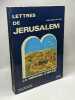
Bon état couverture défraîchie bords frottés intérieur propre
Meutre dans la cathédrale, traduit de l'anglais et présenté par Henri Fluchère [envoi autographe signé de Henri Fluchère à Thierry Maulnier]
Paris Seuil 1946 in-8 broché Paris, Editions du Seuil, 1946. 19 x 14 cm, in-8, 140 (3) pp., broché.
![Meutre dans la cathédrale, traduit de l'anglais et présenté par Henri Fluchère [envoi autographe signé de Henri Fluchère à Thierry Maulnier]. Eliot, ...](https://static.livre-rare-book.com/pictures/AJM/4317_1_thumb.jpg)
![Meutre dans la cathédrale, traduit de l'anglais et présenté par Henri Fluchère [envoi autographe signé de Henri Fluchère à Thierry Maulnier]. Eliot, ...](https://static.livre-rare-book.com/pictures/AJM/4317_2_thumb.jpg)
Edition originale de la traduction française de "Murder in the Cathedral".Exemplaire du service de presse enrichi d'un bel ENVOI autographe signé et daté de Henri Fluchère à Thierry Maulnier (Jacques Talagrand, 1908-1988) : "à Thierry Maulnier, cette traduction de Meurtre dans la cathédrale, avec mes sentiments les plus sympathiques - à cause de notre commun amour pour Scève". Couverture un peu défraîchie. Assez bon

