 Write to the booksellers
-
Type
Book (7142)
Disk (1)
Drawings (1)
Engraving (9)
Magazine (89)
Maps (4)
Music sheets (136)
New book (4)
Old papers (1)
Photographs (7)
-
Latest
Last 24h (4)
Last 3 days (5)
Last month (116)
Last week (20)
-
Language
Czech (1)
Dutch (9)
English (158)
French (7212)
German (4)
Italian (2)
Japanese (1)
Latin (3)
Russian (4)
-
Century
16th (9)
17th (43)
18th (194)
19th (878)
20th (2405)
21st (1535)
-
Countries
Belgium (1156)
Canada (34)
China (56)
Côte d'Ivoire (7)
Denmark (1063)
France (4725)
Germany (1)
Netherlands (181)
Switzerland (155)
United Kingdom (12)
United States of America (4)
-
Syndicate
ALAC (27)
CLAM (25)
CLAQ (2)
ILAB (2254)
NVVA (15)
SLACES (15)
SLAM (1041)
SNCAO (4)
De l'existance d'un nouveau métal, le thallium.
(Paris, Mallet-Bachelier), 1862. 4to. No wrappers. In: ""Comptes rendus hebdomadaires des séances de l’Académie des sciences"", Vol. 54, No 24. Pp. (1237-) 1287. (Entire issues offered). Lamy's paper: pp. 1255-1258.
First appearance of the paper in which Lamy reported the first isolation of the new element Thallium. A large paper on the isolation was published in ""Annales de Chimie et de Physique"" a year after (1863). William Crookes was the first to observe Thallium (1861) as he found a new green line in a selenium sample, but Lamy was the first to isolate it and to prove that it was a metal.""Claude-Auguste Lamy (1820-1878) examined some slime from a sulfuric acid plant at Loos which was using Belgian pyrite and observed the green spectral line. He extracted thallium sesquichloride and isolated the metal new by electrolysis. Only after his discovery, he found out that Crookes had earlier discovered and named the new element, and gave Crookes the honour. Crookes presumed that his Thallium was something of the order of Sulphur, Selenium or Tellurium but Lamy found it to be a metal. In April 1862 he reported to the French Académie des sciences."" (Timeline of chemical elements).Parkinson ""Breakthroughs"", 1862 C - Weeks pp. 192 ff.

Lamy Audrey Rouve Jean-Paul Debrabant Ilan Rappeneau Julien
Reference : 500328718
ISBN : 5051889703860
Le trésor du petit nicolas [Blu-ray] (NEUF SOUS BLISTER)
Warner Bros 13 6x17 1x1 3cm. Sans date. blu_ray. The Suicide Squad est un film d'action mettant en scène une équipe de super-vilains dangereux dont Harley Quinn envoyés par le gouvernement sur l'île de Corto Maltese pour une mission périlleuse. Décrit comme une explosion de bande dessinée sanglante et peu recommandable il transforme ses méchants en anti-héros attachants au cœur d'une aventure éblouissante et émotionnelle
![Le trésor du petit nicolas [Blu-ray] (NEUF SOUS BLISTER). Lamy Audrey Rouve Jean-Paul Debrabant Ilan Rappeneau Julien](https://static.livre-rare-book.com/pictures/IGE/500328718_thumb.jpg)
Neuf
De l'Existence d'un nouveau Métal. le Thallium. (+) Rapport fait à l'Academie des Sciences sur un Mémoire de K. Lamy relatif au Thallium. Commisaires Pelouze, H. Sainte-Claire, Dumas rapporteur. (+ regnault:) Sur la Chaleur specifique de Thallium. ...
Paris, Victor Masson et Fils, Imprimerie Gauthier-Villars, 1863. Without wrappers. In ""Annales de Chimie et de Physique"", Troisieme Series - Tome 67, Cahier Avril. Titlepage to tome 68. Pp. 385- 512 pp. and 1 folded colour plate (Spectre solaire, Spectre Thallium, showing the green line). (The entire issue offered). The papers on Thallium: pp. 385-434. Smal, stamps on verso of titlepage. Lamy's paper: pp. 383-417.
William Crookes was the first to observe Thallium (1861) as he found a new green line in a selenium sample, but Lamy was the first to isolate it and to prove that it was a metal (1862). The paper offered is Lamy's full description of his discovery, a shorter announcement was published in ""Comptes rendus"", 23 June 1862.Claude-Auguste Lamy (1820-1878) examined some slime from a sulfuric acid plant at Loos which was using Belgian pyrite and observed the green spectral line. He extracted thallium sesquichloride and isolated the metal new by electrolysis. Only after his discovery, he found out that Crookes had earlier discovered and named the new element, and gave Crookes the honour. Crookes presumed that his Thallium was something of the order of Sulphur, Selenium or Tellurium but Lamy found it to be a metal. In April 1862 he reported to the French Académie des sciences. (Timeline of chemical elements).
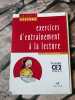
Objectif Lecture - Exercices d'entraînement à la lecture CE2: Fichier
HATIER 1997 43 pages 17x0 6x24 6cm. 1997. Broché. 43 pages.
Bon état
Árbók. 1944-52, 1967-70, 1972-73.
Reykjavik, 1945-74. Lex8vo. Ialt 17 bind. Med orig. omslag. Et bagomslag mangler.
"LANGEBEK, JACOB (et P.F. SUHM). - THE MIDDLE AGES IN SCANDINAVIA.
Reference : 48558
(1772)
Scriptores Rerum Danicarum Medii Ævi, partim hactenus inediti, partim emandatius editi, qvos Collegit, Adornavit et Publici Juris fecit. Tomus I-VII (all published by Langebek and P.F. Suhm). + Indicibus. (Ved Chr. Werlauff = R egisterbind, Bd. IX).
Hafniæ, Godiche, N. Möller, 1772-92. - (Registerbind), 1878. Folio. Bd. 1-2 i samtidige helldrbd. med rig rygforgyldning og ophøjede bind. Med en del brugsspor. Bd. 3-7 samt registerbindet. i nyereensartede hshirtbd. Med 12 foldetabeller. Bd. 1-3 med de 19 kobberstukne plancher af håndskriftfaksimiler. Bd. 4-7 uden håndskriftfaksimiler. Spredt papirsbruning, men ellers ren, bortset fra et titelblad som er noget smudsigt. Supplementsbindet (kaldet VIII, som udkom 1834 er ikke tilstede).
The largest collection of Danish medieval texts. In 1834 - 30 years later - a supplementary volume was published (called Vol. VIII), this is not present here. With the Index-volume (in 2 parts) published more than 100 years after the first volume. - From vol. IV P.F. Suhm was editor, after the death of Langebek. ""I dtte værk der indeholder de vigtigste kilder til dansk middelalder, og som står mål med tilsvarende udenlandske værker i samtiden, finder man resultatet af mange års grundige studier."" (DBL).
LANGEBEK, JACOB (et P.F. SUHM). - THE MIDDLE AGES IN SCANDINAVIA
Reference : 56743
(1772)
Scriptores Rerum Danicarum Medii Ævi, partim hactenus inediti, partim emandatius editi, qvos Collegit, Adornavit et Publici Juris fecit. Tomus I-VIII + IX (Indicibus. Ved Chr. Werlauff= Registerbind). 9 Bd. (alt).
Hafniæ, Godiche, N. Möller, 1772-92. - (VIII, 1834 og Registerbind IX, 1878). Folio. Bind 1-7 i samtidige hellædrbind i flammet kalv. Ophøjede bind. Rig rygforgyldning. Forgyldte tome- og titelfelter i skind. Nogle kapitæler slidte. Bind 8, som ikke udkom i samtiden, men først 1834, er i originalt papbd. med shirtryg. Bind 9, som først udkom 1878 er i nyere hfableabd. De 7 første bind indeholder en del foldetabeller, kobberstukne faksimiler af håndskrifter, kobberstukne foldekort etc. Disse 7 bind har tilhørt retshistorikeren J.L.A. kolderup-Rosenvinge.
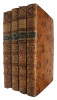
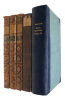
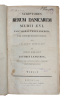
The largest collection of Danish medieval texts. In 1834 - 30 years later - a supplementary volume was published (called Vol. VIII), this is present here together with the Index-volume published more than 100 years after the first volume. - From vol. IV P.F. Suhm was editor, after the death of Langebek.
Om Sindsbevægelser. Et Psyko-Fysiologisk Studie.
Kjøbenhavn, Jacob Lund, 1885. Orig. bogtrykt omslag. Løs i heftningen og omslaget med rifter og pletter. (4),91 pp. Indvendig pæn.
First edition. The most importent Danish work in psychology. It is a psychophysiological study on vasomotor disturbances and conditioned reflexes during period of emotional stress - known as the James-Lange-theory.
Dorothea Lange Los años decisivos - SANS JAQUETTE
La Fábrica Editorial 2009 192 pages 26 6x2 4x22 6cm. 2009. Cartonné. 192 pages. ATTENTION: SANS JAQUETTE
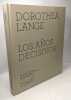
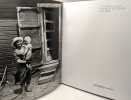
Très Bon Etat de conservation intérieur propre bonne tenue ATTENTION: SANS JAQUETTE
Admitting the Holocaust: Collected Essays
Oxford University Press Inc 1995 213 pages in8. 1995. Cartonné jaquette. 213 pages.
Très bon état avec sa jaquette intérieur propre bonne tenue
Art from the Ashes: A Holocaust Anthology
Oxford University Press Inc 1995 720 pages 16 764x6 858x24 13cm. 1995. Broché. 720 pages.
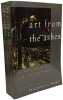
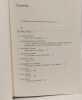
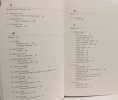
Très bon état
L'Ionisation des Gaz. (Chapter titles: I. L'Ionisation par les Rayons de Röntgen. II. L'Ionisation par les Rayons cathodiques.III. Recombination et Mobilités des Ions dans les Gaz" La Recombinaison des Ions).
Paris, Masson et Cie, 1903. 8vo. Bound with original printed yellow wrappers in contemp. hcalf, raised bands, gilt spine. Light wear along edges. Small stamps on verso of titlepage, on printed frontwrappers and on foot of p. 576. In ""Annales de Chimie et de Physique"", 7me Series - Tome XXVIII. (Entire volume offered). 576 pp., textillustrations. Langevin's paper: pp. 289-384 (Chapitre I-II) and pp. 433-530 (Chapitre III). Internally clean and fine.
First printing of Langevin's doctoral dissertation on X-rays and on the ionization of gases.Einstein wrote about Langevin : ""Langevin’s scientific thought displayed an extraordinary clarity and vivacity combined with a quick and sure intuition for the essential point. Because of those qualities, his courses exerted a decisive influence on more than a generation of French theoretical physicists..... It seems to me certain that he would have developed the special theory of relativity if that had not been done elsewhere, for he had clearly recognized its essential points.""
TECHNIQUE DE LA PEINTURE A L'HUILE HISTOIRE DU PROCEDE A L'HUILE VAN EYCK A (LA: Histoire du procédé à l'huile de Van Eyck à nos jours éléments ... suivie d'une étude sur la peinture acrylique
Flammarion 1993 494 pages in8. 1993. Broché. 494 pages.
Bon Etat de conservation dos un peu creusé intérieur propre
Le Bolomètre. Mémoire lu devant la Societe Mét´rorologique américaine, décembre 1880.
Paris, Imprimerie Gauthier-Villars, 1881. 8vo. Contemporary half calf, raised bands, gilt spine. Light wear along edges. Two small stamps on verso of title-page, and one on verso of the plates. In ""Annales de Chimie et de Physique"", Cinquiéme Series - Tome XXIV. 576 pp. + 2 folded plates. Langley's paper: pp. 275-284, textillustrations.
First French edition of the paper in which Langley describes the function of his invention of the bolometer for measurements of the cosmic microwave background radiation. A bolometer is a device for measuring the power of incident electromagnetic radiation via the heating of a material with a temperature-dependent electrical resistance.""Correctly recognizing the need for measurements of the energy of radiation as a function of wavelenght, Langley developed a new instrument ""the bolometer"" between 1879 and 1881 to do this......The superior measurements by means of the bolometer, the newly discovered extent of the solar spectrum, and the new results for selective absorption of the earth’s atmosphere were significant contributions to the study of the sun and its effects on the earth.""(DSB).Langley was awarded the Nobe l in physics in 1908.The volume conatins also Gabriel Lippmann (Nobel Prize 1908) ""Princiope de la Coservation de L'électricité"", pp. 145-178 and Crooke's famous paper (in French) ""Sur la viscosité des Gaz trés raréfies"", pp. 476-547 with 1 plate.
Language. Volume 63, #1
1987 - broché - Volume 63, Number 1 - March 1987 - Journal of the Linguistic Society of America - Edited by William BRIGHT - Published by The Linguistic Society of America, at The Waverly Press Inc., Baltimore - In-8 (25,5 x 17 cm) broché - p. 1 à 215 - Texte en anglais - SOMMAIRE : The lexicon (Victoria A. FROMKIN) - Predication and Pro (N. HORNSTEIN & D. LIGHTFOOT) - Nouns and verbs (Ronald W. LANGACKER) - Bybee: Morphology (M. ARONOFF) - ...
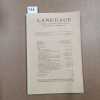
Bon état - Menus frottements sur la couverture
Language. Volume 69, #3
1993 - broché - Volume 69, Number 3 - September 1993 - Journal of the Linguistic Society of America - Edited by Sarah GREY THOMASON - Published by The Linguistic Society of America, at The Waverly Press Inc., Baltimore - In-8 (25,5 x 17 cm) broché - p. 449 à 647 - Texte en anglais - SOMMAIRE : On rules of referral (Gregory T. STUMP) - Structural head and aspectuality (Yafei LI) - The hyperspace effect: Phonetic targets are hyperarticulated (Keith JOHNSON, Edward FLEMMING & Richard WRIGHT) - ...
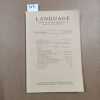
Bon état - Menus frottements sur la couverture
New Missions Anglais 2de 2014 Manuel de l'élève avec DVD vidéo
BORDAS 2014 216 pages 21x1 6x27 8cm. 2014. Broché. 216 pages.
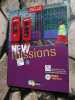


Très bon état
PASSIONNEMENT CHOCOLAT
PROBOOK. 1990. In-12. Broché. Parfait état, Couv. convenable, Dos satisfaisant, Intérieur frais. 95 pages illustrées de photos hors texte.. . . . Classification Dewey : 633.7-Plantes alcaloïdes (tabac, thé, cacao, café, pavot)
La fabuleuse histoire du chocolat, au pays du chocolat, le chocolat plaisir. Classification Dewey : 633.7-Plantes alcaloïdes (tabac, thé, cacao, café, pavot)

Theorie der Kraft. 1.-4 Haupttheil. (1. Welche in den Haarröhren und bei ähnlichen Erscheinungen wirkt. - 2. Die Wirkung der Haaröhren-Kraft auf eine neue Art Betrachtet. - 3. Theorie des Anziehens und Abstossens schwimmender Körper, der Adhäsion eine...
Leipzig, Joh. Ambrosius Barth, 1809. Contemp. hcalf. Gilt spine, raised bands. Very slightly rubbed. In ""Annalen der Physik. Herausgegeben von Ludwig Wilhelm Gilbert"", Bd. 33. (Entire volume offered). (12),452 pp. and 4 folded engraved plates. Internally clean and fine. Small stamps on verso of titlepage. Laplace's papers: pp. 1-114, pp. 141-182, pp. 273-293, pp. 293-338 a. pp. 373-394.
First German edition of Laplace's groundbreeking papers on the ""Short-range Forces"" i.e. capillary action, cohesion of solids, chemical reactions etc., where Laplace makes a major contribution to the mathematization of the subject. The papers are his first contributions to mathematical physics, and appeared as supplements to Book X of the fourth volume of his ""Traité de mécanique céleste"".""The importence, for Laplace's theory, of the shortrange character of the molecular forces cannot be overstressed. Small terms involving the square of the distance were repeatedly ignored, and it is no coincidence that in his concluding remarks to the second supplement Laplace reiterated his belief in the idntity of the forces at work in optical refraction, capillary action, and chemical reactions. In accordance with his belief that capillarity is a consequence of intermolecular action at a distance (albeit a very small distance), he tried to determine the relativemagnitude of the attractive force between the particles composing the liquid (F1) and the force between the particles of liquid and those of the tube (F2).... experiments, performed at Laplace's request, by Gay-Lussac, Haüy, and Jean-Lois Trémary...gave the theory added plausibility, as Laplace himself was always ready to observe"" and they certainly helped it to survive the criticism of Laplace's only contemporary rival in the treatment of capillarity, Thomas Young.""(DSB XV, Suppl. I, pp. 358 ff.).
ALBUM Les ECRIVAINS de la REVOLUTION
Un ouvrage de 320 pages, format 110 x 175 mm, illustré, relié simili-cuir sous rhodoïd, publié en 1989, NRF Gallimard, collection "La Pléiade", bon état
Iconographie choisie et commentée par Pierre Gascar
Phone number : 04 74 33 45 19
La Revue du Cinéma - Directeur-Rédacteur en chef : Jean George Auriol
Reference : 33428
La Revue du Cinéma / Scénarios (extraits) : Citizen Kane. The Magnificent Ambersons (Orson Wells) - Les débuts d'Orson Wells à Hollywood (Roy Alexander Fowler) - Le cinéma à la recherche du temps perdu (Illustrations de Jean Gervais) (Jacques Bourgeois) - Septième art, dixième muse (Lo Duca) - Faire des films (III): Avec de la technique et du génie (Jean George Auriol) - L'Elément non visuel au cinéma (III): Psychologie du rapport vision-audition (Pierre Schaeffer) - ...
N° 3 - 1er décembre 1946 - Série nouvelle Tome I - Mensuelle illustrée - broché - 80 pages
assez bon état (couv. un peu usée et ternie, avec le dos un peu rapé - petite déchirure au bas du dos)
La revue Napoléon - revue trimestrielle / english languageContents : January, February, march 1801Chronological table - The historical context - Interior minister Chaptal - Madame Récamier ( 177 - 1849 ) The Lunéville peace conference and treaty - Jefferson's election - england after the treaty of Lunéville and the fall of Pitt's cabinet - Bonaparte and Spain : The treaty of Aranjuez and the war of the oranges - The assassination of Paul I - The league of Neutrals and the battle of Copenhagen - The renaissance of sumptuary arts under the Consulate - Ganteaume's squadron - Painting under the Consulate - Uniforms in 1801 - The first Consul's dinners in 1801
1 vol in-4 broché - N° 5 february 2001 - Wonderfull images in and out text
nice condition
La revue Napoléon - revue trimestrielle / english languageContents : JApril, May, June 1801Chronological table - The historical context - ILe Tsar Alexandre et Bonaparte en 1801 - The plundering of art works - Toussaint Louverture proclaims the constitution of Saint Domingue : may-july 1801 - Hunger is back in France - Napoleonic Italy, 1796 - 1801 - The Concordat - admiral Gravina, hero of the sapnish navy - Bonaparte and Moreau - Bonaparte et Madame Campan - Jean-Etienne Portalis ( 1746 - 1807 ) - David's Studio - The frenche armies of 1801 - Napoleon Bonaparte's correspondence
1 vol in-4 broché - N° 6 May 2001 - Wonderfull images in and out text
nice condition
Guide courtine de paris 250 bonnes adresses gourmandes
FLAMMARION 1992 384 pages 1992. Broché. 384 pages.
Très bon état
"LARMOR, JOSEPH. - THE FITZGERALD-LORENTZ CONTRACTION CONFIRMED.
Reference : 43015
(1898)
A Dynamical Theory of the Electric and Luminiferous Medium. - Part III. Relations with Material Medica. Received April 21, 1897, - Read May 13, 1897.
(London, Harrison and Sons, 1898). 4to. No wrappers as extracted from ""Philosophical Transactions"" Year 1897, Volume 190 - Series A. - Pp. 205-300, textillustr. Clean and fine.
First appearance of an importent paper announcing the first formulation of the complete Lorentz-transformation and with the first prediction of time dilation. ""It seems churlish however to deny that Larmor had gained an importent, if limited insight into time dilation, two years before Lorentz's striking similar and independent insight of 1899.""(Harvey R. brown in ""Physical relativity"", p. 61). - The paper also presents the ""Larmor formula"".It's notable that Larmor was the first who recognized that some sort of time dilation is a consequence of the Loretz transformation as well, because individual electrons describe corresponding parts of their orbits in times shorter for the [rest] system in the ratio 1/y.Parallel to the development of Lorentz ether theory, Larmor published the complete Lorentz transformations in the Philosophical Transactions of the Royal Society in 1897 (in the paper offered) some two years before Hendrik Lorentz (1899, 1904) and eight years before Albert Einstein (1905). Larmor predicted the phenomenon of time dilation, at least for orbiting electrons, and verified that the FitzGerald-Lorentz contraction (length contraction) should occur for bodies whose atoms were held together by electromagnetic forces. In his book Aether and Matter (1900), he again presented the Lorentz transformations, time dilation and length contraction (treating these as dynamic rather than kinematic effects). Larmor opposed Albert Einstein's theory of relativity (though he supported it for a short time). Larmor rejected both the curvature of space and the special theory of relativity, to the extent that he claimed that an absolute time was essential to astronomy.Larmor held that matter consisted of particles moving in the aether. Larmor believed the source of electric charge was a ""particle"" (which as early as 1894 he was referring to as the electron). Thus, in what was apparently the first specific prediction of time dilation, he wrote ""... individual electrons describe corresponding parts of their orbits in times shorter for the [rest] system in the ratio (1 - v2/c2)1/2"" (in the paper offered).

