 Write to the booksellers
-
Type
Book (7300)
Disk (1)
Drawings (1)
Engraving (9)
Magazine (140)
Maps (4)
Music sheets (136)
New book (4)
Old papers (1)
Photographs (7)
-
Latest
Last 24h (10)
Last 3 days (5)
Last month (124)
Last week (20)
-
Language
Czech (1)
Dutch (9)
English (158)
French (7421)
German (4)
Italian (2)
Japanese (1)
Latin (3)
Russian (4)
-
Century
16th (9)
17th (43)
18th (194)
19th (884)
20th (2517)
21st (1560)
-
Countries
Belgium (1156)
Canada (34)
China (56)
Côte d'Ivoire (7)
Denmark (1063)
France (4934)
Germany (1)
Netherlands (181)
Switzerland (155)
United Kingdom (12)
United States of America (4)
-
Syndicate
ALAC (27)
CLAM (25)
CLAQ (2)
ILAB (2251)
NVVA (15)
SLACES (15)
SLAM (1038)
SNCAO (4)
Et si l'on partageait notre passion du goût ? Petites histoires et grandes recettes.
Paris, éd. Albin Michel, 2004, EDITION ORIGINALE, pt. in-4, cartonnage souple à rabats éd., couv. photos coul. éd., 160 pp., papier glacé, très nb. photos et reproductions de publicités et de documents anciens en coul. et en coul., sommaire, table des recettes, Une pointe de moutarde pour pimenter une viande, un cube de bouillon pour relever un légume, un petit sachet rose pour lever une pâte, un filet d'huile d'olive pour égayer une salade. Depuis des générations, ces ingrédients ornent les étagères de nos cuisines et font partie de notre quotidien. Grâce au concours de 14 grands chefs et à l'imagination d'amateurs passionnés, ce livre offre de savoureuses recettes inventives et facile à faire. Moutarde, vinaigre, mayonnaise, épices ont traversé le temps et orné les tables royales durant des siècles avant de trôner sur nos tables en fidèles compagnons. A travers leur saga racontée dans ce livre se dévoile une partie de notre histoire et de l'évolution de nos goûts. Comment, grâce à Sit Lipton, le thé est-il devenu une boisson si populaire ? Pourquoi, jusqu'au XIXe siècle, la moutarde et le vinaigre était-il fabriqué par le même artisan ? D'histoires savoureuses en découvertes culinaires, un livre à parcourir pour le plaisir et à consulter pour ses recettes, sans modération ! Très bon état
Biological Indicators of Environmental Quality: Bibliography of Abstracts
Imprint unknown 1973 264 pages 15 494x2 286x23 114cm. 1973. Cartonné jaquette. 264 pages.
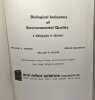
Bon état intérieur propre jaquette défraîchie frottée
"EULER, J. ALBERT. - THE LAW OF BILLIARD TRAJECTORIES - THE PHYSICS OF THE BILLIARD BALL.
Reference : 45862
(1765)
Recherches des Mouvemens d'un Globe sur un Plan horizontal. (1.-) Seond Mémoire. (2 Papers).
(Berlin, Haude et Spener, 1765 u. 1767). 4to. No wrappers, as issued in ""Mémoires de l'Academie Royale des Sciences et Belles-Lettres"" 1758, tome XIV a. XVI, pp. 284-353 a. 2 folded engraved plates + pp. 261-284 a. 1 folded engraved plate.
First printing of Johann Albert Euler's importent paper in which he set forth the so-called ""Theorem of Johann-Albert Euler"", stating that the trajectory of a ball is a parabola followed by a straight line. The eldest son of Leonhard Euler was a prominent geometer in his own right. In 1758, Johann-Albert Euler (1734-1800) published a study of the motion of a sphere on an horizontal plane in the presence of Newtonian friction. His main result would be rediscovered independently by Gaspard Coriolis as part of his authoritative theoretical work on the topic: Théorie mathématique des effets du jeu de billard (1835). Johann Albrecht Euler, born in St. Petersburg 1732 was a Swiss-Russian astronomer and mathematician and he was the first child born to the great Swiss mathematician Leonhard Euler.

Recherches sur la Cause physiques de L'Electricité.
(Berlin, Haude et Spener, 1759). 4to. No wrappers, as issued in ""Mémoires de L'Academie Royale des Sciences et belles-Lettres"", tome XIII, 1757. With titlepage to the year 1757 with engraved titlevignette and pp. 125-159 and 1 folded engraved plate. A Stamp to titlepage.
First appearance of this paper which expands his prize-winning memoir from the Petersbourg Academy. He is now convinced by Aepinus of the importence of Franklin's distinction between positive and negative electricity. He elaborates his theory of the identity of the electrical fluid with the ether.
De innumerabilibus Curuis tautochronis in in Vacuo. (On the innumerable tautochrone curves in a vacuum). (+) Curva Tautochrona in Fluido resistentiam faciente secundum Quadrata cerilitatum. (Tautochrone curves in a fluid making a second resistance pr...
(Petropoli, St. Petersburg, Typis Academiae, 1735). 4to. No wrappers. In: ""Classes Prima continens Mathematica. Commentarii Academiae Scientiarum Imperialis Petropolitanae"", Tomus IV ad Annum 1729. The whole section of ""Mathematica""offered. Pp 1-118 pp. and 10 engraved plates. Euler's papers: pp. 49-67 a. 2 engraved plates. Pp. 67-89 a. 1 engraved plate. Wide-margined, clean.
Both first editions and some of the earliest mathematical papers by Euler. The first paper is a masterful work, in which Euler first establishes a surprisingly simple geometric condition for tautochronic curves, and then shows how to generate such curves, both analytic and algebraic, starting from the familiar cycloid "" the next paper extends the analysis to a resistive medium where the resistance is in proportion to the square of the speed. - Enestroem E12 and E13.The section (Mathematica) also contains papers by Jacob Hermann, Christopher Maier, G.W. Krafft and Daniel Bernoulli ""Problema astronomicum inneniendi altitudinem poli,...."", pp. 89-94.
Recherches sur l'effet d'un machine hydraulique proposée par M. Segner, professeur à Goettingue. (Research concerning the effects of a hydraulic machine proposed by M. Segner, professor at Gottingen)
(Berlin, Haude et Spener, 1752). 4to. No wrappers, as issued in ""Mémoires de l'Academie Royale des Sciences et Belles-Lettres"", tome VI, Année 1750. Pp. 311-354 and 5 folded engraved plates.
First edition. In this importent paper Euler perfection Segner's hydraulic turbine, giving the theory of hydraulic turbines created in accordence with the principle of action and reaction.""In this work, Euler gives a complete hydraulic analysis, an early example of the theory of relative motion. He also shows that very high speeds are necessary for good efficiency. He argues that ""by means of fixed conducting tubes, adjust the incoming velocity of the water so that the speed of efflux relative to the rotor is zero"" in this way, the theorietical efficiency will be 100% at the desired speed of operation.""""(Truesdell).Enestroem: 179.
"EULER, LEONHARD. - EULER'S SECOND LUNAR THEORY AND THE PROBLEM OF THREE BODIES.
Reference : 41682
(1769)
Nouvelle Méthode de Déterminer les Dérangemens dans le Mouvement des Corps Célestes, Causés par leur Action mutuelle. (New Method to determine the pertubations during the motion of heavenly bodies caused by their mutual attraction) - Réflexions sur le...
(Berlin, Haude et Spener, 1769). 4to. No wrappers, as issued in ""Mémoires de l'Academie Royale des Sciences et Belles-Lettres"", tome XIX,. (2 =halftitle Mémoires..),141-220. 1.memoir pp. 141-179 a. 1 enraved plate. - 2. pp. 180-193. - 3. pp. 194-220. - 4. pp. 221-234 a. 1 plate.
First printing of these 4 fundamental papers on the perturbations of the moon, as Euler was the first to use of the Calculus on the motion of the moon in relation to the attractive powers of the Moon, the Earth and the Sun. The theories laid down here is also called Euler's second theory and it is the most interesting. It was of the greatest importtence as a basis for later developments.""He applied his mathematics to astronomy, working out the nature of some perturbations, being in this respect the precursor of Lagrange and Laplace. He began to replace the geometric methods of proof used by Galileo and Newton with the algebraic, a tendency carried to its conclusion by Lagrange. In particular he worked on lunar theory, that is, on the analysis of the exact motion of the moon, the complications of which have been the despair of astronomers and mathematicians since the time of Kepler. - Eneström: 398, 399, 400 a. 401.
"EULER, LEONHARD. - INTRODUCING ""THE EULER CONSTANT"" AND ""THE FUNCTION NOTATION""
Reference : 50926
(1740)
De Linea celerrimi descensus in Medio qvocunqve resistente. (On the curve of fastest descent in whatever resistent medium). (+) De progressionibus harmonicis observationes. (On harmonic progressions). (+) De infinitis curvis iusdem generis seu methodu...
(Petropoli, St. Petersburg, Typis Academiae, 1740). 4to. No wrappers. In: ""Classes Prima continens Mathematica. Commentarii Academiae Scientiarum Imperialis Petropolitanae"", Tomus VII ad Annum 1735, &..... Euler's papers: pp. 135-149, 150-161, 174-183 a. 184-200 and 2 engraved plates. Clean and fine.
First printing of 4 importent early papers by Euler. Enestroem: E42, E43, E44 a. E45.E42: This is Euler's second paper on the ""Brachistochrone problem"".E43. Here Euler introduces THE EULER CONSTANT. ""The Euler-Mascheroni constant (also called Euler's constant) is a mathematical constant recurring in analysis and number theory, usually denoted by the lowercase Greek letter gamma.""E44: ""This is an extensive paper that develops a method for finding a family of curves arising from the constant of integration of dz = Pdx, which is treated as the second variable"" the rudiments of partial differentiation are presented, and there is an extensive survey of homogeneous functions centred around what is now know as Euler's Theorem for such functions. The origins of this paper would seem to be Proposition 15 of Vol. 2 of the Mechanica, relating to families of tautochronous curves, where an integration relying on Euler's Theorem is required."" (Ian Bruce).E45: Here Euler introduces the FUNCTION NOTATION f(x). ""This is an equally extensive paper that continues the development of methods for finding a family of curves arising from the constant of integration of dz = Pdx, which is treated as the second variable. A method is developed for finding the modular equation for the first order equation that is extended to cover a number of cases"" this in turn is extended to second and higher orders. The method involves finding suitable functions to integrate, starting from a part of the modular equation that is integrable, so that the whole equation is of this form. This paper is noteworthy in addition as it seems to be the first in which the function notation, albeit in a slightly different form from the modern meaning, is introduce. I have not been able to check all the equations at this stage.""(Ian Bruce).This section also contains DANIEL BERNOULLI: Demonstrationes theorematum svorum de oscillationibus corporum filo flexili connexorum et catenae verticaliter suspensae. Pp. 162-173.
"EULER, LEONHARD. - LIGHT REFRACTION AND THE WAVE THEORY OF LIGHT.
Reference : 48838
(1758)
Expériences pour determiner la Refraction de toutes Sortes de Liqueurs transparantes.
(Berlin, Haude et Spener, 1758). 4to. No wrappers as issued in ""Memoires de l'Academie Royale des Sciences et Belles Lettres"". tome XI, 1756 pp. 235-266 and 1 folded engraved plate. Clean and fine.
First edition. In this memoir Euler records different experiments and their mathematical treatment with light refraction in liquids to follow up his own wave theory of light-refractions already put forward in 1746. - Enestrom: 234.
Discussion plus particuliere de diverses Manieres d'elever de L'Eau par le moyen des Pompes avec le plus grand Avantage. (In depth explanation concerning different methods with which to raise water through pumps with the greatest effectiveness).
(Berlin, Haude et Spener, 1754) 4to. No wrappers, as issued in ""Mémoires de l'Academie Royale des Sciences et Belles-Lettres"", tome VIII, Année 1752. Pp. 149-184 and 1 folded engraved plates.
First appearance of an importent work on different kinds of water-pumps, analyzing their different amounts of force used.""Euler also investigated a number of concrete problems on the motion of liquids and gases in pipes, on vibration of air in pipes, and on propagation of sound. Along with this, he worked on problems of hydrotechnology, discussed, in part, above. Especially remarkable were the improvements he introduced into the design of a hydraulic machine imagined by Segner in 1749 and the theory of hydraulic turbines, which he created in accordance with the principle of action and reaction (1752-1761).""(DSB).Eneström E 207.
Réfléxions sur quelques Loix génerales de la Nature qui s'observent dans les Effets des Forces quelconques. (Reflection on some general laws of nature which are observed in the effects of random forces).
(Berlin, Haude et Spener, 1750). 4to. No wrappers as issued in ""Mémoires de l'Academie Royale des Sciences et Belles-Lettres"" Tome IV, Année 1748. Pp. (189-) 218 and 1 engraved plate.
First appearance of this paper, in which Euler proves that given the static principle, he can derive the equilibrium conditions for a fluid, and from these, he obtains the integrability conditions for a ""Pfaffian"" form in three variables. He also looks at the equilibrium of a weight suspended from three elastic cords by looking, via analogy, to a special case of the problem for fluids.""In his 1748 paper, Euler in ""Reflexions sur quelques loix generales de la nature.."" starts by declaring his commitment to the least-action principle. His expression corresponds to what we would now call potential energy, so that his statement of least action (formulated by Maupertuis in 1746) in statics is equivalent to the principle that a system of bodies at rest will adopt a configuration that minimizes total potential energy. Euler called this quantity ""effort"".""Enestrom: E 146.
"EULER, LEONHARD. - SOLVING FOR THE FIRST TIME THE CONTACT PROBLEM OF FRICTION.
Reference : 45497
(1750)
Sur l'atmosphere de la Lune prouvée par la derniere eclipse annulaire du Soleil. (On the atmosphere of the moon as proved by the last ringed eclipse of the sun) + Sur le frottement des corps solides. (On the friction of solid bodies) + Sur la diminu...
(Berlin, Haude et Spener, 1750). 4to. No wrappers, as issued in ""Mémoires de l'Academie Royale des Sciences et Belles-Lettres"", tome IV, pp. 103-121 + pp. 122-132 + pp. 133-148 and 6 engraved plates (on 5).
Three first editions by Euler. Euler's goal in the first paper is to show that certain phenomena that resulted from the eclipse of July 25, 1748 are evidence that the moon has an atmosphere that is almost 200 times less dense than that of the earth. (The phenomena Euler observed are optical effects of light passing close to a sharp edge, and not the refraction of a lunar atmosphere).The other papers on the physics of rigid bodies are groundbreaking as Euler here set forth what is known as ""Euler's dynamical equations of the motion of the mass-center of any solid"", and thus STATING FOR THE FIRST TIME THE LAW OF DRY FRICTION, mathematically. Euler explains his experiments with the inclined plane and discovers the DIFFERENCE BETWEEN KINETIC AND STATIC FRICTION.""Leonhard Euler occupied himself with the mathematical point of view of friction as well as the experimental. He introduced the differentiation between static frictional forces and kinetic frictional forces, and solved the problem of rope friction, probably the first contact problem to be analytically solved in history. (1750, the papers offered). He was the first to lay the foundations of the mathematically way of dealing with the law of dry friction and in this way promoted further development. We have to thank for the symbol as the coefficient of friction. Euler worked with the idea that friction originates from the interlocation, between small triangular irregularities.This understanding survived, in different variations,for a hundred years and is also used today as the ""Tomlinson Model"" in connection with friction on atomic scale.""(L. Popov ""History of the Contact Mechanics and the Physics of Function"", p.3).Eneström: E142, E143, E144.
De Superficie Conorum Scalenorum, aliorumqve corporum conicorum. (On the surface of scalene cones and of other conic bodies). (+) Theoremata circa divisores numerorum. (Theorems on divisors of numbers). (2 papers by Euler).
(Petropoli (St. Petersbourg), 1750). 4to. Uncut, without wrappers. Extracted from ""Novi Commentarii Academiae Scientiarum Imperialis Petropolitanae"", Tom. I. ad Annum 1747 et 1748. Pp. 3-19 a. 1 engraved plate., and pp. 20-48.
First printing of both papers. The second is important as it contains Euler'is second proof of the Euler-Fermat theorem, which Euler presents as a consequence of the theorem that (a+b)p = ap+bp (mod p). This paper also includes results about possible divisors of a2n + b2n, and Euler uses this to show again that F5 is not prime. - Enestroem No. 133 a. 134.
Sur le Point de Rebroussement de la seconde Espece de mr. le Marquis de l'Hopital. (On the nispidal points of the second kind of Mons. le Marquis de l'Hopital). (+) Recherches sur les Racines Imaginaires des Equations. (Research on imaginary roots o...
(Berlin, Haude et Spener, 1770). 4to. No wrappers, as issued in ""Mémoires de l'Academie Royale des Sciences et Belles-Lettres"", Tome V, pp. 203-221, 1 plate and pp. 222-288, 1 engraved plate.
Both papers first edition. The first paper is Euler's discussion of ""Cramers Paradox"" and it contains his inventions of 2 kinds of curves, ""Cusps of first kind"" or keratoid cusp and ""Cups of second kind"" or ramphoid cusp. - Enestroem E 169.The second paper contains Euler's famous proof of ""The fundamental Theorem of Algebra"". - Enestroem E 170.
3 works by Euler: Nouvelle Méthode d'Éliminer les Quantités inconnues des Equations. - Recherches sur les Microscopes a´Trois Verres et les Moyens de les Perfectionner. - Sur L'Avantage du Banquier au Jeu du Pharaon.
(Berlin, Haude et Spener, 1766). 4to. No wrappers, as issued in ""Mémoires de l'Academie Royale des Sciences et Belles Lettres"", tome XX, pp. 91-164 (91-116"117-143"144-164). 1 engraved plate ( belonging to ""Microscope..."")
3 first editions by Euler in algebra, in optics and in the theory of chance - in this last paper he discusses the so-called St. Petersburg paradox, the Game Pharon.
Examen de la dissertation de M. le Professeur Koenig, inseree dans les actes de Leipzig, pour le mois de mars 1751. (Examination of the dissertation of Professor Koenig inserted into the Acts of Leipzig for the month of March 1751) (+) Essay d'une D...
(Berlin, Haude et Spener, 1753). 4to. No wrappers, as issued in ""Mémoires de l'Academie Royale des Sciences et Belles-Lettres"", tome VII, Année 1751. Pp. 221-245 and pp. 246-254 a. 1 engraved plate.
First editions. The first paper concerns the Argument over the principle of least action, relating to the famous controversy - and one of the ugliest scientific controversies - between Koenig and Maupertuis. ""In 1751 a sensational new argument began when S. König published some critical remarks on Maupertuis’s principle of least action (1744) and cited a letter of Leibniz in which the principle was, in König’s opinion, formulated more precisely. Submitting to Maupertuis, the Berlin Academy rose to defend him and demanded that the original of Leibniz’ letter (a copy had been sent to König from Switzerland) be presented. When it became clear that the original could not be found, Euler published, with the approval of the Academy, ""Exposé concernant l’examen de la lettre de M. de Leibnitz"" (1752), where, among other things, he declared the letter a fake. The conflict grew critical when later in the same year Voltaire published his Diatribe du docteur Akakia, médecin du pape, defending König and making laughingstocks of both Maupertuis and Euler.""(DSB) - Enestrom No. 199.The second paper - Enestrom No. 200.
"EULER, LEONHARD. - THE MATHEMATICAL THEORY OF WINDMILL-EFFECTS.
Reference : 42952
(1758)
Recherches plus exactes sur L'Effet des Moulins à Vent. (Refined studies into the effect of windmills)
(Berlin, Haude et Spener, 1758). 4to. No wrappers as issued in ""Memoires de l'Academie Royale des Sciences et Belles Lettres"". tome XII, 1756. Pp. 165-234 a. 1 folded engraved plate.
First printing of Euler's importent large memoir in which he develops the mathematical theory of windmills, and generates analytically the equations of the effects of winds on duoble-bended surfaces in relation to mechanical work. - Together with d'Alembert and Daniel Bernoully, Euler laid the foundation of mathematical physics. - Enestroem E 233.
"EULER, LEONHARD. - THE OPTICAL THEORY OF COMPOUND LENSES FOR TELESCOPES AND MICROSCOPES.
Reference : 45126
(1759)
Régles générales pour la Construction des telescopes et de Microscopes, de quelque nombre de Verres qu'ils soient composés. (Rules for the construction of telescopes and microscopes).
(Berlin, Haude et Spener, 1759). 4to. No wrappers, as issued in ""Mémoires de l'Academie Royale des Sciences et Belles Lettres"", Année 1757, tome XIII, pp. a. 1 engraved plate.
First printing of an importent paper in which Euler shows how to manufacture catoptrical telescopes and microscopes in accordance with general rules and founded on his own experiments. - The calculation concerning light ray aberrations, brought about due to the sphericty of the glass, is a masterpiece of analysis of the highest order and he also incorporates the mathematical theory of achromatic combination of lenses, which was first realized by Dollond in the same year, 1757.
Harmonie entre les Principes generaux de repos et de Mouvement de M. de Maupertuis.
(Berlin, Haude et Spener, 1753). 4to. No wrappers, as extracted from ""Mémoires de l'Academie Royale des Sciences et Belles-Lettres"", tome VII, pp. (167-)198.and 2 folded engraved plates.
First printing of this memoir in which Euler tries to show that the ""harmony"" between Maupertuis' Law of rest, which he formulated for any system of bodies attracted by forces, is a generalization of his own Principle of least Action.
"EULER, LEONHARD. - THE RETROGRADE MOVEMENTS OF THE PLANETS.
Reference : 46593
(1748)
Mémoire sur la plus grande Équation des Planetes. (Memoir on the Maximum Value of an Equation of the Planets).
(Berlin, Haude et Spener, 1748). 4to. No wrappers as issued in ""Memoires de l'Academie Royale des Sciences et Belles Lettres"". tome II, 1746. Pp. 225-248.
First apperance of Euler's mathematical treatment of the retrograde motions of the planets. He discusses the fact that planets observed from the earth exhibit a very irregular motion. In general, they move from west to east along the ecliptic. At times however, the motion slows to a stop and the planet even appears to reverse direction and move from east to west. We call this retrograde motion. After some time the planet stops again and resumes its west to east journey. However, if we observe the planet from the stand point of an observer on the sun, this retrograde motion will not occur, and only a west to east path of the planet is seen. These facts Euler treats mathematically.
European Security Special Panel Of The Study Goodpastor Gen Rtd Andrew J. Goodpastor Andrew J Esecs/att: Herman Feshbach
Reference : 100147284
(1985)
ISBN : 9780813370781
Strengthening Conventional Deterrence In Europe: A Detailed Program For The 1980s (Westview Special Studies in International Security)
Westview Press 1985 166 pages in8. 1985. Broché. 166 pages.
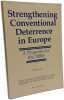
Bon état bonne tenue intérieur propre
Palace of the Mind. The Cloister of Silos and Spanish Sculpture of the Twelfth Century.
Turnhout, Brepols, 2012 Hardback, 300 pages ., 300 b/w ill., 210 x 280 mm. fine condition !! ISBN 9782503517117.
The extraordinary cloister of Santo Domingo de Silos is central to our understanding of medieval sculpture, and of Spain's place in its development. Elizabeth Valdez del Alamo offers an innovative reading of the monastery's medieval sculpture and the first complete study in English. Her carefully documented work revises many traditional theories about the site built during the late eleventh and twelfth centuries. Rather than expressing resistance to religious reform, as commonly held for the renowned Emmaus and Thomas reliefs of the first campaign, they embrace the newly imposed Roman rite. The sirens, dragons, lions, and birds of the capitals are shown to have significance beyond mere decoration. The inventive images of the second campaign, an Annunciation-Coronation and a Trinity set into the Tree of Jesse, derive specifically from monastic devotion, colored by local concerns such as the Reconquest. Languages: English.
Heliand. L'evangile de la Mer du Nord,
Turnhout, Brepols, 2008 Paperback, 488 pages., 14 x 21 cm.Languages : French. ISBN 9782503528663.
Ce poeme germanique de pres de 6000 vers a ete compose entre 822 et 840, vraisemblablement vers 825, dans les premieres annees du regne de Louis le Pieux, par un erudit chretien, sans doute compagnon du Frison Liudger. Ce dernier etait le continuateur de l??uvre, en pays frison et saxon, des evangelisateurs anglo-saxons du VIIIeme siecle, dont Willehad, lequel avait succede a Boniface, tue en 754 a Dokkum alors qu?il poursuivait l?evangelisation entreprise par Willibrord. La langue utilisee, qualifiee de Vieux-Saxon par les specialistes, etait donc tout a fait familiere a son auteur. Celui-ci, soucieux d?assurer le succes de l?Evangile dans les c?urs a la suite de la dure conquete par Charlemagne de la Frise Occidentale et du pays saxon, usa d?une langue connue des peuples riverains de la Mer du Nord au debut du IXeme siecle. Surtout, il apporta au texte de l?Evangile, base sur des manuscrits et travaux provenant de Fulda, abbaye fondee par Boniface, des adaptations d?ordre sociologique propres a susciter l?adhesion des peuples rudes et fiers de ces contrees nordiques. En ce sens, le Heliand n?est pas seulement une reprise de l?Evangile : il est aussi le document particulier par lequel les evangelisateurs des pays riverains de la Mer du Nord font entrer le lecteur dans la societe des nouveaux convertis d?entre Weser, Ems et Lauwers, fraichement vaincus et soumis par les Francs. La presente traduction, en prose, est accompagnee du texte germanique tel qu?edite a Halle en 1878 par Eduard Sievers, et de commentaires et annotations. Elle est precedee d?une introduction historique et d'un lexique de termes empruntes au Heliand et compares a quatre langues germaniques proches, avec traduction en francais.
GIOTTO Scuola Editrice
1962 1962. grand format cartonné avec jacquette 64 pages édition originale difficile à trouver. bel ouvrage de collection avec galerie de reproductions couleur des oeuvres de l'Artiste ; introduction (13 pages) en italien et 25 planches hors-texte en couleurs contrecollées sur vélin épais avec un texte explicatif en regard en italien français anglais et allemand. en TRES BEL ETAT sans déchirures ni annotations; intérieur impeccable propre et frais; très bel ouvrage
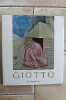
Très bon état
Flandre et Portugal au confluent de deux cultures
Mercatorfonds 1991 in4. 1991. Cartonné jaquette.

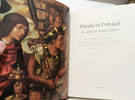
livre comme neuf avec sa jaquette emboîtage défraichi taché

