 Write to the booksellers
-
Type
Book (175)
Magazine (8)
Music sheets (2)
-
Language
English (1)
French (183)
Russian (1)
-
Century
17th (1)
18th (4)
19th (39)
20th (53)
21st (9)
-
Countries
Belgium (8)
Côte d'Ivoire (1)
Denmark (33)
France (92)
Switzerland (50)
United States of America (1)
-
Syndicate
ILAB (50)
SLAM (13)
"LORENZ, L. (LUDWIG VALENTIN) - LIGHT IS IDENTICAL WITH ELECTROMECANICAL WAVES.
Reference : 55371
(1867)
Om Identiteten af Lyssvingninger og elektriske Stømme. (On the Identity of the Vibrations of Light with electrical Currents).
(København, 1867). Contemp. marbled clothbacked boards. Titlelabel with gilt lettering on upper cover. Pp. 26-45. Extracted from ""Oversigt over det Kgl. danskeVidenskabernes Selskabs Forhandlinger 1867, Nr. 1"".
Extremely scarce first edition of the paper in which Lorenz, independent of Maxwell, stated that light is electromechanical in nature, probably inspired by his former teacher H. C. Oersted, the discoverer of electromagnetism and professor at the Polytechnic College, he aimed at unifying the forces of nature without introducing new physical hypotheses. ""The idea that the various forces in nature are merely different manifestations of the one and same force has proved itself more fertile than all physical theories"".Most impressive of all Lorenz’ achievements in optics is his electromagnetic theory of light, developed in a relatively unknown paper of 1867, two years after Maxwell’s famous paper on the same subject. At that time Lorenz did not know Maxwell’s theory, and his own approach was quite different. Lorenz’ electromagnetic theory of light can be described briefly as an interpretation of the light vector as the current density vector in a medium obeying Ohm’s law. This paper contains the fundamental equations for the vector potential and the scalar potential or - for the first time - the corresponding retarded potentials expressed in terms of the current density vector and the electrical charge density. The concept of retarded potentials had already been introduced in an earlier paper by Lorenz in connection with research on the theory of elasticity. He found that the differential equation for the current density vector was the same as his fundamental wave equation for the light vector, completed with a term which explains the absorption of light in conducting media, and that his theory led to the correct value for the velocity of light."" (Mogens Pihl in DSB).The paper was published in English, 1867 ""On the identity of the vibrations of light with electrical currents."" (Philosophical Magazine 34: 287-301) and also in German in ""Annalen der Physik""

Lot de 4 dessins originaux au crayon et à l'encre sur calque de modèles de lampe grandeur nature signés Friedmann.
2 d'un format de 40X26 cm et 2 de 33 X 24 cm environ.
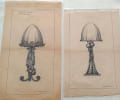
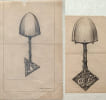
4 projets de luminaire par l'Atelier de ferronnerie d'Art Friedmann à Paris de l'Epoque Art Déco.CHACUN :
Le luminaire de l'antiquité au XIXe siècle. 105 illustrations (héliogravures et figures).
Paris, R. Ducher 1934. Bel exemplaire broché, couverture ornée d'éd., gd in-8, 64 pages.
STEUBEN DESIGN. A LEGACY OF LIGHT AND FORM.
New York, Harry N. Abrams, 2004 Bound, grey cloth with silver impression, illustrated dustjacket, picture-frontispice, 225 x 275mm., 144pp., profoundly illustrated. ISBN 0810946459.
For one hundred years Steuben Glass has represented the pinnacle of the American glassmaker's art. Internationally acclaimed, a gift of presidents, and treasured possession of collectors, each piece of Steuben is a perfect marriage of art and function. Whatever form it takes, Steuben glass has the power to illuminate and transform its surroundings, magnifying the simple joys of everyday living. New book.
"MAJORANA, Q. - PROVING THAT THE SPEED OF LIGHT IS INDEPENDENT OF ITS SOURCE.
Reference : 48169
(1917)
Démonstration experimentale de la constance de vitesse de la lumiére réfléchie par un miroir en mouvement.
(Paris, Gauthier-Villars), 1917. 4to. No wrappers. In: ""Comptes Rendus hebdomadaires des Séances de L'Academie des Sciences"", tome 165, No 14. Pp. (417-) 448. (Entire issue offered). Majorana's paper: pp. 424-428. A stamp in upper right corner of the first page.
First apperance of Majorana's paper which was the first experimentally to prove the speed of light as set forth by Einstein in his special relativity theory. Majorana was critical to Einstein's relativity, and he therefore tried to prove experimentally that the postulate of the speed of light was wrong. His experiments turned out otherwise, and he hereby proved Einstein's postulate that the speed of light was independent of the velocxity of its source.
Considerations sur la seconde inégalité du mouvement des Satellites de Jupiter, & sur l'hypothese du mouvement successif de la lumiere.
(Paris, Jean Boudot, 1708). 4to. Without wrappers. Extracted from ""Mémoires de l'Academie des Sciences"". Année 1707. Pp. 25-32. A small tear to inner margins.
First printing of one of Maraldi's more theoretical memoirs in which he defended the point of view of Cassini I, opposing the hypothesis of the finite velocity of light, conceived by Ole Römer to account for certain irregularities in the movement of Jupiter’s satellites.
Martiniani-Reber (Marielle) - Chrazanovski (Laurent)
Reference : 54881
(2012)
ISBN : 8874396082
A la tombée de la nuit.... Art et histoire de l’éclairage
5 Continents 2012 In-4 cartonnage éditeur 29,20 cm. CCLI pages. Livre neuf. Poids sans emballage : 1800 grammes.
Très bon état d’occasion
Ottocento.
Treviso (Italie), éd. Masiero SRL, 2014, EDITION ORIGINALE, gd. in-4, cartonnage tissu brodé noir et or avec le nom de Masiero en noir sur "plaque" dorée en relief éd., gardes dorées, non paginé (environ 300 pp.) papier glacé, très nb. photos en coul. sur fond noir et blanc, texte en 5 langues (italien - anglais - français - russe - allemand), petites fiches techniques pour chaque luninaire de la collection au bas de chaque photo, sommaire, Sompueux catalogue de vente de luminères de la marque Masiero en Italie. Des photographies extra-ordinaires. Le MUST pour ce type de luminaires. Très RARE Très bon état, comme neuf
"MAXWELL, JAMES CLARK. - THE INTRODUCTION OF THE ""ELECTRICAL FORMULATION"" OF THE ELECTROMAGNETIC THEORY OF LIGHT.
Reference : 42029
(1869)
On a Method of making a Direct Comparison of Electrostatic with Electromagnetic Force"" with a Note on the Electromagnetic Theory of Light. (Read June 18, 1868).
(London, Taylor & Francis, 1869) Large 4to. Without wrappers. Extracted from ""Philosophical Transactions of the Royal Society of London."", Vol. 158. Maxwell's paper: pp. 643-657. Clean and fine, wide margins.
First appearance of this major paper on electromagnetic dynamics, in which Maxwell improves the groundbreaking equations he had set forth in his famous paper of 1865, the ""A dynamical Theory of Electro-Magnetic Fields"". In the paper offered here, he for the first time proposed to base the electromagnetic theory of light solely on 2 equations. The paper is one of Maxwell's 5 most importent contributions to electromagnetism.""Formulas for the forces between moving charged bodies may indeed de derived from Maxwell's equations, but the action is not along the line joining them and can be reconciled with a dynamical principle only by taking into account the exchange of momentum with the field. Maxwell remarked that the equations might be condensed, but ""to eliminate a quantity which expresses a useful idea would be rather a loss than a gain in this stage of our enquiry."" he had in fact simplified the equations in his fifth major paper, the short, but importent ""Note on the Electromagnetic Theory of Light."" (1868), writing them in an integral form without the function A, based on four postulates derived from electrical experiments. This may be called the electrical formulation of the theory, in contrast with the original dynamical formulation."" (C.W.F. Everitt in DSB).
Maya Barakat-Nuq Frédéric Berqué Christian Cino
Reference : 500329875
ISBN : 9782754016995
Ce soir je reçois
Toquades 85 pages Sans date. 85 pages. Ce livre de cuisine propose des recettes légères et faciles à réaliser spécialement conçues pour les occasions où l'on reçoit des invités. Il se présente comme "le livre de cuisine light le + facile du monde"
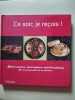
Bom estado
L’Eclairage dans la maison
Armand Colin 1994 In-4 reliure éditeur, 144 pp. Illustrations couleurs
Bon état d’occasion
DIFFRACTION OF LIGHT BY PROGRESSIVE SUPERSONIC WAVES,
Brussel, Paleis der Academien, 1950 Gebrocheerd, papieromslag, 180 x 260mm., 21pp., grafieken en tabellen.
Mededelingen van de Koninklijke Vlaamse Academie voor Wetenschappen, Letteren en Schone Kunsten van Belgie. Klasse der Wetenschappen. Jaargang XII N?° 7. In goede staat.
Yonel Lebovici Sculpteur De Haut Niveau
Paris Stein Ouaki 1995 24x30cm Michèle Chartier Yonel Lebovici Sculpteur de haut niveau Catalogue raisonné des objets, sculptures, luminaires. Paris, Editions Stein Ouaki 1995. 24x30cm, 148 pages illustré en noir et en couleur. Reliure cartonnée avec découpe en forme de niveau et jaquette illustrée. Tirage 400 exemplaires. 36 pages de texte et 112 illustrations pleine page. La totalité de la production de l'artiste est répertoriée et minutieusement décrite avec indication des tirages. Yonel Lebovici mêle avec humour l'irraisonnable et le déraisonnable . L'originalité et la variété de son ouvre trahissent une exigence de liberté et un souci de perfection. Sa sculpture de précision échappe à l'expression conventionnelle en conservant une signification substantielle. Cette monographie regroupe pour la première fois en 148 et 170 photographies la totalité de l'ouvre du maître incontesté des objets détournés. Nombreuses expositions de groupes et personnelles : SAD, Lumières je vous aime (Centre Pompidou), salon du luminaire, Galerie JC Riedel, Galerie Avant-Seine, Arts Décoratifs. Exemplaire du tirage de luxe à 100 exemplaires inclus dans une sculpture lumineuse "Niveau" en aluminium signée et numérotée à la pointe, fournie avec un petit transformateur permettant de l'allumer. (100510)
24x30cm Jaquette en bon état Cartonnage De L'éditeur 100 Exemplaires Numérotés
Bien eclairer son interieur.
Massin, sd 1990 In-4 relié. Très bon état d’occasion.
Très bon état d’occasion
BOUGIES ET BOUGEOIRS
Fleurus 1996 In-4 relié 28,2 cm sur 23,2. 159 pages. Très bon état d’occasion.
Très bon état d’occasion
Lighting
Watson-Guptill 1999 In-4 relié 28,2 cm sur 24,1. 176 pages. Très bon état d’occasion.
Très bon état d’occasion
Chandelles et bougies : L'art de fabriquer bougies et bougeoirs à l'aide d'ingrédients simples et naturels
Editions Soline 1997 jaquette défraichie , , usée en coiffe sur la longueur , cornée au bas droit
Bon état d’occasion
Entendez la musette, o gai !...
Micouin 1935 1 in-12 Imprimerie A. Micouin, (1930), in-12, broché, couverture crème illustrée de motifs floraux bleux et roses.
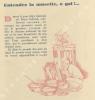
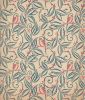
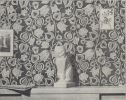
Catalogue présentant le talent de René Gabriel, dominotier qui a su asservir la machine à son art, et ainsi rendre accessible à toutes les bourses les Papiers Peints de France. Deux planches, hors-texte, en noir, présentent différents modèles de papier peint. Salissures à la couverture et infimes plis.

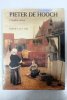
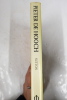
Pieter de Hooch
Bound book, 312 pages, published on 6 March 1980 by Phaidon Press Ltd, in very good general condition, slightly worn jacket. Livre relié, 312 pages, paru le 6 mars 1980 chez Phaidon Press Ltd, très bon état général, jaquette légèrement usée.
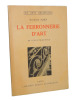
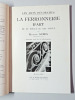
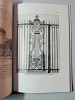
La ferronnerie d'art 64 illustrations
vol broché, 22x15cm, bel exemplaire, 63pp. Paris, Flammarion 1935 ref/177
Luminaires retro
Larrey cartonnage éditeur grand in 8 à l’italienne, uniformément terni et un peu frotté mais bien propre et solide
Bon état d’occasion
"RITTER, (JOHANN W.). - THE DISCOVERY OF ""CHEMICAL RAYS"" - ULTRAVIOLET LIGHT AND RADIATION.
Reference : 43492
(1801)
Announcing his discovery of ultraviolet light ""Von den Herren Ritter und Bückmann. - - Am 22sten Febr. habe ich auch auf der Seite des Violetts im Farbespectrum, ausserhalb desselben, Sonnenstrahlen angetroffen....
Halle, Rengerschen Buchhandlung, 1801. Without wrappers as published in ""Annalen der Physik. Herausgegeben von Ludwig Wilhelm Gilbert"", Bd. 7, Viertes Stück. The entire issue offered (=Heft 4). Pp. 387-528. Ritter's announcement p. 525. With titlepage to volume 7. Clean and fine. Titlepage a bit shavedin inner margin.
First printing of Ritter's announcement of his discovery of ultraviolet light in a halfpage letter addressed to Gilbert's Annalen. With that discovery, it became clear that visible light represents no more than a fraction of a continous spectrum.A year earlier, in 1800, William Herschel discovered infrared light. This was the first time that a form of light beyond visible light had been detected. After hearing about Herschel's discovery of an invisible form of light beyond the red portion of the spectrum, Ritter decided to conduct experiments to determine if invisible light existed beyond the violet end of the spectrum as well. He had heard that blue light caused a greater reaction in silver chloride than red light did. Ritter decided to measure the rate at which silver chloride reacted to the different colors of light. He directed sunlight through a glass prism to create a spectrum. He then placed silver chloride in each color of the spectrum and found that it showed little change in the red part of the spectrum, but darkened toward the violet end of the spectrum. Johann Ritter then decided to place silver chloride in the area just beyond the violet end of the spectrum, in a region where no sunlight was visible. To his amazement, this region showed the most intense reaction of all. This showed for the first time that an invisible form of light existed beyond the violet end of the visible spectrum. This new type of light, which Ritter called Chemical Rays, later became known as ultraviolet light or ultraviolet radiation (the word ultra means beyond). - Parkinson, Breakthroughs: 1801 P.
Versuche über das Sonnenlicht.
Halle, Rengerschen Buchhandlung, 1803. Without wrappers as extracted from ""Annalen der Physik. Herausgegeben von Ludwig Wilhelm Gilbert"", Jahrgang 1802, Bd. 12, Zwölftes Stück. Pp. 409-416. Titlepage to vol. 12.
This is Ritter's first expositon of his discovery of ultraviolet light. It was announced the year before in a halfpage letter addressed to Gilbert's Annalen and printed in the Annalen. With that discovery, it became clear that visible light represents no more than a fraction of a continous spectrum.A year earlier, in 1800, William Herschel discovered infrared light. This was the first time that a form of light beyond visible light had been detected. After hearing about Herschel's discovery of an invisible form of light beyond the red portion of the spectrum, Ritter decided to conduct experiments to determine if invisible light existed beyond the violet end of the spectrum as well. He had heard that blue light caused a greater reaction in silver chloride than red light did. Ritter decided to measure the rate at which silver chloride reacted to the different colors of light. He directed sunlight through a glass prism to create a spectrum. He then placed silver chloride in each color of the spectrum and found that it showed little change in the red part of the spectrum, but darkened toward the violet end of the spectrum. Johann Ritter then decided to place silver chloride in the area just beyond the violet end of the spectrum, in a region where no sunlight was visible. To his amazement, this region showed the most intense reaction of all. This showed for the first time that an invisible form of light existed beyond the violet end of the visible spectrum. This new type of light, which Ritter called Chemical Rays, later became known as ultraviolet light or ultraviolet radiation (the word ultra means beyond).

