Write to the booksellers
-
Type
Any type (2)
Art print (7)
Book (31529)
Disk (1)
Drawings (7)
Engraving (9)
Magazine (130)
Old papers (1)
Photographs (14)
Posters (4)
-
Latest
Last 24h (13)
Last 3 days (39)
Last month (294)
Last week (196)
-
Language
Dutch (1)
English (54)
French (31603)
German (6)
Italian (18)
Japanese (2)
Portuguese (9)
Spanish (11)
-
Century
16th (15)
17th (56)
18th (207)
19th (1574)
20th (9742)
21st (1795)
-
Countries
Belgium (9589)
Brazil (7)
Canada (108)
China (3)
Côte d'Ivoire (124)
Denmark (214)
France (18573)
Germany (1)
Greece (1)
Italy (36)
Switzerland (3048)
-
Syndicate
ALAC (99)
CLAM (42)
CLAQ (94)
CNE (3)
ILAB (11265)
NVVA (1161)
SLACES (1161)
SLAM (8744)
SNCAO (9)
Marton Paolo Wundram Manfred Pape Thomas
Reference : 100113102
(2004)
ISBN : 3822821098
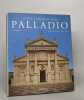
Palladio: The Complete Buildings
Taschen GmbH 2004 248 pages 20x2 2x25cm. 2004. Broché. 248 pages.
Très bon état
Hungaria Regia 1000-1800 fastes et d fis
, Brepols Publishers 1999, 1999 Softcover, 336 pages, Texte en Francais, 295 x 245 mm, beaucoup illustrations,. ISBN 9782503508818.
The catalogue begins with the establishment of the Kingdom of Hungary in the year 1000 and runs to the collapse of the dynastic union between Hungary and the Southern Netherlands in the closing years of the 18th century. Some 40 Hungarian museums and church collections are lending works of art: precious metal work paintings and sculptures, armoury, costumes and manuscripts from the world famous library of King Matthias Corvinus' renaissance court. La notion d'Europe centrale fait nouveau partie de notre vocabulaire. L poque o nous divisions sans nuance le continent en Europe de l'Este et Europe de l'Ouest est donc r volue. Nous sommes nouveau conscients de l'unit fondamentale ainsi que de la richesse et des variations de la culture europ enne. C'est pr cis ment cette id e que l'exposition Hungaria regia veut transmettre au plus large public. Pour ce faire le catalogue a t ax e sur trois th mes centraux: les moments-cl s de l'histoire hongroise, le r le que ce pays joue traditionnellement en tant que lieu de rencontre et de passage des cultures europ ennes, et les liens de la Hongrie avec nos contr es. L'exposition d bute avec la fondation du Royaume de Hongrie en l'an 1000 et court jusqu' la dislocation de l'union dynastique de la Hongrie avec les Pays-Bas m ridionaux dans les derni res ann es du XVIIIe si cle. Une quarantaine de mus es et collections eccl siastiques hongroises nous pr tent des oeuvres majeures: orf vrerie, tableaux et sculptures, armes, costumes et manuscrits de la c l bre biblioth que du roi Matthias Corvin.
L'Histoire de Notre-Dame de Paris. d'après les estampes, dessins , miniatures, tableaux exécutés aux XVe, XVIe, XVIIe, XVIIIe et XIXe siècles par Aveline, Bérain, Blondel, Bollery, Bosse, Jacques Cellier, C.-N. Cochin, Corot, Courvoisier, Gros, Isabey, Jaime, Jollain, Le Clère, Lemercier, Marot, Méryon, Moncornet, Percier & Fontaine, Pérelle, Picart, Prieur, Raffet, Sergent Marceau, Israël Silvestre, Testard & Roger, Vierge, Viollet-Leduc, etc. Fac-similés des originaux accompagnés d'un résumé chronologique et d'une bibliographie par André Marty
Paris, chez l'auteur, 1907 in-folio, [2] ff. n. ch., 58 pp., [18] ff. n. ch., avec 90 planches hors texte, chiffrées 1-100 (nombreuses planches à deux illustrations), demi-chagrin ivoire à coins, dos à nerfs cloisonné et fleurdelisé, simple filet doré sur les plats, tête dorée, couverture et dos conservés (Richardot). Dos légèrement passé.
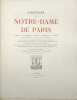
Tirage limité à 125 exemplaires numérotés à la presse (12/125).Unique édition, peu commune, de ce magnifique album qui constitue surtout un exceptionnel ensemble de fac-similé d'iconographie relative à la cathédrale parisienne : on notera spécialement une reproduction de sceaux sous passe-partout cartonné et dépliant ; ainsi qu'une impression sur soie (planche 29 / 25). André Marty (1857-1928) - qu'il ne faut évidemment pas confondre avec l'agitateur communiste homonyme - fut un éditeur d'estampes reconnu : c'est sur ses propres presses qu'il fit paraître cet ouvrage.Bel exemplaire. - - VENTE PAR CORRESPONDANCE UNIQUEMENT - LIEN DE PAIEMENT, NOUS CONSULTER.
Histoire Universelle de l'Art. Architecture - Sculpture - Peinture - Gravure - Arts décoratifs. Préface de F. Durrbach.
1926 P., Albin Michel (Bibliothèque de l'Amateur d'Art et du Collectionneur), 1926, 2 volumes grand in 4° brochés, 749 pages en pagination continue ; très nombreuses illustrations ; couverture un peu fanées avec petits manques.
...................... Photos sur demande ..........................


Phone number : 04 77 32 63 69
LA MAISON RURALE EN VELAY ET BRIVADOIS , CONTRIBUTION A UN INVENTAIRE REGIONAL
SAINT-JUST-PRES-BRIOUDE CREER 2010 Un volume grand in-8 broché de 108 pages , couverture et très nombreuses illustrations en couleurs , très bon exemplaire . Très bon Couverture souple
Phone number : 04.71.02.85.23
MARTY JEAN-PIERRE POUR LE VOLUME 1 ET ONDET ROLAND ET TRAPON PATRICE POUR LE VOLUME II
Reference : 000227
(1977)
LA MAISON RURALE EN AUVERGNE
NONETTE CENTRE DE REALISATIONS D' ETUDES ET D' EDITIONS REGIONALES 1977 CONTRIBUTION A UN INVENTAIRE REGIONAL , 2 volumes grand in-8 brochés de 63 et 60 pages , couvertures illustrées , dessins , photos et plans des auteurs , très bons exemplaires. Très bon Couverture rigide
Phone number : 04.71.02.85.23
Mini saga des ponts de Paris
Port Autonome de Paris Broché Port Autonome de Paris, 1980. Petit In-4 carré broché. 94 pages + nombreuses photos. Bon état.
Toutes les expéditions sont faites en suivi au-dessus de 25 euros. Expédition quotidienne pour les envois simples, suivis, recommandés ou Colissimo.
Basiliques et églises de Rome.
Paris et Rome, Desclée, Lefebvre et Cie. 1902, 235x150mm, XXXIX - 528pages, reliure demi-chagrin à coins avec pièce de titre et d’auteur dorés au dos à quatre faux-nerfs. Plat toilé. Garde papier fantaisie. Tranche supérieure rouge. Hormis dos insolé, belle reliure. Bel exemplaire.
147 illustrations n/b in et hors texte (plans dépliants et photos), Pour un paiement via PayPal, veuillez nous en faire la demande et nous vous enverrons une facture PayPal
Le Forum Romain et le Palatin d’après les dernières découvertes, avec deux plans et plusieures illustrations dans le texte. Troisième édition revue, avec introduction sur Les Forums et la Voie de l’Empire par O. Montenovesi.
Rome, Desclée & Cie. 1933, 220x140mm, XXVIII - 381pages, reliure demi-chagrin. Auteur, titre et filets dorés au dos à nerfs. Plats papier marbré. Couvertures conservées. Belle reliure. Bel exemplaire.
avec les deux plans dépliants, Pour un paiement via PayPal, veuillez nous en faire la demande et nous vous enverrons une facture PayPal
Roma sotterranea cristiana (Nuova serie) Descrizione analitica dei monumenti esistenti negli antichi cimiteri suburbaani pubbl. a cura della comm. di archeologia sacra. Tome Primo: Monumenti del cimitero di Domitilla sulla via ardeatina. Fascicolo I: Tavole (1909) / Fascicolo II Testo e tavole (1914).
Roma, Ed. Libr. Spithoever, 1909 - 1914, in-folio, 2 ff. + 2 p. + 25 Tavole (Chromolithogr.) / 2 ff. + p. 101 à 260 + Tavole 26 à 36, brochure originale.
(SLACES, NVVA)
Phone number : 41 (0)26 3223808
Jan van Eyck?s Crucifixion and Last Judgment: Solving a Conundrum
, , Hardcover Pages: 195 pages, Size:225 x 300 mm Illustrations:170 col. Language(s):English. ISBN 9782503596907.
R p tons-le: Maryan W. Ainsworth propose un ouvrage la pointe de l? rudition et du savoir; f licitons-la aussi pour l?iconographie tr s riche, n?obligeant pas le lecteur rechercher les figures travers le livre. Regrettons cependant l?absence d?index, des personnes, des lieux et des ?uvres. (Jacques Paviot, dans Francia-Recensio, 4, 2023) BIO Maryan Ainsworth is Curator Emerita in the Department of European Paintings, The Metropolitan Museum of Art, New York Sophie Scully is Assistant Conservator in the Department of Paintings Conservation, The Metropolitan Museum of Art, New York Silvia Centeno is Research Scientist in the Department of Scientific Research, The Metropolitan Museum of Art, New York Marc Smith is Professor of Paleography at the cole des Chartes in Paris, France Christina Meckelnborg is Professor Emerita of Classical and Medieval Studies at the University of Osnabr ck, Germany SUMMARY Among the most intriguing and confounding works of Jan van Eyck?s oeuvre are the Crucifixion and Last Judgment in New York?s Metropolitan Museum of Art. Although acquired in 1933 as a diptych, questions have remained about their initial configuration, and how these paintings functioned. The recent technical investigations of the paintings and their original frames added further complexities to these inquiries when a fragmentary text in Middle Dutch was discovered through X-radiography on the frames surrounding the two paintings. The many facets of the ensuing investigation necessitated an interdisciplinary collaboration of researchers involving an art historian, paintings conservator, and museum scientist ? namely, Maryan Ainsworth, Sophie Scully, and Silvia Centeno. Moreover, the new discovery of the formerly hidden text called for the enrichment of the interdisciplinary team by a paleographer and a classical philologist, Marc Smith and Christina Meckelnborg. This book relates the unfolding story of the investigations from in-depth technical research, facilitating the conservation treatment of the frames, to the art historical study that connected these findings to the religious, political, and social contexts of the times. Through considerable interdisciplinary detective work, it was possible to reach a new understanding about the original form and function of the Crucifixion and Last Judgment and their pivotal role concerning devotions to a cherished relic, the Miraculous Bleeding Host, housed in the then collegiate church of Saint Michael and Saint Gudula in Brussels. The implications of these discoveries also shed new light on the relationship between The Met Crucifixion and Van Eyck?s metalpoint drawing of the same theme in the Museum Boijmans Van Beuningen, Rotterdam. Finally, the study of the Crucifixion and the Last Judgment draws attention to commissions Van Eyck received that are somewhat outside of the canon of works usually associated with this esteemed artist. TABLE OF CONTENTS Introduction Maryan W. Ainsworth The Technical Examination and Restoration of the Frames Sophie Scully and Silvia A. Centeno In Search of the Original Form and Function of the Crucifixion and Last Judgment Maryan W. Ainsworth Investigating Van Eyck?s Working Technique Sophie Scully and Silvia A. Centeno Attribution and Dating Questions in Historical Context Maryan W. Ainsworth Reconsidering the Relationship Between The Met Painting and the Rotterdam Crucifixion Drawing Maryan W. Ainsworth Appendix A. Deciphering the Middle Dutch Text on the Crucifixion and Last Judgment Frames Marc Smith ? Appendix B. Transcriptions of the Texts within the Crucifixion and Last Judgment Christina Meckelnborg Bibliography
Voyages inoubliables : Les plus beaux itin raires du monde
, GEO 2016, 2016 Softcover, 192 pages, Texte en Francais,280 x 220 mm, Tres belle exemplaire !!. ISBN 9782810417100.
Que le lecteur souhaite partir ou simplement r ver depuis son fauteuil, ce beau livre lui propose de sillonner le monde pied, en bateau, en voiture, v lo... De croisi res paisibles en road trips mythiques, de trains l gendaires en randonn es secr tes : chacune des destinations est une exp rience unique. Pour aider l' laboration du voyage, chaque itin raire est accompagn d'une foule de conseils pratiques, de cartes et sch mas ainsi que de nombreuses photographies sign es GEO.
Norman Churches in the Canterbury Diocese
The History Press, 2009. Format 17x25 cm, 208 pages. Etat de neuf.

Ref archi. Exemplaire agrémenté d'un envoi autographe de Mary Berg, en page de titre.
Falkland Road: The Prostitutes of Bombay
, Steidl Publishers, 2008 Hardcover, 124 pages, ENG, 325 x 285 x 18 mm, dustjacket ( has some minor scratches, book itself is in perfect condition) Full page coloured photographs. ISBN 9783865211286.
Falkland Road is a notorious street of prostitutes in Bombay. It is like any busy lower-class street in Bombay, densely populated by vendors, merchants and shops, but also overcrowded with girls, from 11-year-olds to 65-year-old ex-madams. The street is lined with old wooden buildings, which teem with prostitutes hanging out of the windows, in the viewing cages on the ground floor, and on the steps. From sunrise to sunset the customers pass down the street to survey the girls. Mary Ellen Mark's extraordinary portrait of Falkland Road was first published in 1981 and has long been recognized as one of the major bodies of work in the canon of this significant Magnum photographer. The book contains 65 photographs made over six weeks that show the daily life lived by the women (and men) of the street. Mark's images are beautiful, electric, shocking and remarkable for their emotional power and for the visceral brilliance of their color. Together with Mark's captions and introductory text, Falkland Road is an astonishing work of insight into a raw and frightening world, made accessible by the completeness of the photographer's involvement, by her humanity, and by the way she captures the variety of individual life and the color, passion and tenderness that still abide there.
Gordon Matta-Clark a retrospective + catalogue Muhka
Antwerpen , Museum van Hedendaagse kunst, / Museum of Contemporary Art, softcover, 149 pages 30x27cm ++ Nederlandstalige catalogus MUKHA Geniet, 31pp., 27.5x21cm., ingesloten. (2 vols) ISBN 9780933856202.
expo Museum of Contemporary Art (Chicago, Ill.) Gordon Matta-Clark. + Expocat. MUHKA (Antwerp) Een Retrospectief Overzicht 1968-1978.
Cathédrale de Reims. Guide de présentation de la cathédrale.
Couverture souple. Broché. 48 pages.
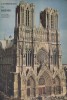
Livre. Par L. Mary, sculpteur et décorateur. Chez l'auteur, 1985.
Lalique : Perfume Bottles
, Thames & Hudson Ltd 1991, 1991 Hardcover, 160 pages, ENG, 265 x 235 mm, some scratches on the cover but book itself is in good condition, coloured illustrations. ISBN 9780500236222.
THE STONES OF FLORENCE AND VENICE OBSERVED.
PENGUIN TRAVEL LIBRARY. 1988. In-12. Broché. Etat d'usage, Couv. légèrement passée, Dos satisfaisant, Intérieur frais. 280 pages. Premier plat illustré en couleurs. Texte en anglais.. . . . Classification Dewey : 720-Architecture
Classification Dewey : 720-Architecture
Barbotines de la C te d'Azur : Barbotine, Reflets m talliques, Garnissage
, Massin, 2002 Hardcover, 245 pages, Texte en Francais, Tres belle exemplaire, 280 x 225 x 20 mm, jacquette, beaucoup ilmlustrations en couleur, sp cimen rare,. ISBN 9782707204189.
De Marseille Menton, la C te d'Azur est, depuis les Grecs, un haut lieu de fabrication de poteries. Si le culinaire l'a emport pendant un tr s grand nombre d'ann es, le XIXe si cle a constitu un tournant dans la production des c ramiques. Outre l'usage de moules en pl tre, la barbotine peinte maill e, les reflets m talliques et la poterie de garnissage ont permis de produire des th mes de d coration, d'ext rieur et d'int rieur. Le but de ce livre est de rendre hommage aux fa enciers de cette fin du XIXe au d but du XXe si cle. Pr curseurs et novateurs, certains ont t reconnus dans le monde entier leur poque. D'autres, moins chanceux, n'ont pas d pass leur r gion et sont encore tr s m connus. Cet ouvrage a aussi pour objectif de pr senter des techniques de productions tr s diff rentes, riches en id es nouvelles, et en couleurs et souvent tr s tonnantes. Ce sont des objets surprenants, parfois tr s humoristiques, parfois tr s commerciaux, parfois tr s gracieux, qui font le charme de leur d couverte. Enfin, il est une tentative de mettre en lumi re " l'esprit " des diff rents centres de productions travers de nombreuses photographies, tout en illustrant l'historique de ces ateliers.
L'ARCHITECTURE MUSULMANE D'OCCIDENT
Arts et métiers graphiques.1955.In-4 br.Croquis.541 p.Etat satisfaisant.
L’ARCHITECTURE MUSULMANE D’OCCIDENT, Tunisie, Algérie, Maroc, Espagne, Sicile
Arts et Métiers Graphiques, Paris, 1954
Un fort volume in-4° , cousu, avec un couverture semi-rigide éditeur vert clair avec un lettrage en rouge. C’est la première édition, avec 541 pages, 108 planches en noir, 286 figures, 9 chapitre, des Addenda, une Bibliographie, un Index des termes techniques, un Index des noms de personnes, un index des noms de leux, une Table des figures, une Table des planches , une Table des matières. Un ouvrage de grande qualité, comme toutes les publications des éditions Arts et Métiers Graphiques. Notre exemplaire porte le N° 1907 sur 2000 (et sur 3000 imprimés). Hormis quelques rares et discrètes rousseurs (uniquement sur la tranche), il est en EXCELLENT ETAT [52061]
L'Architecture musulmane d'Occident. Tunisie, Algérie, Maroc, Espagne et Sicile.
P., Arts et Métiers Graphiques, 1955, fort in-4°, xi-541 pp, 286 figures, cartes et plans dans le texte et 108 illustrations photographiques reproduites en héliogravure sur 64 planches, biblio, index, broché, trace d'humidité ancienne au dos, bon état. Edition originale, un des 2000 exemplaires numérotés réservés au Gouvernement général de l'Algérie. On joint un carton imprimé : "De la part de Monsieur le Gouverneur général de l'Algérie"
"Tous les travailleurs connaissent le “Manuel d'art musulman” publié en 1926-1927 par M. Georges Marçais. C'est le même sujet, l'architecture et la décoration des pays occidentaux de l'Islam, traité un peu de la même manière, mais avec quelques modifications et des additions importantes, qu'étudie M. Georges Marçais en un très beau volume richement illustré. (...) L'ouvrage est divisé en neuf parties : les royaumes musulmans au IXe siècle ; le domaine des Fatimides, la Sicile musulmane et normande (Xe au XIIe siècle) ; l'Espagne des Omeyades et le califat de Cordoue ; les royaumes espagnols et les empires hispano-berbères du XIe au XIIIe siècle ; les dynasties héritières des Almohades aux XIIIe et XIVe siècles ; l'art mudéjar – c'est-à-dire l'art des musulmans vivant en terre chrétienne et travaillant selon leur technique et d'après leurs traditions, sous le joug des vainqueurs chrétiens, tandis que l'art « mozarabe » est l'art des Espagnols convertis ou restés chrétiens travaillant pour les vainqueurs musulmans ; le Maroc sous les dynasties chérifiennes ; l'Algérie turque ; la Tunisie des derniers hafeides et des Turcs. Chaque partie comprend une introduction historique ; une étude détaillée des monuments religieux, civils et militaires, de la technique et de la décoration ; une conclusion. (...) Tel est ce volume que M. Georges Marçais a écrit non seulement avec une parfaite connaissance du sujet, mais encore avec un goût délicat et une précision qui emportent la conviction." (Marcel Aubert, Bulletin Monumental, 1955) — "L'Islam occidental a dans le monde musulman son individualité propre qu'il est en ce moment particulièrement important de tâcher de comprendre par la connaissance de son histoire, de toute son histoire. C'est pourquoi le beau livre que vient de publier M. Georges Marçais sur son architecture vient à l'heure qui convient. Chaque chapitre en est précédé d'une introduction sur “Les conditions historiques”, de telle sorte que l'ensemble de ces introductions préliminaires constitue par lui-même tout un livre permettant de saisir au mieux tout ce qui dans le passé explique et conditionne le Maghreb d'aujourd'hui. Ce gros ouvrage de quelque 550 pages réunit les résultats de plus de cinquante années de recherches dans un domaine où le maître de nos études d'art musulman a en vérité frayé les voies..." (Elie Lambert, Journal des savants, 1956)
Tadao Ando 1941- : De geometrie van de menselijke ruimte
, Taschen / De Morgen, 2007 Hardcover, 96 pag. NL, 240 x 190 mm, goede staat, ill. in kleur / z/w. ISBN 9789077686584.
History of European Architecture
Showado dos carré collé sous jaquette 1998 In-8 (15 x 21 cm), dos carré collé sous jaquette, 242 pages, texte en japonais, iconographie en noir ; très bon état général. Livraison a domicile (La Poste) ou en Mondial Relay sur simple demande.