 Write to the booksellers
-
Type
Any type (1)
Book (128)
Drawings (1)
Magazine (38)
New book (1)
Photographs (1)
-
Language
English (1)
French (169)
-
Century
19th (4)
20th (79)
21st (20)
-
Countries
Belgium (9)
Canada (1)
France (153)
Switzerland (5)
United Kingdom (2)
-
Syndicate
ALAC (1)
ILAB (45)
SLAM (42)
Monique Castaignède - Alberti Olympia (preface)
Reference : RO20265431
(1999)
ISBN : 2268034380
Chroniques barbares
DU ROCHER. 1999. In-8. Broché. Bon état, Couv. convenable, Dos satisfaisant, Intérieur frais. 175 pages - couverture rempliée. . . . Classification Dewey : 840.091-XX ème siècle
Classification Dewey : 840.091-XX ème siècle
Vie d'Olympia Morata. Episode de la Renaissance et de la Réforme en Italie.
P., Ducloux, 1850, in 8° broché, 240 pages ; qq. rousseurs ; couverture fanée avec infimes manques.
Exemplaire enrichi d'un envoi autographe signé sur la garde blanche.PHOTOS sur DEMANDE. Fermeture du 1er au 23 Août


Phone number : 04 77 32 63 69
OLYMPIE : L'ALTIS et le MUSEE
Un ouvrage de 120 pages, format 170 x 240 mm, illustré, broché couverture couleurs rempliée, publié en 1985, Editions d'Art S. Mélétzis, bon état
Histoire et architecture d'Olympie, en Grèce
Phone number : 04 74 33 45 19
NIZON (Paul). NYSSEN (Hubert). KROCKAUER (Doris). ALBERTI (Olympia). DRAGHINCESCU (Rodica). FREIXE (Alain). SIMEON (Jean-Pierre). GUEZ RICORD (Christian Gabriel). MOURTHE (Claude).
Reference : 46591
Autre Sud, numéro 12, mars 2001.
Marseille, directeur : Gérard Blua. 1 volume 14,5x22cm, 159 pages.
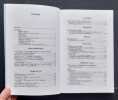
Autre Sud prend la suite de la revue Sud, créée en 1970 jusqu'en 1996. Tous nos livres sont visibles sur notre site : https://www.livrepoesie.com/
Steiner's tour.
Paris. Olympia Press. 1960. In-12 broché sous jaquette illustrée. 169 pages. E.O.
Bel exemplaire.
The Yellow Book. Allemand/Français/Italien.
Montfaucon Research Center, Bruxelles, 1972. Responsable de la publication : Joelle de la Casinière. 18,5 x 12 cm, non paginé. Nom de l'auteur manuscrit sur la page de titre sinon bon exemplaire. Édition originale.
Un jasmin ivre
Albin Michel 1982 272 pages 21 8x14 4x2 6cm. 1982. Broché. 272 pages.
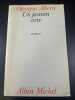
Très bon état - légères marques de lecture et/ou de stockage mais du reste en très bon état- expédié soigneusement depuis la France
Croire vivre
L'Amourier Editions (25 avril 2002)
In-8 broché, comme neuf. dépliant en accordéon
Archival Historiographies. The Impact of Twentieth-Century Legacy Data on Archaeological Investigations
, Brepols, 2022 Paperback, xii + 180 pages, Size:216 x 280 mm, Illustrations:142 b/w, 4 col., 1 tables b/w., 2 maps b/w, Language: English. ISBN 9782503600185.
Summary Archives held in institutions around the world hold a wealth of material but traditionally, the fields of Classical and ancient Near Eastern archaeology have been slow to make use of such legacy data in their investigations. In recent years, however, this trend has begun to change, and scholars increasingly recognize the importance of archival material to their research. Drawing directly on these trends, this volume offers the first in-depth analysis of what it means to engage in archive archaeology and how it can influence understandings of both the ancient world and the recent past. Excavation historiographies and the formation of archaeological archives in the twentieth century are investigated in locations from across the Eastern Mediterranean and the Middle East, with current understanding of sites such as Dura Europos or Palmyra being fundamentally reassessed in the light of the archival material. Crucially, the volume contributions gathered here look to the future as well as to the past: archives are acknowledged as essential to cultural heritage preservation and restitution initiatives, and chapters explore best practices, as well as presenting some of the manifold potentials of archive and legacy data to future research. TABLE OF CONTENTS List of Illustrations 1. Introduction OLYMPIA BOBOU, AMY MIRANDA, and RUBINA RAJA 2. Going Backwards to Move Forwards: Archive Archaeology and the Provenance of the Pottery from the House of the Frescoes at Knossos EMILIA ODDO 3. Herbert J. Gute and the Yale-French Excavations at Dura-Europos LISA R. BRODY 4. Digital Archaeological Archives 2.0: Answering Past Critiques with Linked Open Data (LOD) ANNE HUNNELL CHEN 5. The Gerasa Archives at the Yale University Art Gallery: Exploring the Archives of the Anglo-American Excavations of 1928-1930 and 1930-1934 LISA BRODY and RUBINA RAJA 6. Harald Ingholt's Fieldwork Diaries: Legacy Data of the Early Twentieth Century RUBINA RAJA and JULIA STEDING 7. The Ingholt Archive: The Impact of Archives on Palmyrene Studies and Syrian Cultural Heritage Preservation AMY MIRANDA and RUBINA 8. Perspectives on Funerary Sculpture from Roman Palmyra through the Harald Ingholt Archive DITTE KVIST JOHNSON and AMY MIRANDA 9. Digital Treatment of Paul Collart's Archives on the Temple of Baalsham n: Challenges and Results (2018-2021) PATRICK M. MICHEL 10. Archive Archaeology at the Forschungsstelle Asia Minor, University of M nster: The Untapped Potential of the D rner Archive MICHAEL BL MER and EMANUELE E. INTAGLIATA 11. The Site of the Archive: Responsibility and Rhetoric in Archival Archaeology of the Middle East J. A. BAIRD Index.
Ingholt Archive The Palmyrene Material, Transcribed with Commentary and Bibliography 4 vols.
, Brepols - Harvey Miller, 2023 hardcover; 4 vols, 1954 pages, Size:300 x 240 mm, Illustrations:8 b/w, 2111 col., 8 tables b/w. Language(s):English. ISBN 9782503598222.
SUMMARY For a period of over 50 years, from his first visit to Palmyra in the 1920s until the late 1970s, Danish archaeologist Harald Ingholt carefully collected and curated a detailed archive of Palmyrene sculpture, architecture, and epigraphy. Containing approximately 2000 images, each archive sheet contains handwritten annotations on Palmyrene funerary art, transcribes and translates inscriptions, includes detailed observations on object style and dating, and provides bibliographical information for each sculpture. As such, this archive is a treasure trove of information on Palmyrene sculpture, architecture, and epigraphy. Moreover, Ingholt?s notes go beyond shedding light on the creation of these sculptures, and also provide rich information about their more recent histories: object biographies offer details on provenance, collection history, and excavation photography. In doing so, they offer unique insights into twentieth-century excavation, conservation, and collection practices. Since 1983, Ingholt?s archive has been housed at the Ny Carlsberg Glyptotek in Copenhagen, Denmark, and then, from 2012 onwards, the archive took digital shape within the framework of the Palmyra Portrait Project at Aarhus University. Now available in print for the first time, the Ingholt Archive is here presented in its entirety as a lavishly illustrated four-volume set. The authors have transcribed and commented upon each sheet in the archive, provided new translations of the inscriptions that accompany the sculptures, and compiled an updated bibliography for each item. This unique set is published together with a detailed introduction, thirteen concordances, and a bibliography, making it an invaluable resource for researchers in the field.
Nurturing the Elite Representations of Drinking, Eating, and Religious Vessels in Palmyrene Funerary Iconography
, Brepols, 2026 Hardback, xxvii + 513 p., 216 x 280 mm, Illustrations:205 b/w, 27 col., 26 tables b/w., Language(s):English. *New . ISBN 9782503617800.
Vessels as attributes were prominently depicted across all types of funerary monuments in Palmyra but have rarely been the subject of focused study. Yet with over 400 documented examples, vessels in fact hold a central place in shaping the iconography of Palmyrene portraits and offer unique insights into the aspirations, identities, and status of the individuals commemorated. This monograph investigates the role of vessels in Palmyrene funerary sculpture, exploring often neglected aspects of local portraiture. Through this approach, it seeks to place the study of vessels at the heart of ongoing critical discourse into Palmyrene society, its values, and its rituals, as well as exploring the city?s broader connections within cultural and economic networks in the Roman Near East and further afield. This research has been made possible thanks to the extensive data collection of the Palmyra Portrait Project (Aarhus University), which, since 2012, has compiled a comprehensive catalogue of Palmyrene sculptural production from the first three centuries AD.
Palmyrene Sarcophagi
, Brepols, 2023 Hardback, 2 vols, 1003 pages, Size:216 x 280 mm, Illustrations:722 b/w, 95 col., 1 tables b/w., 2 maps b/w, 9 maps color, Language: English. ISBN 9782503604664.
Summary While the funerary portraiture of Palmyra is rightly world-renowned, up to now, the corpus of sarcophagi from the ancient city has received relatively little attention as a cohesive group in their own right. Comprising sarcophagi, banqueting reliefs and founder reliefs, as well as sarcophagus reliefs, most of these objects share a common iconographic motif, that of the banquet, although other scenes, mostly drawn from the daily life of the city's caravan leaders and their families, also appear. The emphasis on the banqueting scene in particular reveals the crucial importance of dining in ancient Palmyrene society: for the living, banquets were a marker of social standing and gave hosts a chance to honour the gods and offer an ephemeral benefaction to their fellow citizens, while for the dead, the banquet motif offered the opportunity for the entire family to be depicted together and showcase their wealth and sophistication, as well as their connections outside the city. This single corpus of material gathered through the Palmyra Portrait Project, is presented in this beautifully illustrated two-volume monograph. Through careful analysis of the portraits, and the costumes and attribute choices that appear in these images, the authors explore how the sarcophagi were used by Palmyrenes to project an image of local pride, while at the same time participating in the visual cultures of the Roman and Parthian Empires between which their city was situated. TABLE OF CONTENTS Volume 1 List of Figures Colour Plates Acknowledgements Chapters 1. Palmyra and its Funerary Sphere 2. The Portrait Habit in Palmyra and the Funerary Sphere 3. Dated Objects 4 In situ Contexts 5. Iconography Appendix: The Costume of Reclining Figures 6. Conclusion: Sarcophagi as Vehicles of Elite Identity Works Cited Catalogue Dated by Inscription (Cat. 1-12) Objects from Tower Tombs (Cat. 13-59) Objects from Hypogea (Cat. 60-179) Objects from Temple Tombs (Cat. 180-277) Credits Text Image Credits Catalogue Image Credits Volume 2 Colour Plates Catalogue Objects with Indication of General Context (Cat. 278-288) Sarcophagi with No Known Provenance or from Secondary Contexts (Cat. 289-444) Sarcophagi Reliefs (Cat. 445-450) Fragments from either Sarcophagus Lids or Boxes (Cat. 451-476) Possible Sarcophagus Fragments (Cat. 477-488) Heads from Sarcophagi (Cat. 489-683) Banqueting Reliefs (Cat. 684-729) Appendix 1. Lost Dated Reliefs Appendix 2. Lost Reliefs from Tower Tombs Appendix 3. Lost Reliefs from Temple Tombs Appendix 4. Marble Sarcophagi from Attica Appendix 5. Sarcophagi without Portraits Appendix 6. Objects Known Only through Publications Appendix 7. Reliefs with Frame, without Portraits Credits Catalogue Image Credits
Turning the Page Archaeological Archives and Entangled Knowledge
, Brepols - Harvey Miller, 2025 Hardback, xx + 486 Pages, Size:216 x 280 mm, Illustrations:676 b/w, 96 col., 9 tables b/w., Language:English, *new. ISBN 9782503616858.
Throughout the nineteenth, and for much of the twentieth century, archives were considered to be containers of knowledge, holding material that was deemed to be objective and unbiased. In more recent years, however, as scholars have begun to engage more with archival material, this perception has changed, and archives have increasingly been recognized as sites of contention, holding curated historical documents ? a re-evaluation that, in turn, has led to a new understanding of the role and significance of both archives and archiving practices, as well as to revived interest in their contents. Taking renewed scholarly interest in archives as its starting point, this volume highlights the importance of archival material both as a source of study, and as a way of unleashing hitherto ?lost? knowledge. The chapters gathered here present previously unpublished material for the first time, as well as offer new insights into archival and curatorial practices. Through this approach, the authors not only reveal unknown aspects and histories of both past and ongoing excavations, but also shed light on the creation processes of an archive, an element that is typically lost by the time the material is designated as an archive by those who study it. The result is a volume that can shape best archival practices and approaches for the future. TABLE OF CONTENTS List of Illustrations List of Abbreviations 1. Turning the Page: Critical Archival Studies and Archaeological Historiographies Olympia Bobou, Rubina Raja, and Maria Stamatopoulou 2. Alexandrian Archaeology (1798?1903): A ?Local Archaeology? Marie-Dominique Nenna 3. Revisiting Herzfeld?s Letters and Diaries from the Samarra Excavation 1911?1913 Miriam K hn 4. The Infrastructure of an Excavation: Harald Ingholt?s Excavation Journals from Hama, Syria, 1931?1938 Anne Haslund Hansen and John Lund 5. In the Field and through the Archives: The 1928 American-British Campaign in Gerasa and the Excavation of the Church of St. Theodore Rubina Raja 6. Re-Assembling the Network: Richard Christensen and the 1872?1873 Purchase of Antiquities in Athens for the Copenhagen Collections Yannis Galanakis and Bente Bladsgaard Jensen 7. Where in the World are the Papademos Antiquities? A Search for the Stock of an Athenian Art Dealer of the Late Nineteenth/Early Twentieth Century Christina Avronidaki and Giorgos Kavvadias 8. ?Grave Z? at Demetrias and the Notorious Case of the Volos Gold Wreath: Arvanitopoulos?s Archives and Early Twentieth-Century Greek Archaeology Maria Stamatopoulou 9. The Archaeological Department of the Greek Governance of Smyrna (1919?1922): Archaeology in the War Zone through Archival Testimonies Chrysanthi Tsouli and Kostas Paschalidis 10. The Ephemeral City: Refugees Amongst Antiquities in Interwar Athens Athina Chatzidimitriou and Maria-Xeni Garezou 11. Visions of Epiros between Greece and Rome: Demetrios Evangelidis and Luigi Ugolini Oliver Gilkes and Milena Melfi 12. Antiquities, Diplomacy, and the Construction of Soft Power in Greek-US Political Relationships in the Beginning of the Cold War Era: A Perspective from Archival Research in Greece and the USA Nassos Papalexandrou 13. Archival Palimpsests: Investigating the History of Harald Ingholt?s Archive of Palmyrene Sculptures Olympia Bobou and Rubina Raja 14. Lord William Taylour: Parallel Lives in Greece and Cambridge Michael Loy 15. The Annotated Archive: Marginalia and Meaning in Following Pots Morag M. Kersel and Meredith S. Chesson 16. Gentlemen?s Agreements: Applying Contemporary Archaeological Ethics in an Archival Setting Jon M. Frey
Turning the Page Archaeological Archives and Entangled Knowledge
, Brepols - Harvey Miller, 2025 Hardback, Pages: xx + 486 p., Size:216 x 280 mm, Illustrations:676 b/w, 96 col., 9 tables b/w. Language(s):English, NEW. ISBN 9782503616858.
Summary Throughout the nineteenth, and for much of the twentieth century, archives were considered to be containers of knowledge, holding material that was deemed to be objective and unbiased. In more recent years, however, as scholars have begun to engage more with archival material, this perception has changed, and archives have increasingly been recognized as sites of contention, holding curated historical documents ? a re-evaluation that, in turn, has led to a new understanding of the role and significance of both archives and archiving practices, as well as to revived interest in their contents. Taking renewed scholarly interest in archives as its starting point, this volume highlights the importance of archival material both as a source of study, and as a way of unleashing hitherto ?lost? knowledge. The chapters gathered here present previously unpublished material for the first time, as well as offer new insights into archival and curatorial practices. Through this approach, the authors not only reveal unknown aspects and histories of both past and ongoing excavations, but also shed light on the creation processes of an archive, an element that is typically lost by the time the material is designated as an archive by those who study it. The result is a volume that can shape best archival practices and approaches for the future. TABLE OF CONTENTS List of Illustrations List of Abbreviations 1. Turning the Page: Critical Archival Studies and Archaeological Historiographies Olympia Bobou, Rubina Raja, and Maria Stamatopoulou 2. Alexandrian Archaeology (1798?1903): A ?Local Archaeology? Marie-Dominique Nenna 3. Revisiting Herzfeld?s Letters and Diaries from the Samarra Excavation 1911?1913 Miriam K hn 4. The Infrastructure of an Excavation: Harald Ingholt?s Excavation Journals from Hama, Syria, 1931?1938 Anne Haslund Hansen and John Lund 5. In the Field and through the Archives: The 1928 American-British Campaign in Gerasa and the Excavation of the Church of St. Theodore Rubina Raja 6. Re-Assembling the Network: Richard Christensen and the 1872?1873 Purchase of Antiquities in Athens for the Copenhagen Collections Yannis Galanakis and Bente Bladsgaard Jensen 7. Where in the World are the Papademos Antiquities? A Search for the Stock of an Athenian Art Dealer of the Late Nineteenth/Early Twentieth Century Christina Avronidaki and Giorgos Kavvadias 8. ?Grave Z? at Demetrias and the Notorious Case of the Volos Gold Wreath: Arvanitopoulos?s Archives and Early Twentieth-Century Greek Archaeology Maria Stamatopoulou 9. The Archaeological Department of the Greek Governance of Smyrna (1919?1922): Archaeology in the War Zone through Archival Testimonies Chrysanthi Tsouli and Kostas Paschalidis 10. The Ephemeral City: Refugees Amongst Antiquities in Interwar Athens Athina Chatzidimitriou and Maria-Xeni Garezou 11. Visions of Epiros between Greece and Rome: Demetrios Evangelidis and Luigi Ugolini Oliver Gilkes and Milena Melfi 12. Antiquities, Diplomacy, and the Construction of Soft Power in Greek-US Political Relationships in the Beginning of the Cold War Era: A Perspective from Archival Research in Greece and the USA Nassos Papalexandrou 13. Archival Palimpsests: Investigating the History of Harald Ingholt?s Archive of Palmyrene Sculptures Olympia Bobou and Rubina Raja 14. Lord William Taylour: Parallel Lives in Greece and Cambridge Michael Loy 15. The Annotated Archive: Marginalia and Meaning in Following Pots Morag M. Kersel and Meredith S. Chesson 16. Gentlemen?s Agreements: Applying Contemporary Archaeological Ethics in an Archival Setting Jon M. Frey
Michel Leeb, accompagné par le Grand Orchestre de Gérard Badini.
CHEZ L'AUTEUR. 1987. In-4. Broché. Bon état, Couv. fraîche, Dos satisfaisant, Intérieur frais. Programme d'environ 20/25 pages. Quelques photos en noir et blanc et en couleurs, dans le texte et hors-texte.. . . . Classification Dewey : 792-Théâtre

Classification Dewey : 792-Théâtre
Programme à partir du 18 décembre 1990. Popeck.
CHEZ L'AUTEUR. 1990. In-4. Broché. Bon état, Couv. fraîche, Dos satisfaisant, Intérieur frais. Programme d'environ 20 pages, illustrées en noir et blanc et en couleurs.. . . . Classification Dewey : 792-Théâtre
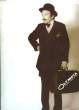
Quelques dessins de Jean Cocteau. Classification Dewey : 792-Théâtre
Robert Charlebois, à l'Olympia
CHEZ L'AUTEUR. 1983. In-4. Broché. Bon état, Couv. convenable, Dos satisfaisant, Intérieur frais. Environ 20/25 pages illustrées en noir et blanc.. . . . Classification Dewey : 782.92-Chanteurs
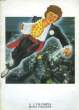
Programme de la tournée. Classification Dewey : 782.92-Chanteurs
The Fine Art & Antiques Fair - 31 May - 10 June 1990
Philbeach events Limited broché Bristol illustré London 1990 203 pages en format 23 - 29.5 - nombreuses photographies en couleurs et en noir
Bon État
Soirée de gala
Chez l'auteur. 1952. In-16. Broché. Bon état, Couv. convenable, Dos satisfaisant, Intérieur frais. 4 pages. illustrées noir et blanc de pub.. . . . Classification Dewey : 628.92-Pompiers, incendies
Programme d'un soirée de gala au profit des oeuvres des Sapeurs pompiers français. Spectacle de Julien Quinié. Classification Dewey : 628.92-Pompiers, incendies
The Corpse wore grey.
Paris. Olympia Press. "Othello Books". [Maurice Girodias, éditeur]. 1962. In-12 broché. 204 pages. E.O. (pas de grand papier).
Etat neuf. "Not to be sold in the U.S.A. or U.K."
Lili à l'Olympia Sporting Club n°39 illustrations d'AI.G
Les Beaux Albums de la Jeunesse Joyeuse 1975 47 pages IN4. 1975. agrafé. 47 pages. Lili est embauchée comme monitrice de sport à l'Olympia Sporting Club pour redonner le goût du sport et de la compétition à des adolescents. Sa mission est compliquée par la présence de Julia de St Hubert embauchée dans le club concurrent et déterminée à ne pas laisser Lili gagner
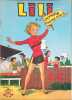
Bon état
WHIPS INCORPORATED.
Paris. Olympia Press. Collection "Ophelia Press". 1965. In-12 broché. 205 pages. (1er tirage en 1960).
Bel exemplaire.
LA CATHEDRALE OLYMPIQUE ou MUNICH 72.
1980 / 198 pages. Broché. Editions Pandora.
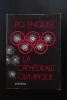
Des très légers frottements d'usage sur la couverture, intérieur trés frais. Trés bon état.

