 Write to the booksellers
-
Type
Book (29960)
Disk (1)
Engraving (1)
Magazine (1069)
Old papers (2)
Photographs (2)
Reprint (4)
-
Latest
Last 24h (6)
Last 3 days (14)
Last month (493)
Last week (137)
-
Language
Chinese (1)
Dutch (82)
English (52)
French (30864)
German (15)
Italian (16)
Latin (5)
Portuguese (1)
Spanish (3)
-
Century
16th (3)
17th (14)
18th (60)
19th (1700)
20th (12210)
21st (1380)
-
Countries
Belgium (4076)
Brazil (2)
Canada (6)
China (14)
Côte d'Ivoire (192)
Denmark (483)
France (22107)
Greece (7)
Netherlands (1711)
Switzerland (2441)
-
Syndicate
ALAC (6)
CLAM (107)
ILAB (11450)
NVVA (1063)
SLACES (1063)
SLAM (9764)
SNCAO (71)
Terra-Cotta's uit het Museum van Oudheden te Leiden. Met X Platen in kleurdruk
Leyde, T. Hooiberg et Zoon, 1862 in-folio, IV-28 pp. de texte, avec 10 planches en chromolithographie, demi-chagrin vert, dos à nerfs orné de filets dorés, tranches mouchetées (reliure de l'époque). Bon exemplaire.
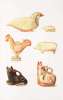
Rare. Originaire d'une famille de pasteurs, Janssen (1806-1869) avait vu sa vocation archéologique naître en 1832 lorsqu'il effectua une visite au village allemand de Pfalzdorf un jour où les paysans exhumaient des vestiges romains. Sa première monographie concerne ces découvertes rhénanes. Il devint ultérieurement (en 1840) le conservateur du Musée national des antiquités de Leyde.Aucun exemplaire au CCF. - - VENTE PAR CORRESPONDANCE UNIQUEMENT - LIEN DE PAIEMENT, NOUS CONSULTER.

"Congrès de Huy; 18-22 août 1976 ; annales/annalen; (tome 3/deel 3). Fédération des Cercles d'archéologie et d'histoire de Belgique/Federatie van kringen voor oudheidkunde en geschiedenis van Belgïe, XLIVe session, "
Liège, Fédération des Cercles d'archéologie et d'histoire de Belgique, 1976. 16 x 24, 304 pp., très nombreuses figures et dessins, broché, bon état.
tome 3 seul.
Contribution to the verbal system in old Egyptian. A new approach to the reconstruction of the hamito-semitic verbal system.
Leuven, Peeters, 1972. In-8 broché, 55 pp., texte en anglais.
Coll. : Orientalia Gandensia, VI. Bon ex. - Frais de port : -France 4,9 € -U.E. 7 € -Monde (z B : 11 €) (z C : 21 €)
Trébizonde en Colchide - Université libre de Bruxelles - TOME XL
Presses universitaires de Bruxelles 1969 in8. 1969. Broché. iconographie en noir et blanc
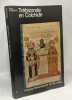
avec jaquette légères rousseurs sur tranche intérieur propre
Arts of Central Nigeria, Art and the Sacred in Mumuyeland
BE - , Stichting Kunstboek, 2018 Hardcover, HB, 280 x 210 mm, 144 pages , 90 illustrations, English edition. fine! ISBN 9789058566003.
Arts of Central Nigeria Despite some field research our knowledge of the sacred among the Mumuye is still embryonic. In all these acephalic groups of a binary and antinomic nature, the complex va constitutes an extremely varied semantic field in which certain aspects are accentuated depending on the circumstances. Religious power is linked to the strength contained in sacred objects, of which only the elders are the guardians. Moreover, this gerontocracy relies on a system of initiatory stages which one must pass to have access to the status of 'religious leader'. Geographically isolated, the Mumuye were able to resist the attacks of the Muslim invaders, the British colonial authority and the activities of the different Christian missions for a long time. As a result the Mumuye practised woodcarving until the beginning of our century. In 1970 Philip Fry published his essay on the statuary of the Mumuye of which the analysis of the endogenous network has so far lost nothing of its value. Basing himself on in situ observations, Jan Strybol attempted to analyse the exogenous network of this woodcarving. Thus he was able to document about forty figures and some masks and additionally to identify more than twenty-five Mumuye artists as well as a specific type of sculpture as being confined to the Mumuye Kpugbong group. During and after the Biafran war, hundreds of Mumuye sculptures were collected. Based on information gathered between 1970 and 1993 the author has demonstrated that a certain number of these works are not Mumuye but must be attributed to relic groups scattered in Mumuye territory.
Toro Muerto, vol. I. A Catalogue of Iconographic Motifs in Rock Art / Un catálogo de motivos iconográficos del arte rupestre
, Brepols, 2026 Hardback, Pages: 510, Size:216 x 280 mm, Illustrations:228 b/w, 146 col., 3 tables b/w., Languages: English, Spanish. ISBN 9782503623573.
Summary This book inaugurates a planned series focusing on Toro Muerto, the largest rock art site in South America. Located in Peru's Arequipa region, Toro Muerto covers approximately 50 km², with the densest concentration of nearly 2500 volcanic boulders engraved with petroglyphs contained within its central 10 km². Known since the 1950s, the site was nevertheless only partially recorded, and earlier documentation was often incomplete or inaccurate. Since 2015, a team of Polish researchers from the University of Warsaw, working in collaboration with Peruvian specialists, has undertaken a systematic programme of documentation; the results are presented here for the first time. Lavishly illustrated and published in both English and Spanish, this volume functions as both a catalogue and a typology of Toro Muerto's geometric, zoomorphic, and anthropomorphic motifs. It presents the first high-resolution digital record of the site, featuring nearly 50 motif types, almost 700 photographs, and 5500 drawings. With an unprecedented level of detail, the book provides a solid foundation for future iconographic and archaeological research, offering new insights into the symbolic and ritual significance of one of the world's most impressive rock art complexes. TABLE OF CONTENTS List of Illustrations / Lista de ilustraciones Foreword / Prólogo Introduction / Introducción Acknowledgements / Agradecimientos Catalogue / Catálogo Creation and Structure of the Catalogue / Creación y estructura del catálogo Geometric Motifs / Motivos geométricos Zoomorphic Motifs / Motivos zomorfos Anthropomorphic Motifs / Motivos antropomorfos Works Cited / Obras citadas
Gotlands mellenneolitiska gravar.
Stockholm, 1974. 355 pp., 56 plates and 43 tabels. (Diss.). With dedication to C. J. Becker from the author.
The Middle-Neolithic Graves of Gotland.
Japon - Hong Kong - Thailande - Cambodge. 29 photos en noir, 28 photos en couleurs, 10 cartes, 27 dessins.
,Paris, Editions Vilo 1967, 469 pp., 1 vol. in 8 relié plein percalline rouge éditeur avec jaquette (petites déchirures).
‘Mon dieu qu’ai-je fait? Les diggir-sà-dab(5)-ba et la piété privée en Mésopotamie. ‘Orbis Biblicus et Orientalis’ 273
Fribourg, Academic Press / Göttingen, Vandenhoeck & Ruprecht, 2015, gr. in-8vo, XIV + 462 p, ill. + 4 ff., orig. publisher’s illustrated red cloth. Spines sunned, else a fine set.

(SLACES, NVVA)
Phone number : 41 (0)26 3223808
Klagetraditionen. Form und Funktion der Klage in den Kulturen der Antike. ‘Orbis Biblicus et Orientalis’ 251
Fribourg : Acad. Press / Göttingen : Vandenhoeck & Ruprecht, 2011, gr. in-8vo, 110 S., hellblauer Original-Pappband, / orig. hardcover.
(SLACES, NVVA)
Phone number : 41 (0)26 3223808
Athènes ancienne. Collection : Le monde hellénique.
Paris, Les Belles Lettres, 1930. 13 x 20, 46 pp., 12 planches, broché, bon état (dos recollé).
La formation du peuple grec - avec sept cartes dans le texte
,Paris, La Renaissance du Livre 'L'évolution de l'humanité' 1923, XII-425 pp., 1 vol. in 8 br.
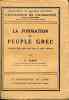
La formation du peuple grec. Bibliothèque de synthèse historique : L'évolution de l'humanité, N° 10.
Paris, La Renaissance du Livre, 1923. 14 x 20, 425 pp., 7 cartes, broché, bon état (sans rousseur).
L'OR DES GALIONS d'après les archives espagnoles.
P , France Empire , 1979 , in8 br , 270 pp . Illustrations. Langue: Français
Sichem. Eine archäologische und religionsgeschichtliche Studie mit besonderer Berücksichtigung von Jos 24
Freiburg Schweiz / Göttingen, Universitätsverlag / Vandenhoeck & Ruprecht 1976 280pp.with ills., 24cm., in the series "Orbis biblicus et orientalis" vol.11, cart.cover, 2 stamps, else VG, R70209
Répertoire onomastique de Deir El-Médineh - documents de fouilles de l'institut français d'archéologie orientale du Caire TOME XII
Imprimerie de l'institut français d'archéologie 1949 in4. 1949. Broché. iconographie en noir et blanc
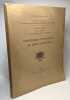
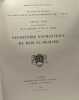
Bon état de conservation bords frottés accrocs aux extrémités du dos couverture défraîchie ternie trace de stylo sur le premier plat intérieur propre
Proceedings of the XVI International Numismatic Congress, 11-16.09.2022, Warsaw: Vol. III: Medieval Numismatics
, Brepols, 2025 Paperback, Pages: 373, Size:216 x 280 mm, Illustrations:265 b/w, 13 col., 5 tables b/w., Languages: English, French, German. ISBN 9782503616742.
Summary The XVI International Numismatic Congress, held in Warsaw, Poland, in September 2022, was a landmark event, drawing the largest number of participants in its history. With over 550 papers presented during thematic sessions and round tables, this congress showcased the latest advancements and research in the field of numismatics from leading experts and scholars in their field. A curated selection of papers from the conference have now been drawn together into peer-reviewed conference proceedings, representing a comprehensive spectrum of numismatic studies from antiquity to modern times. Each paper is meticulously illustrated with high-quality images, often of unique specimens, along with detailed diagrams, maps, and die/typological chains. Topics covered include coins and coin finds, medals, tokens, banknotes, the history of collections and collecting, and cutting-edge chemical analyses and technologies used in coin examination. This book, the third in four thematic volumes, explores medieval coinage. Research presented in forty-two different chapters ranges from the early Byzantine period through to the late Middle Ages, including Asiatique and Islamic coinages, and medieval tokens. TABLE OF CONTENTS List of Illustrations Introduction Jaros?aw Bodzek, Aleksander Bursche, Anna Zapolska 1. Publishing Catalogues and Hoards in Medieval Numismatics: the Medieval European Coinage project Elina Screen 2. Income Sources and Effects of Medieval Emergency Debasements Roger Svensson 3. When Small Change Was not a Big Problem Roger Svensson, Andreas Westermark 4. The Silver Coinage of Constans II Revisited Nikolaus Aue 5. A Small Byzantine Hoard from the Desert of Aswan Elena Baldi, Maria Carmela Gatto, Antonio Curci 6. Silk Road Imitations of Byzantine and Sasanian Coins: Evidence from Shoroon Bumbagar in Mongolia Anran Mao, Chi Xu 7. Coin Types in Georgia and the Byzantine World Leri Tavadze 8. Distribution of Coins in Late Antiquity and the Early Middle Ages in Southern Italy (325-725 AD): a Comparison Between Border and Inland Area Domenico Luciano Moretti, Giuseppe Sarcinelli 9. The Use of Coins in Tombs in Veneto During Late Antiquity and the Middle Ages Noé Conejo 10. Vorstellung des abgeschlossenen Promotionsprojekts: Fränkische Bildpolitik auf Münzen und Siegeln im Kulturvergleich Daniel Seelbach 11. Les oboles mérovingiennes unifaces et leurs techniques de frappe Philippe Schiesser 12. Modeling the Lifetime in Circulation of Visigothic Gold Coins David Yoon 13. North Sea Gold Economy in the Age of 'Gift Exchange', c.450-c.760 Kevin Hoffman 14. Kings, Bishops and Vikings: Coinage in 9th-century Northumbria Lucy Moore 15. The Coinage of the Kingdom of Italy from Louis II to Berengar II (855-961): a Reappraisal Luca Gianazza 16. Biskupiec - The First Hoard of Carolingian Coins from Poland. A Preliminary Report Mateusz Bogucki 17. Rome and Coinage in the Tenth Century: Possible Reasons for the Closure of the Mint Mariele Valci 18. An Early Medieval Silver Hoard from an Unknown Locality in the Ossolineum Collection Barbara Butent-Stefaniak 19. Monetization in Medieval Bohemia Roman Zaoral 20. Sicily and al-Andalus: Trade Relationships and Monetary Circulation in the Eleventh Century Carolina Doménech-Belda 21. Pourquoi, sur ses deniers, Boleslas le Vaillant se designa-t-il comme DVX INCLITVS? Stanis?aw Suchodolski 22. The Circulation of the Coinage of Lucca in Emilia-Romagna (Italy) in the Eleventh and Twelfth Centuries Mattia Francesco Antonio Cantatore, Domenico Luciano Moretti 23. The Discovery of the Second Medieval Hoard from S?uszków Adam K?dzierski, Micha? Zawadzki 24. The Medieval Hoard from G?ogów - an Unsolved Mystery of Polish Coinage from the End of the 12th Century Krystian Ksi??ek 25. Origins of the Recoinage in Poland in the Light of New Research Grzegorz ?nie?ko 26.'Latin' Imitations of Hyperpyra of John III Vatatzès of Nicaea - A Coinage of Geoffrey II of Villehardouin, Prince of Achaea Robert D. Leonard Jr. 27. Monetization as a Process rather than an Outcome: Coin Use in Denmark, AD 1074-1241 Thomas Guntzelnick Poulsen 28. Who Used Silver Money and in Which Markets? Some Reflections on Hybrid Economic Forms in Twelfth and Early Thirteenth Century Piast Poland Dariusz Adamczyk 29. Returning Again to Early Minting in Riga, Livonia Ivar Leimus 30. Münzwesen von P?emysl Otakar II. (Przemysl Ottokar II.) in den österreichischen Ländern in der 2. Hälfte des 13. Jahrhunderts Dagmar Grossmannová, Tomá? Krej?ík 31. The First 100 Years of the Gold Florin of Florence (1252-1351): Analysis and New Research Perspectives Massimo De Benetti 32. New Research on the Gold Florin of Florence and its Imitations (1252-1351): the Case of the Zalewo and ?roda ?l?ska Hoards (Poland) Massimo De Benetti 33. Une Renaissance en Haute Mésopotamie aux douzième et treizième siècles? Quelques remarques à propos des monnayages zangides et artuqides Nicolas Consiglio 34. How to Catalogue the Gros Au Lis Marcus Phillips 35. Silver Payment Ingots in Eastern Europe: Genesis and Dating Ilya Shtalenkov 36. An Archaeological Study of the Places of Hoard Finds in Belarus Luda Tolkacheva, Raman Krytsuk 37. From Local Authority to Papal Authority: The Mint of Ancona During the Expansion of the Papal States, 14th-15th Centuries William R. Day, Jr 38. The Early Coinage of Mircea the Elder Cristiana T?taru 39. Beyond the Catalogue of Georgian Numismatics - New Coin Finds from Georgia Evgeni Chanishvili 40. Numismatic Evidence for a Brief Restoration of Royal Power in Armenia in the Fifteenth Century: Coins by King Smbat Sefedinian-Arcruni and Hakkari Kurds Aram Vardanyan 41. Once more into the Broach: The Mamluk Silver Dirhams from Codrington's 'The Broach Hoard' in JRASBB, 1881-1882 Warren C. Schultz, 42. Finding the 'Missing Pieces': Coin Weights and the Circulation of Gold Coin in England and Wales, 1300-1600 Murray Andrews
Fouille de Pirak. T. I. Texte - T. II. Étude architecturale et figures.
Paris, De Boccard, 1979. 2 tomes en 2 vol. in-4 broché, XII-411pp., 36 pp., front. en coul. au T. I, 1 carte sur double page, 121 fig. de plans dont 1 dépl., céramiques, objets, 56 planches de fig. et d'ill. photogr., sommaire et résumé en anglais.
Publication de la commission des Fouilles archéologiques, Fouilles du Pakistan n°2. Avec la contribution de Monique Lechevallier, Lorenzo Costantini et Richard Meadow et la collaboration de Catherine Jarrige. Très bel ex. - Frais de port : -France 9,65 € -U.E. 11 € -Monde (z B : 17 €) (z C : 42 €)
THEODORE MONOD
1990, PLON. In-8, broché avec couverture illustre. 239 Pages. Quelques planches photos, cartes et illustrations en noir et blanc dans et hors texte
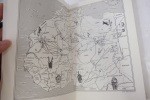
Bon exemplaire, quelques marques d'usage ainsi que des frottements aux coins mais rien de très grave.
POMPEI, HERCULANUM ET STABIAE
La Bibliothèque des Arts. 1965. In-12. Relié. Bon état, Couv. légèrement passée, Dos satisfaisant, Intérieur frais. 60 pages. Illustré de nombreuses photos en couleur. Quelques rousseurs sur la couverture.. . . A l'italienne. Classification Dewey : 930.1-Archéologie
'Collection-Panorama'. Intro. de Wilhelmina F. Jashemski. Trad. de David Rosset. Classification Dewey : 930.1-Archéologie
[The Oriental Institute of the University of Chicago] - JASNOW, Richard
Reference : 59549
(1992)
A late period Hieratic Wisdom Text (P. Brooklyn 47.218.135)
4to, paperback, The Oriental Institute of the University of Chicago, Studies in Ancient Oriental Civilization, n°52, Chicago, Illinois, 1992, 217 pp. and plates
Good. Bon état (qq. traces d'usage, très bon état par ailleurs).
Domdidier. Chapelle Notre-Dame-de-Compassion. Archéologie. Domdidier. Chapelle Notre-Dame-de-Compassion. Anthropologie. Archéologie fribourgeoise. Freiburger Archäologie. Nos. 9a et 9b. Service archéologique cantonal. Kantonaler archäologischer Dienst.
Fribourg, Editions Universitaires 1992, 300x210mm, 148 + 210pages, broché. Bel exemplaire.
illustrations n/b et in et hors texte, Pour un paiement via PayPal, veuillez nous en faire la demande et nous vous enverrons une facture PayPal
Poids romains trouvés à Sigus. Extrait du Recueil des Notices et Mémoires de la Société archéologique de Constantine. Vol. XLIV. Année 1910.
Constantine, Imprimerie D. Braham 1911, 215x140mm, 12pages, broché. Dédicacé par l’auteur. Bel exemplaire.
1 planches en n/b, Pour un paiement via PayPal, veuillez nous en faire la demande et nous vous enverrons une facture PayPal
Mission archéologique en Arabie.
Le Caire, IFAO, 1997. 3 Tomes + un Atlas en 5 vol. in-4 brochés sous jaquettes ill., XIV-507, XV-689-98pp., 134 pp, illustrés respectivement de: 228 fig. dont des plans et XXXIV planches in-fine en noir + 57 fig + 21 fig. Le vol. d'Atlas comprend CLIII planches en noir hors-texte dont plusieurs dépliantes. (Réimpression de l'éd. de Paris, Ernest Leroux, 1907).
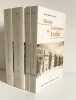
Très important ouvrage sur ce sujet. Une petite marque en queue du dos du T. II, excellent état d'ensemble. - Frais de port : -France 15 € -U.E. 15 € -Monde (z B : 35 €) (z C : 92 €)
Atlas to the prehistory of the Slavs. Part I : Maps [sans le volume de texte].
Lodz, 1949. In-4 broché, [4] ff., 20 pl. de cartes en couleurs. (Societas Scientiarum Lodziensis, II, 2).
Couv. défraîchie, int. propre, état convenable. - Frais de port : -France 4,9 € -U.E. 7 € -Monde (z B : 11 €) (z C : 21 €)

